.svg)



%20(1).svg)
%20(2).svg)
.png?width=480&height=420&name=Img%20(1).png)
%20(3).svg)
%20(4).svg)

%20(5).svg)


 View all states
%20(1)-1.png?width=40&height=40&name=image%20(65)%20(1)-1.png)
13 mins

In this blog
You did everything right. You bought early, held the property, let appreciation work in your favor, and locked in a first mortgage rate you have no intention of giving up. Now you're sitting on a rental property with six figures of tappable home equity, and you're trying to figure out how to access it without touching that first mortgage.
A HELOC on an investment property looks like the logical answer. NftyDoor for HELOC loans has made the process faster and more accessible than most investment property owners expected. But speed is only one part of this decision. The more important question, the one that determines whether a HELOC, a DSCR loan, a bank statement product, or a first-position equity line is actually the right move, is about structure, not speed.
Lenders like Truss Financial Group are built for rental property owners, buy-and-hold investors, and self-employed borrowers engaged in real estate investing who want a clear framework for making that call. Not a platform review. Not a product pitch. An honest breakdown of how to match your financing structure to your actual portfolio situation, so you are comparing the right options, not just the fastest ones.
NFTYDoor Shows the Speed Investors Want, But Speed Is Only One Part of the Decision

NftyDoor built something worth understanding. The platform took a home equity line of credit, historically one of the slowest and most paper-heavy lending products available, and rebuilt it end-to-end.
Digital application, automated underwriting, remote online notarization, and fast funding via the RTP network. Where traditional lenders average 40 to 45 days to close a HELOC, NftyDoor averages roughly six calendar days, with some loans closing and funding the same day. Roughly 80% of its loans are funded via the RTP network, enabling funding seven days a week, including weekends and holidays.
For a real estate investor moving on a time-sensitive acquisition or a contractor deposit that can't wait two weeks, that speed is a genuine differentiator. NftyDoor recently spun out as an independent company, expanded its credit box, and improved borrower pricing and partner economics, all moves that widen access at the margins and offer more competitive rates to qualifying borrowers.
But here is what the speed story doesn't answer: whether a revolving second lien behind your existing mortgage is the right structure for your rental property, your income verification profile, and your exit strategy.
Before any investor asks how quickly they can get funds, the more valuable questions are whether their CLTV supports a second lien, whether their income documents the way HELOC underwriting expects, and whether a line of credit is actually the right tool for what they are trying to accomplish. Those answers determine which financing path makes sense, and NftyDoor is one possible route within that larger decision.
What Investment Property HELOC Eligibility Actually Requires?
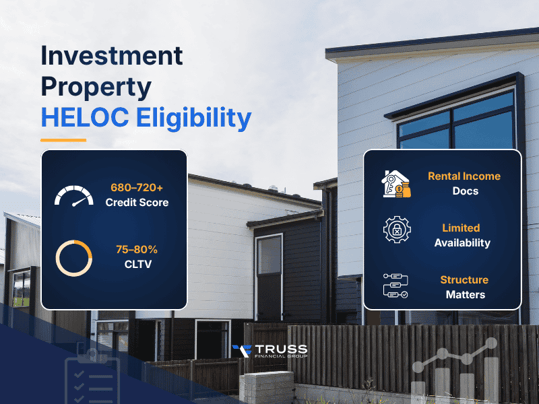
Most investment property owners who have taken out a HELOC on a primary residence assume the process will be similar on a rental property. It isn't. Many lenders treat non-owner-occupied properties as higher risk, and that risk gets priced into the eligibility criteria directly.
Credit Score
Most lenders require a minimum of 680 to 720 or above for an investment property HELOC, meaningfully stricter than what primary homes typically require.
Combined LTV
Generally capped at 75 to 80% on investment properties. That means an investor needs substantial equity before a HELOC is even on the table.
Rental Income Document
Lenders want to see that the property is cash-flowing, and income verification matters significantly. For self-employed investors, particularly those running their portfolio through an LLC or whose tax returns reflect heavy depreciation.
Product Availability
Most traditional lenders and many credit unions simply don't offer HELOCs on investment properties at all. The product is less standardized, less commonly available, and carries more underwriting complexity than the primary residence version.
For self-employed investors, the gap between taxable income and real cash flow can create qualification issues that have nothing to do with the borrower's real financial picture. Consulting a tax advisor before applying can help investors understand how their returns will be read by an underwriter. NftyDoor's expanded credit box improves access at the margins, but these structural eligibility realities apply across the board.
Eligibility is only one filter. The deeper question is whether the HELOC structure itself, a revolving equity line sitting as a second lien behind an existing mortgage, is the right tool for what the investor is trying to accomplish.
Investor Financing Paths to Compare Before You Apply
This is the decision that matters most, and it is the one most real estate investors skip by going straight to an application. The right financing structure depends on how the property is owned, how income is documented, what the capital is being used for, and what the investor's exit looks like. A good loan officer will walk through all of these variables before recommending a product. Here is how the map breaks down:
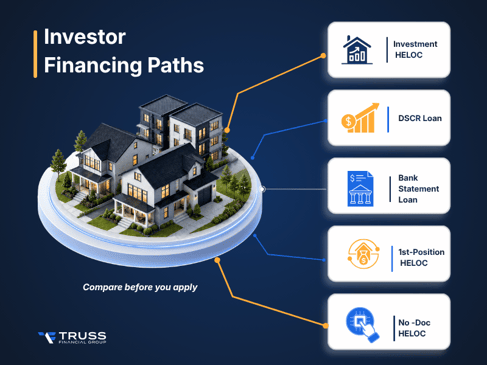
1. You as an Investor Want Flexible Access Without Touching a Low-Rate First Mortgage? Investment Property HELOC
A HELOC on an investment property sits behind the existing mortgage as a revolving second lien. The investor draws only what is needed, makes interest-only payments on the drawn balance during the draw period, and preserves the first mortgage rate entirely.
Once the draw period ends, the repayment period begins, and monthly payments include both principal and interest. Variable rates tied to the prime rate are standard on HELOCs, and investors should factor that into their cost projections.
This is the right structure for investors with clean documentation, strong equity, and a need for flexible, repeatable capital access rather than a one-time lump sum. For short-term bridge financing between acquisitions, a HELOC can be a particularly efficient tool.
2. Rental Income Is High, But Personal Income Is Complex? DSCR Loan
A debt service coverage ratio loan qualifies based on the rental income the property generates, not the borrower's personal tax returns or debt-to-income ratio.
For investment property owners with multiple properties, significant write-offs, or income that doesn't present cleanly on a 1040, this is a material structural advantage. A DSCR loan is a first-lien product that restructures primary financing based on property cash flow rather than adding a second lien behind an existing mortgage.
3. You Are a Self-Employed Investor With Strong Deposits But Weak Tax-Return Income? Bank Statement Loan
Bank statement loans qualify on actual cash flow, typically 12 to 24 months of business or personal bank statements, rather than taxable income. For investors running a portfolio through an S-corp or LLC, this is often the most accurate reflection of their real financial picture.
Standard HELOC underwriting and many conventional products don't account for how self-employed borrowers actually earn, which is why alternative qualification paths matter. A reputable lender with non-QM experience will know how to structure these correctly.
4. You as an Investor Own Free and Clear or Want a Single Primary Lien? First-Position HELOC
A first-position HELOC replaces the existing first mortgage entirely rather than sitting behind it as a second lien.
For investors who own a rental property outright with no existing mortgage, or who want to consolidate into a single revolving line of credit rather than managing layered liens, this is a cleaner structure and a lower-cost approach to ongoing capital access.
5. You, as an Investor, Need Reduced Documentation? No-Doc or Reduced-Doc HELOC
No-doc and reduced-doc HELOCs exist in the non-QM lending space for borrowers who cannot or prefer not to document income through traditional means. These are not widely available through traditional lenders. They sit in the non-agency space where specialized mortgage brokers and platform-forward lenders operate.
For the right investor profile, they offer a path to equity access that conventional underwriting doesn't provide, and personal loans or other options simply can't match in terms of scale and lower interest rates.
Lenders like Truss Financial Group structure all five of these paths. The value is not in knowing that these products exist. It is in knowing which one fits a specific investor's portfolio, income documentation, and goals, and then executing on it.
Where the NftyDoor HELOC Fits and Where a Different Structure Wins
With that framework in place, the NftyDoor question becomes easier to answer.
| NftyDoor HELOC Fits | Different Structure Wins |
|---|---|
| Strong credit score, documented rental income, meaningful equity in a stabilized property. | Self-employed investor with tax returns that understate actual earnings. |
| Investor needs fast funding for a time-sensitive acquisition or portfolio move. | Investor is already near LTV limits across the portfolio. |
| Flexibility of a revolving line is preferred over a lump-sum cash-out refinance. | Near-term sale or refinance planned, as a second lien complicates exit strategies. |
| Preserving a low-rate first mortgage is the priority. | The investor owns free and clear, and a first-position HELOC is a structurally cleaner fit. |
The point is not that NftyDoor is the wrong answer. It is that the right answer depends on variables that no platform can resolve on its own.
Frequently Asked Questions
1. Can You Get an NftyDoor HELOC on an Investment Property?
Yes. NftyDoor offers home equity lines of credit and has expanded its credit box to improve access for more borrower profiles. Investment property eligibility still requires meeting higher credit score thresholds, tighter CLTV limits, and income verification standards that are stricter than primary residence HELOCs. Whether a HELOC is the right structure is a separate question from whether you qualify for one.
2. What Credit Score Do You Need for an Investment Property HELOC?
Most lenders require a minimum credit score of 680 to 720 for an investment property HELOC, higher than what primary homes typically require. Credit score is one filter among several, alongside CLTV, rental income documentation, and the lender's specific underwriting criteria.
3. How Fast Does NftyDoor Close a HELOC?
NftyDoor averages roughly six calendar days to close, compared to the industry standard of 40 to 45 days. Some loans close and fund the same day. For investors who need fast funding on time-sensitive deals, that speed is a real advantage, but it answers the "how fast" question, not the "which structure" question.
4. What Is a DSCR Loan, and How Is It Different From a HELOC?
A DSCR loan qualifies based on the rental income the property generates rather than the borrower's personal income or debt-to-income ratio. It is a first-lien product that restructures primary financing around property cash flow. A HELOC sits behind the existing mortgage as a revolving second lien with variable rates tied to the prime rate, and draws on home equity as needed with interest-only payments during the draw period.
These are structurally different tools serving different investor needs, and the right choice depends on the investor's documentation profile, lien preferences, and goals.
5. Can a Self-Employed Investor Qualify for an Investment Property HELOC?
It depends on income verification. HELOC underwriting typically relies on tax returns, which often understate actual earnings for self-employed borrowers with significant write-offs or depreciation. Working with a tax advisor to understand how returns will be read by an underwriter is a useful first step.
6. What Is a First-Position HELOC, and When Does It Make Sense?
A first-position HELOC replaces the existing first mortgage rather than sitting behind it as a second lien. It functions as a single revolving line of credit against the property. It is most relevant for investment property owners who own free and clear or who want one primary lien rather than layered debt. Most traditional lenders do not offer this product as it sits in the non-QM and non-agency space.
7. Is a HELOC or a Cash-Out Refinance Better for a Rental Property?
A cash-out refinance replaces the existing first mortgage and locks in a new rate on the full loan balance. In a rate-locked environment, most real estate investors prefer to avoid that trade. A HELOC preserves the existing mortgage and draws only what is needed, with interest-only payments during the draw period and monthly payments covering principal and interest once the repayment period begins.
For investors with more complex income documentation, a DSCR loan or bank statement product may be the stronger path regardless of which equity access vehicle they prefer. Our guide on refi vs. HELOC can help compare that decision more closely.
Ready to Match the Right Structure to Your Rental Portfolio?
NftyDoor has raised the bar on what digital HELOC delivery looks like, and for the right investment property owner, it is a genuinely fast and accessible path to home equity. But for most real estate investors, the structure decision comes before the platform decision, and it depends on lien position, income verification, CLTV, and where the portfolio is headed.
The investors navigating this market most effectively are not applying for the first product they find. They are working with a reputable lender and a knowledgeable loan officer to match financing structure to situation, whether that means an investment property HELOC, a DSCR loan, a bank statement product, a first-position HELOC, or a no-doc option, based on how they actually own and operate.
Specialized lenders like Truss Financial Group help rental property investors work through exactly that decision. Whether the right path is a HELOC, a DSCR loan, a bank statement product, or something else entirely, the team structures and executes financing built around the way you actually invest, not the way a standard application expects you to look.

.svg)

Discuss your unique requirements
Get direct answers and a roadmap for your future.
.png?width=202&height=202&name=image%20588255187%20(1).png)

.png?width=389&height=221&name=xxxxxx%20header%20(13).png)


.png?width=389&height=221&name=xxxxxx%20header%20(55).png)


.svg)

.svg)
.svg)