.svg)



%20(1).svg)
%20(2).svg)
.png?width=480&height=420&name=Img%20(1).png)
%20(3).svg)
%20(4).svg)

%20(5).svg)


 View all states
How Does a HELOC Work? Complete Guide for 2026

13 mins

In this blog
Key Takeaways
- A HELOC lets you borrow against home equity as needed, with interest-only payments during the draw period before full repayment begins.
- Variable interest rates tied to the prime rate mean monthly payments can increase unexpectedly, requiring careful budgeting for potential rate changes.
- Your home secures the loan, so defaulting risks foreclosure, borrow strategically with a clear repayment plan, not for discretionary spending.

A Home Equity Line of Credit (HELOC) is a revolving credit line secured by your home's equity, not a one-time loan. Unlike a home equity loan, you borrow only what you need, when you need it, and interest applies only to the amount drawn. Most HELOCs have variable interest rates tied to the prime rate, which means payments can change over time.
This guide explains exactly how a HELOC works, how lenders calculate limits, how repayment actually feels month-to-month, and where people misjudge the risk. Truss Financial Group helps borrowers understand when a HELOC is a smart tool, and when it isn't.
What Is a HELOC and How Does It Work?
A HELOC is a revolving line of credit secured by home equity, similar in structure to a credit card but backed by real estate. Your home serves as collateral, which gives lenders confidence in repayment and typically results in lower interest rates compared to personal loans or credit cards. Because the loan is secured against your property, you're able to access larger amounts of credit at more favorable terms than unsecured borrowing options.
How does it work?
- Your available credit is based on your home value, existing mortgage balance, credit score, and lender's combined loan-to-value (CLTV) limits.
- You can draw funds, repay, and redraw during the draw period without reapplying. This flexibility makes a HELOC fundamentally different from traditional loans, where you receive a lump sum upfront.
- You access funds as needed up to your approved credit limit, and you pay interest only on the outstanding balance you've actually used.
- If you have a $50,000 credit line but only draw $15,000, you're charged interest solely on that $15,000.
- As you repay what you've borrowed, that credit becomes available again, creating a revolving cycle similar to how credit cards work, but with your home's equity backing the arrangement.
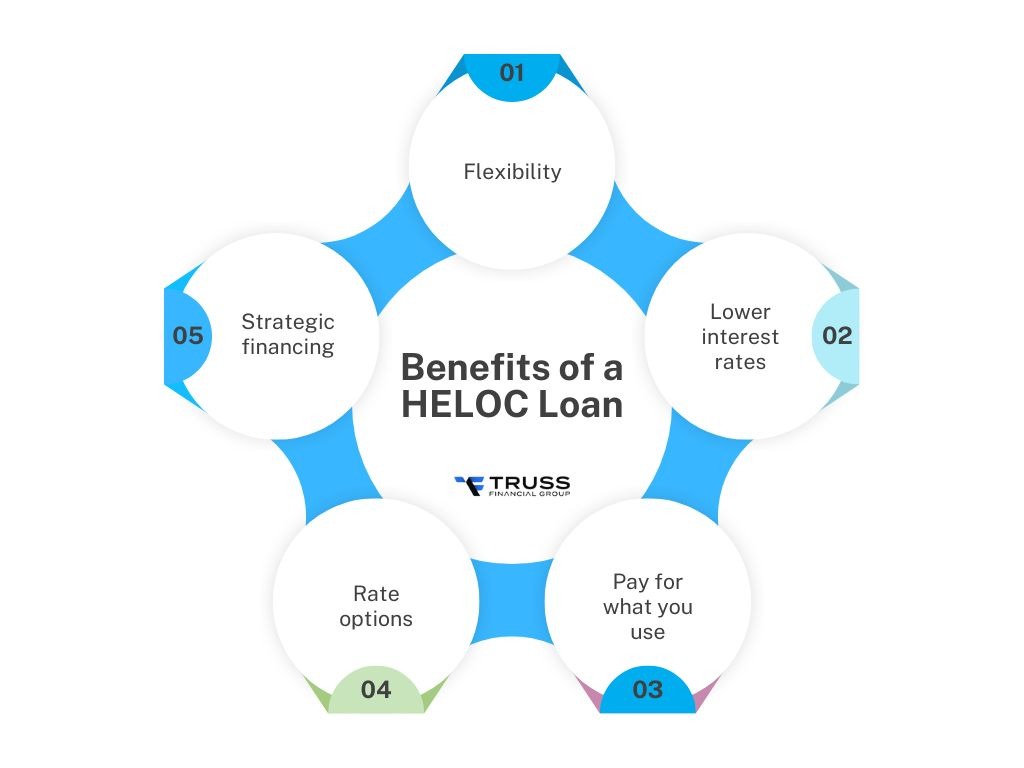
Benefits of a HELOC Loan
A HELOC offers several advantages that make it an attractive financing option for homeowners who need flexible access to funds:
- Flexibility: Borrow and repay funds as needed throughout the draw period without reapplying.
- Lower interest rates: HELOCs typically cost less than personal loans or credit cards.
- Pay for what you use: Interest charges apply only to your outstanding balance, not unused credit.
- Rate options: Many lenders offer fixed-rate conversions and discounts for automatic payments.
- Strategic financing: A valuable addition to your overall financial strategy when used responsibly.
How Do Lenders Calculate Your HELOC Credit Limit?
Lenders use a combined loan-to-value (CLTV) formula to cap total borrowing:
(Home value × max CLTV percentage) − existing mortgage balance = max HELOC limit
Here's a concrete example: If your home is appraised at $400,000 and you owe $240,000 on your mortgage, with an 85% CLTV cap:
($400,000 × 0.85) − $240,000 = $100,000 maximum HELOC
However, if you owed $300,000 instead:
($400,000 × 0.85) − $300,000 = $40,000 maximum HELOC
Most lenders cap borrowing at 80% to 85% of your home's appraised value. Credit score, property type, and debt-to-income ratio adjust this limit. Borrowers with 720+ credit scores typically qualify for the highest limits and best rates.
HELOC Draw Period Explained (How Borrowing Actually Works)
The draw period typically lasts 5 to 10 years. Here's how it works:
- Make interest-only payments on the amount you draw. If you borrow $20,000 at 7%, your monthly payment is approximately $117, not including principal.
- Borrow only what you need when you need it. You're not required to use your full credit line. Many keep it available as an emergency fund.
- Repay and reborrow freely during this period. If you draw $15,000 and repay $10,000, you now have access to your original limit minus the $5,000 outstanding.
- Avoid discretionary spending. The ease of access tempts some to use funds for vacations or electronics without a repayment plan, creating mounting debt.
For homeowners managing phased renovations or ongoing education expenses, HELOC options that don't require a traditional appraisal can streamline the process and reduce upfront costs.

HELOC Repayment Period
After the draw period ends, the HELOC converts to full amortization, typically lasting 10 to 20 years. Here's what changes:
- Borrowing stops: You can no longer access additional funds from your credit line.
- Payments increase significantly: If you borrowed $50,000 and paid $290 monthly during the draw period at 7%, your payment could jump to $465 monthly with a 15-year amortization. That's a 60% increase.
- Principal repayment begins: Unlike interest-only payments during the draw period, you now repay both principal and interest.
- Make voluntary principal payments early: Borrowers who pay down principal during the draw period reduce their balance before full repayment begins, softening payment shock.
- Consider fixed-rate conversion options: Some lenders let you lock in all or part of your balance at a fixed rate for payment predictability.
For borrowers seeking faster, digitally underwritten HELOC options, understanding these repayment dynamics upfront helps you plan for long-term affordability. Enter with a clear exit strategy, whether that means paying down principal early, budgeting for higher payments, or refinancing before the transition.
How Is HELOC Interest Calculated?
HELOC interest rates are typically variable and tied to the prime rate plus a margin. For example, if the prime rate is 8.5% and your margin is 1%, your HELOC rate would be 9.5%. If the prime rate rises to 9%, your rate adjusts to 10%.
Interest accrues daily on the outstanding balance, not the full credit limit:
(Outstanding balance × annual interest rate) ÷ 365 = daily interest charge
Example with a $25,000 balance at 9.5%:
($25,000 × 0.095) ÷ 365 = $6.51 per day
Over a 30-day month, that's approximately $195 in interest. Most HELOCs include a lifetime rate cap, often 18% to 21%, that limits how high your rate can climb regardless of market conditions.
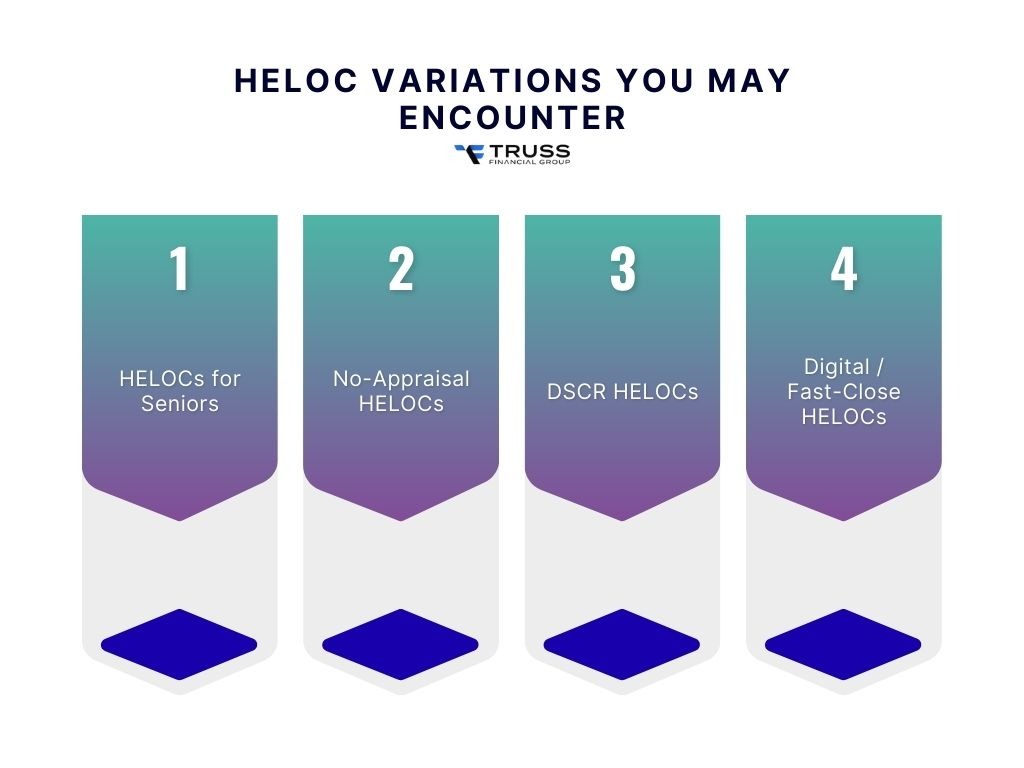
HELOC Variations You May Encounter
Not all HELOCs follow the same underwriting or structure. Lenders have developed specialized products to serve different borrower needs, property types, and qualification scenarios.
HELOCs for Seniors
Older homeowners often have substantial equity but face unique income considerations during retirement. HELOC options for retirees and older homeowners focus on income structure rather than age, evaluating sources like Social Security, pension distributions, investment income, and retirement account withdrawals.
Lenders assess debt-to-income ratios differently for retirees, recognizing that lower monthly expenses and paid-off primary mortgages improve affordability even with reduced earned income. These programs help seniors access equity for healthcare costs, home modifications, or supplemental cash flow without selling their homes.
No-Appraisal HELOCs
Traditional HELOCs require a full appraisal, which adds time and cost to the process. No-appraisal HELOCs use automated valuation models (AVMs) that pull recent comparable sales, tax assessments, and market data to estimate home value. These work best in areas with robust sales data and stable pricing.
Borrowers with lower loan-to-value ratios, typically requesting credit lines well below the standard 85% CLTV cap, often qualify for appraisal waivers. The tradeoff is that lenders may offer slightly lower credit limits or require stronger credit profiles to offset the reduced due diligence.
DSCR HELOCs
Debt Service Coverage Ratio (DSCR) HELOCs are investor-focused products designed for rental properties and income-generating real estate, not owner-occupied homes. Instead of evaluating personal income, lenders assess whether the property's rental income covers its debt obligations. If a property generates $3,000 per month in rent and the total debt service (mortgage plus HELOC payment) is $2,400, the DSCR is 1.25, indicating positive cash flow.
HELOCs designed for real estate investors and rental properties enable investors to pull equity from one property to fund down payments on additional acquisitions or renovations without tapping personal income.
Fast-Close HELOCs
Fast-close HELOCs streamline documentation and leverage technology to compress closing timelines from 30 to 45 days to as little as 7 to 14 days. Digital underwriting pulls bank statements, income verification, and credit data automatically, reducing paperwork burden. The tradeoff is less customization.
Borrowers must fit standard credit and income profiles, and exceptions are harder to accommodate. For straightforward scenarios with strong credit, minimal debt, and clear income documentation, these products offer convenience without sacrificing competitive rates.
Mortgage brokers like Truss Financial Group specialize in helping borrowers understand which structure fits their situation, not forcing a one-size-fits-all HELOC. Each variation serves a specific need, and matching the right product to your circumstances improves both approval odds and long-term satisfaction with the credit line.
HELOC vs. Home Equity Loan: Which is Better for You?
Searchers comparing these two products need clarity on the structural differences, not just rate comparisons. Both allow you to borrow against home equity, but they function in fundamentally different ways.
|
Feature |
HELOC |
Home Equity Loan |
|
Structure |
Revolving line of credit |
One-time lump sum |
|
Interest Rate |
Variable (tied to prime rate) |
Fixed |
|
Access to Funds |
Draw as needed during the draw period |
Full amount at closing |
|
Payments |
Interest-only during the draw period, then principal + interest |
Principal + interest from day one |
|
Reborrowing |
Can repay and reborrow up to the limit |
Cannot reborrow after paydown |
|
Best For |
Ongoing expenses with uncertain timing (phased renovations, education costs) |
One-time expenses with known costs (debt payoff, single large purchase) |
|
Typical Term |
5-10 year draw + 10-20 year repayment |
10-20 years |
The choice depends on usage pattern, not rate alone. If you need $50,000 today for a defined purpose and want payment predictability, a home equity loan makes sense. If you need access to $50,000 over the next two years as projects evolve and want to minimize interest by only borrowing what you use when you use it, a HELOC fits better.
Some borrowers mistakenly choose based solely on whether they prefer variable or fixed rates, but rate type is just one factor. Mismatching the product to your usage pattern creates inefficiency. Taking a lump sum loan when you only need funds intermittently means paying interest on unused money, while opening a HELOC for a one-time expense adds unnecessary complexity.
Risks and Disadvantages of a HELOC
This is where trust is built. No financial product is without downsides, and HELOCs carry specific risks that borrowers must understand before committing.
- Variable rates can raise payments unexpectedly: If the prime rate climbs from 7% to 10%, your monthly interest on a $40,000 balance jumps from roughly $267 to $367. Rate increases compound costs significantly over time.
- Your home is collateral, default risks foreclosure: Missing HELOC payments can result in losing your home, just like failing to pay your primary mortgage. This isn't abstract risk; lenders have legal foreclosure rights if you default on secured debt.
- Easy access can encourage overspending: The revolving nature, combined with low interest-only payments, creates a psychological trap. It's tempting to view available credit as extra money rather than borrowed funds requiring repayment with interest.
- Payment shock during the repayment transition catches borrowers off guard: Many focus on low draw-period payments and fail to model full amortization. Borrowers who maximize borrowing for 10 years face overwhelming payment increases when principal repayment begins, especially with higher rates.
Is a HELOC a Good Idea?
A HELOC is a tool, not free money. Whether it's a good idea depends entirely on how you plan to use it, whether you can afford the payments under multiple rate scenarios, and whether you have the discipline to borrow responsibly.
Before opening a HELOC, ask yourself:
- Do I have a specific purpose for these funds, or am I opening the line "just in case"?
- Can I afford the payments if interest rates rise by 3% to 4%?
- Do I have the discipline to avoid drawing for discretionary purchases?
- What's my plan for repaying this before the draw period ends?
Truss Financial Group positions HELOCs as strategic financing, not lifestyle leverage. The best outcomes happen when borrowers view the line of credit as a purposeful financial tool, use it sparingly and intentionally, and maintain a clear path to repayment.
If you're considering a HELOC, take time to understand the mechanics, model various scenarios, and be honest about your financial habits. The right decision comes from clarity, not convenience.

FAQ
What are the disadvantages of a HELOC?
Main disadvantages include variable interest rates increasing monthly payments unexpectedly, foreclosure risk since your home is collateral, temptation to overspend, and payment shock when interest-only payments convert to principal-and-interest during repayment.
How does a HELOC work for dummies?
A HELOC lets you borrow against home equity like a credit card. Draw what you need during a 5-10 year period with interest-only payments, then repay over 10-20 years.
How exactly does a HELOC loan work?
Lenders calculate your maximum credit using: (home value × 80-85%) minus existing mortgage. During the draw period, access funds as needed, making interest-only payments. Afterward, repay principal plus interest over the remaining term.
How is the interest calculated on a HELOC?
Interest accrues daily on the outstanding balance: (balance × annual rate) ÷ 365 equals daily interest. Most HELOCs have variable rates tied to the prime rate plus lender margin, adjusting as rates change.
Is a HELOC a trap?
A HELOC becomes a trap when treated like free money, used for discretionary spending without repayment plans, or when payment increases are underestimated. Used strategically with discipline, it's a valuable tool.
Can you get a HELOC without an appraisal?
Yes, many lenders offer no-appraisal HELOCs using automated valuation models. Best when requesting credit well below the maximum loan-to-value ratio with strong credit. The tradeoff may be slightly lower credit limits.
Does the HELOC method really work?
The HELOC method uses a HELOC to pay mortgage principal faster by depositing income and using it for expenses. Mathematically sound but requires strict discipline and works best when HELOC rates are lower.
What is the downside of a HELOC loan?
Beyond variable rates and foreclosure risk, downsides include closing costs, annual fees, reduced home equity limiting future borrowing, possible balloon payments, and psychological temptation to continuously borrow rather than building equity.

.svg)

Discuss your unique requirements
Get direct answers and a roadmap for your future.
.png?width=202&height=202&name=image%20588255187%20(1).png)

.jpg?width=389&height=221&name=Blog%20covers%20(1).jpg)

-1.png?width=389&height=221&name=Blog%20covers%20(7)-1.png)
%20(1).png?width=389&height=221&name=Blog%20covers%20(2)%20(1).png)



.svg)

.svg)
.svg)