.svg)



%20(1).svg)
%20(2).svg)
.png?width=480&height=420&name=Img%20(1).png)
%20(3).svg)
%20(4).svg)

%20(5).svg)


 View all states
%20(1)-1.png?width=40&height=40&name=image%20(65)%20(1)-1.png)
11 mins
.png)
In this blog
Homeowners in today's times are continuously looking for ways to enhance their finances, tap into the value of their homes to meet their financial needs. With ever increasing value of sales, dynamically changing mortgage environment and rates, along with different needs and priorities of life, home equity has become an important source of funding for any need - be it home improvements, managing education costs, or consolidating debt. Home equity provides lesser interest rates in comparison to other borrowing options like personal loans or credit cards. From a variety of options available when it comes to choice of loans, two options are commonly chosen that include refinancing an existing mortgage or opening a home equity line. Both options enable homeowners to borrow money with home equity but with a difference in loan structure, repayment period, and long-term impact on monthly mortgage payments. Let us compare refinance vs. HELOC in depth to make an informed decision.
Choosing between refinancing and HELOC depends on multiple factors like current mortgage terms, interest rates, available credit, and how the funds are required - whether in lump sum or staggered over a period of time. The timing also is important especially when it comes to mortgage rates, future income expectations, and how long one intends to stay in the particular property. Understanding these differences enables homeowners to be comfortable with the loan taken though the phase than face pressure at the type of repayment.
Quick Comparison: Refinance vs HELOC
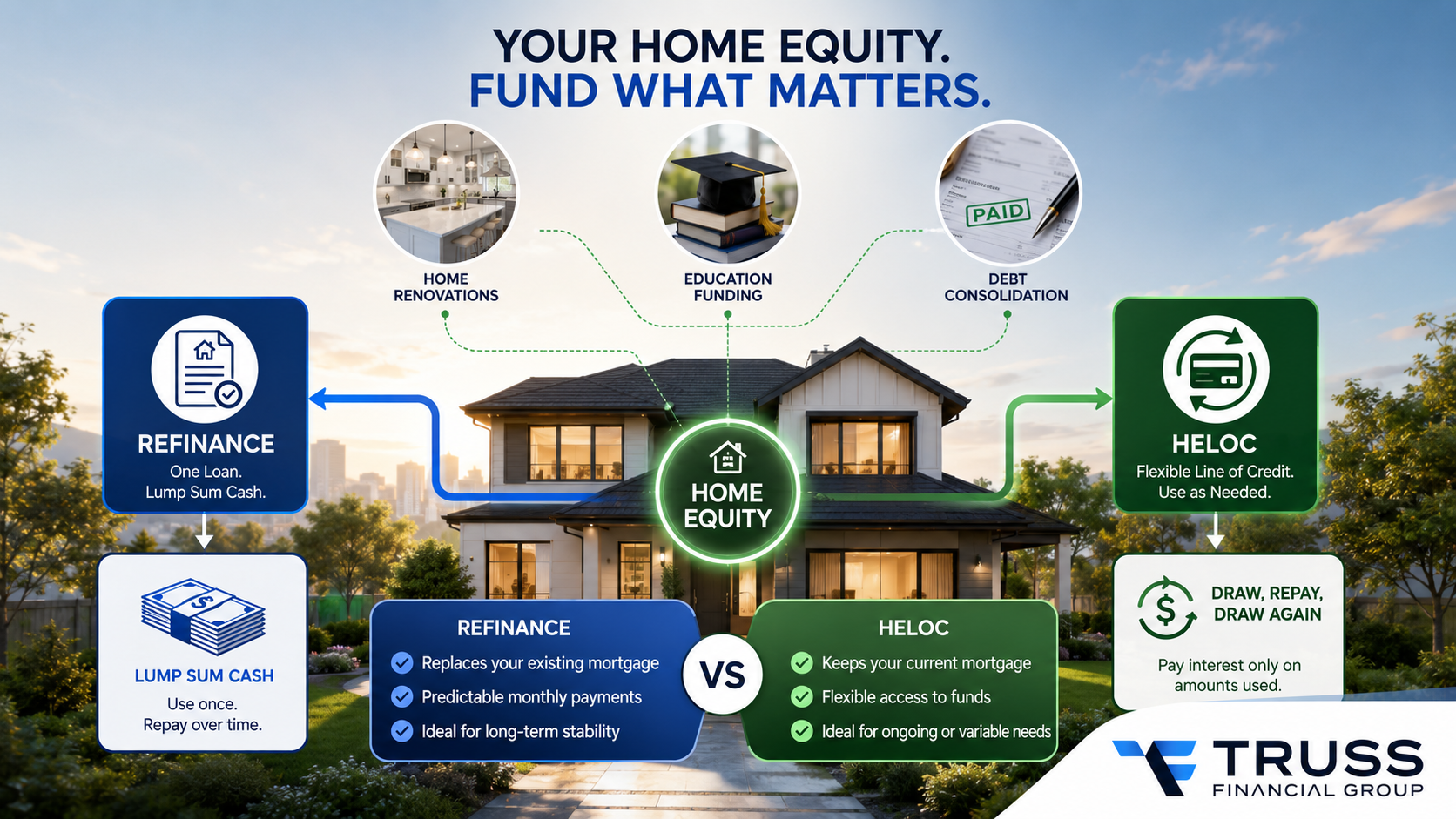
A refinance replaces the existing mortgage with a new loan, often giving one lump sum and one updated mortgage payment. A HELOC keeps the primary mortgage in place and adds a revolving credit line that can be drawn as needed. The better fit depends on the current mortgage rate, how much cash is needed, and whether the homeowner wants fixed structure or flexible access.
What Is a Mortgage Refinance?
A mortgage refinance helps with managing finances by replacing the current existing mortgage with a new mortgage loan. This helps in paying off the earlier mortgage loan, and paying as per the new mortgage terms. Refinancing is done to bring a change in the interest rate, loan term, or overall loan amount. Refinancing is often considered when the new interest rates are lower than that of the original loan taken, or when homeowners want to adjust the loan structure for better predictability. The Federal Reserve consumer guide to mortgage refinancings explains the basic refinance concept and borrower considerations.
Types of Refinancing
A rate-and-term refinance brings in adaptation in interest rate or loan term while ensuring the loan amount is close to the original mortgage loan. This type of loan is ideal when homeowners look for predictable monthly payments or wish to shift from adjustable rates to a fixed interest rate. Go for cash out refinance options if you desire to replace the existing mortgage with a bigger loan, enabling homeowners to access cash from home equity. The loan can be taken as a lump sum, which increases the principal balance of the new mortgage loan, thereby increasing the overall mortgage.
1. Rate-and-Term Refinance
Best when the goal is changing the rate, term, or payment structure without taking a large cash amount from equity.
2. Cash-Out Refinance
Best when the homeowner wants one larger mortgage and a lump sum from home equity. If the goal is debt payoff, compare this with using home equity to pay off debt.
How It Works
In refinancing, the existing mortgage is replaced with a new loan, such that the old loan is closed and payments are made on the new loan according to revised mortgage terms. The new may carry fixed or adjustable rates which depend on market conditions, loan options, and eligibility. Here, the closing costs apply and the new repayment period begins from day one. In cash out refi, the new loan provides cash for closing the old one, along with additional amounts that may be used in home improvements, debt consolidation, medical expenses, or other major expenses. Most lenders ask for a minimum credit score with adequate home equity, and stable gross monthly income to approve refinancing with an acceptable debt to income ratio.
Best For
Refinancing is an ideal option for homeowners who look for one mortgage payment and a predictable fixed payment every month over a long period of time. When comparing refinance vs. HELOC, refinancing helps consolidate high-interest personal loans, help meet large one-time expenses, or replace an older mortgage with a new mortgage loan at lower interest rates compared to the original loan. Homeowners who plan to live in the same property for the long term tend to benefit the most, with higher closing costs being spread across the full loan term, making it easier to manage over a period of time.
What Is a HELOC?
A HELOC is a home equity line that enables homeowners to borrow funds against the home equity without replacing their primary mortgage. It acts as a second mortgage while keeping the first one as it is and the second one being kept as a new credit line. This structure works well for borrowers who have secured a low fixed rate on the first mortgage and want to continue with the same. The Federal Reserve guide to home equity lines of credit is also useful when reviewing terms, rates, and draw-period rules.
How a HELOC Works
A HELOC works as a revolving line of credit. With a draw period of 5 to 10 years. The borrowers can withdraw funds up to the approved credit limit, as and when needed in any amount, as many times required in the draw period. Borrowers are also free to repay balances, and access funds again during this phase providing borrowers significant level of flexibility. Payments done in the draw period are mostly only the interests or minimum payment of what has been drawn. This helps keep the monthly obligations relatively low at the start. At the end of the draw period, the repayment period begins which lasts for about 10 to 20 years. During this phase, the borrowers repay both principal and interest and are not allowed to draw more. The repayment in the HELOC period also depends on the variable interest and market conditions.
Best For
A HELOC is apt for homeowners who look for flexible withdrawal of approved credit limit instead of getting the whole lump sum in one go. The funds can be withdrawn depending on one's needs like home renovation, education fees or emergency medical needs. Borrowers benefit here as they only withdraw the amount needed, and can manage monthly payments with a control.
Key Differences: Refinance vs HELOC
When comparing refinance vs HELOC, both come with different loan structure, interest rates, and access to funds. A cash out refinance helps replace existing mortgages, creating one larger mortgage loan with a fixed rate resulting in a single mortgage payment. With refinancing, homeowners get a lump sum amount. A HELOC provides a separate equity line of credit that acts as additional loan in addition to the original mortgage loan taken. HELOC typically has variable interest loans, and allows homeowners to borrow funds to desired limit, at any time of the day any number of times. Both options have their own benefits and effects on the original mortgage and offer distinct repayment expectations.
| Factor | Refinance | HELOC |
|---|---|---|
| Loan structure | Replaces the existing mortgage with a new mortgage loan. | Adds a separate revolving equity line while keeping the first mortgage in place. |
| Access to funds | Usually gives a lump sum through cash-out refinance. | Allows flexible draws from an approved credit limit. |
| Payment style | Structured mortgage payment based on the new loan. | Often starts with lower interest-only payments, then shifts during repayment. |
| Best fit | Large one-time need, rate improvement, or desire for one mortgage. | Flexible expenses, staged projects, or preserving a low first mortgage rate. |

When Refinancing Makes More Sense
Refinancing as an option is ideal for owners who look to secure lower interest rates in comparison to current mortgage. Homeowners looking for predictable monthly payments, or requiring a large lump sum amount for any major expenses, or just want to simplify finances with one single mortgage payment can go for a refinancing option. It also helps convert adjustable rates into a fixed rate loan or when planning to live in the same house for several years ensuring stability across the loan term.
When a HELOC Is the Better Option
HELOC loan is apt for homeowners who already have a low fixed rate interest on their first mortgage, and plans to continue the same one, but require additional funds with a flexible access to withdraw according to the need, or want to manage expenses gradually. HELOC is also good when one wants to avoid increasing their primary mortgage balance and wish to borrow in smaller amounts over time. The FTC also explains the basic tradeoffs of home equity loans and lines of credit for consumers comparing equity options.
Cost Comparison
Refinancing Costs
Refinancing typically involves higher closing costs, often ranging between 2% and 5% of the new mortgage loan amount. Borrowers also restart amortization, which can increase total interest payments over time. New closing costs, appraisal fees, and lender charges should be weighed against long-term interest savings to determine whether refinancing is financially beneficial between refi vs heloc.
HELOC Costs
HELOCs usually have lower upfront fees and sometimes no closing costs. However, variable interest rates introduce uncertainty, and monthly payments may rise as rates increase. Payment shock can occur when the repayment period begins, particularly if borrowing was heavy during the draw period and rates have risen. For more detail, review closing costs on a HELOC.
When deciding between refi vs heloc, homeowners must first evaluate what amount would they want to borrow, what is the purpose of borrowing, what is the current debt to income ratio and also evaluate the long term financial goals with respect to present income stability. This not only helps determine eligibility, but also plan future financial commitments. Deciding on if one plans to stay in a given home for years and evaluating if variable payments fit comfortably into the budget helps one make the right choice between refinancing and HELOC.
Along with this, one must also understand the loan structure, interest rate behavior, and repayment expectations to use home equity effectively without any financial stress. Truss Financial Group supports homeowners with several financing solutions like HELOC refinance options, DSCR refinance for investors, jumbo refinance for higher-value properties, and reverse mortgage refinance solutions for seniors. Choosing the right loan structure in consultation with the experts can help homeowners access home equity in a way that supports immediate needs while enhancing long-term financial stability.
Frequently Asked Questions
1. Is a HELOC better than refinancing?
A HELOC provides flexibility to access funds over a period of time with variable interests according to market conditions. Refinancing on other hand provides structured repayment and predictable monthly payments. One must evaluate their present debts, income, and purpose of loans to decide what is better for them.
2. Does refinancing hurt credit?
Refinancing may affect credit for a short period of time but with regular payment, the long term credit report improves.
3. Can I have both a refinance and a HELOC?
Most lenders allow homeowners to go for both refinance and HELOC if they have adequate home equity.
4. Which option has lower payments?
HELOC payments are usually lower given the interest-only payments, while refinancing typically means consistent monthly mortgage payments.
5. What if rates drop later?
Homeowners can reassess the loan options available along with present interest rate, financial stability if the interest rates drop.
Compare Your Home Equity Options
If you are deciding between refinancing and a HELOC, Truss Financial Group can help you compare structure, payment expectations, and available home equity options.

.svg)

Discuss your unique requirements
Get direct answers and a roadmap for your future.
.png?width=202&height=202&name=image%20588255187%20(1).png)



.png?width=389&height=221&name=Blog%20covers%20(6).png)

.png?width=389&height=221&name=Blog%20covers%20(1).png)


.svg)

.svg)
.svg)