.svg "Truss Financial Group")
4.6 from 700+ reviews

4.6 from 700+ reviews

4.6 from 700+ reviews
.svg)
Securing a mortgage as a self-employed professional in Arizona has traditionally been more challenging than for salaried borrowers. Irregular income patterns, extensive tax deductions, and complex financial documentation often make it difficult to qualify under standard lending guidelines. However, the mortgage landscape has evolved significantly in recent years.
Today, lenders, especially specialized firms like Truss Financial Group, offer flexible programs designed specifically for entrepreneurs, freelancers, consultants, and real estate investors. These programs focus less on taxable income and more on actual cash flow, business stability, and financial strength.
Why Self-Employed Mortgages Matter in Arizona
Arizona has one of the fastest-growing populations of self-employed professionals and small business owners. With sectors like real estate, construction, digital services, and e-commerce expanding rapidly, a large percentage of potential homebuyers do not fit into traditional W-2 income structures.
The challenge lies in how income is assessed. Most self-employed individuals legally reduce their taxable income through deductions, which can significantly lower the income figure shown on tax returns. While this is beneficial for tax purposes, it can limit borrowing power under conventional mortgage rules.
Modern mortgage solutions bridge this gap by evaluating alternative financial indicators such as bank deposits, business revenue, and rental income. This shift allows borrowers to qualify based on their true earning capacity rather than just reported income.
Main Mortgage Options for Self-Employed Buyers in Arizona
Self-employed borrowers in Arizona now have access to multiple mortgage options, each designed to accommodate different financial profiles.
Comparison of Loan Options
| Loan Type | Income Verification Method | Typical Down Payment | Ideal For |
| Bank Statement Loans | 12–24 months bank statements | 10%–20% | Business owners with high deductions |
|
Non-QM / Stated Income |
Assets, credit, alternative docs | 10%–25% | Irregular or complex income profiles |
| DSCR Loans | Rental income (property-based) | 20%–25% | Real estate investors |
| Conventional / FHA Loans | Tax returns + financials | 3.5%–20% | Stable, documentable income |
Bank Statement Loans
Bank statement loans are among the most popular options for self-employed borrowers. Instead of relying on tax returns, lenders analyze 12 to 24 months of bank deposits to determine income. This method provides a more accurate reflection of cash flow, especially for business owners who maximize deductions.
Non-QM / Stated-Income Mortgages
Non-qualified mortgages (Non-QM) offer flexibility beyond traditional lending rules. These loans consider a broader financial picture, including assets, liquidity, and overall creditworthiness. They are particularly useful for borrowers with fluctuating or seasonal income.
DSCR (Debt Service Coverage Ratio) Loans
For real estate investors, DSCR loans provide a streamlined approach to financing. Instead of evaluating personal income, lenders assess whether the rental income from a property can cover the mortgage payments. This makes it easier for investors to scale portfolios without income-related constraints.
Conventional or FHA Loans with CPA Support
Traditional loans are still viable for self-employed borrowers who can document stable income. FHA loans, in particular, offer lower down payment requirements and flexible credit criteria. Working with a CPA to present clean and well-structured financials can significantly improve approval chances.
Why These Programs Work Well for Self-Employed Borrowers
The key advantage of these mortgage programs is their ability to align with real-world income patterns. Unlike traditional loans that rely heavily on tax returns, these options focus on actual earnings and financial behavior.
By evaluating bank statements, business revenue, or rental income, lenders gain a clearer picture of a borrower’s financial stability. This approach reduces the limitations caused by tax deductions and provides greater flexibility in underwriting.
Additionally, many of these programs allow for higher tolerance in debt-to-income ratios and offer customized solutions based on individual financial profiles.
Lender Requirements for Self-Employed Mortgages
While these programs are more flexible, lenders still follow structured criteria to assess risk. The requirements vary depending on the loan type but generally include credit, down payment, financial reserves, and income verification.
Typical Qualification Benchmarks
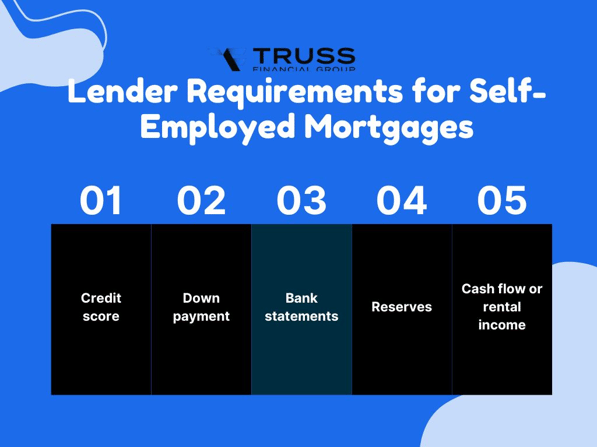
| Requirement | Typical Range |
| Credit Score | 580 – 700+ |
| Down Payment | 3.5% – 25% |
| Bank Statements | 12 – 24 months |
| Cash Reserves | 6 – 12 months |
| Work History | 1 – 2 years self-employment |
A strong credit profile and consistent financial records can significantly improve loan terms and approval speed.
Benefits of Self-Employed Mortgages in Arizona
Self-employed mortgage programs offer a level of flexibility that traditional loans often lack. Borrowers can qualify using alternative documentation, access higher loan amounts, and secure financing even with complex income structures.
Another major benefit is speed. With reduced reliance on tax documentation, approvals can often be processed faster, especially when bank statements or asset-based evaluations are used.
For investors, DSCR loans provide an efficient way to expand real estate portfolios without being limited by personal income calculations.
Pros and Cons of Self-Employed Mortgage Programs
While these loans offer significant advantages, it’s important to understand both sides before making a decision.
Pros and Cons Overview
| Pros | Cons |
| Flexible income verification | Slightly higher interest rates |
| Suitable for business owners | Larger down payments in some cases |
| Multiple loan options available | Additional documentation for business activity |
| Faster approvals in many cases | Reserve requirements may be higher |
Understanding these trade-offs helps borrowers choose the right program based on their financial goals.
How to Strengthen Your Application
Even with flexible loan options, preparation plays a critical role in securing favorable terms. Lenders evaluate consistency, stability, and financial discipline when reviewing applications.
Maintaining clean and well-organized bank statements is essential, as these documents often replace traditional income verification. Keeping personal and business finances separate also improves clarity and credibility.
Improving your credit score before applying can lead to better interest rates and lower down payment requirements. Additionally, reducing excessive tax write-offs in the year prior to applying can help present stronger income figures.
Working with a CPA ensures that your financials are accurately represented, while building at least six months of reserves demonstrates financial stability to lenders.
Frequently Asked Questions
Yes, many lenders offer bank statements and Non-QM loans that do not require traditional tax returns. Instead, they evaluate income using bank deposits or assets.
Most lenders require at least two years of self-employment history. However, some programs allow one year if you have prior experience in the same industry.
FHA loans can be a strong option due to their low down payment requirement and flexible credit criteria. However, they do require full documentation, including tax returns.
Bank statement loans and DSCR loans are generally considered easier because they rely on cash flow or rental income rather than taxable income.
In many cases, yes. Non-QM loans may carry slightly higher rates due to increased lender risk, but they offer greater flexibility in qualification.
Start Your Journey in 3 Simple Steps
Getting approved for a self-employed mortgage in Arizona doesn’t have to be complicated. At Truss Financial Group, we’ve streamlined the process to make it fast, transparent, and tailored to your financial situation. It starts with a quick consultation where we understand your income structure, business model, and goals. From there, our team evaluates your eligibility across multiple loan programs, whether it's a bank statement, Non-QM, or DSCR, to match you with the best option. Finally, we guide you through documentation and approval, ensuring a smooth and stress-free closing experience.
Get the information you need to make confident decisions
Discover your borrowing power and plan your mortgage journey with knowledge on your side.
Get a quote- No documents required
- No commitment
- No commitment
Get a quote in 3 easy steps
Tell us what you want
Fill out our online form to help us understand your financial situation and loan needs.
We get to work for you
We review your info and look for competitive rates that match your specific goals.
You get a personalized quote
You’ll receive a customized rate quote that meets your unique profile.