.svg "Truss Financial Group")
4.6 from 700+ reviews

4.6 from 700+ reviews

4.6 from 700+ reviews
.svg)
For many self-employed professionals in Arizona, qualifying for a traditional mortgage can be challenging. Business owners, freelancers, and independent contractors often minimize taxable income through deductions, which can reduce their borrowing capacity under standard lending guidelines.
Bank statement loans offer a flexible alternative by allowing borrowers to qualify based on actual cash flow rather than tax returns. At Truss Financial Group, we help self-employed individuals secure financing that reflects their real income and financial strength.
What Is a Bank Statement Loan?
A bank statement loan is a type of Non-QM (non-qualified mortgage) designed for self-employed borrowers. Instead of relying on W-2s or tax returns, lenders evaluate income using 12 to 24 months of bank statements.
These loans are ideal for borrowers whose financial reality is not accurately represented in their tax filings. By analyzing deposits and cash flow, lenders can determine a more realistic income profile.
How Does It Work?
Bank statement loans focus on consistent deposits over time. Lenders review either personal or business bank statements to calculate average monthly income.
Income Calculation Overview
| Factor | How It’s Evaluated |
| Total Deposits | Monthly deposits averaged over 12–24 months |
| Expense Adjustment | Applied (especially for business accounts) |
| Qualifying Income | Adjusted average monthly income |
| Stability Check | Consistency of deposits over time |
For business accounts, lenders often apply an expense factor (typically 25%–50%) to estimate net income. This approach provides a clearer picture of actual earnings compared to tax returns.
Who Is a Bank Statement Loan Right For?
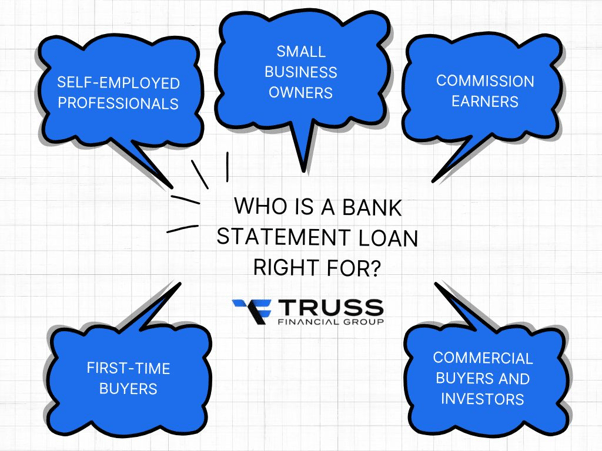
Bank statement loans are designed for borrowers who have strong cash flow but non-traditional income documentation.
They are particularly suitable for:
- Self-employed professionals and entrepreneurs
- Freelancers and gig workers
- Consultants and 1099 earners
- Small business owners with high write-offs
- Real estate investors with complex income streams
If your tax returns don’t reflect your true income, this loan type can be a powerful solution.
How Bank Statement Loans Differ from Traditional Mortgages
The primary difference lies in how income is verified. Traditional mortgages rely heavily on tax returns, while bank statement loans focus on cash flow.
Key Differences
|
Feature |
Bank Statement Loans |
Traditional Mortgages |
|
Income Verification |
Bank statements |
Tax returns, W-2s |
|
Flexibility |
High |
Limited |
|
Approval Process |
Faster |
More documentation-heavy |
|
Interest Rates |
Slightly higher |
Lower |
|
Ideal Borrower |
Self-employed |
Salaried individuals |
This flexibility makes bank statement loans especially valuable in Arizona’s growing self-employed economy.
Eligible Properties: Homes and Beyond
Bank statement loans can be used for a variety of property types, making them suitable for both homeowners and investors.
Eligible properties typically include:
- Primary residences
- Second homes
- Investment properties
- Single-family homes
- Multi-unit properties (in some cases)
- Condominiums and townhomes
This versatility allows borrowers to finance both personal and income-generating properties.
Requirements For A Bank Statement Loans
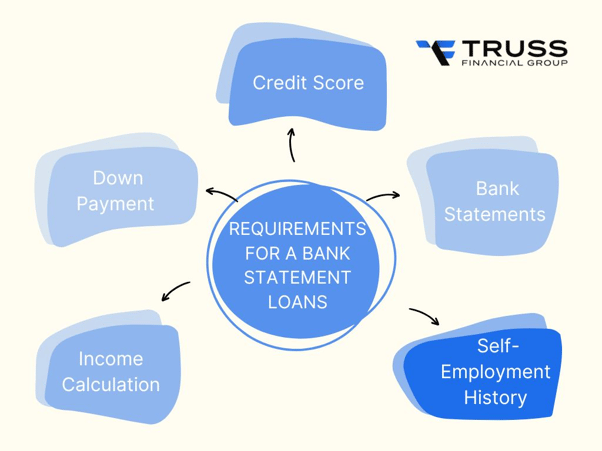
While these loans are flexible, lenders still evaluate key financial factors to ensure borrower reliability.
Qualification Snapshot
| Requirement | Typical Range |
| Credit Score | 620 – 700+ |
| Down Payment | 10% – 20%+ |
| Bank Statements | 12 – 24 months |
| Self-Employment History | 1 – 2 years |
Credit Score
Most lenders require a minimum score of around 620, though higher scores can improve interest rates and loan terms.
Down Payment
Down payments generally start at 10% but may increase depending on credit profile and property type.
Bank Statements
Borrowers must provide 12 to 24 months of personal or business bank statements to demonstrate consistent income.
Income Calculation
Income is calculated based on average monthly deposits, with adjustments made for business expenses when applicable.
Self-Employment History
Most lenders require at least one to two years of self-employment history, though exceptions may apply with prior industry experience.
Pros of Bank Statement Loans
Bank statement loans provide several advantages for self-employed borrowers who struggle with traditional documentation.
Key Benefits
| Advantage | Description |
| No Tax Return Requirement | Qualify without relying on filed income |
| Flexible Income Evaluation | Based on real cash flow |
| Faster Approval Process | Reduced documentation speeds up approvals |
| Higher Loan Potential | Reflects true earning capacity |
| Suitable for Various Property Types | Works for both homes and investments |
These benefits make bank statement loans one of the most practical options for modern borrowers.
Cons of Bank Statement Loans
While flexible, these loans come with certain trade-offs that borrowers should consider.
Potential Drawbacks
| Limitation | Impact |
| Higher Interest Rates | Compared to conventional loans |
| Larger Down Payments | Typically 10%–20%+ |
| Expense Adjustments | Can reduce qualifying income |
| Documentation of Deposits | Requires clean and consistent records |
Understanding these factors helps borrowers make informed decisions.
FAQs About Bank Statement Loans in Arizona

Can I qualify without tax returns?
Yes. Bank statement loans are specifically designed to eliminate the need for traditional tax return income verification.
How many months of bank statements are required?
Most lenders require 12 to 24 months of statements to assess income consistency.
Are these loans only for self-employed borrowers?
Primarily yes, though they may also be used by individuals with non-traditional income sources.
Do bank statement loans have higher interest rates?
Yes, rates are typically slightly higher due to increased lender risk and flexible qualification criteria.
Can I use this loan for investment properties?
Yes. Many lenders allow bank statement loans for both primary residences and investment properties.
Start Your Journey in 3 Simple Steps
Getting approved for a bank statement loan in Arizona is simpler than you might expect. At Truss Financial Group, we begin by understanding your business structure and reviewing your bank statements to assess your true income potential. Next, we match you with the most suitable loan program based on your financial profile and property goals. Finally, we guide you through a streamlined approval and closing process, ensuring clarity and efficiency every step of the way.
Get the information you need to make confident decisions
Discover your borrowing power and plan your mortgage journey with knowledge on your side.
Get a quote- No documents required
- No commitment
- No commitment
Get a quote in 3 easy steps
Tell us what you want
Fill out our online form to help us understand your financial situation and loan needs.
We get to work for you
We review your info and look for competitive rates that match your specific goals.
You get a personalized quote
You’ll receive a customized rate quote that meets your unique profile.