.svg)



%20(1).svg)
%20(2).svg)
.png?width=480&height=420&name=Img%20(1).png)
%20(3).svg)
%20(4).svg)

%20(5).svg)


 View all states

14 mins
In this blog
You applied for a HELOC, sent the requested documents and expected to be close to getting the funds. Instead, the file seems to be sitting in place.
So, why is your HELOC taking so long?
Most HELOC delays happen because one specific part of the process is still unfinished. Your lender may be waiting for documents, reviewing underwriting conditions, completing the home valuation or title work, getting a payoff or lien release, or finishing final closing requirements. For some HELOCs secured by a primary residence, there may also be a federally required waiting period after the account is opened.
From application to funding, closing a HELOC typically takes around two to six weeks, although some applications may close faster while others take longer depending on the borrower, property, lender, and any issues that come up during the process.
How Long Does a HELOC Usually Take in 2026?
There is no single HELOC closing timeline that applies to every borrower. Current consumer guidance from Achieve puts the typical process at around two to six weeks, while Truss Financial Group notes that fast-close HELOCs can fund in five to 10 business days when the file meets the necessary conditions.
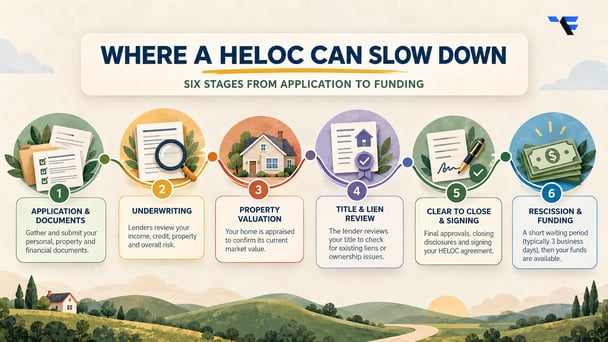
The process generally moves through several stages:
| Stage | What happens | Common delay | What to ask next |
|---|---|---|---|
| Application & documents | Income, credit, debt and property information are collected | Missing, inconsistent or unreadable documents | "What documents or conditions are still outstanding?" |
| Underwriting | The lender reviews the borrower's financial profile | Income questions, DTI, employment verification or additional conditions | "Is my file currently with underwriting?" |
| Property valuation | The lender determines the home's value using an eligible valuation method | Appraisal scheduling, limited comparable sales or property complexity | "What valuation method is being used, and is it complete?" |
| Title & lien review | Ownership, existing liens and lien position are checked | Old liens, judgments, tax issues or ownership discrepancies | "What exact title exception is holding up the file?" |
| Clear to close & signing | Final documents and closing requirements are completed | Missing signatures or unresolved conditions | "What is the last item needed for a clear to close?" |
| Rescission & funding | Any required waiting period runs, followed by final disbursement | Waiting period or final verification | "When does the waiting period end, and when is funding expected?" |
If you’re unfamiliar with how a HELOC works, TFG’s guide to how HELOCs work explains how the line of credit is structured and how borrowing from it differs from taking out a traditional lump-sum home equity loan.
Why Is My HELOC Taking So Long?
Missing or Inconsistent Borrower Documents
Sometimes, the delay has nothing to do with the property. The lender may simply need more income documents, bank statements, identification, or other paperwork before underwriting can be completed. A document can also lead to follow-up questions if the information does not match what was provided elsewhere in the application.
For example:
- A missing or outdated bank statement
- Income documentation that does not clearly support the stated income
- A name or address mismatch
- Large or unexplained deposits that need clarification
- New debt appearing after the application
- A credit report that cannot be accessed because of a credit freeze or other issue
- A requested condition that was submitted but has not yet been reviewed.
Self-employed and variable-income borrowers may face additional documentation questions because the lender may need a clearer picture of income and cash flow.
Lenders typically look at several financial and property factors before approving a HELOC, including your credit, income, existing debts, and available home equity. The exact requirements vary by lender, but these are some of the main factors that can affect the approval process.
If you suspect a document is holding things up, ask the lender for the exact outstanding condition rather than simply asking whether the file is "still in underwriting." This tells you what is actually missing and what needs to happen next.
Underwriting and Verification Delays
Underwriting is where the lender checks whether the application meets the requirements of the particular HELOC program.
That can include reviewing credit, debt-to-income ratio, income stability, employment, existing obligations, property information and the proposed lien. A straightforward file may move through this stage quickly. A file that raises questions can go back and forth while the borrower supplies more information.
This is particularly relevant when income is less traditional, when debt has changed recently or when the lender needs additional verification.
A delay here does not necessarily mean the HELOC has been declined. It may simply mean a condition remains unresolved.
Property Valuation and Appraisal Delays
Not every HELOC requires a traditional interior appraisal.
Depending on the lender and program, property value may be assessed through an automated valuation model (AVM), desktop review, exterior report or full appraisal. Which method is used can affect the timeline. Current HELOC guidance also notes that valuation requirements vary by lender and borrower situation.
A valuation can take longer when:
- There are few recent comparable sales
- The property is unusual or difficult to value
- The home is in a rural or less active market
- An in-person visit is required and scheduling takes time
- The available property data does not give the lender enough confidence
For eligible properties, a no-appraisal HELOC may use an automated valuation model instead of a traditional appraisal. That can remove one potential step from the process, but documentation, title conditions, underwriting, and applicable waiting periods can still affect the overall timeline.
Why Can a HELOC Title Search Take So Long?
This is one of the most important questions to ask when a lender tells you "title is holding up the file."
A HELOC is secured by your property. Before the new lender can close, the title review needs to establish who owns the property, what liens are already recorded and where the new lien can sit in the priority order.
A title search can uncover things the borrower may not have realised were still on the property record.
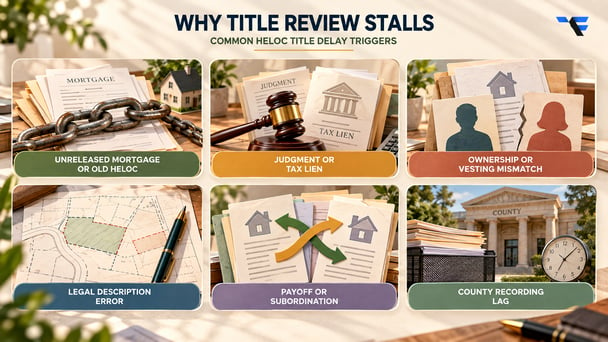
Common examples include:
An old mortgage or HELOC that was paid off but never formally released. Paying a balance down to zero does not necessarily remove the recorded lien. A formal release may still need to be recorded. AFX Research specifically notes that an old HELOC can remain recorded even with a zero balance until it is formally closed and released.
Judgments or tax liens. These may need to be addressed before the new lender can establish the required lien position.
Contractor or mechanic's liens. Unresolved liens related to construction or renovation can create another title issue.
Ownership or vesting mismatches. The name on the deed may not match the person or people applying for the HELOC. Transfers into a trust, changes in ownership or other gaps in the record can lead to additional documentation.
Probate, divorce or estate-related issues. A prior transfer may not have been recorded in a way that clearly establishes current ownership.
Errors in the legal description or recorded documents. A problem with how the property was described or how a prior document was recorded may need to be corrected.
The title company's findings usually appear in a title commitment, which identifies the title condition and the items that need to be addressed before the lender can proceed.
That fixing process is often called title curative work. In simple terms, it means correcting a title problem so the new lender can move forward.
The lender's concern about lien position also depends on where the HELOC sits in relation to the existing mortgage. A conventional HELOC generally functions as a second mortgage, while a first-position HELOC takes a different position in the lien structure.
Payoff, Subordination and County Recording Delays
A title issue may also involve another lender. For example, an existing loan may need a current payoff statement before closing. If an old mortgage or HELOC has been paid off, the title record may still need a formal release of lien.
In other cases, an existing lien may need to remain in place but change priority. That is where a subordination agreement can become relevant.
There can also be a lag between paying off a mortgage and seeing its lien release reflected in public property records. The CFPB notes that state property records can be used to verify whether a lien has been released and that there may be a delay between payoff and release.
Recording procedures and turnaround times also differ between local land-records offices. That means a third-party recording issue can take time even after the borrower has supplied everything requested.
What Happens After HELOC Closing?
One common source of confusion is assuming that signed documents = money in the bank.
That is not always the case.
For a covered HELOC secured by a consumer's principal dwelling, Regulation Z provides a right of rescission. The consumer generally has until midnight of the third business day after the triggering event, delivery of required disclosures and delivery of the rescission notice, whichever occurs last. Unless the right has been validly waived for a bona fide personal financial emergency, the creditor generally cannot disburse funds until that period has expired and it is reasonably satisfied that the consumer has not rescinded.
When the right of rescission applies, federal rules generally give the consumer three business days to cancel the transaction. The current CFPB Regulation Z rules set out when the right applies and when the rescission period begins.
This waiting period should not automatically be treated as a lender-created delay. It is a federal requirement when the rule applies. The right of rescission does not apply to every transaction, so the property type, transaction structure, and applicable law matter. The CFPB also explains the general HELOC right-to-cancel framework and other features of these lines of credit.
Once the applicable waiting period ends, the lender still has to complete its final funding process.
How Can I Find the Exact Cause of My HELOC Delay?
Instead of repeatedly asking for a general status update, ask for these six details:
- Current stage: Is the file in processing, underwriting, title, valuation, closing or funding?
- Exact open condition: What specific item is preventing the file from moving forward?
- Date requested: When was that item first identified?
- Date supplied: When was the requested document or information provided?
- Responsible party: Is the next action with the borrower, lender, title company, existing lender or another third party?
- Next update: When should the borrower expect a definitive status update?
If the delay involves the title, payoff, home valuation, or recording, ask the lender to explain the issue in writing. This makes it easier to understand whether you’re waiting on a third party or whether there’s still something that needs to be completed on your file.
How Truss Financial Group Can Help With a Delayed HELOC
A delayed HELOC does not always require starting over. The first step is understanding what is actually causing the delay.
Truss Financial Group can review the current scenario and determine whether the issue is related to documentation, valuation, title, lien structure, or program fit. For borrowers with less traditional income, the right program can also change the type of documentation required.
Depending on the borrower and property, alternatives may include a no-appraisal HELOC or a no-doc, no-appraisal HELOC.
For eligible digital or no-appraisal files, TFG states that funding may occur in as little as five business days, subject to complete documentation, acceptable valuation and title, underwriting, program and state requirements, and applicable waiting periods.
That does not mean every delayed HELOC can be replaced with a five-day process. Starting over can create a new underwriting, title, valuation, and disclosure timeline. The useful comparison is the remaining work on the current file versus the requirements of a new program.
Before drawing on the line, borrowers should also understand how payments can change over time. The monthly payment depends on factors such as the outstanding balance, interest rate, and whether the HELOC is still in its draw period or has entered repayment. Learn how HELOC monthly payments work.
When Should You Escalate a HELOC Delay?
Start with the loan officer or processor handling the file.
If the open issue belongs to a title company, payoff lender or another third party, ask for the appropriate contact or for the loan team to confirm who is responsible. When the same unresolved condition has remained open without a clear explanation, it is reasonable to ask for a supervisor or manager to review the file.
A simple written escalation can look like this:
Application date: [date]
Current stage: [underwriting/title/closing]
Open item: [specific condition]
Date supplied: [date]
Responsible party: [party]
Requested update: Please confirm what remains outstanding and the expected date for the next step.
A genuine title, probate, ownership or fraud issue may require advice from a title professional or attorney rather than only the mortgage team.
The Bottom Line
When a HELOC seems to be taking forever, the timeline usually becomes easier to understand once the exact stage is identified.
The file may be waiting for a borrower document, an underwriting decision, a property valuation, title curative work, a payoff or release, a subordination agreement, final closing requirements or an applicable rescission period.
The goal is not to guess which party is responsible. It is to find the specific condition keeping the file from moving and determine what has to happen next.
For homeowners whose current HELOC has stalled, Truss Financial Group can review the situation and determine which eligible home-equity options may fit the property, documentation and timing requirements.
Frequently Asked Questions
1. How long should I wait for a HELOC?
A typical HELOC process can take about two to six weeks from application to funding, although the actual timeline varies by lender, property, borrower and file complexity.
2. How long does HELOC underwriting usually take?
There is no universal underwriting time. A clean file with complete documentation may move quickly, while self-employed income, debt questions, credit issues or additional conditions can extend the review.
3. Why is my title search taking so long?
The title company may have found an unreleased lien, judgment, tax issue, ownership discrepancy, legal-description problem or another condition that needs to be resolved before the new HELOC can close.
4. Can an old paid-off HELOC still appear as a lien?
Yes. A zero balance does not necessarily mean the recorded lien has been formally released. A release may still need to be obtained and recorded.
5. Are HELOC funds available immediately after closing?
Not necessarily. For covered HELOCs secured by a principal dwelling, the federal right of rescission can require a three-business-day waiting period before funds are disbursed.
6. Does a no-appraisal HELOC still require title work?
Yes. A no-appraisal option changes the property valuation method. It does not automatically remove the need to verify ownership, liens and the lender's required lien position.
7. Can I switch lenders if my HELOC is delayed?
You can explore another lender, but switching does not automatically eliminate the underlying problem. A title defect or unreleased lien, for example, may still need to be resolved with a new lender. Starting over can also create a new application, underwriting, valuation and closing timeline.
8. Does Truss Financial Group delay HELOCs, and what can cause a delay?
There is no single cause behind a delayed TFG HELOC. Timing can still depend on documentation, title conditions, valuation, underwriting, program or state requirements and applicable waiting periods. TFG's stated fast-close timelines apply only to eligible files that meet the relevant requirements

.svg)

Discuss your unique requirements
Get direct answers and a roadmap for your future.
.png?width=202&height=202&name=image%20588255187%20(1).png)

-4.png?width=389&height=221&name=Blog%20covers%20(1)-4.png)

%20(1).png?width=389&height=221&name=Blog%20covers%20(2)%20(1).png)




.svg)

.svg)
.svg)