.svg)



%20(1).svg)
%20(2).svg)
.png?width=480&height=420&name=Img%20(1).png)
%20(3).svg)
%20(4).svg)

%20(5).svg)


 View all states
HELOC Monthly Payments: How Interest, Rates & Repayment Work

18 mins

In this blog
Key Takeaways
- Your HELOC payment depends on your outstanding balance, current interest rate, payment formula, and loan phase.
- During the draw period, your minimum payment may cover interest only, or it may include principal, depending on your HELOC agreement.
- HELOC interest is commonly calculated using a daily or average-daily balance, so a simple APR ÷ 12 calculation may not match your actual statement.
- A variable rate can cause your payment to increase even if your outstanding balance stays the same.
- When the draw period ends, new borrowing usually stops and payments typically shift toward principal and interest, which can create payment shock.
- Before the transition, review your repayment terms, model a higher-rate scenario, and understand whether your HELOC has a balloon payment or fixed-rate conversion option.
A HELOC payment is not determined by your credit limit alone. It depends on four moving parts: how much you have borrowed, your current interest rate, the lender’s payment formula, and whether you are in the draw or repayment period.
During the draw period, your required payment may cover only accrued interest, or it may include some principal, depending on the HELOC agreement. Once the draw period ends, new borrowing usually stops and the outstanding balance typically moves into a principal-and-interest repayment schedule. That can make the monthly payment considerably higher.
The complication is that many HELOCs have variable rates. Your payment can therefore change even when your balance does not. That is why understanding how HELOC payments work means looking beyond the advertised rate or credit limit and understanding what happens to the balance from the first draw through final repayment.
How Do HELOC Payments Work: Quick Answer
There is no single HELOC payment formula that applies to every lender or product. Your HELOC monthly payment is primarily driven by:
- Outstanding balance: You generally pay interest on the amount you have actually borrowed, not the unused portion of the credit line.
- Current interest rate: Many HELOCs have variable rates tied to an index plus a lender margin.
- Payment formula: Your agreement determines whether the minimum payment covers accrued interest, principal and interest, a percentage of the balance, or another amount.
- Loan phase: Your payment can work differently during the draw period and the repayment period.
For example, a $50,000 HELOC with a $50,000 outstanding balance will generally have a different payment from a $100,000 HELOC where only $20,000 has been drawn.
And if your line is still open but you have not borrowed anything, you generally will not owe interest on an unused balance, although the account may still carry fees depending on the agreement. The CFPB notes that some HELOCs may also have minimum draws, minimum outstanding balances, or initial borrowing requirements.
For a broader explanation of the product itself, see this guide to how HELOC works
The HELOC Payment Life Cycle
Think of a HELOC as a credit line that changes as you borrow and repay.
| Stage | What the borrower can do | What the payment may include |
|---|---|---|
| Before a draw | The line is open and available, subject to the agreement | Usually no interest on an unused balance; account fees may apply |
| Draw period | Borrow, repay and potentially borrow again | Accrued interest only, or interest plus principal |
| Rate adjustment | Balance can remain unchanged | Payment can change when the variable rate changes |
| Repayment period | New draws usually stop | Principal and interest over the disclosed repayment term |
| Maturity or balloon | No further borrowing | Remaining balance may become due if the agreement required it |
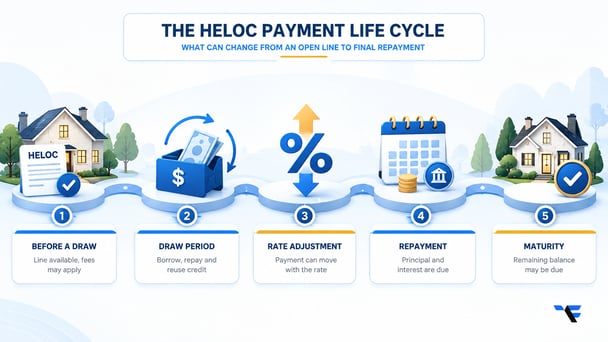
The exact timeline varies by product. A 10-year draw period followed by a 10- or 20-year repayment period is a common structure, but it is not a national rule. Federal disclosure rules require lenders to disclose the length of the draw and repayment periods and explain how the minimum payment is calculated.
If you want to understand the mechanics of the repayment phase specifically, TFG’s HELOC repayment guide goes deeper into that transition.
Monthly Payments During the Draw Period
A HELOC’s draw period is the period when you can generally borrow from the available credit line. As you draw money, your outstanding balance increases. As you repay principal, the balance can decrease and, depending on the agreement, that repayment may restore some available credit.
But the minimum payment is determined by the terms of your particular HELOC. Some plans may require a payment based on accrued interest during the draw period. Others may require principal repayment as well. You should never assume that every HELOC is automatically interest-only.
Consider our running example:
You have borrowed $50,000 at an 8% annual rate.
If your particular HELOC requires an interest-only minimum, a simple monthly approximation would be:
$50,000 × 8% ÷ 12 = $333.33
| Please Note: $333.33 is an illustration, not a universal HELOC payment. Actual interest may be calculated using a daily or average-daily balance, and the statement can differ depending on the number of days in the billing cycle and the agreement's calculation method. |
If you make only the required interest payment, the $50,000 principal does not decline. If you subsequently draw another $10,000, your balance becomes $60,000 and the interest calculation changes. If instead you pay $5,000 toward principal and make no new draw, the balance falls to $45,000, reducing the amount on which future interest is calculated.
That revolving feature is one of the fundamental differences between a HELOC and a traditional lump-sum home equity loan. The CFPB explains that available credit can generally be replenished as you repay, subject to the terms of the line.
How HELOC Interest Is Calculated
Understanding how HELOC interest is calculated is important because the rate you see on a statement is not necessarily enough to reproduce the exact finance charge.
Many HELOCs have a variable rate based on an index plus a lender margin. Your agreement should identify the index, margin, adjustment frequency, floor and applicable rate caps.
For example, if an agreement uses an index of 7% and a 1% margin, the resulting rate would be 8%, subject to the specific terms of that HELOC.
When the underlying index changes, your rate may change too. That means your payment can rise or fall even if your outstanding balance remains exactly the same.
Interest is commonly calculated using a daily or average-daily balance method. For a simplified illustration using daily accrual, you might estimate interest as:
Outstanding balance × annual interest rate ÷ 365 × number of days
So, at an 8% annual rate, $50,000 outstanding for 30 days would produce an illustrative interest charge of about:
$50,000 × 0.08 ÷ 365 × 30 = $328.77
That is deliberately different from the $333.33 monthly approximation above. Because a real HELOC statement can account for the exact number of days in the billing cycle, changes in the outstanding balance during that cycle, and the lender's specified day-count and balance methodology. Your agreement and statement control.
And remember that the interest rate is not necessarily the same thing as the total cost of the credit. A HELOC can also have application, annual, transaction, closing, fixed-rate conversion or early-closure-related charges depending on the product. The FTC notes that lenders must disclose applicable HELOC costs and payment terms.
You can also read TFG's guide to HELOC APRs for a closer look at the difference between the interest rate and APR.
A Simple HELOC Payment Example
Let's keep the same $50,000 balance throughout the comparison so you can see what actually changes.
| Illustrative case | Approximate monthly payment | What it shows |
|---|---|---|
| $50,000 at 8%, interest-only | $333 | Principal does not decline |
| $50,000 at 8%, 15-year amortization | $478 | Payment includes principal and interest |
| $50,000 at 10%, 15-year amortization | $537 | A higher rate increases the payment |
These figures are hypothetical educational calculations. The first uses a simple annual-rate-divided-by-12 approximation. The latter two use standard monthly amortization for a 15-year term. A real HELOC statement may differ because the lender's payment formula, rate adjustments, daily accrual method, fees and other terms control the actual amount due.
Here’s what you need to consider:
At 8% with an interest-only payment, you are servicing the interest without necessarily reducing the $50,000 principal.
At 8% with a 15-year amortization, the payment is higher because part of each payment is allocated toward principal.
At 10%, the same $50,000 balance and 15-year amortization produces a higher payment because the interest rate is higher.
And the repayment-period rate does not automatically become fixed simply because the draw period has ended. Many HELOCs remain variable unless the agreement provides for a fixed-rate conversion or another structure.
For borrowers comparing variable and fixed-rate options, TFG's fixed-rate vs. variable-rate HELOC guide explains the differences in greater detail.
What Makes HELOC Payments Change?
Your HELOC payment can change for several reasons.
You draw more money
A larger outstanding balance generally means more interest.
You pay down principal
A lower balance generally means less interest accrues, although your required payment may not change in exactly the way you expect because the payment formula controls.
Your variable rate changes
If your HELOC is tied to an index, a change in that index can change your rate and therefore your payment.
An introductory rate expires
Some products offer an introductory rate for a defined period. Once it expires, the regular rate formula applies.
The draw period ends
Your payment can increase substantially when the lender begins requiring principal repayment.
You convert part of the balance to a fixed rate
Some HELOCs allow borrowers to convert some or all of the balance into a fixed-rate segment. That segment may have its own rate, term and payment.
Fees or past-due amounts appear
Depending on the agreement, fees, late amounts or other charges can affect the amount shown on your statement.
The CFPB specifically warns that HELOC payments can change because these lines commonly have variable interest rates.
What Happens When the Draw Period Ends?
The end of the draw period is often where HELOC payment shock becomes a real concern.
Once the draw period ends, you generally can no longer borrow additional money from the line. The outstanding balance then moves into the repayment structure specified by your agreement.
In many HELOCs, that means paying principal and interest over a defined repayment term. Suppose our hypothetical $50,000 balance is still outstanding when the draw period ends.
If the agreement now requires that balance to be amortized over 15 years at 8%, the illustrative payment is about $478 per month, compared with about $333 per month under the earlier interest-only illustration. And the actual payment could be higher or lower depending on the balance, current rate, remaining term and payment formula.
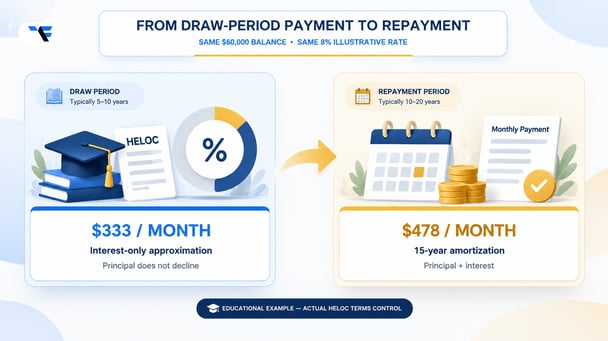
The CFPB notes that monthly payments are often significantly higher after the draw period ends, and that some HELOC agreements can require the full outstanding balance to be repaid when the draw period ends. A HELOC therefore does not automatically “turn into” a home equity loan. The agreement determines what happens next.
Before the transition, find out:
- When your draw period ends
- Whether new borrowing stops immediately
- How the new payment will be calculated
- How long the repayment period lasts
- Whether the rate remains variable
- Whether a balloon payment applies
- Whether a fixed-rate conversion is available
Balloon Payments and Full-Payoff Terms
A balloon payment is a large amount due at a specified point rather than being fully repaid through regular scheduled payments. Not every HELOC has a balloon feature. But some agreements can require the outstanding balance to be paid in full at the end of the draw period or at maturity. That is why the phrase “low monthly payment” should never be considered in isolation.
A low payment may reflect the fact that the required payment covers only interest or otherwise delays principal repayment. If your agreement contains a balloon provision, identify the maturity date well in advance and consider how you would realistically repay the balance.
Refinancing may be one possible strategy, but approval is never guaranteed. It depends on your financial circumstances, property, equity, lender requirements and market conditions at the time.
Fixed-Rate Conversion Options
Some HELOCs allow borrowers to convert part or all of an outstanding balance into a fixed-rate segment. This can provide greater payment predictability for the portion that is converted, while the remaining balance may continue to carry a variable rate.
The details matter.
Before assuming a fixed-rate conversion solves a payment problem, ask about:
- The fixed interest rate
- Conversion fees
- Minimum balance requirements
- The conversion window
- Available repayment terms
- The number of fixed-rate segments permitted
- Whether repaying the fixed segment restores available credit
- What happens to the remaining variable balance
Federal disclosure rules require certain fixed-rate conversion features to be disclosed, including applicable terms, fees and rate information.
Making Extra Principal Payments
If your HELOC allows principal payments during the draw period, paying down the balance can reduce the amount on which future interest accrues. It can also potentially restore available credit during the draw period. But there is an important distinction between making an extra principal payment and simply paying the next month's bill early.
Check with the servicer to confirm how additional funds are applied. You want to know whether the extra amount reduces principal or merely satisfies a future scheduled payment. Also remember that paying your balance down to zero is not necessarily the same thing as closing the HELOC. An account with a zero balance may remain open and could still be subject to applicable account terms or fees.
If you're researching the costs involved in establishing or closing a line, see TFG's HELOC closing-cost guide.
How to Read a HELOC Statement
Your monthly statement is one of the best places to understand why your payment changed.
Look for:
- Beginning balance
- New draws
- Payments and credits
- Current interest rate
- Finance charge
- Fees
- Minimum payment
- Due date
- Available credit
- Draw-period end date
- Maturity or repayment information, where shown
Then compare the current rate with the index and margin described in your HELOC agreement.
If the rate changed, check when the adjustment occurred and whether the change corresponds with the adjustment rules in your contract. If you see an unexplained balance, fee, payment allocation or rate, contact your servicer promptly rather than assuming the statement is correct.
How to Prepare Before Repayment Starts
Don't wait until the month before your draw period ends.
A few months ahead of the transition, review your agreement and recent statements. Then ask your servicer for an estimate of the payment you can expect under the repayment formula.
For example, if your current balance is $50,000 and your estimated repayment payment is based on 8%, calculate what happens if the rate moves higher. You are not predicting where rates will go. You are simply testing whether your household budget has enough room for a higher payment.
You can also consider whether reducing principal makes sense for your finances, while maintaining an appropriate emergency reserve and keeping up with your other housing costs.
If you're considering a new HELOC, refinancing, or another way to access equity, compare the total cost and repayment structure rather than focusing only on the monthly payment.
TFG's guide to HELOC approval factors can help explain what lenders typically evaluate when reviewing an application.
Managing Payments and Avoiding Default
A HELOC deserves the same payment discipline as any other secured debt. Set a calendar reminder or automatic payment so you do not miss the due date, but continue reviewing your statements because the required amount can change.
Keep some room in your monthly budget for a higher payment, particularly if your HELOC has a variable rate or you are approaching the end of the draw period.
If you think you may have trouble making a payment, contact the servicer before missing it. Ask what options, if any, are available under your agreement. Do not assume that a payment extension, modification, refinance or other relief will automatically be approved.
The reason is simple: your home secures the HELOC. Falling seriously behind can damage your credit and, ultimately, put the property at risk of foreclosure. Both the CFPB and FTC emphasize this collateral risk.
What to Compare Before Opening a HELOC
If you are still shopping for a HELOC, don't compare offers based on the advertised rate alone.
Look at:
- Index
- Margin
- Current APR
- Introductory-rate period, if any
- Rate floor
- Periodic and lifetime caps
- Payment formula
- Draw period
- Repayment period
- Minimum draw
- Initial draw requirement
- Annual or transaction fees
- Fixed-rate conversion options
- Balloon or full-payoff provisions
- Early-closure cost recapture
- Other disclosed closing costs
Ask lenders for payment examples using the same balance and rate assumptions. That makes the comparison much more useful than simply comparing two headline APRs.
You can also review TFG's current HELOC rate information to understand how variable-rate HELOC pricing is generally structured.
And before applying, remember that approval, available credit, pricing and terms depend on the lender, property, state, income, credit profile, equity position and final underwriting.
The Bottom Line
The easiest way to understand how HELOC payments work is to stop thinking of the payment as one fixed number.
It is the result of four things working together:
Your outstanding balance + your current rate + your lender's payment formula + your loan phase.
During the draw period, a lower minimum payment may be possible, depending on the agreement. But that does not necessarily mean you are reducing principal. When the repayment period begins, principal repayment can push the monthly payment higher. If the rate is variable, the payment can move again.
That is why the most useful number to know is not simply today's minimum payment. It is what your payment could look like today, after the draw period ends, and under a higher-rate scenario.
If you are considering a HELOC or already have one, Truss Financial Group can help you look at those numbers together: your current payment, a higher-rate scenario and the projected repayment-period payment.
Rates, payments, eligibility, product features and availability vary by lender, state, property, borrower profile and final loan agreement.
Frequently Asked Questions
Do HELOC payments start immediately?
A payment obligation generally begins once you have a balance, subject to the agreement's billing cycle and any initial-draw or fee requirements. An unused line generally does not generate interest on an amount you have not borrowed.
Are HELOC payments always interest-only?
No. Payment formulas differ. Some HELOCs may have interest-only minimums during the draw period, while others require principal repayment or use another formula.
Do I pay interest on the full credit limit?
Generally, interest is based on the amount you have actually borrowed rather than the unused portion of the credit line. Fees can still apply according to the agreement.
Why did my HELOC payment increase?
A higher balance, variable-rate adjustment, expiration of an introductory rate, transition into repayment, fixed-rate conversion, fees or past-due amounts can affect the amount due.
Can I pay principal during the draw period?
Often, yes, but confirm the payment rules and how additional funds are applied with your servicer.
What happens to repaid principal?
During the draw period, repaid principal may restore available credit, subject to the terms of the HELOC and any lender-imposed restrictions.
How much will my payment be after the draw period?
There is no universal multiplier. The calculation depends on your remaining balance, current rate, remaining repayment term and the payment formula in your agreement.
Can I keep borrowing during repayment?
Usually not. New borrowing generally stops when the draw period ends unless the lender provides a new arrangement or agreement.
Can I pay off a HELOC early?
Often, borrowers can make principal payments or pay off the balance early. But paying the balance to zero is different from closing the account. Check for any early-closure fee or recapture of previously waived costs.
Is HELOC interest tax deductible?
It depends on how you use the borrowed funds and whether you meet the applicable tax requirements.
Under current IRS guidance, interest on a HELOC may be deductible when the proceeds are used to buy, build or substantially improve the home securing the debt, subject to applicable limitations and other requirements. Interest on funds used for personal expenses generally does not qualify under these rules.
Tax treatment can depend on your individual circumstances, so speak with a qualified tax professional before assuming HELOC interest will be deductible.

.svg)

Discuss your unique requirements
Get direct answers and a roadmap for your future.
.png?width=202&height=202&name=image%20588255187%20(1).png)

.png?width=389&height=221&name=Blog%20covers%20(1).png)


.png?width=389&height=221&name=Blog%20covers%20(2).png)



.svg)

.svg)
.svg)