.svg)



%20(1).svg)
%20(2).svg)
.png?width=480&height=420&name=Img%20(1).png)
%20(3).svg)
%20(4).svg)

%20(5).svg)


 View all states

13 mins

In this blog
Somewhere between submitting your application and waiting for an answer, the process quietly shifted from a financial review to a title review. Most borrowers don't know that distinction exists until they're holding a decline letter that says "lien" and offers nothing else. No explanation of what type. No guidance on what it means. No indication of whether anything can still be done.
For a lot of borrowers, especially real estate investors and self-employed borrowers with substantial equity and solid financials, that answer lands like a door slamming without an explanation. The property value is real. The equity is real. So why is a lien enough to stop a HELOC approval entirely?
Mortgage brokers like Truss Financial Group see this situation regularly, and this resource exists to answer that question clearly and walk you through what your actual options are. Whether that means a first-position HELOC, a platform like NFTYDoor HELOC with a wider credit box, or an alternative financing path built around your property income rather than your title position, there are still routes forward. The right one depends on your lien type, your property, and your financial goals.
Why a Lien Stops a HELOC Approval Even When Your Finances Are Clean?

To understand why a lien kills a HELOC application, you first need to understand how a HELOC is structured. Here is the logic lenders follow, and where liens break it:
The lien didn't disqualify you as a borrower. It disqualified the lien position the lender needed. That distinction matters because it points directly to the solutions.
Not All Liens Are the Same. And the Type You Have Changes Your Options.
Before assuming the worst, it's worth understanding what kind of lien you're dealing with. The type of lien on your title has a direct bearing on how resolvable it is and how quickly.
| Lien Type | Common Cause | Typical Resolution Path |
|---|---|---|
| Federal or State Tax Lien | Unpaid income or property taxes | IRS subordination/discharge process; payoff at closing |
| Mechanic's / Contractor's Lien | Unpaid contractor or subcontractor | Negotiation, payment, or bonding before closing |
| Judgment Lien | Court ruling against the property owner | Payoff or negotiation; attached to the property until resolved |
| HOA Lien | Unpaid dues or assessments | Payment of outstanding balance; often resolvable quickly |
| Child Support Lien | Court-ordered support obligations | Formal legal resolution required |
Some of these, particularly HOA liens and smaller mechanic's liens, are resolvable quickly, sometimes at or before closing. Others, like federal tax liens, involve a formal process with the IRS that takes time and documentation but is navigable with the right guidance.
The type of lien you have determines whether resolution is a realistic near-term move or whether the smarter path is to route around the title issue entirely through a different financing structure. A senior loan officer or financial advisor who works with complex title situations can help you assess which path makes sense before you spend time and appraisal fees reapplying somewhere else.
What a First-Position HELOC Actually Is? And When It Changes the Equation?
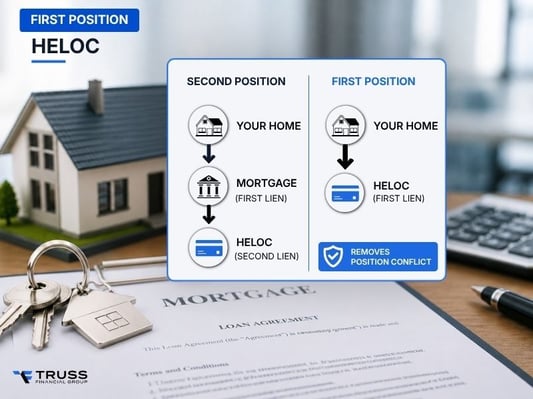
Most borrowers have never heard of a first-lien HELOC before their traditional HELOC gets declined. Here is what it is and when it actually helps.
How It Works?
A first-position HELOC, sometimes called a first-lien HELOC, replaces your existing mortgage rather than sitting behind it. Instead of being the second lien on the property, the HELOC lender holds the senior lien position from day one. There is no original mortgage ahead of it in the repayment hierarchy.
This structure applies in two situations: the property is owned free and clear with no outstanding balance, or the borrower uses the HELOC proceeds to pay off the existing mortgage at closing. In either case, the HELOC moves into first position, and the lien-position problem that kills most second mortgage HELOC applications is removed from the equation.
What It Actually Solves?
For borrowers with sufficient equity and a lien that was competing with a second-lien product, a first-lien HELOC can genuinely change what's possible. Unlike home equity loans that deliver a lump sum upfront with fixed monthly payments, a first-lien HELOC gives you a revolving credit limit you draw from as needed.
The competitive interest rates on these products tend to be variable, and the draw period functions the same as a standard equity line of credit. You borrow money as you need it, make interest-only payments on the outstanding HELOC balance during the draw period, and move into the repayment terms on whatever remains. For borrowers funding home improvements or consolidating high-interest debts, that flexibility matters.
The Honest Caveat
A first-position HELOC does not eliminate the underlying lien. It changes the product structure. If the lien on your title is the kind that prevents a title insurance company from issuing a policy at all, regardless of position, a first-lien HELOC will still not close. Title must be insurable. This product is also not widely available at most banks and credit unions; it requires specific qualifying conditions and a lender set that offers it.
Can NFTYDoor Help When a Traditional Lender Says No?
NFTYDoor is an AI-powered digital lending platform offering home equity lines of credit through a fully digital process, including application, automated underwriting, remote online notarization, and funding, with some loans closing and funding the same day.
The platform recently spun out as an independent company and expanded its credit box, explicitly designed to widen borrower eligibility and convert more borderline or declined borrowers into funded deals. Here is what that actually means in practice:
What the Expanded Credit Box Covers
Wider underwriting criteria on income documentation, credit score thresholds, and equity requirements, giving loan officers more room to work with borrowers who don't fit conventional parameters. Borrowers with high credit scores and clean credit reports who were declined purely on conventional underwriting grounds are often the best fit.
How Access Works
NFTYDoor operates through a B2B partner model. Borrowers don't apply directly; they access the platform through brokers and lending partners operating under direct agreements with the company. Your loan officer is the entry point, not a direct application.
The Honest Framing on Liens
An expanded credit box widens eligibility on income, credit utilization, and equity criteria. It does not override the requirement for insurable title. If your HELOC was declined because of an active, unresolved lien preventing a title insurance company from issuing a policy, that barrier exists on NFTYDoor's platform, the same as anywhere else.
Where NFTYDoor Fits Best
Borrowers whose decline was driven by conventional underwriting rigidity, income documentation that doesn't fit a W-2 mold, a credit profile flagged by credit bureaus for reasons unrelated to actual financial stability, or a property that a traditional lender's automated valuation models undervalued. If the lien is resolvable and the decline had other contributing factors, NFTYDoor's credit box may be exactly the right fit.
When the HELOC Route Is Blocked?
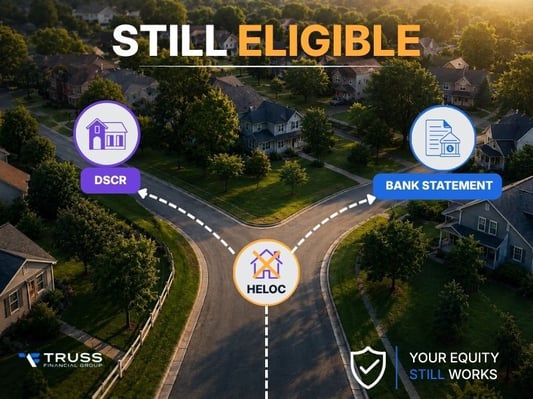
What Investors and Self-Employed Borrowers Can Do Instead?
For real estate investors and self-employed borrowers, a lien-related HELOC decline does not have to be the end of the conversation. There are alternative financing options that approach the property from an entirely different angle, ones that don't rely on the same title position requirements that blocked the original application.
1. DSCR Loans
A DSCR loan, or Debt Service Coverage Ratio loan, qualifies based on the rental income a property generates, not on personal income, tax returns, W-2s, or the title position of a HELOC.
If the property cash flows sufficiently to service the debt, the loan can move forward even when a HELOC cannot. This is a meaningful distinction for investors: the lien still needs to be addressed at closing on a cash-out refinance, but the qualification pathway, rental income against monthly payments rather than personal debt-to-income, is entirely different.
Borrowers who have been turned away because their tax returns understate their actual income, or because their financial situation doesn't fit a conventional mortgage loan mold, often find a clear path through DSCR. Unlike personal loans or home equity loans that require strong personal income documentation, a DSCR loan centers the underwriting on the asset itself.
2. Bank Statement Loans
Bank statement loans serve a similar function for self-employed borrowers. Rather than qualifying on tax return income, which frequently understates what a self-employed borrower actually earns after legitimate deductions, 12 to 24 months of bank statement deposits are used to document monthly income.
For borrowers managing high-interest debts or trying to consolidate debt across multiple properties, and who have been declined not just because of a lien but because their income documentation didn't satisfy a conventional lender's sufficient income threshold, bank statement products can unlock refinance and equity access options that standard products cannot.
The mortgage interest and repayment terms on these products are structured to reflect the borrower's actual cash flow, not their tax return alone.
Lenders like Truss Financial Group structure financing for borrowers and investors navigating exactly these conditions, complex title situations, non-traditional income documentation, and market environments where conventional qualification criteria leave otherwise strong borrowers on the outside.
Frequently Asked Questions
1. Can I Get a HELOC if I Have a Lien on My Property?
It depends on the lien type and whether a title insurance company will insure the title. Some liens, including HOA liens and smaller mechanic's liens, are resolvable at or before closing and may not prevent a HELOC from proceeding if handled correctly. Others, particularly unresolved federal tax liens or judgment liens, typically block a conventional HELOC until they are addressed. The key variable is title insurability, not the lien's existence alone. A senior loan officer who works with complex title situations can give you a faster read on which category your lien falls into than most online resources can.
2. What Is a First-Position HELOC, and Does It Help With Lien Issues?
A first-lien HELOC replaces your existing primary loan and holds the senior lien position rather than sitting behind it as a second mortgage would. This removes the lien-position conflict that causes most second-lien HELOC declines, but it does not eliminate the underlying lien or the requirement for insurable title. It is a genuine solution for specific situations, not a universal workaround. Unlike a lump sum home equity loan with fixed monthly payments, a first-lien HELOC gives you a revolving credit limit with predictable payments during the draw period.
3. Can NFTYDoor Approve a HELOC That a Traditional Lender Declined?
NFTYDoor's expanded credit box widens eligibility on income documentation, credit report history, and underwriting criteria, giving loan officers more room to work with borrowers who don't fit conventional parameters. However, an insurable title is still a requirement. NFTYDoor is best suited for borrowers whose decline was driven by income documentation or conventional underwriting rigidity, not for situations where an unresolved lien is the sole barrier.
4. What Types of Liens Most Commonly Cause HELOC Declines?
Federal and state tax liens, mechanic's and contractor's liens, judgment liens, HOA liens, and child support liens are the most common. Tax liens and judgment liens tend to be the most complex to resolve. HOA liens and smaller mechanic's liens are often the most straightforward. The lien type section above covers each in more detail.
5. What Can I Do if My HELOC Was Declined Because of a Tax Lien?
The IRS has a formal subordination and discharge process for federal tax liens. This is worth exploring with a tax advisor before assuming the lien permanently blocks your options. Lien payoff at closing is another path if the equity supports it. For investors who need to move faster than the resolution timeline allows, a DSCR loan or bank statement product may offer a parallel path to equity access while the lien is being addressed, without the credit utilization and personal finance scrutiny that comes with standard qualification.
6. Are There Home Equity Products That Don't Require a Clean Title?
All lien-based equity products require title to be insurable at some level. That requirement does not disappear with any platform or product type. The more useful question is which products offer the most flexibility on lien resolution at closing versus requiring full resolution before you even apply. A conversation with a loan officer who understands both the title side and the financing side is the most efficient way to answer that for your specific situation without paying unnecessary appraisal fees or triggering additional credit bureau inquiries upfront.
7. Are the Interest Payments on a HELOC Tax-Deductible?
In many cases, yes, but it depends on how the funds are used. The IRS generally allows mortgage interest deductions on home equity debt when the proceeds are used to buy, build, or substantially improve the property securing the loan, such as home improvements. When funds are used for debt consolidation or personal expenses, the tax benefits may not apply. A tax advisor can give you a definitive read based on your financial situation and loan term.
Your Equity Shouldn't Be Locked Out Because of a Lien. Here's Where to Start.
A lien-related HELOC decline is not the end of the road. It is a signal that the standard product doesn't fit this situation, and that the right financing structure depends on the lien type, the property, and how you earn.
Borrowers who understand whether their lien is resolvable, whether a first-position HELOC or a platform like NFTYDoor fits their situation, and whether a DSCR or bank statement loan is the smarter alternative are in a fundamentally different position than those waiting for a decline letter to explain itself. Financial stability doesn't require a perfect title picture. It requires the right product for the picture you actually have.
The equity is there. The question is which path gets you to it.
Specialised lenders like Truss Financial Group work with homeowners, real estate investors, and self-employed borrowers to structure financing around complex title situations and non-traditional income. If your HELOC was declined and you want a clear picture of what's still possible, that conversation starts here.

.svg)

Discuss your unique requirements
Get direct answers and a roadmap for your future.
.png?width=202&height=202&name=image%20588255187%20(1).png)



.jpg?width=389&height=221&name=Blog%20covers%20(4).jpg)
%20(1).png?width=389&height=221&name=Blog%20covers%20(2)%20(1).png)



.svg)

.svg)
.svg)