.svg)



%20(1).svg)
%20(2).svg)
.png?width=480&height=420&name=Img%20(1).png)
%20(3).svg)
%20(4).svg)

%20(5).svg)


 View all states
Fast Close HELOC: How Quickly You Can Access Your Home Equity?

16 mins
.png)
In this blog
Key Takeaways
- Fast close HELOCs can fund in 5–10 business days under ideal conditions, compared to the 2–6 week industry standard
- Speed depends on the valuation method, credit profile, loan amount, title condition, and how quickly you submit documents
- Even the fastest HELOC includes a mandatory 3-day rescission period before you can access funds
If you need to access cash quickly and you own a home with available equity, you've probably searched "how fast can a HELOC close" more than once. The answer isn't as simple as a single number and anyone promising "instant approval" or "same-day funding" is selling you something that doesn't exist in the regulated mortgage world.
Here's the reality: a fast close HELOC can fund in as few as 5-10 business days from application to disbursement, but only when specific conditions align. Your credit profile needs to be strong, your property must qualify for streamlined valuation, your title must be clean, and you need to respond to lender requests immediately. Traditional banks and credit unions often take 2-6 weeks or longer due to outdated systems, manual underwriting, and appraisal backlogs.
Lenders like Truss Financial Group specialize in fast close HELOCs by using digital workflows, automated valuation models when eligible, and streamlined underwriting designed to eliminate common delays. But even with the most efficient lender, speed is never guaranteed - it's earned through preparation and eligibility.
This guide explains exactly what makes a HELOC close faster, what slows it down, and how to position yourself for the quickest possible timeline when you need access to your home equity line.
What Is a Fast Close HELOC?
A fast close HELOC is a home equity line of credit structured and processed to reduce the time between application and funding. It's not a different financial product - it's the same revolving line of credit you'd get from any lender, but delivered through a more efficient process.
How a HELOC Works?
A HELOC is a revolving line of credit secured by your home. Unlike a lump-sum home equity loan, a HELOC gives you a credit limit you can draw from as needed during a set draw period, typically 10 years. You pay interest only on what you borrow, and as you repay the principal, you can borrow again - similar to a credit card, but with a variable rate tied to the prime rate.
Most HELOCs follow a two-phase structure: a draw period where you access funds and make interest-only payments, followed by a repayment period where the line closes, and you pay down both principal and interest over 10-20 years.
What "Fast Close" Actually Means
"Fast close" refers to the timeline from completed application to funded loan. In a fast close scenario, lenders use:
- Digital application platforms that collect information instantly
- Automated valuation models (AVMs) or desktop appraisals instead of full in-person appraisals
- Streamlined underwriting that prioritizes clean credit profiles and straightforward property situations
- Electronic document submission and signing to eliminate mailing delays
The goal is to compress what traditionally takes weeks into days, without sacrificing compliance or accuracy.
What "Fast Close" Does NOT Mean
Fast close does not mean:
- No underwriting review - Every HELOC requires income verification, credit analysis, and property valuation
- No appraisal or valuation - You'll still need some form of property assessment, even if it's not a full in-person appraisal
- Skipping compliance steps - Federal regulations, including the 3-day right of rescission, still apply
- Guaranteed approval - Speed applies only to eligible borrowers; complex files still take longer
Understanding these limitations prevents frustration and helps you set realistic expectations.
How Long Does a HELOC Usually Take to Close?
Standard HELOC Timeline (2-6 Weeks)
At traditional banks and credit unions, the typical HELOC closing process spans 2-6 weeks. Here's why:
- Appraisal scheduling and completion: In-person appraisals often face 7-14-day backlogs, especially in busy markets
- Manual underwriting processes: Legacy systems require humans to review every document, creating bottlenecks
- Title review and search: Identifying liens, back taxes, or ownership issues can take 5-10 business days
- High application volumes: Lenders with outdated systems or heavy workloads process applications more slowly
If your property is unique, your credit has recent issues, or the lender requests additional documentation, timelines extend further.
Fast Close HELOC Timeline (5-10 Business Days in Ideal Cases)
Digital lenders and specialty home equity providers can close in 5-10 business days when:
- Your credit score is 720 or higher
- The loan amount is under $250,000-$400,000
- The property qualifies for an AVM or desktop appraisal
- Your title is clean with no liens or ownership disputes
- You submit all requested documents within 24 hours
Digital lenders can fund loans under $400,000 in as few as 5 days after approval when using streamlined online applications and automated processes. These timelines assume everything goes perfectly - one missing bank statement or unexplained deposit can add days.
The 3-Day Right of Rescission
Federal law mandates a 3-day right of rescission for HELOCs on primary residences. After you sign the closing documents, you must wait three business days before the lender can disburse funds. This cooling-off period protects borrowers from predatory lending and cannot be waived.
Even if your lender "closes" in 5 days, you won't access funds until day 8 at the earliest. This is non-negotiable and applies to every HELOC on an owner-occupied property.
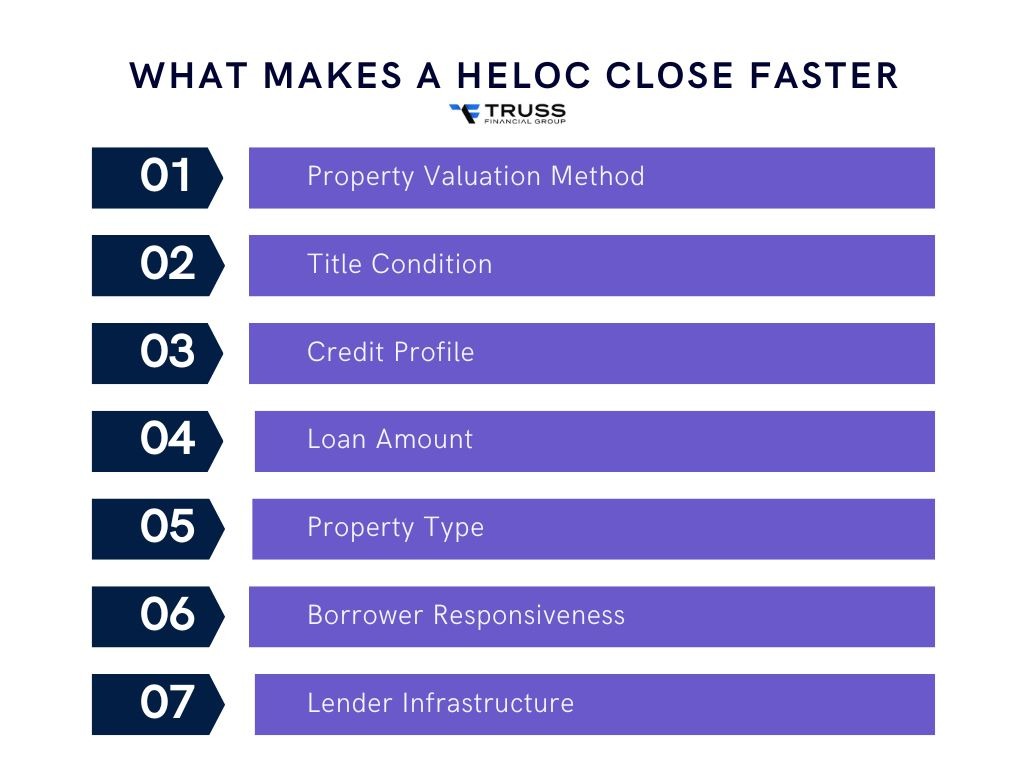
What Makes a HELOC Close Faster (7 Key Factors)
1. Property Valuation Method
Full Appraisal vs Desktop vs AVM
The biggest variable in HELOC closing speed is how your property gets valued:
- Full in-person appraisal: Requires scheduling an appraiser, site visit, and detailed report - adds 7-21 days
- Desktop appraisal: Appraiser reviews property data, comparable sales, and photos without visiting - saves 5-10 days
- Automated Valuation Model (AVM): A computer algorithm analyzes recent sales, tax records, and property data - delivers results instantly
Many lenders waive full appraisals for loans under $250,000-$400,000 in favor of AVMs, which can shave two weeks off the timeline. If your property is in a well-documented area with recent comparable sales, AVM eligibility is likely.
2. Title Condition
Liens, Back Taxes, Ownership Issues
A clean title is essential for fast closing. Title issues that cause delays include:
- Outstanding liens from contractors, judgments, or previous mortgages
- Unpaid property taxes or HOA dues
- Ownership disputes, easements, or boundary problems
- Errors in public records requiring legal correction
Title companies typically complete searches in 3-7 business days for straightforward properties. Any red flags trigger manual review and potentially legal intervention, adding weeks to the process.
3. Credit Profile
Credit Score & Debt-to-Income (DTI)
Lenders offering the fastest turnarounds require:
- Credit score of 720 or higher for automated underwriting eligibility
- Debt-to-income ratio below 43% to avoid manual review
- Clean credit history with no recent late payments, collections, or bankruptcies
Strong credit profiles move through underwriting faster because they qualify for streamlined approval paths. If your credit score is below 680 or your DTI exceeds 43%, expect additional scrutiny and longer processing times.
4. Loan Amount
Why Smaller HELOCs Close Faster
Smaller loans face fewer regulatory hurdles:
- Loans under $250,000-$400,000 often qualify for appraisal waivers and automated underwriting
-
Loans above $500,000 trigger enhanced due diligence, more documentation, and manual underwriting
- Small loans under minimum thresholds (typically $10,000-$15,000) may not be worth the lender's time
The sweet spot for speed is generally $25,000-$250,000 on primary residences with strong credit.
5. Property Type
Primary vs Second Home vs Investment
Primary residences close fastest because they carry the least risk:
- Primary residence: Fastest closing, best rates, most flexible underwriting
- Second home: Slightly more scrutiny, potential for longer timelines
- Investment property: Requires rental income verification, higher rates, and manual underwriting - adds 5-10 days
If you're accessing equity on a rental property, factor in additional time for lease documentation and cash flow analysis.
6. Borrower Responsiveness
Document Speed
Your speed matters as much as the lender's:
- Immediate document submission: Upload requested items within hours, not days
- Complete and accurate information: Partial documents or illegible scans require follow-up
- Prompt responses to underwriter questions: Every 24-hour delay compounds
The fastest closings happen when borrowers treat the process like a priority and respond to lender requests the same day they arrive.
7. Lender Infrastructure
Digital vs Traditional Banks
Lender technology determines baseline speed:
- Digital lenders: Online applications, automated workflows, electronic notary - built for speed
- Traditional banks: Branch-based processes, paper documents, manual reviews - slower by design
- Credit unions: Member-focused service but often limited by legacy systems
Online lenders using digital platforms can approve and close significantly faster than institutions relying on outdated infrastructure or high application volumes.
Can You Get a HELOC Without an Appraisal and Still Close Fast?
What "No Appraisal" Really Means?
AVMs and Desktop Valuations
When lenders advertise "no appraisal" HELOCs, they're not skipping valuation entirely - they're using alternative methods:
- Automated Valuation Models (AVMs): Computer-generated estimates based on property data, comparable sales, and public records
- Desktop appraisals: Licensed appraisers review data remotely without visiting the property
Both methods deliver results in hours or days instead of weeks, making them ideal for fast close scenarios. Some lenders eliminate in-person appraisals for loans under $400,000, relying on digital valuation tools instead.
When Appraisals Are Still Required?
Full appraisals remain mandatory when:
- Loan amounts exceed $400,000-$500,000, depending on the lender
- Properties are unique or lack comparable sales data (rural areas, custom homes, unusual layouts)
- High loan-to-value (LTV) ratios above 80-85% trigger enhanced scrutiny
- Property condition is questionable based on tax records or previous assessments
If your property doesn't fit the AVM mold, expect a traditional appraisal and a longer timeline.
Why AVM-Eligible Files Move Faster?
AVMs eliminate the most common bottleneck in HELOC closing: waiting for appraiser availability. In markets with appraiser shortages, this single step can add 10-14 days. By using automated property data, lenders reduce friction and accelerate underwriting without sacrificing accuracy for straightforward properties.
Some lenders like Truss Financial Group offer no-appraisal HELOCs for eligible borrowers, using AVMs to streamline the valuation process and close faster.
Costs, Rates, and Tradeoffs of a Fast Close HELOC
Interest Rates
Fast close HELOCs typically carry variable interest rates tied to the Wall Street Journal Prime Rate, currently at 6.75% (rates vary by lender and credit profile, with lenders adding a margin typically ranging from 0.5% to 2%). Your annual percentage rate (APR) depends on:
- Credit score (higher scores = lower rates)
- Loan-to-value ratio (lower LTV = better pricing)
- Loan amount (larger loans may get rate discounts)
Some lenders offer both fixed-rate and variable-rate options, giving you payment predictability if you prefer stability over potential savings.
Fees and Closing Costs
Appraisal, Title, Annual Fees
Typical HELOC closing costs include:
- Origination fee: 1-2% of the credit line (some lenders waive this)
- Title search and insurance: $300-$800
- Appraisal fee: $300-$600 if required (waived on many fast close programs)
- Recording fees: $50-$200
- Annual maintenance fee: $0-$75 per year
Fast-close programs for smaller amounts may waive closing costs entirely, making them more attractive for borrowers who need quick access without upfront expenses.
Is Speed More Expensive?
Not necessarily. While some lenders charge premium rates for expedited processing, many fast close programs achieve speed through efficiency rather than premium pricing. You may pay slightly higher rates compared to the absolute lowest advertised APRs, but the tradeoff is measured in days, not dollars.
The real cost of speed is reduced flexibility: if your financial situation is complex or your property unusual, fast close programs may not accommodate you at all.
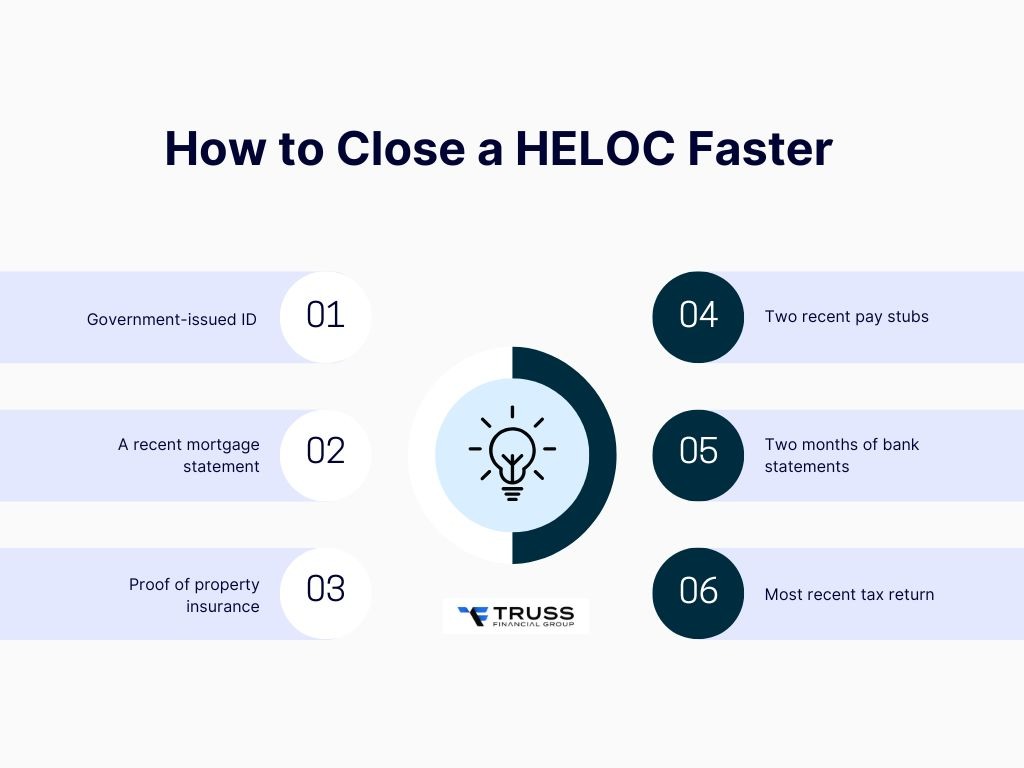
How to Close a HELOC Faster (Borrower Checklist)
Documents to Prepare Before Applying
ID, Insurance, Mortgage Statement
Gather these documents before starting your application:
- Government-issued ID (driver's license or passport)
- A recent mortgage statement showing the remaining balance and payment history
- Proof of property insurance with adequate coverage
- Two recent pay stubs or proof of income
- Two months of bank statements showing consistent deposits
- Most recent tax return if self-employed
Having everything ready before you apply eliminates back-and-forth delays.
What to Avoid During Underwriting
Deposits, Credit Changes
Do not:
- Make large, unexplained cash deposits - underwriters will request documentation
- Open new credit accounts or close existing ones
- Change jobs or income sources mid-process
- Finance large purchases that increase your debt-to-income ratio
- Miss any bill payments, even unrelated to the HELOC
Any change to your financial profile during underwriting can trigger re-verification and delay closing.
Questions to Ask Lenders
Before committing, ask:
- What is your typical timeline from application to funding?
- Do I qualify for an appraisal waiver at my loan amount?
- What documents will you need, and when?
- Are there fees for faster processing?
- What could slow down my specific application?
Clear answers help you choose the right lender and set realistic expectations for your timeline.
Fast Close HELOC vs Other Options
Fast Close HELOC vs Traditional HELOC
Fast Close HELOC:
- 5-10 day timeline (ideal cases)
- Digital application and closing
- AVM or desktop appraisal
- Higher credit score requirements
Traditional HELOC:
- 2-6 week timeline
- May require in-person meetings
- Full appraisal standard
- More flexible credit requirements
Fast Close HELOC vs Cash-Out Refinance
A cash-out refinance replaces your existing mortgage with a larger loan, giving you the difference in cash. It typically takes 30-45 days and resets your mortgage rate - beneficial if current rates are lower than your existing mortgage, but slower and more expensive if you're only accessing a small amount of equity.
HELOCs close faster, preserve your existing mortgage rate, and offer revolving access to funds. However, they carry higher interest rates than first mortgages and variable-rate risk.
|
Feature |
Fast Close HELOC |
Traditional HELOC |
Cash-Out Refinance |
Home Equity Loan |
|
Timeline |
5-10 days |
2-6 weeks |
30-45 days |
2-4 weeks |
|
Application |
Digital, streamlined |
May require in-person |
Extensive documentation |
Standard process |
|
Valuation |
AVM or desktop |
Full appraisal |
Full appraisal |
Full appraisal |
|
Access to Funds |
Revolving credit line |
Revolving credit line |
One-time lump sum |
One-time lump sum |
|
Interest Rate |
Variable (typically) |
Variable |
Fixed |
Fixed |
|
Affects Existing Mortgage |
No |
No |
Yes (replaces it) |
No |
|
Credit Requirements |
720+ for fastest speed |
680+ typically |
620+ typically |
640+ typically |
|
Best For |
Quick access, strong credit |
Flexible borrowing |
Lowering the mortgage rate |
One-time projects |
When a HELOC Is the Wrong Tool
Avoid HELOCs if:
- You need funding in less than 7 days (even fast close HELOCs can't beat the 3-day rescission)
- You're uncomfortable with variable rate risk
- Your credit score is below 640
- You lack sufficient equity (most lenders require 15-20% remaining after the HELOC)
In these cases, consider alternatives like personal loans, 401(k) loans, or delaying your project until you can qualify for better terms.
Explore additional options with a Digital HELOC or learn about HELOCs over $750K for larger projects.

FAQs About Fast Close HELOCs
How fast can a HELOC close?
A HELOC can close in as few as 5-10 business days under ideal conditions: strong credit (720+), loan amount under $400,000, clean title, and immediate document submission. Traditional banks typically take 2-6 weeks. All HELOCs include a mandatory 3-day rescission period before funds are available.
Can you close on a HELOC in less than two weeks?
Yes, but only if you meet specific criteria: excellent credit, streamlined property valuation (AVM or desktop appraisal), clean title, and a responsive approach to lender requests. Digital lenders specializing in fast close programs are your best option for sub-two-week timelines.
How long does HELOC signing take?
The actual signing process takes 15-30 minutes with electronic notary services offered by most digital lenders. However, you must wait 3 business days after signing before the lender disburses funds due to the federal right of rescission.
Can you get a HELOC immediately?
No. The fastest possible HELOC timeline is approximately 8 days: 5 days for processing and approval, plus the mandatory 3-day rescission period. Anyone claiming same-day or next-day HELOC funding is either lying or offering a different product entirely.
What is the fastest way to get a HELOC?
Apply with a digital lender offering streamlined underwriting, choose a loan amount under $400,000 to qualify for appraisal waivers, maintain a credit score above 720, submit all documents immediately, and respond to underwriter questions the same day. Preparation is the fastest borrower-controlled variable.
Do I need an appraisal for a HELOC?
It depends on the loan amount and the property type. Many lenders waive full in-person appraisals for loans under $250,000-$400,000, using automated valuation models or desktop appraisals instead. Larger loans, unique properties, or high LTV ratios typically require traditional appraisals.
What is the monthly payment on a $50,000 HELOC?
During the draw period, you pay interest only on what you borrow. At a current rate of approximately 7.5% to 8.5% APR (6.75% prime plus a typical lender margin of 0.75% to 1.75%), a $50,000 balance would require approximately $312 to $354 per month in interest-only payments during the draw period. Once you enter the repayment period, payments increase to cover both principal and interest over the remaining loan term.
Final Thoughts
Fast close HELOCs reward preparation, not shortcuts. Borrowers who close in 5-10 days don't get special treatment - they simply present clean files that fit streamlined underwriting criteria: strong credit, straightforward properties, reasonable loan amounts, and immediate document responsiveness.
Truss Financial Group specializes in fast close HELOCs by eliminating common delays through digital workflows, automated valuation when eligible, and experienced underwriting teams focused on speed without sacrificing accuracy. But even with the most efficient lender, your timeline depends on factors within your control: credit profile, property condition, loan amount, and how quickly you respond to requests.
If you need access to your home equity in less than two weeks, start with an honest self-assessment. Check your credit score, verify your available equity, gather your documents, and apply with a lender built for speed. The fastest closings happen when borrowers and lenders work together efficiently - and when expectations match reality from day one.

.svg)

Discuss your unique requirements
Get direct answers and a roadmap for your future.
.png?width=202&height=202&name=image%20588255187%20(1).png)

-2.jpg?width=389&height=221&name=Blog%20covers%20(5)-2.jpg)

-1.jpg?width=389&height=221&name=Blog%20covers%20(6)-1.jpg)
-4.jpg?width=389&height=221&name=Blog%20covers%20(4)-4.jpg)


.svg)

.svg)
.svg)