.svg "Truss Financial Group")
26 min read

26 min read

If you are searching for “Point loans” you may actually be looking at two different products. Point offers a Home Equity Investment (HEI), which is structured differently from a conventional loan, and it also markets a separate HELOC. The distinction matters because the products have different repayment structures, costs and risks.
With a Point HEI, a homeowner receives an upfront lump sum and agrees to a future settlement based partly on the home’s value. There are no conventional monthly HEI payments or interest accrual, but the agreement is secured by a lien and must eventually be settled. Point’s HELOC, meanwhile, is a traditional line of credit with monthly payments and interest under its applicable credit agreement.
This guide explains how the Point HEI works, how Point HEI repayment is determined, what it can cost, what to consider before signing, and how it compares with a HELOC, home equity loan, and cash-out refinance.
Point describes its HEI as an investment in the future value of a home rather than a conventional loan. The homeowner receives cash upfront and later settles the agreement, with the amount depending partly on changes in the home’s value.
That does not mean there is no financial obligation. The HEI is secured by a lien on the property, while the homeowner remains responsible for the mortgage and ordinary costs of owning the home, including taxes, insurance and maintenance.
For a broader explanation of this type of arrangement, see TFG’s home equity agreement guide.
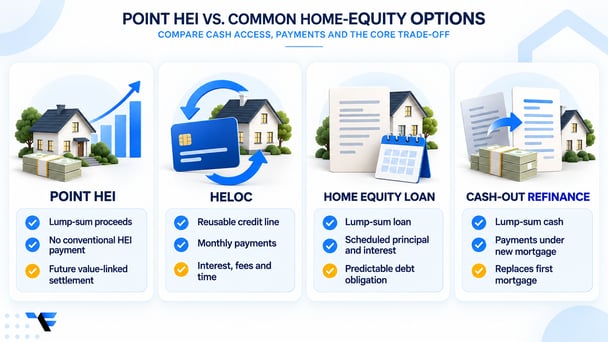
| Product | Basic structure | Repayment | Main consideration |
|---|---|---|---|
| Point HEI | Upfront cash under a home equity investment agreement | Future lump-sum settlement | Contractual settlement is linked partly to home value |
| Point HELOC | Home-secured revolving line of credit | Monthly payments and interest | Terms depend on the applicable credit agreement |
| Home equity loan | Closed-end loan secured by the home | Scheduled principal and interest | Predictable debt obligation, but monthly payments apply |
| Cash-out refinance | New mortgage replaces the existing mortgage and provides cash | Payments under the new mortgage | Changes the terms of the first mortgage |
Point’s HEI should therefore not be treated as another name for a HELOC or home equity loan. Once you know which product you are considering, use the more precise term: Point HEI or Point HELOC.
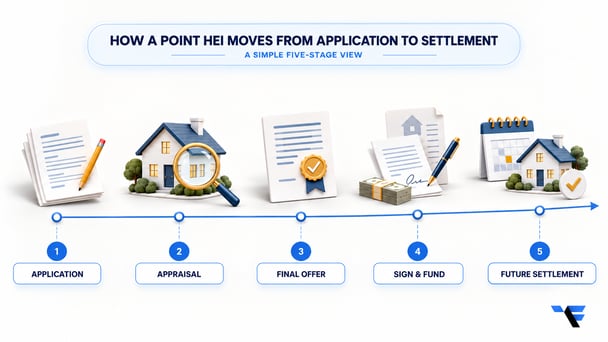
Point allows homeowners to begin with an online prequalification process. Its current HEI page says homeowners can see whether they qualify without needing to pay an application fee. Prequalification is not a guarantee of final approval or a final offer.
The final terms depend on the property, existing liens, title, equity and other information reviewed during the application.
Point reviews the property and homeowner information before finalizing an offer. Its current eligibility requirements say the homeowner must be on title and that all owners must sign at closing. Point also considers existing liens and the amount of equity remaining after the investment
The home’s value is an important part of the transaction. Point says it uses an independent third-party appraisal to establish the property’s initial value. That figure is then used to determine an Appreciation Starting Value, which is lower than the appraised value.
This distinction is important because the Appreciation Starting Value becomes part of the calculation used when the HEI is eventually settled.
Before signing, review the actual numbers and terms in the agreement, including:
Rather than a general description of an HEI, these terms determine what your transaction will actually cost.
After the agreement is finalized, the documents are signed and Point secures the HEI with a lien on the property. Fees may be deducted from the transaction, which means the amount shown as the investment is not necessarily the same as the net amount deposited into the homeowner’s amount.
This is the part that makes an HEI different from a traditional home equity loan. There is not a single payoff amount that applies to every Point customer. The settlement depends on the specific agreement and factors including:
The Appreciation Starting Value deserves particular attention. Because it is lower than the initial appraised value, the appreciation calculation does not simply compare the home’s original appraisal with its eventual sale or settlement value.
Point also says that if the home’s value falls below the Appreciation Starting Value, it shares in the loss. Conversely, if the property appreciates substantially, the Homeowner Protection Cap limits the amount that can be repaid under the applicable agreement.
The cap is therefore a protection against an unlimited settlement, but it does not mean an HEI will necessarily be inexpensive.
For a real transaction, use the figures in your Point offer and the current Point cost estimator rather than applying a generic formula. The signed agreement controls the actual settlement.
Point currently says an HEI can be settled at any time during its 30-year term. Repayment can occur through a home sale, refinance, home-equity financing, personal funds or another permitted route. Point also uses the term “buy back” when describing early settlement of the homeowner's equity.
Older Point agreements can have a different term, including a 10-year term, so homeowners should rely on their signed agreement rather than assuming every HEI has identical terms.
The practical process generally involves:
If you are considering a refinance, address the HEI early in the process. The existing lien and settlement requirement can affect how a future transaction is structured, and a future lender may have its own requirements.
The cost of a Point HEI should be viewed as more than an upfront processing fee.
Point currently describes a processing fee of up to 3.9%, subject to a $2,000 minimum, along with certain third-party costs. The applicable transaction can involve expenses related to valuation, title and other closing requirements.
But the larger economic question may be what happens when the HEI is settled.
Because Point receives a contractual share tied to changes in the home's value, a homeowner who holds the agreement while the property appreciates may give up part of that future appreciation. That is the opportunity cost of receiving cash today without taking on a conventional monthly loan payment.
This is why comparing an HEI with a HELOC using only an interest rate can be misleading. Instead, compare:
The CFPB has similarly noted that home equity contracts can be difficult to compare because companies use different methodologies for calculating repayment and disclosures are not standardized.
You can also compare the structures in TFG's guide to HEI vs. HELOC vs. home equity loan.
Point's current HEI eligibility page says the property must be in an eligible state or region and have a value of at least $155,000. It adds that homeowners generally need to retain significant equity after the investment, usually 27% or more, and that it reviews the homeowner's credit history with a minimum credit score of 500. Recent bankruptcies and foreclosures can also be subject to waiting periods.
Point currently describes its HEI as available to homeowners with a broad range of credit profiles and says there are no income requirements for the HEI. That does not mean the application is based on no financial review; Point still reviews credit history, property information and other eligibility criteria. It’s current HEI page advertises access of $30,000 to $600,000, subject to qualification and the property's available equity. State and property availability can change, so prospective applicants should check Point's current eligibility information for their location rather than relying on an older list.
The lack of monthly HEI payments can be useful for cash flow, but it shifts the financial obligation into the future.
With a traditional loan, the interest rate, balance and payment schedule give you a clearer picture of what you will owe. An HEI settlement depends partly on the home's future value, so the final amount is not fully known at closing.
The Appreciation Starting Value can be lower than the initial appraisal. That difference affects how appreciation is measured and therefore how much may ultimately be owed.
There may be no monthly HEI payment, but the agreement still has to be settled. A homeowner who wants to remain in the property may need to refinance, use other home-equity financing or liquidate other assets.
The CFPB specifically notes that homeowners with home equity contracts may face difficulty refinancing or may need to sell the property if they cannot otherwise fund the settlement.
Because the HEI is secured by a lien, it needs to be considered when you later refinance or obtain another loan against the property.
An HEI does not transfer the ordinary responsibilities of homeownership to Point. You remain responsible for the mortgage, taxes, insurance, maintenance, HOA dues and other applicable property costs.
The agreement determines how the property's value is established at settlement and how issues such as improvements, property condition or valuation disputes are handled. Read those provisions before signing.
Do not assume that HEI proceeds or settlement payments receive the same tax treatment as conventional mortgage debt or interest. Tax treatment can depend on the specific transaction and your circumstances, so a qualified tax professional or attorney should review your agreement.
| Factor | Point HEI | HELOC | Home Equity Loan | Cash-Out Refinance |
|---|---|---|---|---|
| Cash access | Lump sum | Reusable line | Lump sum | Lump sum |
| Monthly payment | No conventional HEI payment | Yes | Yes | Yes |
| Interest | No HEI interest accrual | Interest applies | Interest applies | Interest applies |
| Future appreciation | Shared according to contract | Generally retained by homeowner | Generally retained by homeowner | Generally retained by homeowner |
| Existing first mortgage | Usually remains | Usually remains | Usually remains | Replaced |
| Main cost driver | Contract settlement and home value | Interest, fees and time | Interest, fees and term | New mortgage rate, balance, fees and term |
| Main risk | Uncertain settlement and lien | Rate and payment changes | Ongoing monthly obligation | Changes the terms of the first mortgage |
A HELOC provides reusable access to home equity and typically requires monthly payments. The CFPB describes it as an open-end line of credit secured by the home.
A home equity loan provides a specific lump sum secured by the home and generally involves scheduled payments.
A cash-out refinance replaces the existing mortgage with a new mortgage and provides additional cash from the transaction. This can make sense in some situations, but it means reconsidering the rate, balance, term and costs of the entire first mortgage.
TFG's HELOC guide explains the mechanics of a HELOC, while its guide to HELOC approval factors explains the factors lenders may review.
A Point HEI may be worth investigating if you:
You may want to compare alternatives more carefully if you:
The same feature can help one homeowner and create a disadvantage for another. The right question is not whether an HEI is universally better or worse, but whether its cost and repayment structure fit your situation.
Before signing a Point HEI, make sure you can answer:
The most useful way to evaluate Point loans is to compare the actual economics rather than the product labels.
If you need a specific amount of cash, compare what you would receive through a Point HEI with what the same cash need would look like through a HELOC, home equity loan or cash-out refinance. Consider the monthly payment, upfront costs, expected time before repayment, potential home appreciation and how you would eventually settle the balance or obligation.
TFG's comparison of HEI vs. HELOC vs. home equity loan can help frame that decision, while its HELOC guide provides more detail on the conventional credit alternative.
A TFG loan review is separate from Point's HEI and does not imply a partnership, endorsement or access to Point's HEI. The goal is simply to help homeowners compare available ways to use their home equity and understand the costs and obligations attached to each one.
When considering Point loans, look beyond the amount of cash offered today. The more important question is what that cash may cost you later, how your home's future value affects the settlement, and whether you have a realistic plan for repaying the obligation.
Point offers multiple home-equity products, including an HEI and a separate HELOC. The HEI is structured as a home equity investment rather than a conventional loan, while the HELOC is a credit product with its own repayment and interest terms.
The homeowner remains the owner and retains the right to occupy the property. The HEI is secured by a lien and gives Point a contractual economic interest based on the agreement rather than immediately transferring title to part of the home.
Point's current HEI does not require conventional monthly payments or accrue interest like a traditional loan. Instead, the homeowner settles the agreement later, with the amount determined under the contract.
The amount depends on the agreement. The calculation can involve the original investment, Appreciation Starting Value, HEI percentage, ending home value and applicable Homeowner Protection Cap.
Point currently says homeowners can settle the HEI at any time during the 30-year term without a prepayment penalty. Older agreements can have different terms, so the signed agreement controls.
Refinancing can be one way to settle an HEI, but the existing lien and required settlement need to be addressed. A future lender's approval is not guaranteed.
Point says it shares in losses when the home's value falls below the Appreciation Starting Value. The exact settlement depends on the terms of the agreement.
The agreement requires settlement by the applicable deadline. If you cannot provide the required funds, you may need to sell the property, obtain financing or use another permitted source of funds. Because the HEI is secured by a lien, default can put the property at risk.
Point currently says it uses an independent third-party appraisal as part of establishing the property's initial value.
Point states that its HEI is secured by a lien and that default under the agreement can lead to enforcement rights. Homeowners should review the agreement's default and enforcement provisions carefully rather than assuming that a lien carries no consequences.
There is no blanket answer that applies to every homeowner. Tax treatment depends on the transaction and individual circumstances, so consult a qualified tax professional about your specific agreement.
Not automatically. An HEI avoids the conventional monthly payment and interest structure but gives Point a contractual share of future home value and creates a future settlement obligation. A HELOC requires monthly payments and interest but generally allows the homeowner to retain future appreciation.



Take your pick of loans
Experience a clear, stress-free loan process with personalized service and expert guidance.
Get a quote

26 min
.png?width=352&name=Blog%20covers%20(3).png)

15 min
.png?width=352&name=Blog%20covers%20(6).png)

10 min
Discover your borrowing power and plan your mortgage journey with knowledge on your side.
Get a quoteGet a quote in 3 easy steps
Tell us what you want
Fill out our online form to help us understand your financial situation and loan needs.
We get to work for you
We review your info and look for competitive rates that match your specific goals.
You get a personalized quote
You’ll receive a customized rate quote that meets your unique profile.