.svg)



%20(1).svg)
%20(2).svg)
.png?width=480&height=420&name=Img%20(1).png)
%20(3).svg)
%20(4).svg)

%20(5).svg)


 View all states

18 mins

In this blog
Your Home Is An Asset, Not An ATM
Home equity is the portion of your home you truly own, the difference between your home’s market value and what you owe on your mortgage.
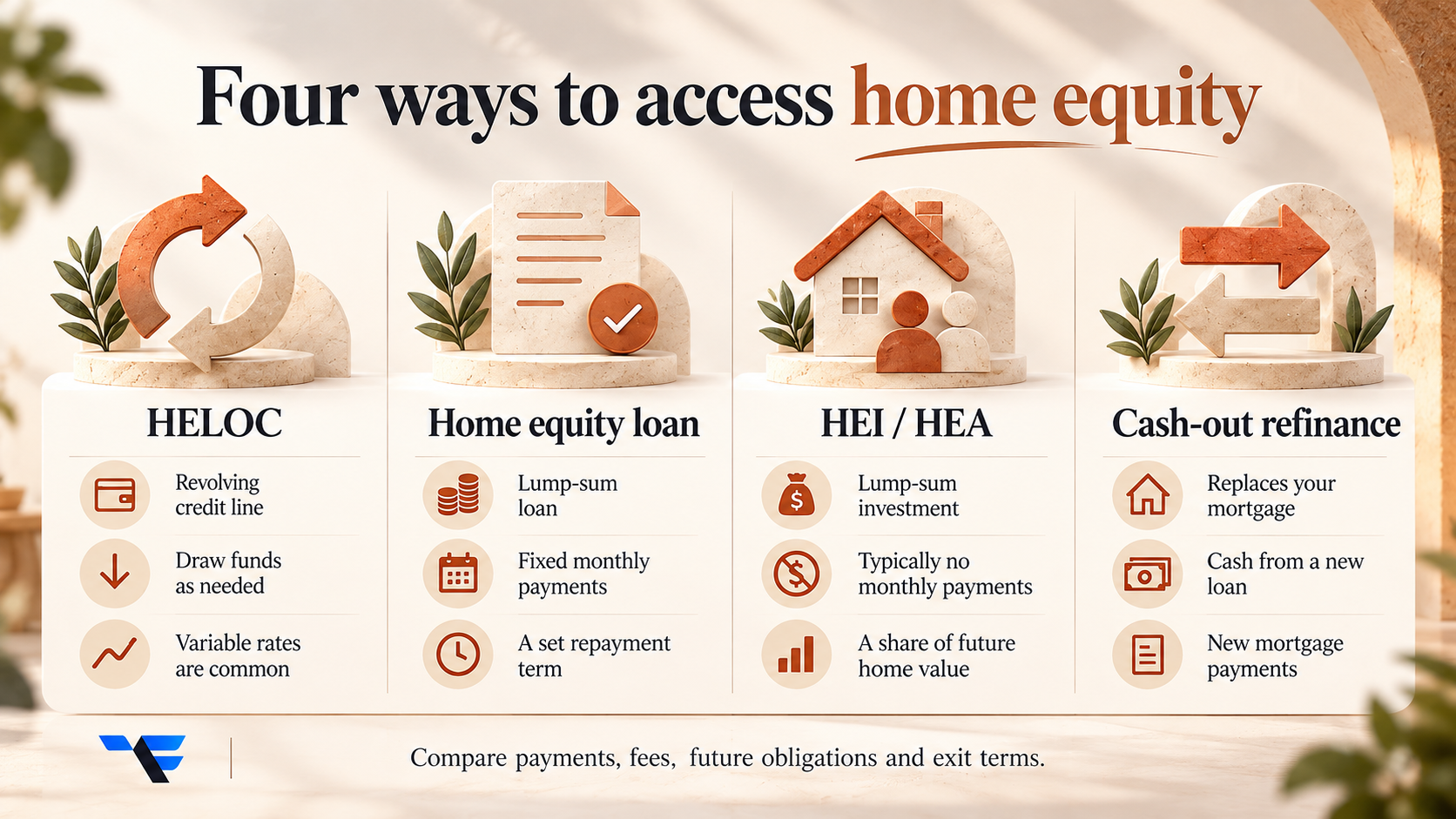
There are four main ways to tap that equity: a home equity loan, a home equity line of credit (HELOC), a home equity investment (HEI/HEA), or a cash-out refinance.
On paper, each option turns equity into cash, but the trade-offs are very different. With a HELOC or home equity loan, you borrow against your equity and keep 100% of your home’s future appreciation. With a home equity investment HEI, you get cash with no monthly payments, but you give an investment company a claim on your home’s future value.
This guide will walk through hei vs heloc and home equity loan vs home equity investment so you can see the real cost of “quick cash now” versus protecting your long-term wealth and control.
How Truss Financial Group Thinks About Home Equity
Truss Financial Group specializes in flexible, non-QM home equity solutions, especially home equity line of credit (HELOC) products and related options for self-employed borrowers, investors, and homeowners who don’t fit traditional bank rules.
Our starting point is simple: whenever possible, we want borrowers to access the equity they need while keeping full ownership of their home’s future growth. That’s why this guide leans toward HELOCs and home equity loans as first-line tools, and treats HEIs as a niche, last-resort option when standard financing truly isn’t available.
Quick Snapshot: HEI vs HELOC vs Home Equity Loan vs Cash-Out
At-a-Glance Comparison Table
| Product | How You Get the Money | Monthly Payments Required? | Typical Credit Score & Income Needs | Key Risks |
|---|---|---|---|---|
| HELOC (Home Equity Line of Credit) | Revolving credit line you draw from as needed | Interest-only during draw period, full payments later | Usually 620+ credit score, verifiable income | Variable interest rate changes, payment shock after draw period, foreclosure risk |
| Home Equity Loan | Lump sum at a fixed interest rate | Yes, fixed monthly principal + interest | Usually 620+ credit score, stable income | Higher monthly obligations, foreclosure risk, closing costs |
| Home Equity Investment (HEI/HEA) | Lump sum from an investor in exchange for a share of future home value | No monthly payments | Flexible credit; softer income requirements | “Shared appreciation” costs, expensive buyout, refinance limitations |
| Cash-Out Refinance | New mortgage replacing the old one, gives a lump sum | Yes, new monthly mortgage payment | Strong credit and income required; must qualify for full new loan | Higher interest rate, resets entire loan term, closing costs, foreclosure risk |
This snapshot shows the basic differences, lump sum vs revolving credit line, monthly payments vs no payments, and who keeps your future home value. The rest of this guide breaks down long-term costs, interest rate risks, credit score requirements, and how each option impacts your ability to refinance or sell later.
Home Equity Basics (Context for All Options)
What Is Home Equity And Available Equity?
Home equity is the portion of your home you truly own. It’s calculated by taking your home’s market value and subtracting your current mortgage balance. The higher your home’s value and the lower your loan balance, the more equity you have.
Mortgage lenders and HEI providers use this equity to determine how much money you can access. They look at your combined loan-to-value ratio (combined LTV), the percentage of your home’s value already tied up in mortgages or liens.
Your available equity is whatever remains below the lender’s or investor’s maximum LTV limit. This available equity becomes the starting point for a HELOC, home equity loan, HEI agreement, or cash-out refinance.
How Lenders And Investors Look At Your Home
Before offering any product, a mortgage lender or HEI provider will review your home’s value through an appraisal. Traditional lenders typically use the full appraised value to calculate loan amounts, while HEI companies often apply a risk-adjusted value, a discounted version of your home’s market value to protect themselves against price declines.
Both lenders and HEI providers also cap how much equity you’re allowed to access, keeping total combined LTV within safe limits. This ensures the homeowner doesn’t over-leverage the property and helps maintain long-term stability regardless of which option you choose.
What Is A Home Equity Loan?
Home Equity Loan (Second Mortgage) Explained
A home equity loan is a lump-sum second mortgage with a fixed rate and a set repayment term. You receive all the funds upfront and repay the loan through fixed monthly payments. Homeowners typically use a home equity loan for single large expenses, consolidating debt, or financing major home improvements.
Pros Of A Home Equity Loan
A home equity loan offers predictable fixed payments and a fixed interest rate, making budgeting straightforward. Rates are often lower than unsecured personal loans or credit cards, and you keep 100% of your home’s future appreciation, since you’re borrowing, not selling your equity.
Cons Of A Home Equity Loan
Because payments start immediately, the monthly principal and interest can increase your overall debt load. The home is collateral, so missed monthly payments carry foreclosure risk. Home equity loans also involve closing costs and fees, and they’re not ideal if you need flexible, stop-and-start access to funds rather than a single lump sum.
What Is A HELOC (Home Equity Line Of Credit)?
HELOC 101 – A Revolving Line Of Credit Secured By Your Home
A HELOC (Home Equity Line of Credit) is a revolving credit line secured by your home. It has two phases: a draw period, when you can borrow, repay, and borrow again; and a repayment period, when the line closes and you start paying back the remaining balance in full monthly installments. Most HELOCs have a variable interest rate, and you only pay interest on the amount you actually borrow.
Pros Of A HELOC
A HELOC gives you flexible access to funds over time, making it useful for projects, emergencies, or long-term expenses. During the draw period, many lenders allow interest-only payments, which keeps early cash-flow pressure low. HELOCs are often cheaper than personal loans or credit cards for larger balances. And when used for qualifying home improvements, interest may be tax-deductible (consult a tax professional).
Cons Of A HELOC
Because rates are variable, your payments can rise over time. A HELOC is secured by your home, meaning missed payments carry foreclosure risk. Lenders typically require stronger credit, stable income, and a lower debt-to-income ratio to qualify.
The HELOC Variants Truss Financial Group Focuses On
Truss Financial Group offers several specialized home equity line of credit options designed for borrowers who don’t fit traditional lending rules. All of these HELOC structures allow you to access funds while keeping 100% of your home’s future appreciation.
No-Tax-Return HELOC (Bank-Statement HELOC): Built for self-employed borrowers who have strong cash flow but non-traditional paperwork. Income is evaluated through bank statements rather than tax returns.
No-Appraisal HELOC: In eligible states, this option removes the appraisal requirement, allowing homeowners to open a line of credit HELOC faster and with fewer steps.
Investor HELOC: Designed for DSCR and rental property owners who want flexible capital for renovations, acquisitions, or portfolio management. Uses property cash flow rather than W-2 income.
Senior HELOC (Non-Reverse): A fit for older homeowners who want access to equity without giving up homeownership, avoiding the complexity of reverse mortgages.
Across all these products, borrowers benefit from the same core HELOC structure, revolving credit, a draw period, a repayment period, a flexible credit limit, and access to funds at a variable interest rate through trusted HELOC lenders.
What Is A Home Equity Investment (HEI / HEA)?
Home Equity Investment (HEI) – Cash Today For A Slice Of Your Home’s Future
A home equity investment (HEI/HEA) gives you a lump sum from an investment company in exchange for a share of your home’s future appreciation. It is not a loan, there’s no interest rate, no revolving credit line, and no repayment schedule during the term. Most HEIs require no monthly payments, with repayment due when you sell the home, buy out the investor, or reach the end of the investment term (typically 10–30 years).
How Home Equity Investments Work In Practice
The process starts with an application and a property appraisal. Unlike lenders, HEI companies may use a risk-adjusted home value, which is a discounted version of your appraised value. Based on that number, they make an offer and set the share of future appreciation the investor shares in. They also cap how much equity you can access, keeping combined LTV within their limits.
To exit a home equity agreement, you can:
- Sell the home and pay the investor from the proceeds
- Refinance or take a new HELOC/home equity loan to buy out the investor
- Pay the buyout amount in cash if you have the funds
Pros Of Home Equity Investments
- No monthly payments, making HEIs appealing when cash flow is tight.
- More flexible underwriting with lower credit score and income requirements.
- If your home’s value declines, the investor absorbs part of the loss.
Cons Of Home Equity Investments
- If your home appreciates, the buyout can become very expensive compared to HELOCs or loans.
- HEIs can limit refinancing options; some mortgage lenders won’t allow a new loan behind an active HEI.
- Not available in all states or for all property types.
- Typically no tax benefits, since it’s not treated like traditional loan interest.
HEI vs HELOC vs Home Equity Loan: Cost Comparison
Short-Term Monthly Cost vs Long-Term Total Cost
A HELOC or home equity loan creates an immediate monthly-payment obligation. You’re committing to interest-only payments during the draw period for a HELOC, or full principal-and-interest payments with a home equity loan. This affects short-term cash flow but keeps all future appreciation in your hands.
A home equity investment (HEI) feels cheaper upfront because there are no monthly payments. The real cost shows up later, when you sell the home or buy out the investor. That future buyout is tied directly to how much your home appreciates, which can make an HEI far more expensive in the long run.
Scenario Example – The Value Gap Between HEI And HELOC
Here’s a simplified illustration of how costs diverge:
Home value today: $600,000
Existing mortgage: $300,000
Amount accessed: $100,000
Home value growth: 5% per year for 10 years
HEI: If the home grows over 10 years, it could be worth roughly $975,000. An HEI provider taking a share of the appreciation might require a buyout of around $160,000 for the same $100,000 received upfront.
HELOC:With a HELOC, you keep all the appreciation. Even with a variable interest rate over the full term, total interest paid might fall in the $70,000–$80,000 range, depending on rates and repayment timeline.
This example is only an illustration, but it highlights the core difference: HEIs look inexpensive in the short run, while HELOCs and home equity loans can be far less costly over time because you’re not trading away your home’s future value.
Fees, Closing Costs, And Risk Adjustments
HELOCs and home equity loans typically come with closing costs and fees, such as origination charges, appraisal fees, recording fees, or early-closure penalties. These add to the upfront cost, but they don’t affect your future home value or ownership stake. Your long-term financial impact comes mainly from interest charges and interest accrual over the life of the loan, similar to any other form of secured credit or high-interest debt you’re trying to replace.
Home equity investments work differently. Instead of traditional fees, many HEI providers apply a risk-adjusted valuation, discounting your appraised value by 10–15% before calculating how much equity they’ll share. This lower valuation effectively charges you upfront, because you receive less than your home’s true market value while still giving up a share of its future appreciation.
The structure can look fee-free on the surface, but the long-term financial impact often appears at the buyout stage, when the investor’s share is taken from your increased home value and no tax benefits apply, since an HEI isn’t treated as a loan.
Qualification Comparison (Credit Score, Income, and Risk)
Who Qualifies For What?
HELOC And Home Equity Loan Requirements
Most lenders expect a minimum credit score of around 620+, with higher scores needed to secure better interest rates. A full credit check, income verification, and review of your debt-to-income ratio are standard. Lenders also look at your combined LTV to decide how much equity you can access, if your financial situation is strong, you may qualify for a larger loan or credit line.
HEI Requirements
A home equity investment (HEI) typically has more flexible entry criteria. Providers often accept lower minimum credit scores and place less emphasis on traditional income documentation. This flexibility, however, comes with a higher effective cost and more complex long-term obligations tied to your home’s future value and cash flow needs
How Each Option Affects Your Credit Profile
HELOCs and home equity loans report to your credit report like any other loan. On-time payments can strengthen your score, while missed payments can damage it and put your home at risk.
HEIs generally don’t report monthly activity because there are no monthly payments, so they won’t help build credit. They also won’t penalize you for late payments, though the long-term financial impact can be far greater at the time of buyout.
Who Really Owns Your Future Home Value?
Repayment And Exit With HELOC And Home Equity Loans
With a HELOC or home equity loan, you control the repayment timeline. You can pay down the remaining balance early, refinance your primary mortgage, or simply follow the scheduled payments through the repayment period.
The main caution is the payment shock that can occur when a HELOC’s draw period ends and full principal + interest payments begin. But even then, the homeowner maintains complete ownership of their future home value.
Repayment And Exit With HEIs
A home equity investment requires a balloon-style repayment. You must settle the agreement when the investment term ends, when you sell, or when you refinance. If you cannot buy out the investor, you may feel pressure to sell or refinance on their timeline, not yours. The more your home appreciates, the more expensive this buyout becomes, since you are giving up a share of future value.
Using Cash-Out Refinance To Exit An HEI
Some homeowners eventually use a cash-out refinance or a new HELOC to refinance an active HEI and buy out the investor. While this can restore full ownership, it depends heavily on future interest rates and lending standards. If rates rise or guidelines tighten, replacing an HEI with a traditional loan may become more expensive, or not possible at all.
Decision Guide: Which Option Fits Your Situation?
Start With Your Priorities: Cash Flow vs Ownership vs Cost
When A HELOC Is Usually The Better Fit
A HELOC tends to work best when you have a 620+ credit score, stable, verifiable income, and you want flexible access to cash over time instead of a single lump sum. You keep 100% of your home’s future appreciation, and you’re comfortable handling variable interest rates and at least interest-only payments during the draw period
When A Home Equity Loan Makes Sense
A home equity loan is ideal when you need a single large, predictable amount, like funding a major remodel or consolidating high-interest debt. You get fixed payments, a fixed rate, and a structured payoff schedule, which works well if you can handle the increased monthly obligations.
When An HEI Might Be A “Last-Resort” Tool
A home equity investment is typically reserved for situations where traditional financing is out of reach. If your credit score or income makes a HELOC or loan difficult to qualify for, and you must avoid new monthly payments, an HEI may fill the gap. But you must clearly understand that you’re trading future home value and control for cash today.
Why Truss Financial Group Prioritizes HELOCs Over HEIs
Truss Financial Group focuses on helping homeowners keep full ownership of their future appreciation while still accessing the equity they need. TFG’s expertise with self-employed borrowers, real estate investors, and seniors allows us to offer tailored HELOC solutions that fit real-world financial situations, without the long-term cost of giving up home value to an investor
Truss Financial Group Solutions: HELOC Options Built Around Real-World Use Cases
Matching The Right HELOC To The Right Borrower
Self-Employed And 1099 / Business-Owner HELOCs
For many self-employed borrowers, tax returns don’t reflect true cash flow. TFG offers bank-statement / no-tax-return HELOCs, allowing business owners to qualify using deposits instead of traditional income documentation.
(Internal link: /no-tax-return-home-equity-line-of-credit)
Investor HELOCs For DSCR And Rental Properties
Real estate investors can use Investor HELOCs to access equity from rental or DSCR-qualified properties without selling or tapping personal savings. The goal is to unlock capital while keeping long-term upside in the portfolio.
Senior HELOCs For Older Homeowners
A Senior HELOC provides access to home equity without giving up ownership offering a flexible alternative to reverse mortgages or HEIs. It’s a cleaner way for seniors to manage expenses while maintaining full control over their home’s value.
No-Appraisal And Digital-First HELOC Flows
Where available, TFG supports no-appraisal HELOCs and streamlined digital processes to speed up approvals. These fast-track options help homeowners access equity without long wait times, subject to state and underwriting limitations.
FAQ: Straight Answers To “HEI vs HELOC” Questions
What is the difference between a home equity investment and a home equity loan?
A home equity investment (HEI) gives you a lump sum in exchange for a share of your home’s future appreciation. A home equity loan is a fixed-rate, lump-sum loan you repay through monthly payments. With a loan, you keep 100% of your future home value; with an HEI, an investor takes a portion.
Which is better, a HELOC or an HEI?
For most qualified homeowners, a HELOC is better because you keep full ownership of future appreciation and only pay interest on what you borrow. A HEI is usually a last-resort option when you cannot qualify for a loan or line of credit and need to avoid monthly payments.
What is the downside to a home equity investment (HEI / HEA)?
The main downside is cost. If your home appreciates, the buyout can be very expensive, because the investor takes a share of that growth. HEIs can also complicate refinancing and limit future loan options.
What are the pros and cons of a HEI loan vs a HELOC?
A HEI has no monthly payments and flexible credit requirements, but you give up part of your future home value and face a large buyout later. A HELOC requires payments and stronger credit but is usually far cheaper over time and keeps appreciation fully yours.
Who is a HEI best for?
An HEI is best for homeowners who cannot qualify for a HELOC or home equity loan, need to avoid new monthly payments, and are willing to trade future appreciation for cash today.
Does a home equity investment affect my credit score?
HEIs typically do not report to your credit file. They won’t help you build credit, but they also won’t reduce your score because there are no monthly payments.
Can you refinance or get a new HELOC if you already have an HEI?
Sometimes, but not always. Many lenders are cautious about issuing a new loan behind an active HEI, which can limit refinancing or HELOC options. You may need to buy out the HEI before a lender will approve a new loan.
What credit score do you need for a HEI-style product vs a HELOC?
HEIs generally allow lower minimum credit scores and more flexible income requirements. HELOCs typically require a 620+ credit score, verifiable income, and a stronger overall financial profile.
Don’t Sell Your Future For A Short-Term Fix
See What A HELOC Could Look Like For You
Before giving up a share of your home’s future, run the numbers. Use our HELOC and home equity scenario calculator to compare monthly payments, long-term costs, and how much appreciation you keep versus an HEI-style equity share.
If you want help deciding how to access equity in a way that aligns with your financial goals, you can schedule a quick consult with a Truss Financial Group specialist.
Talk To A Human Before You Sign Anything
A home equity decision is a major personal finance choice. Speak with a loan officer or financial advisor before committing to any HEI or long-term agreement. TFG can break down the side-by-side numbers for a HELOC, home equity loan, cash-out refinance, or any HEI offer you're reviewing, so you understand the true cost and keep control of your financial future.

.svg)

Discuss your unique requirements
Get direct answers and a roadmap for your future.
.png?width=202&height=202&name=image%20588255187%20(1).png)







.svg)

.svg)
.svg)