.svg)



%20(1).svg)
%20(2).svg)
.png?width=480&height=420&name=Img%20(1).png)
%20(3).svg)
%20(4).svg)

%20(5).svg)


 View all states

17 mins

In this blog
You’ve built up equity in your home. Now you need cash, but taking on another monthly payment doesn’t sound great. That’s where a home equity agreement can enter the picture.
A home equity agreement gives you an upfront cash payment in exchange for a future settlement tied partly to your home’s value. There’s usually no conventional monthly principal-and-interest payment to the provider, but that doesn’t mean the money comes without a cost. You’re making a trade: cash today in exchange for a contractual share of some future home value.
The eventual payoff can be substantial, and the agreement may be secured by a lien on your property. Published by Truss Financial Group, this article looks at how these arrangements work, what they can cost, where the risks show up, and how they stack up against a HELOC, home equity loan, cash-out refinance and other alternatives.
What Is a Home Equity Agreement?
A home equity agreement is a contract between a homeowner and a provider. The homeowner receives money upfront and agrees to make a future settlement based partly on what the home is worth later.
You’ll see these arrangements described by several names. Home equity investment, home equity contract, home equity sharing agreement, and shared equity agreement are some of the terms you may come across.
The biggest difference from a traditional home equity loan or HELOC is how you repay the money.
With a conventional loan, you borrow a specific amount and make scheduled payments that generally include principal and interest. A HELOC works more like a revolving credit line, with interest charged on what you borrow.
A home equity agreement works differently. The provider typically doesn’t receive ordinary monthly principal-and-interest payments. Instead, you settle the contract later, often when you sell the home, reach the end of the contract term, or choose an approved early buyout.
And you generally still own and occupy the property. You remain responsible for the existing mortgage, property taxes, homeowners insurance, maintenance, and other costs that come with owning a home.
The Consumer Financial Protection Bureau says home equity contracts commonly run for 10 to 30 years, although the term and the specific conditions attached to it vary by agreement.
How Does a Home Equity Agreement Work?
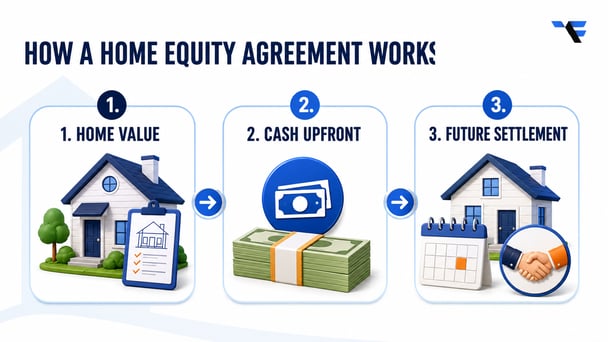
1. The Company Values the Home and Offers Cash
First, the provider needs to determine what your property is worth. That might involve a traditional appraisal, an automated valuation model, or another valuation method specified by the provider. The resulting figure becomes important because it can influence both the amount of cash offered and the future settlement.
Your home’s value isn’t the only thing being considered, though. Existing mortgage debt, available equity, the amount of cash you want, property characteristics, occupancy and the provider’s underwriting rules can all matter.
Keep three numbers separate when looking at an offer:
- Home value: The estimated or appraised value of the property.
- Existing mortgage balance: What you still owe on your current mortgage.
- Upfront cash payment: The amount you receive under the agreement.
2. The Contract Determines the Future Settlement
A home equity agreement doesn’t necessarily mean the provider simply takes a fixed percentage of your home’s appreciation. The settlement formula can be more involved. Depending on the contract, it may account for the upfront payment, starting home value, ending home value, an equity share, multiplier, valuation adjustment, cap or floor. There may also be specific rules for home improvements.
| Contract component | What it means |
|---|---|
| Starting value | The home value used when the agreement begins. This may differ from the full appraised value if an adjustment or discount applies. |
| Equity share or multiplier | Determines how the provider’s financial interest relates to the upfront payment, future home value, or appreciation. |
| Ending value | Usually the sale price or another valuation determined under the contract. |
| Cap or floor | A limit or minimum that can change the settlement amount. Not every agreement includes one. |
| Improvement adjustment | Explains how documented renovations are handled when determining the home’s final value. |
3. A Lien Is Placed on the Property
A provider generally records a property lien or other security instrument against the home. That can be easy to overlook when there’s no monthly payment. But the lien still matters.
Imagine that a few years from now you want to refinance your existing mortgage. Or perhaps you decide you need a HELOC. The home equity agreement may have to be settled, modified or otherwise addressed before the new financing can move forward. The same issue can come up when you sell the home.
4. Eventually, the Agreement Has to Be Settled
A sale of the home is one common settlement event. The end of the contract term is another. Some agreements also let homeowners buy out the provider earlier, subject to specific rules.
Other triggering events may apply depending on the contract. These can include default on a senior mortgage, unpaid property taxes or homeowners insurance, certain ownership transfers, occupancy violations or other contract breaches. Some agreements also have provisions dealing with death or extended absences.
Early settlement deserves a close look, too. You may be allowed to pay the agreement off early, but the calculation could be different from what you would owe at the normal end of the term. Partial payments may not be permitted.
How Much Does a Home Equity Agreement Cost?
Upfront Fees and Closing Costs
According to the CFPB, processing fees are often around 3% to 5% of the initial payment. That’s a reported range, not a universal rule. Your actual contract may be different. There can also be third-party expenses, including:
- Appraisal or valuation costs
- Property inspection fees
- Title-related expenses
- Recording charges
- Government taxes
- Other closing costs
The Long-Term Cost Can Be More Important
The bigger cost may not have anything that looks like an interest rate. Instead, the settlement formula determines what you eventually give back. If your home rises substantially in value, the provider’s contractual share can become much larger than the amount you initially received.
That’s why “no monthly payment” shouldn’t be confused with “low cost.” A better question is: How much cash do I receive today, and how much could I have to give up later?
Run the numbers at several possible future home values. Your house might appreciate slowly. It might appreciate quickly. It could even lose value. You want to know how the agreement behaves across those scenarios.
A CFPB Hypothetical Shows Why Home Value Matters
The CFPB has published a simplified example comparing a home equity contract with a HELOC. The numbers below are only a regulator hypothetical. They are not a Truss Financial Group quote, prediction or standard contract.
| Item | CFPB illustrative amount |
|---|---|
| Cash received | $50,000 |
| HELOC assumption | 9% rate with interest-only payments for 10 years |
| HELOC paid over 10 years | $45,000 interest + $50,000 principal = $95,000 total |
| Home equity contract settlement after 10 years | $94,074 to $215,892 across the CFPB’s home-price scenarios |
Actual HELOC rates, fees, and repayment terms vary. Home equity agreements vary too. So this example shouldn’t be used to predict what your own transaction would cost.
What Are the Risks of a Home Equity Agreement?
The Final Payment Can Be Large
Not having a monthly payment can feel like a huge relief, particularly when cash flow is tight. But the obligation hasn’t disappeared. It has been pushed into the future.
When the agreement ends, you may need a large lump sum. That could mean using savings, refinancing or selling the property, depending on what your contract permits and what your finances look like at that point.
You May Give Up More If the Home Appreciates
If your house rises a lot more than you expected, your payout can end up bigger than you planned. The exact settlement formula matters. You may be paid using what is true right now. Still, the provider might use part of tomorrow’s home price when it settles.
Refinancing May Get Harder
That lien entry can make later borrowing harder. When you want a refinance, a second mortgage, or a HELOC, you may need to handle the home equity deal first. This can shift when you can close, what you pay, and what choices you have. If you plan to refinance later, check the rule ahead of time. Do it before you sign, not after you need the money.
Valuation Disputes Can Matter
What your home is worth at the end also affects the settlement. Because of that, the valuation step is a big deal. Read the contract closely. Look for who orders the final appraisal. Look for how the home is valued. Also check what you can do if you disagree with the number. There may be extra rules if the sale is not in good standing.
Renovations Can Complicate the Math
Spending money does not always mean it lowers the amount the provider uses. Some deals reduce the settlement based on home work that is documented. Other deals may treat those costs in a different way. If you plan major renovations, learn how the contract counts them for the ending figure before you commit.
Occupancy and Maintenance Rules
Owning a home does not pause just because you have a different plan in mind. Day to day duties still show up. You may still be paying the mortgage each month. You may also need to handle property taxes, insurance, and repairs. Some agreements add extra limits too. For example, there can be rules about renting out the home, leaving for a long time, transferring ownership, or delaying repairs.
Default Could Put the Home at Risk
Certain things may set off a settlement step. The contract usually lists what counts. It can include missing a senior mortgage payment. It can also involve unpaid property tax bills. In some cases, an insurance lapse can be part of it. If the settlement amount is not paid when it is due, the fallout can be severe. The home may end up at risk. What happens next is based on the contract terms, plus state and federal rules that apply.
The Legal Treatment Isn’t Uniform
The wording, the required disclosures, and the limits can vary. That depends on how the deal is set up and where you live. Do not assume it is automatically covered or safe from lending rules. You also should not assume the same consumer rights apply in every case. With a long term commitment tied to your home, it can help to talk with a lawyer before you sign.
Home Equity Agreement vs HELOC
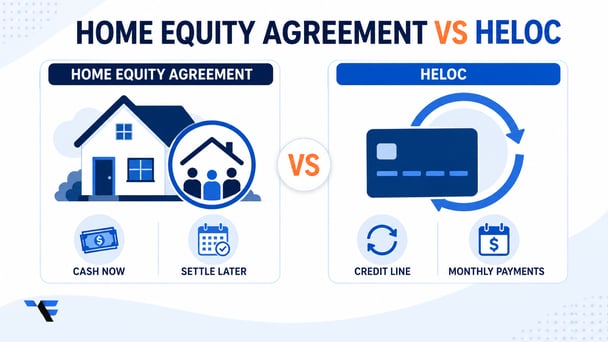
A home equity agreement can reduce the immediate monthly-payment burden, but you may give up some future home value. A HELOC requires payments, but its cost is generally based on the amount borrowed, interest and fees rather than a share of future appreciation.
| Feature | Home equity agreement | HELOC |
|---|---|---|
| Funds | Upfront cash payment | Revolving credit line |
| Monthly payment | Usually no conventional monthly payment to the provider | Payments are required after funds are drawn |
| Cost | Future settlement formula plus fees | Interest on the outstanding balance plus fees |
| Home appreciation | Provider may receive a contract-defined share or value adjustment | Homeowner generally keeps future appreciation |
| Rate certainty | No conventional interest rate, but future payoff can be uncertain | Often variable, so payments may change |
| Qualification | May put greater emphasis on property and equity, but rules vary | Typically considers equity, credit, income and ability to repay |
| Lien | Generally remains until the agreement is settled | Remains until the borrowed balance and applicable charges are repaid |
| Potential fit | Someone prioritizing payment relief with a realistic future payoff plan | Someone who can handle payments and wants flexible access to funds |
Truss Financial Group offers home-equity options for eligible homeowners, including a no-appraisal HELOC. Program availability, documentation, valuation requirements and terms can vary by state and individual circumstances.
HELOC Alternatives to Compare Before You Decide
A HELOC isn’t the only alternative to a home equity agreement. Depending on how much money you need and how long you expect to keep the property, other options may make more sense.
| Option | How it works | Main trade-off |
|---|---|---|
| Home equity loan | A second mortgage provides a lump sum with scheduled payments | Payments are generally more predictable, but you don’t get the same revolving flexibility as a HELOC |
| Cash-out refinance | Replaces the existing first mortgage with a larger mortgage and gives you the difference in cash | You change the terms of the entire first mortgage and may pay closing costs |
| Reverse mortgage or HECM | Eligible older homeowners can access home equity without required monthly principal-and-interest payments while program requirements are met | Age, occupancy, counseling, insurance, taxes, maintenance and the growing loan balance all matter |
| Personal loan or line | Unsecured borrowing primarily based on credit and income | Your home isn’t collateral, but borrowing limits or rates may be less favorable |
| Delay, save or reduce the project | Borrow less, save more or postpone the expense | It may lower financial risk, but the project or purchase has to wait |
You can also look at cash-out refinance options if replacing your existing mortgage makes sense. Eligible homeowners can also explore reverse mortgage options. Keep in mind that a HECM is a specific federally insured reverse mortgage program. It shouldn’t be treated as identical to every proprietary reverse mortgage product.
Is a Home Equity Agreement a Good Idea?
The right question isn’t whether home equity agreements are good or bad in general. It’s whether the particular agreement makes sense for your finances, your home, and what you expect to do with the property.
It may be worth comparing if you have significant home equity but adding another monthly payment would stretch your budget. It can also be an option to investigate if income or credit circumstances make conventional borrowing difficult and your property meets the provider’s requirements.
Be especially careful if you expect to stay in the home indefinitely and have no obvious way to fund the final settlement. The same goes if you expect strong home appreciation, plan major renovations, or think you may refinance, rent the property, or transfer ownership during the contract term.
And if you qualify for a conventional loan that you can comfortably afford and that has a lower projected total cost, compare it seriously. A zero-payment structure isn’t automatically the cheaper one.
What to Review Before Signing a Home Equity Agreement
At minimum, figure out:
- Your net cash: What remains after processing fees and third-party costs?
- The settlement formula: How do the starting value, valuation adjustment, equity share, multiplier, cap and floor interact?
- Different home values: What would the payoff look like if the property appreciates modestly, strongly or not at all?
- Different settlement dates: Does waiting longer materially change the amount you owe?
- Triggering events: What happens after a sale, transfer, senior-lien default, tax or insurance lapse, death or contract expiration?
- Early settlement: Can you buy out the agreement early? Are partial payments allowed?
- Renovations: How are homeowner-funded improvements treated?
- Occupancy: Can you rent the home or leave it for an extended period?
- Future financing: What happens if you want a HELOC, refinance, reverse mortgage or another loan?
- Total cost: How does the projected settlement compare with the APR, payments, fees and total cost of realistic loan alternatives?
Tax and Estate Questions to Resolve
Don’t assume the upfront payment is automatically tax-free. Don’t assume the eventual settlement is automatically deductible, either. The answer can depend on the agreement, how the money is used, and your individual tax situation.
For HELOCs and home equity loans, interest deductibility can also depend on how the borrowed funds are used and on applicable IRS rules and limitations.
Frequently Asked Questions
Is a home equity agreement a loan?
Not necessarily. A home equity agreement usually sets up a payout later that is linked to the home’s value. That is different from a typical loan that pays back a fixed principal plus interest each month. How the deal is treated under the law, and what consumer rules apply, can change. It depends on the exact language and where you live.
What happens if my home loses value?
It depends on how the payout is worked out. If the home drops in value, the amount due could drop in some setups. Other deals include a floor or a minimum return, or they use a different adjustment method. Do not assume the company eats all of the loss.
Can I pay off a home equity agreement early?
It might allow an early buyout. Even then, the buyout price may be figured in a way that does not match the normal schedule. In some cases, you can’t make partial payments. You need to read the part on early settlement and how it is priced.
Does a home equity agreement affect refinancing or selling?
Yes, it can matter a lot when you sell or refinance. Many of these agreements place a lien on the property. So you often have to clear it at closing. Before you plan any future financing, ask how the payoff works in practice.
Do I still pay property taxes, insurance and maintenance?
In most cases, the homeowner still has the ongoing duties. That can include property taxes, homeowners insurance, upkeep, and the current mortgage. The agreement may also add more property-related costs or rules.
What happens when the agreement term ends?
The agreement usually must be settled at some point. In your situation, you might cover it with cash you have saved, refinance the home, or sell the property to pay it off.
Is a home equity agreement cheaper than a HELOC?
There is no single rule that fits all cases. A HELOC usually includes interest and fees as you use it. A home equity agreement can involve upfront costs and then a later payment tied to the home’s value. Look at the real totals, not just a monthly figure.
Can I get a home equity agreement with low credit or irregular income?
It may be possible, but there’s no universal approval standard. Providers can consider the property, available equity, income circumstances, and other eligibility factors. Having substantial equity alone does not guarantee approval.
Next Steps for Comparing Home Equity Options
Get your documents ready before you start asking for offers. Have your last mortgage statement on hand. Also note your best guess for what the home is worth. Decide on the cash amount you want. Write down what you plan to use the money for.
It is also useful to figure out what monthly payment you can handle without strain. Think about how long you expect to keep the property. When you look at different offers, judge them in the same way each time. A home equity option might fix a cash-flow issue now. Still, make sure the added cost to your future equity is worth it.
Comparing a home equity agreement with a HELOC or refinance? Speak with a Truss Financial Group loan officer about the loan options available for your property, income profile, and payoff plan.

.svg)

Discuss your unique requirements
Get direct answers and a roadmap for your future.
.png?width=202&height=202&name=image%20588255187%20(1).png)







.svg)

.svg)
.svg)