.svg)



%20(1).svg)
%20(2).svg)
.png?width=480&height=420&name=Img%20(1).png)
%20(3).svg)
%20(4).svg)

%20(5).svg)


 View all states
%20(1)-1.png?width=40&height=40&name=image%20(65)%20(1)-1.png)
11 mins
In this blog
Picture two homeowners with the same amount of home equity sitting down to apply for a HELOC in the same week. One has a W-2, strong credit, and sails through a digital approval in days. The other is self-employed, has aggressive but legal write-offs, and gets flagged by every automated system, despite having a stronger actual cash flow than the first borrower.
The problem isn't the second borrower's financial strength. It's that most mortgage lenders only offer one underwriting path. If you don't fit it, you get declined.
Lenders like Truss Financial Group built its HELOC program around a different premise: one application, two paths, and a routing system that puts borrowers in the right lane from day one. This article breaks down exactly how each path works, who it's built for, and how to know which one fits your situation before you apply.
What Is a Digital HELOC and What Makes It Different?
A digital HELOC is a home equity line of credit where the entire process, application, income verification, appraisal, and closing, happens online. Unlike a traditional home equity loan that delivers a lump sum, a HELOC is a revolving line of credit.
You draw what you need, repay it, and draw again during the draw period. You only pay interest on what you actually use, and the variable interest rate means your payments adjust with the market rather than locking you into fixed loan terms from day one.
For many homeowners, this flexibility makes a HELOC a stronger option than personal loans or a second mortgage, particularly when the goal is ongoing access to funds rather than a one-time lump sum.
It's also worth noting that a HELOC carries a variable rate, so borrowers should factor that into their financial planning alongside any closing costs and loan limits tied to their home value.
What makes the digital path distinct is the infrastructure behind it:
- Instead of scheduling an in-person appraisal, lenders use an automated valuation model, a data-driven tool that estimates property value using comparable properties, recent appraisal data, and property location, without anyone setting foot inside
- Closing is handled through a remote online notary
- Income is verified digitally
The result is a process that can move from application to funding in days, not weeks.
Who It's Built For?
The digital path works best when three variables are all strong:
- Meaningful equity position: Most HELOC lenders set a combined loan-to-value limit, meaning the sum of your existing mortgage balance and the new credit limit can't exceed a set percentage of your home's current market value. Knowing how much equity you have before applying is the first step. The more equity you have, the cleaner the automated approval.
- Strong credit history: A minimum FICO score threshold applies on the digital track. Higher scores unlock better pricing and faster decision-making.
- Clean, documentable W-2 income with a low debt-to-income ratio, the kind an automated system can verify instantly through digital payroll and tax data.
If you're self-employed, carry K-1 distributions, or have Schedule C write-offs that compress your documented income below your real cash flow, the digital path will either decline the file or misprice it. That's not a reflection of your financial position. It's a limitation of what an algorithm can see.
How It Works: From Application to Funding?
The process moves quickly:
- Submit your application online and authorize a credit check
- Confirm your existing mortgage balance so the lender can calculate available home equity
- The automated valuation model runs in the background, with digital valuations replacing the traditional home appraisal process
- Underwriting approval comes back within 24 to 48 hours
- Closing documents are signed through a remote online notary
- Funds are accessible within days, with no physical inspection or drive-by appraisal required
If you fit the profile, there's no reason to sit through a longer process.
What Is the Hybrid HELOC and Why Does It Exist?
The hybrid HELOC uses the same digital front end as the fully digital path, same application, same intake process.
The difference is what happens next. Instead of a fully automated decision, the file moves to a human underwriter who can review the complete financial picture: bank statements, P&L documentation, asset depletion, compensating factors, and, for real estate investors, the property's debt-service coverage ratio.
Automated systems are fast, but rigid. A single soft variable, self-employment income, a recent credit event, or a tighter equity position can trigger a decline or punitive pricing even when the borrower's actual financial health is solid. The hybrid path exists because algorithms can't read context, and a manual underwriter can.
Who It's Built For?
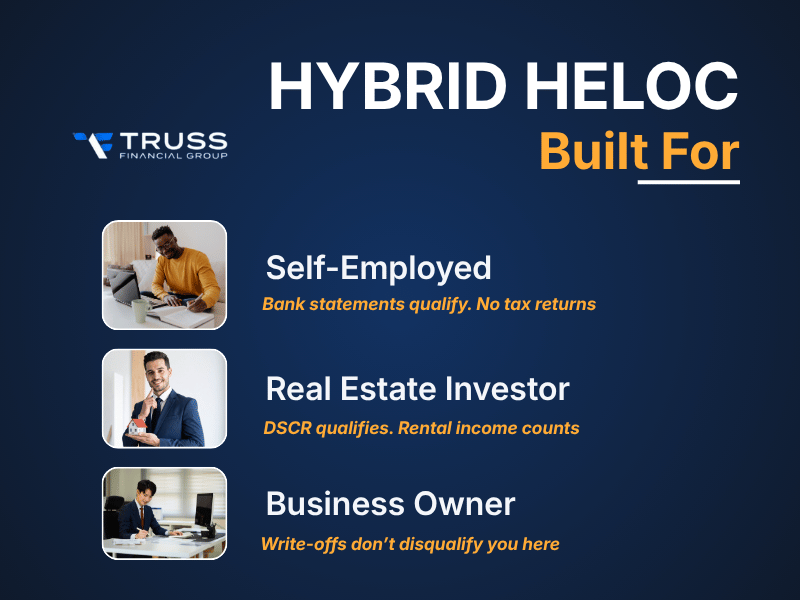
The hybrid path was purpose-built for borrowers whose financial strength doesn't show up cleanly in a digital system:
- Self-employed borrowers and business owners whose Schedule C deductions or K-1 distributions bring their documented income well below what they actually earn
- Borrowers who have used legal write-offs aggressively, a smart tax strategy that creates an income documentation problem for automated underwriting
- Real estate investors who want to qualify based on rental income through DSCR, rather than personal income verification, meaning the property's cash flow carries the file, not their tax returns
- Borrowers with a non-standard ownership structure, a recent credit event, or a slightly elevated combined loan-to-value that a human underwriter can evaluate with compensating factors
These aren't weak files. They're complex ones, and complexity is exactly what a manual underwriter is built to handle.
How It Works: From Application to Funding
The intake is identical to the digital path:
- Submit one application through the same digital front-end
- Truss runs the file against automated criteria
- If anything makes the digital path a poor fit, the file moves to a manual underwriter. No restarting, no duplicate paperwork
- The underwriter reviews what the algorithm couldn't see: real cash flow, reserve levels, payment history, market rent potential on investment properties, and any compensating factors that offset a soft variable
- Approval is based on the full financial picture, not just the documented income number
The timeline is slightly longer than the pure digital path, but meaningfully faster than traditional bank underwriting. For investors using the DSCR qualification, closings can happen in as little as 10 to 15 days, with access to credit lines up to $500,000, depending on home value and cash flow.
One application. Two possible outcomes. The borrower never has to start over.
How Truss Decides Which Path You're On
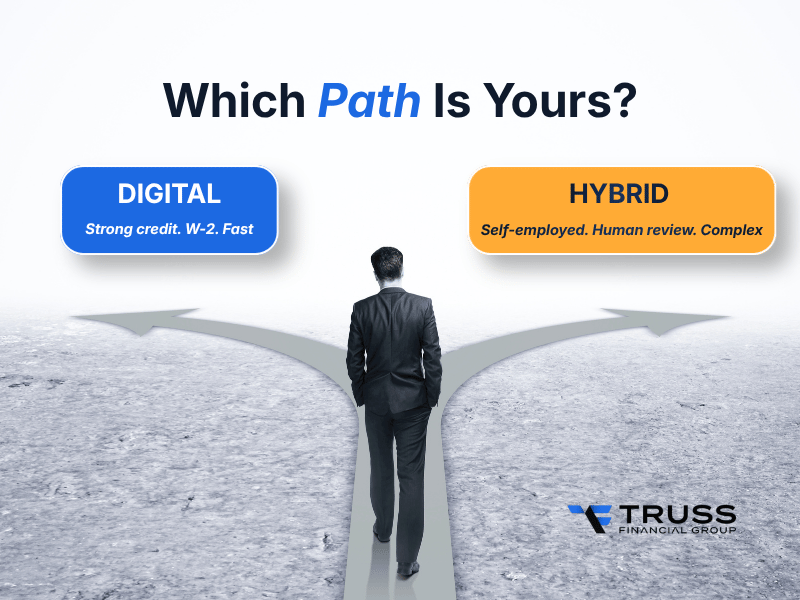
Most lenders offering a digital HELOC have one track. If you fit, you're approved. If you don't, you get a decline letter and a suggestion to try somewhere else.
Specialised lenders like Truss Financial Group were built differently. When you submit a single application, the file is evaluated against the digital criteria first. Strong equity, strong credit, clean documentable income, all three present, you're on the fast track. Any one of those variables soft, the file automatically moves to the hybrid manual underwrite.
Truss ranked as the #2 Non-QM lender nationally in 2025 precisely because the system is designed to find a yes for more borrowers, not just the ones who already fit a standard box. The routing decision happens internally. The borrower just applies.
Side-by-Side: Digital HELOC vs. Hybrid HELOC
| Feature |
Digital HELOC |
Hybrid HELOC |
|
Ideal borrower |
W-2 earner, strong credit, clean income |
Self-employed, investor, complex income |
|
Income documentation |
Digital verification or no doc |
Bank statement HELOC, P&L, asset depletion, DSCR |
|
Appraisal methods |
Automated valuation model, no in-person appraisal |
AVM or full appraisal, depending on the file |
|
HELOC appraisal cost |
Lower, no appraisal fees in many cases |
May include appraisal costs if a full review is needed |
|
Underwriting |
Fully automated |
Digital intake + human underwriter |
|
Funding timeline |
Days |
Slightly longer, faster than traditional lenders |
|
Credit flexibility |
Minimum FICO score required |
Manual review of the full credit picture |
|
Best used when |
All three qualification variables are strong |
Any one variable is soft or non-standard |
If the right column describes your situation more accurately than the left, the hybrid path is not a downgrade. It is the product built for you.
When the Digital Path Backfires?
 Choosing the wrong lane has real consequences. Three scenarios come up most often:
- The algorithm misprices the file. A self-employed borrower with excellent cash flow but heavy write-offs may technically receive approval at terms that don't reflect their actual creditworthiness. The system saw the documented income number, not the real one.
- The automated valuation model underestimates the property. If the AVM comes in below the home's current market value, the available home equity shrinks, and the credit limit drops. A manual underwriter can flag this and request a desktop appraisal or a full appraisal to correct the property valuation.
- A single soft variable kills an otherwise strong file. One recent credit event or a slightly elevated loan-to-value can stop an automated approval cold, even when reserves, payment history, and income all point to a creditworthy borrower. That's the exact profile a hybrid underwriter was built to approve.
None of these scenarios means the borrower doesn't qualify. They mean the borrower is in the wrong lane.
Frequently Asked Questions
What is the difference between a digital HELOC and a traditional HELOC?
A digital HELOC replaces in-person appraisals and paperwork with automated valuations and remote closings, cutting weeks to days.
Who qualifies for the fully digital HELOC path?
W-2 earners with strong credit, a solid equity position, and clean documentable income are the ideal fit for the digital track.
Can self-employed borrowers get a HELOC without tax returns?
Yes. The hybrid path qualifies self-employed borrowers using bank statements, P&L documentation, or asset depletion instead.
What is a no-appraisal HELOC, and how does it work?
An automated valuation model estimates home value digitally, eliminating the traditional HELOC appraisal process and reducing appraisal costs.
How does DSCR qualification work for a HELOC?
The property's rental income covers the debt obligation. No personal income verification, tax returns, or W-2s required.
How long does it take to get funded through each path?
The digital path funds in days. The hybrid path takes slightly longer. DSCR HELOC closings can happen in 10 to 15 days.
What happens if I apply and don't qualify for the digital path?
Truss automatically moves the file to the hybrid manual underwrite. No restarting, no duplicate paperwork required.
Does applying for a HELOC affect my credit score?
Yes. A hard inquiry causes a small temporary dip. On-time payments and responsible use improve your credit history over time.
Can I use a HELOC on an investment property?
Yes. Through the DSCR HELOC program, investors can access funds using rental income without touching their primary mortgage.
What can I use HELOC funds for?
Home improvements, debt consolidation, business expenses, investment property acquisitions, or flexible access to funds as needed.
Ready to Find Out Which Path Is Yours?
The right HELOC path isn't about which product sounds faster or simpler. It's about which one fits the actual shape of your income, your equity, and your credit profile.
The borrowers who get funded, and funded well, aren't always the ones with the cleanest files. They're the ones who applied through a lender that knew exactly which underwriting path to put them on from the first conversation.
Mortgage brokers like Truss Financial Group offer both paths, route borrowers correctly on day one, and were recognized as the #2 Non-QM lender nationally in 2025. Not because we fit borrowers into products, but because we built products that fit borrowers.

.svg)

Discuss your unique requirements
Get direct answers and a roadmap for your future.
.png?width=202&height=202&name=image%20588255187%20(1).png)



.jpg?width=389&height=221&name=Blog%20covers%20(2).jpg)

.png?width=389&height=221&name=Blog%20covers%20(7).png)


.svg)

.svg)
.svg)