.svg)



%20(1).svg)
%20(2).svg)
.png?width=480&height=420&name=Img%20(1).png)
%20(3).svg)
%20(4).svg)

%20(5).svg)


 View all states

16 mins
In this blog
Key Takeaways:
- A 1099 can help a mortgage lender verify where contract or self-employment income comes from, but it usually does not tell the lender how much income can be used to qualify.
- For many 1099 borrowers, tax returns, Schedule C, bank statements, a year-to-date profit and loss statement, and other records may be needed to build the full income picture.
- Conventional mortgages generally analyze self-employment income through documented income, expenses, trends, and business stability.
- Alternative-documentation options, including bank statements and some 1099-focused non-QM programs, may evaluate income differently.
- If your income does not fit a standard W-2 model, Truss Financial Group can review your documentation and help identify mortgage options that may fit your situation.
If you’re a freelancer, consultant, contract or gig worker, you probably receive one or more 1099s showcasing what different clients or companies paid you during the year.
However, when you choose to buy a home, your 1099 can turn into a much bigger conversation around tax returns, business expenses and qualifying income.
So then, what exactly is a 1099 form used for when you're applying for a mortgage?
Fundamentally, it allows a lender to verify your income source. However, your 1099 income doesn’t automatically translate to the qualifying income needed to get you a mortgage.
Knowing this is important, if you are self-employed.
Your lender most likely will look into not just the earnings credited during the year, but how it came through, what changed and if it’s likely to continue. The way those questions are answered can also depend on the type of mortgage you're applying for.
If you're a contractor, understanding how a mortgage works as a 1099 contractor comes handy.
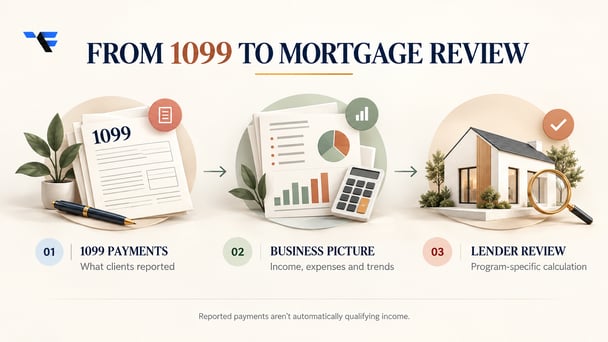
Your 1099 shows what you were paid. Your mortgage file has to show the bigger picture.
Let's say you're a freelance marketing consultant.
Over the course of a year, you receive $120,000 from several clients. During taxation, your clients may send you a 1099-NEC form that reports these earnings. As per the IRS, a 1099-NEC form is used to report nonemployee compensation.
That gives you, your tax preparer and the IRS a record of the payments. It also gives a mortgage lender something it can use to verify your income history. But there is a difference between money paid to you and income that can be used to qualify for a mortgage.
If you spent $30,000 running your business, for example, the $120,000 shown on your 1099 does not necessarily become $120,000 of qualifying mortgage income.
For a conventional loan, the lender may review your tax returns and business income to determine the amount of stable income available for the mortgage. Fannie Mae's current guidance says lenders should look at the stability of self-employed income, the nature and financial strength of the business, and whether the business can continue generating enough income to support the borrower's obligations.
That is why simply handing over a stack of 1099s is usually not the end of the income review.
What does a 1099-NEC have to do with a mortgage?
If you consult for three companies, freelance, or are an independent contractor, your clients may report those payments on 1099-NEC forms. You may also have other 1099s.
A 1099-MISC, for example, can be used for certain types of rent, royalties, prizes and other payments. Other forms in the 1099 family cover things such as interest, dividends and retirement distributions.
However, if you’re applying for a mortgage, then the focus shifts to what each payment represents and not how many 1099s you currently have.
Why lenders don't simply use the number on your 1099
This is probably the part that causes the most frustration.
You may have earned $150,000. You know you earned it because you saw the money come into your accounts. Yet the income number on your tax return may be considerably lower.
That isn't necessarily a problem. It is simply the difference between gross business income and what remains after eligible business expenses are accounted for.
For a sole proprietor, for example, business income is generally reported on Schedule C. Under Fannie Mae's guidance, the lender may make adjustments to Schedule C income when calculating cash flow. Certain recurring items, such as depreciation and some other noncash expenses, can be added back under the applicable rules, while nonrecurring income may be removed from the calculation.
In other words, there isn't a rule that says:
1099 amount = mortgage income
Nor is there a rule that says:
taxable income = the only number a lender can ever use
Please note that the above calculation is an illustration and that the actual calculation depends on the details of the business and the loan program you choose to go ahead with
That distinction is especially important for self-employed borrowers who take legitimate business deductions. Those deductions can reduce taxable income, while some may receive different treatment when a lender calculates cash flow.
What does a lender actually look for in 1099 income?
Once the lender has your 1099s and other financial records, the question becomes less about the form itself and more about the income behind it.
Is the income stable?
If you intend to get a mortgage, your lender may want an income proof that has a documented history and is reasonably expected to continue. That is a basic part of conventional underwriting, not something unique to 1099 borrowers.
For someone with a salary, that can be relatively straightforward.
For a freelancer, it may take a little more work to show.
You might have one very large client. Your work might be seasonal. You might receive a $20,000 payment one month and nothing the next. Or you might have several smaller clients who pay you regularly.
The lender needs enough information to understand what those numbers mean.
How long have you been doing the work?
You may have heard that every self-employed borrower needs two years of income.
That is not quite right.
Fannie Mae generally looks for a two-year history of prior earnings for self-employed borrowers, but its current guidelines allow certain borrowers with less than two years of self-employment history to be considered. For example, a borrower may have a shorter self-employment history if the current tax return shows a full 12 months of self-employment income and the borrower can document prior income in the same or a related field under the applicable requirements.
Fannie Mae also has circumstances where one year of personal and business tax returns can be used when the business and ownership history meet specific requirements.
So if you've been freelancing for 18 months, don't assume you have to wait until you've crossed an arbitrary two-year mark.
Your full work history matters.
Is your income going up, down or staying fairly steady?
A lender is interested in the direction of your income as well as the amount.
Imagine your income looked like this:
Year 1: $65,000
Year 2: $85,000
Year 3: $105,000
Now compare that with:
Year 1: $105,000
Year 2: $85,000
Year 3: $65,000
The total over the three years is the same. The story isn't.
Fannie Mae's self-employment guidance specifically calls for analysis of year-to-year trends in gross income, expenses and taxable income.
That doesn't mean there is one simple formula for every borrower. The lender has to apply the rules of the particular loan program to the income in front of it.
Does the business still look healthy today?
Your latest tax return tells the lender what happened during a previous tax year.
It doesn't necessarily tell them what happened this month.
As previously stated, how your income changes is also equally important. For instance, if you lose a major client or have a windfall in cash flow, the lender may require much more recent information.
Depending on the loan program, that could include a year-to-date profit and loss statement, bank statements, contracts, invoices or other records.
This is one reason it helps to keep your business records organized throughout the year instead of trying to reconstruct everything when you are already under contract for a house.
What documents might a 1099 borrower need?
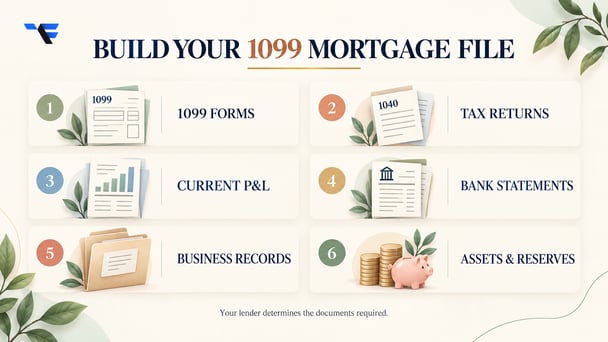
There isn't a universal "1099 mortgage package."
The lender and loan program determine what is needed, but you may be asked for some combination of:
- 1099-NEC or other relevant 1099 forms
- Personal tax returns
- Business tax returns, when applicable
- Schedule C or another business schedule
- IRS tax transcripts
- Year-to-date profit and loss statement
- Business and/or personal bank statements
- Business registration or license
- Contracts or invoices
- Proof of assets and reserves
- Documentation showing the business is still active
For conventional financing, Fannie Mae allows lenders to use tax returns or applicable IRS transcripts to document self-employed income, with specific exceptions and documentation rules. Its current guidance also notes that an IRS Wage and Income Transcript can contain information from forms such as 1099s.
A self-employment verification letter may also be requested in some situations. It can confirm facts about your business, such as your role, ownership, business history or whether the business is currently operating. It generally isn't a replacement for the documents used to calculate qualifying income. TFG explains this distinction in its guide to self-employment letters for proof of income.
The important thing is not to assume that every borrower needs every document listed above.
Your lender's actual documentation request is what matters.
What if your tax return doesn't tell the whole story?
This is where the conversation can change for some 1099 borrowers.
Let's say you run a successful consulting business. Your clients pay you consistently, your bank statements show healthy deposits and your business is doing well. But you also have substantial business expenses, so the income reported on your tax return is much lower than the amount flowing through the business.
A conventional mortgage may still be possible, depending on the complete file and the applicable underwriting rules.
But it may not be the only path worth discussing.
Alternative-documentation mortgages can look at self-employed income differently. A bank statement loan, for example, may use a history of eligible deposits rather than relying entirely on tax-return income. TFG's bank statement mortgage guide describes this type of financing as an alternative for self-employed borrowers whose traditional tax documentation may not reflect the way their businesses actually generate cash flow.
TFG also explains how 1099 borrowers qualify for bank statement mortgages, including the importance of consistent deposits and documentation for unusual transactions.
That doesn't mean a bank statement loan is automatically better, or that it will work for every borrower. It simply means that the first mortgage option you hear about doesn't have to be the only one you consider.
So, what is a 1099-only mortgage?
The term sounds more standardized than it actually is.
A "1099-only mortgage" generally refers to an alternative-documentation, often non-QM, loan where 1099 forms are a primary source of income documentation.
It is not a single standardized mortgage product with identical rules at every lender.
One lender may use a particular percentage of gross 1099 income. Another may have different requirements around the number of 1099s, bank statements, credit, reserves or other documentation.
For example, TFG currently lists a specific 1099 income program within its Non-QM offerings that uses 1099 forms as a primary income document. Its published program details include additional eligibility and documentation requirements.
The important point is that "1099-only" does not mean "no questions asked."
The lender still has to verify the income and determine whether the borrower meets that program's requirements.
A conventional loan, bank statement loan, 1099-based program or another non-QM option makes sense for you, if the qualifying income shown on your tax returns is lower than your actual business cash flow.
TFG's self-employed mortgage options cover several of these alternative documentation approaches.
What can make a 1099 mortgage file harder?
Usually, it isn't the 1099 itself.
It's the story around it.
A lender may have more questions if your income drops sharply from one year to the next, a major client disappears, your business recently changed structure, your bank deposits don't line up with the income you're reporting, or you have several businesses sending you different forms.
A missing or incorrect 1099 can create another issue.
If a client sends you a corrected form, for example, don't try to make the mortgage application fit the original number. Give the lender the corrected document and let them tell you what else they need.
The same goes for a business-name mismatch or an unusually large deposit.
Explain it early.
A clean explanation supported by records is much easier to work with than an issue that appears for the first time during underwriting.
And if you're a freelancer or gig worker, TFG's guide to mortgages for freelancers and gig workers provides additional context on documenting this kind of income.
A quick note about Form 1099-A
If you've searched for information about 1099 forms and mortgages, you may have come across some very unusual claims about Form 1099-A.
It is worth clearing that up. Form 1099-A has nothing to do with using a tax form to buy a house.
The IRS says Form 1099-A, "Acquisition or Abandonment of Secured Property," is filed when a lender acquires an interest in property that secures a debt or has reason to know that the property has been abandoned. The form reports information such as the outstanding principal balance and fair market value of the property.
It is not proof of income. It is not a source of mortgage funds. It does not create a government account that can be used to purchase property, and it does not by itself cancel a mortgage.
If you're trying to document freelance or contract income for a mortgage, you're most likely dealing with a 1099-NEC or another income-related 1099, not a 1099-A.
What should a 1099 borrower do before applying?
The easiest way to make the process harder is to wait until you have found a house before figuring out how your income will be documented.
Instead, start with the income you actually have.
Gather your recent 1099s. Know what your tax returns show. Understand whether you operate as a sole proprietor, LLC, S corporation or another structure. If your income has changed significantly, be ready to explain why. And if you have several sources of income, make sure you can show where each one comes from.
Then talk to a lender who is comfortable working with self-employed borrowers.
TFG works with contractors, freelancers, business owners and other borrowers whose income doesn't always fit neatly into a W-2-style application. Depending on the borrower and the property, the available options may include conventional financing, 1099-based programs, bank statement loans, P&L-based options or other non-QM programs.
That doesn't mean every borrower will qualify for every option. Credit, debt, assets, property type, income history and the specific program guidelines still matter.
What it does mean is that you don't have to look at your 1099 and assume, "This is going to make getting a mortgage difficult."
Your 1099 is a record of how you were paid.
The mortgage application is where the rest of the story gets put together.
Frequently Asked Questions
Can a lender approve a mortgage using only 1099 income?
Yes. A borrower can qualify using income earned through contract or freelance work. The important question is how that income is documented and calculated. A conventional loan may require a detailed review of tax returns and business income, while some alternative programs use 1099s or other financial records differently.
How many years of 1099s do mortgage lenders ask for?
There is no single requirement for every borrower. Conventional self-employed underwriting generally looks for a two-year earnings history, but Fannie Mae has exceptions for certain borrowers with less than two years of self-employment history and circumstances where one year of returns may be permitted.
Do lenders use gross 1099 income or net income?
It depends on the mortgage program. A 1099 shows payments reported by a payer, but that amount isn't automatically the borrower's qualifying income. Conventional underwriting may analyze business income and expenses, while an alternative 1099 program may use a different calculation.
Can I get a mortgage if I have 1099 income but no tax returns?
Potentially. Some alternative-documentation programs may use 1099s, bank statements or other financial records instead of traditional tax returns. That does not mean the lender skips income verification. The lender still needs enough documentation to determine that the borrower meets the requirements of that particular program.
What is the difference between Form 1098 and Form 1099?
They are completely different forms. The 1099 family is used to report various types of payments and financial transactions, while Form 1098 is generally used for mortgage interest and certain other payments. A 1098 does not serve the same purpose as a 1099 used to document contract income.
What happens if a 1099 is missing or incorrect?
Tell your lender as soon as you notice the problem. A corrected 1099 or other supporting records may be needed to reconcile the income. Don't change the document yourself or try to make your mortgage application match an incorrect form. The lender needs to work from accurate records.
Who needs to file a Form 1099?
It depends on the type of payment and the specific 1099 form. For example, businesses generally use Form 1099-NEC to report qualifying payments for services provided by people who are not their employees. The IRS has separate rules for the different forms in the 1099 family.
Can Form 1099-A be used to buy a house?
No. Form 1099-A is used in certain situations involving the acquisition or abandonment of property that secures a debt. It is not proof of income, a source of mortgage funds or a way to purchase a home or eliminate mortgage debt.

.svg)

Discuss your unique requirements
Get direct answers and a roadmap for your future.
.png?width=202&height=202&name=image%20588255187%20(1).png)



%20(1)-1.png?width=40&height=40&name=image%20(65)%20(1)-1.png)


.svg)

.svg)
.svg)