.svg)



%20(1).svg)
%20(2).svg)
.png?width=480&height=420&name=Img%20(1).png)
%20(3).svg)
%20(4).svg)

%20(5).svg)


 View all states

14 mins
In this blog
Getting a mortgage when you work for yourself can come with a slightly confusing request: “We need a self-employment verification letter.”
If you are used to sending tax returns, bank statements and other financial records, it is reasonable to wonder what this letter is supposed to prove. Who writes it? Does it have to come from a CPA? Does it replace your tax returns? And what exactly should it say?
A self-employment verification letter generally confirms facts about your business, such as whether it is active, how long you have been operating it, your role and your ownership percentage. It is usually one part of the lender’s documentation rather than a standalone measure of qualifying income.
If you have been asked for a letter, start by asking your loan officer who needs to sign it and exactly what information needs to be included. This can help you avoid paying an accountant to prepare a letter that does not meet the underwriting condition.
What is a Self-Employment Verification Letter?
A self-employment verification letter is a dated and signed statement confirming specific facts about your self-employment or business.
Depending on what the lender needs to verify, the letter may cover:
- Your business name and address
- Your role in the business
- Your ownership percentage
- When the business commenced
- Whether the business is currently operating
- The type of business or service it provides
- The relationship between the person preparing the letter and your business
It is one piece of the mortgage documentation used to verify your self-employment.
It is different from a W-2 employment verification because you do not have an employer providing a standard employment record. It can also differ from a borrower letter of explanation, which is generally used to explain something unusual or unclear in a loan application.
There is no single self-employment letter that works for every mortgage application. If your loan officer provides a form or specific wording, use that rather than relying on a generic template found online.
Why Would a Mortgage Lender Ask for One?
A lender needs to verify that the business and self-employment information used in the loan application can be documented under the applicable loan guidelines.
For a self-employed borrower, the lender may want to confirm that:
- The business is currently operating
- You have been self-employed for the stated period
- You own the percentage of the business listed on your application
- Your business information matches the rest of your loan application
- There is an acceptable source that can verify the business
The letter is only one way to establish some of these facts. Depending on the loan program, a lender may also use a business license, government or regulatory board, reliable online source, directory, licensing bureau or business bank statement.
For example, Freddie Mac’s documentation guidance calls for verification of the current existence of a business when positive self-employed income is being used as stable monthly income. Its list of acceptable third-party sources includes regulatory and licensing agencies and certain reliable internet or directory sources.
If your lender asks for a business-existence or self-employment letter, it does not necessarily mean there is a problem with your application. It may simply be one of the conditions needed to document your self-employment correctly.
Who can Write the Letter?
Ask your loan officer before asking your accountant.
Depending on the loan program and the specific underwriting condition, the lender may accept a letter from an arm’s-length CPA, enrolled agent, accountant, tax preparer or another independent source.
An arm’s-length professional is generally someone who is independent of the borrower and the business rather than the borrower themselves.
You may be able to write a statement explaining your own business circumstances, but that does not necessarily satisfy a request for independent verification. If the lender specifically requires a third-party source, confirm who they will accept before preparing the letter.
If the lender asks for a CPA letter, the CPA should generally confirm facts supported by records and stay within their professional scope. They should not be asked to guarantee that your business will remain profitable, that your income will continue at a particular level or that you will be able to repay the mortgage.
What Should the Letter Include?
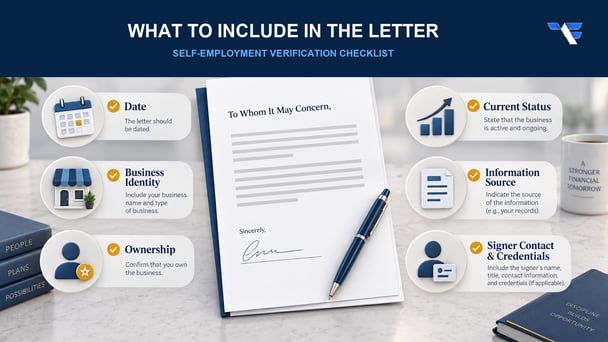
The exact requirements come from the lender. However, a typical self-employment verification letter may include:
- Date: When the letter was prepared
- Recipient: The lender or loan team requesting it
- Borrower: Your full legal name
- Business: Legal business name and address
- Business type: Sole proprietorship, LLC, partnership, corporation or another structure
- Role: Your position or relationship to the business
- Ownership: Your percentage of ownership, if applicable
- Start date: When you began operating or owning the business
- Current status: Confirmation that the business is currently active, if requested
- Information source: Records or information the preparer relied upon
- Preparer relationship: The preparer’s relationship to you or the business
- Contact information: Professional contact details
- Signature and credentials: The preparer’s signature and relevant professional designation
If the lender specifically asks the preparer to state an income amount, the figure should be supported by identifiable records. Gross revenue, business deposits and net qualifying income are different things and should not be casually treated as interchangeable.
If the lender provides exact wording, use it rather than assuming a generic template will satisfy the requirement.
Self-Employment Verification Letter Template
Ask your loan officer who must sign the letter and what it must say before using this sample.
[Date]
[Mortgage Lender / Loan Officer Name] [Company Name] [Address]
Re: Self-Employment Verification for [Borrower's Full Name]
To Whom It May Concern:
I am [preparer's name and professional designation], [relationship to borrower/business].
At the request of [borrower's full name], I am providing the following factual information regarding their self-employment:
Business name: [Business legal name] Business address: [Business address] Business structure: [Sole proprietorship / LLC / Partnership / Corporation / Other] Borrower's role: [Role/title] Ownership percentage: [Percentage, if applicable] Date business began: [Date] Current business status: [Current status, if specifically requested]
The information above is based on [records/information reviewed, as applicable].
[If applicable: “This letter is limited to verification of the facts stated above and should not be interpreted as a guarantee of future business performance, income, solvency, or repayment ability.”]
Please contact me at [phone number] or [email address] if additional factual clarification regarding this statement is required.
Sincerely,
[Signature] [Preparer's Full Name] [Professional Designation / Credentials] [Company Name] [Contact Information]
Other Documents Self-Employed Borrowers May Need
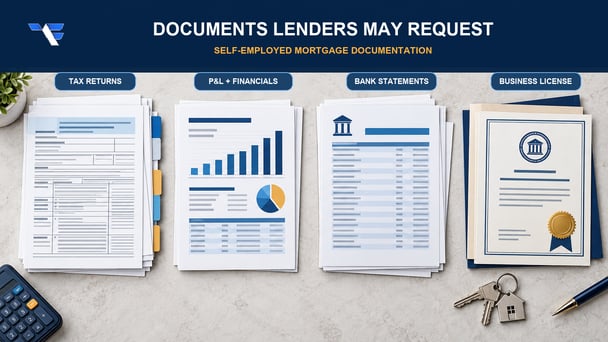
The self-employment letter is only one part of the documentation a lender may request. Depending on the loan program and your circumstances, you may also need:
| Purpose | Documents a lender may request | What to know |
|---|---|---|
| Income history | Personal and business tax returns, schedules, K-1s, 1099s or IRS transcripts | Required years and forms vary by loan program and business structure |
| Current performance | Year-to-date P&L, balance sheet or recent financial statements | Current results may be compared with filed returns |
| Business existence | Business license, registration, directory or website verification, preparer letter or business statement | Recency and acceptable sources vary |
| Assets and cash flow | Personal and business bank statements, reserve documentation | Business funds may require additional analysis |
For conventional financing, Fannie Mae generally calls for two years of signed federal tax returns or applicable IRS transcripts when documenting self-employed income. There are circumstances in which one year of returns can be used, but those are tied to specific requirements around the business’s history and the borrower’s ownership.
Tax transcripts may also be part of the process. Through the IRS Income Verification Express Service, a borrower can authorize a lender or other participating third party to obtain tax transcripts, including through Form 4506-C.
How Mortgage Lenders Review Self-Employment Income
The self-employment letter can verify facts about your business, but the lender still has to determine how much income can reasonably be used to qualify you for the mortgage under the applicable loan guidelines.
Underwriting can involve reviewing:
- Your personal and business tax returns
- Schedule C income for a sole proprietor
- K-1 income from a partnership or S corporation
- Business financial statements
- Bank statements
- Business debt and expenses
- Changes in income over time
- Large or unusual transactions
- Whether business funds are being used for the transaction or reserves
Fannie Mae, for example, says its analysis of self-employed income is intended to determine the amount of stable and continuous income available to the borrower. It also notes that business income reported on an individual return does not necessarily mean that the same amount was actually distributed to the borrower.
This distinction matters if your business is doing well but your tax return does not appear to tell the whole story.
Legitimate business deductions can reduce taxable income. That does not mean a lender automatically adds every deduction back when calculating qualifying income. The calculation depends on the loan program and the type of income being analyzed.
A declining income trend, significant business debt, large one-time transactions or use of business funds can also lead to additional questions or documentation.
What If Your Tax Returns Do Not Show the Full Cash Flow?
A business can have substantial revenue flowing through its accounts while showing considerably less taxable income after legitimate business expenses and deductions.
That does not automatically make a conventional mortgage impossible. It may mean that another documentation path is worth discussing, depending on the borrower’s circumstances and current program guidelines.
Alternative documentation may include:
- Bank statements
- A profit and loss statement
- 1099 income
- One year of tax returns where permitted
- Eligible assets through an asset-based qualification approach
These programs still involve underwriting. A bank statement loan, for example, uses bank deposits as part of its income analysis rather than relying exclusively on traditional tax-return documentation. TFG currently offers bank statement financing for self-employed borrowers, with documentation requirements varying by scenario.
Alternative documentation does not mean “no income verification.” The lender still needs to document the borrower’s financial picture, credit, assets, property and ability to repay under the applicable program.
If your situation does not fit neatly into standard documentation, you can compare available self-employed mortgage options before assuming you have only one path forward. For borrowers whose taxable income is reduced by substantial business write-offs, bank statement loans may be another option worth discussing. TFG also offers asset depletion loans for qualifying borrowers whose eligible assets may form part of their income qualification.
Common Letter and Documentation Mistakes
Most problems with self-employment verification letters are surprisingly ordinary.
The wrong person signs it. Before having a letter prepared, confirm that the lender will accept the person providing the verification.
Important facts are missing. Business start date, ownership percentage, legal business name or current status may be omitted even though the lender specifically requested them.
The letter does not match the loan file. A different business name, ownership percentage or start date can create unnecessary questions.
Income figures are vague. If income is included, the letter should identify what the figure represents and what records support it. Gross receipts and qualifying income are not interchangeable.
The letter is outdated. Some underwriting conditions require recent verification. Ask how recent the letter needs to be before having it prepared.
The rest of the file is incomplete. A clean letter cannot compensate for missing tax schedules, unexplained deposits or financial statements the lender has separately requested.
Send your documentation through the secure channel provided by your loan team, and keep copies of everything you submit.
How to Prepare Before Applying
If you are self-employed and planning to buy or refinance, a little preparation can make the documentation process much less painful.
Start by asking your loan officer:
- Which loan programs are available for your situation?
- Which tax returns, transcripts or financial records are required?
- Who can provide or sign the self-employment verification?
- Are there other ways to verify that the business is active?
- How recent does the documentation need to be?
Then gather the records relevant to your application and make sure your business name, ownership information and dates are consistent across your documents.
If you want a rough starting point, a self-employed mortgage calculator can help you estimate potential qualification based on the information you enter. Treat the result as an estimate. A calculator cannot replace document review or an underwriting decision.
If you are unsure which documentation path fits your situation, a Truss Financial Group loan officer can review your income structure, business history, property and financing goals and explain which currently available mortgage options may be appropriate.
Frequently Asked Questions
Can I write my own self-employment verification letter?
You can write a statement explaining your circumstances, but that may not satisfy a lender’s request for independent verification. If the lender requires a third-party letter, confirm who they will accept before preparing one.
Does a self-employment letter prove mortgage income by itself?
Usually, no. The letter can verify facts about your business, while qualifying income is determined using the documentation and calculation method required by the applicable loan program.
Does the letter have to come from a CPA?
Not always. The acceptable signer depends on the lender and the specific documentation request. A CPA, accountant, tax preparer, enrolled agent or another independent source may be acceptable in some circumstances.
What should a CPA letter for a mortgage say?
It should contain the specific facts the lender requested and identify the records or information supporting those facts. If income is included, the figure should be clearly defined and supported.
How many years of tax returns do self-employed borrowers need?
It depends on the loan program and your circumstances. Fannie Mae generally uses two years of tax returns or applicable transcripts for self-employed income, with specific circumstances allowing one year. Other programs can have different requirements.
Can bank statements be used instead of tax returns?
Some alternative-documentation mortgage programs use personal or business bank statements as part of their income analysis. Requirements vary by program and lender, and bank statement financing still involves underwriting and documentation.
What if I have been self-employed for less than two years?
Do not assume that you automatically have to wait. Some conventional guidelines allow self-employed income with less than two years of self-employment history when specific requirements are met, including documentation of a relevant prior income history. Other loan programs may have different requirements.
How recent should the verification letter be?
There is no universal age requirement for every mortgage program. Ask your loan officer how recent the letter needs to be before having it prepared.

.svg)

Discuss your unique requirements
Get direct answers and a roadmap for your future.
.png?width=202&height=202&name=image%20588255187%20(1).png)




%20(1)-1.png?width=40&height=40&name=image%20(65)%20(1)-1.png)



.svg)

.svg)
.svg)