.svg)



%20(1).svg)
%20(2).svg)
.png?width=480&height=420&name=Img%20(1).png)
%20(3).svg)
%20(4).svg)

%20(5).svg)


 View all states
%20(1)-1.png?width=40&height=40&name=image%20(65)%20(1)-1.png)
11 mins
In this blog
Key takeaways:
- A mortgage for 1099 employees is a viable possibility when income is verifiable and dependable.
- Tax returns, rather than gross 1099 income, can be more relevant in some 1099 mortgage scenarios due to expenses.
- Two years is a general guideline for self-employment income, but it is not a hard-and-fast rule for every program.
- Conventional, FHA, bank statement, and non-QM lending have different qualification and documentation criteria.
- Preparation can make a significant difference in how your file is reviewed.
Mortgage qualification for 1099 employees may require additional documentation compared to someone who receives a W-2. However, a mortgage for 1099 employees is doable, provided income is verifiable, dependable, and adequate for the given transaction.
The phrase 1099 employee is not a specific category, and the IRS typically issues 1099-NEC to report nonemployee compensation. In the context of a mortgage for 1099 employees, however, income-producing activity is more relevant than the tax form itself.
Truss Financial Group works with borrowers whose income does not appear on a standard W-2 form. If your taxes, 1099s, deposits, or work history need to be reviewed more closely, begin the conversation with a program review, rather than an assumption that you do not qualify.
What Does “1099 Employee” Mean?
Form 1099-NEC generally reports nonemployee compensation to the IRS, and most businesses that pay an independent contractor will send out a 1099-NEC by January 31 each year. These payments are not considered wages, and self-employed filers generally report this income on Schedule C.
For an independent contractor mortgage, this distinction matters, since the IRS scrutinizes business income more closely. Someone who is employed as a freelancer, consultant, commission-based salesperson, or contractor can often be classified as self-employed.
When you are researching an independent contractor mortgage, the relevant concerns are whether the income is verifiable, has a history, and has a calculable amount.
The Mortgage Guide for 1099 Contractors from Truss Financial Group is a good resource for a general overview of considerations before you meet with a mortgage professional. That guide, as well as Mortgages for Self-Employed Borrowers, is a helpful resource for the general income documentation considerations.
Why 1099 Mortgage Files Can Be Harder
A W-2 employee can generally produce pay stubs and W-2s that reflect current income. A mortgage for 1099 employees, by contrast, may have to consider a more complicated picture. Someone who is self-employed or an independent contractor can have multiple income sources, pay themselves, and have more expenses that impact their bottom line.
Lenders may examine:
- Work and income history
- Tax returns and schedules
- Expenses and available deductions
- Trends in income
- Credit profile and debt-to-income ratio
- Assets, reserves, and source of deposit
- The capacity and intent of the business to continue producing income
For an independent contractor mortgage, the 1099 is only one part of the picture. In the context of a mortgage self-employed income discussion, it is important to remember that credit and reserves are necessary but not sufficient qualifications. With that said, a complete view of the borrower’s finances can be vital to an independent contractor mortgage.
Truss Financial Group will review tax returns, 1099s, deposits, work history, assets, and goals, and will explain conventional and alternative documentation mortgage products. Qualification and terms depend on the borrower, property, lender, and program.
What Mortgage Lenders Evaluate
Consider the following table, which shows the concerns of a lender and the relevant documentation from the borrower’s perspective.
| Factor | What the Lender Wants to Establish | Borrower Preparation |
|---|---|---|
| Income history | A stable pattern in the same or related work | Collect returns, 1099s, contracts, and an accurate work timeline. |
| Current income | Business activity and earnings remain consistent enough to support repayment | Organize year-to-date P&L, statements, invoices, or other requested records. |
| Tax-return cash flow | Usable income after expenses and permitted adjustments | Review returns before applying; do not assume gross receipts qualify. |
| Credit and DTI | Overall repayment history and room for the new housing payment | Check reports, list recurring debts, and avoid new obligations. |
| Assets and reserves | Verified funds for closing and post-closing needs | Document large deposits and keep business and personal funds traceable. |
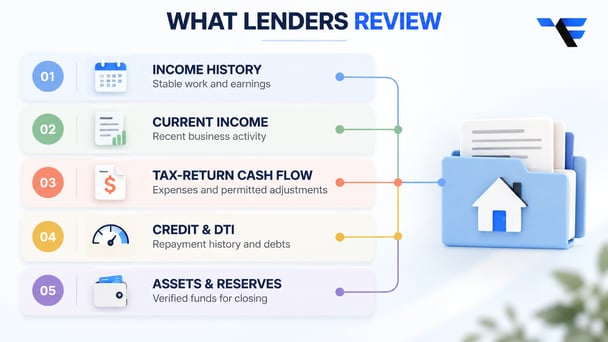
For a self-employed mortgage, the lender may need a reasonable understanding of the borrower’s capacity to produce income in the future.
How Lenders May Calculate 1099 Income
At this point, many contractors are surprised to learn how income is calculated.
Let’s say you had $120,000 in gross 1099 payments and reported $40,000 in expenses on Schedule C. You may not be able to use the full $120,000 as qualifying income.
The lender analyzes the income from the cash-flow perspective, and the calculation is generally not as simple as a deduction. Income trends and expenses both impact the qualifying income, and their relevance varies depending on the program.
Declining income is another concern. If income appears to decrease significantly from year to year, the lender may use a reduced income or ask for additional explanation, depending on the program.
In the context of an independent contractor mortgage, compare the qualification number rather than the gross receipts. This independent contractor mortgage review should be based on your income, not the income tax you report.
How Long Do You Need to be Self-Employed?
The short answer is that it varies. Two years is a general guideline, but it is not a hard-and-fast rule.
Fannie Mae typically uses two years of history when it reviews self-employed income. In practice, however, the guidelines state that borrowers who have been deriving income from self-employment or operating a business for less than 24 months, but for whom the most recent tax year’s return shows a year’s worth of self-employment income and who have been working in the same or a related occupation for the 12 months preceding the first month of self-employment, may meet eligibility requirements.
FHA guidelines are similar, but they note that borrowers who have been in self-employment for one to two years and have a comparable work history in the same or a related occupation may be eligible.
When you are discussing mortgage self-employed income, it is important to note that qualifying income will depend on several factors beyond the length of time in business.
Mortgage Paths to Compare
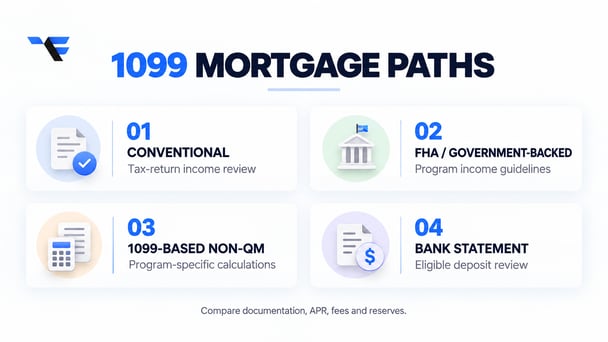
There is no comprehensive list of the best mortgage lenders for 1099 employees. The best mortgage lenders for 1099 income can vary significantly according to income definition and documentation requirements. Compare the best mortgage lenders for 1099 employees by reviewing the program criteria and documentation rules. Even the best mortgage lenders for 1099 employees can have significantly differing overlays.
-
Conventional mortgage
Conventional financing can be appropriate for qualifying self-employed income when documentation supports the income. Deductions, expenses, and trends all impact qualifying income.
-
FHA or government-backed financing
FHA and other government-backed loans have income guidelines for self-employment, but they do not use alternate documentation methods. The borrower still needs to meet the ability-to-repay standards.
-
1099-only mortgage
A 1099-only mortgage product may analyze 1099 income with a set of expenses rather than a conventional tax review. Terms, reserves, and fees can vary with the product. When you compare the best mortgage lenders for 1099 employees, use specific criteria rather than a generalized ranking. Mortgage for 1099 employees options should be compared according to APR, reserves, fees, and documentation rather than a generalized ranking. In short, mortgage loans for 1099 employees should be compared on their terms, not rankings.
-
Bank statement mortgage
A bank statement mortgage may be an option if cash-flow income does not reflect the true income of the borrower. Eligible deposits in a personal or business bank account may qualify according to the alternate income guidelines. Expenses, deposits, and other criteria apply.
If you need assistance finding the right mortgage loan for your income type, contact Truss Financial Group and arrange a review of your income, work history, and mortgage goals.
Documents a 1099 Borrower May Need
Tax returns, Schedule C, 1099 forms, IRS transcripts, year-to-date profit and loss statements, bank statements, and business documentation are all possible parts of a self-employed mortgage application. The exact requirements will depend on the lender. Sensitive information should be uploaded through a secure portal when it becomes available.
If you are a borrower who needs documentation regarding your employment status, the Self-Employment Letter for Proof of Income resource from Truss Financial Group discusses one possible supporting document. Readers considering deposits rather than income tax returns should consult How 1099 Borrowers Qualify for Bank Statement Mortgages.
When Qualifying May Not Be Much Harder
A well-prepared borrower can submit a file that is simple for the lender to review. With regard to a self-employed mortgage, stable income and a consistent paper trail eliminate questions. One reason for a second review of a self-employed mortgage is that the documentation does not support the income.
What Commonly Causes Problems
An alternative mortgage product or a conventional mortgage can have difficulties when the following concerns are present. Another concern for a 1099-only mortgage is whether the qualifying income method is appropriate to the borrower’s file:
- Significant deductions on Schedule C impact qualifying income for conventional mortgages.
- A recent change to self-employment may require proof of a similar occupation.
- Declining income trends may reduce the qualifying income of a self-employed borrower.
- Inconsistent or late tax filings can raise questions about income.
- Mixing personal and business funds can make it difficult to track income and expenses.
- Large, unexplained deposits in a bank account may need to be explained.
A self-employment letter or contract with a client can only go so far toward explaining the income. The Self-Employed Home Loans page from Truss Financial Group can help identify the available mortgage products.
Your Next Step as a 1099 Borrower
A mortgage for 1099 employees can require more documentation and analysis than a W-2 mortgage. With that said, a mortgage for 1099 employees is still possible, as income is usually verifiable and predictable enough for qualification purposes. In the end, a mortgage for 1099 employees is comparable to any other mortgage product, potentially requiring a more detailed income review. When a borrower is considering mortgage loans for 1099 employees, it is best to begin with the income that the borrower has rather than a generalized set of criteria.
Are you ready to compare your options? Contact Truss Financial Group and review your income documentation and mortgage goals.
FAQs (Frequently Asked Questions)
Is it harder to get a home loan if you are self-employed?
The analysis can be more involved, as lenders may analyze income tax returns, business documents, and current income. Self-employed borrowers can still qualify, assuming they meet the guidelines.
What disqualifies a self-employed borrower?
Some of the concerns include income that is unstable or too low, unacceptable obligations, poor credit, unverifiable funds, or inadequate documentation.
How many years of tax returns do 1099 borrowers need?
It depends on the program, but two years is a general guideline. Some programs will accept less than two years, depending on circumstances.
Can you qualify using gross 1099 income?
Qualifying income is generally lower than gross income, as most conventional lenders analyze expenses in addition to income. Some programs analyze gross income, possibly with adjustments.
Can a 1099 worker get an FHA loan?
Yes, as long as the borrower and the file meet the guidelines. The FHA has specific requirements for self-employment income.
Which mortgage is best for a 1099 worker?
The type of mortgage depends on income, occupation, credit profile, reserves, down payment, property, and other factors. Compare programs and guidelines rather than choosing based on a label.
Can I qualify for a mortgage with only one year of 1099 income?
Possibly, but not always. Some programs allow less than two years in certain occupations, as long as the borrower has experience in a comparable field. Fewer than 12 months of 1099 income is generally not sufficient income.

.svg)

Discuss your unique requirements
Get direct answers and a roadmap for your future.
.png?width=202&height=202&name=image%20588255187%20(1).png)


%20(2)-1.png?width=389&height=221&name=Blog%20covers%20(1)%20(2)-1.png)





.svg)

.svg)
.svg)