.svg)



%20(1).svg)
%20(2).svg)
.png?width=480&height=420&name=Img%20(1).png)
%20(3).svg)
%20(4).svg)

%20(5).svg)


 View all states

13 mins

In this blog
If you're a homeowner in financial trouble, carrying a heavy credit card debt load, you may be sitting on a solution you haven't fully considered yet. The average American household carrying card debt owes over $10,000, and at an annual percentage rate north of 20%, that balance doesn't just sit there. It compounds daily, quietly eating through every payment you make before a single dollar touches the principal balance.
Here's what most articles on this topic miss: homeowners have a structural advantage that renters don't. U.S. homeowners collectively hold over $35 trillion in home equity as of Q4 2024, and the average mortgage-holding homeowner has approximately $11 trillion in tappable equity available in 2025. Home equity products typically carry rates between 7% and 9%. That gap, 20%+ on your cards versus 8% on your home equity, is the opportunity this article is built around.
Lenders like Truss Financial Group work with homeowners who are weighing exactly this move. This guide covers the real cost of carrying credit card debt, how mortgage options can eliminate it, what qualification looks like, and the risks that most lenders won't tell you about upfront.
What Credit Card Debt Is Actually Costing You
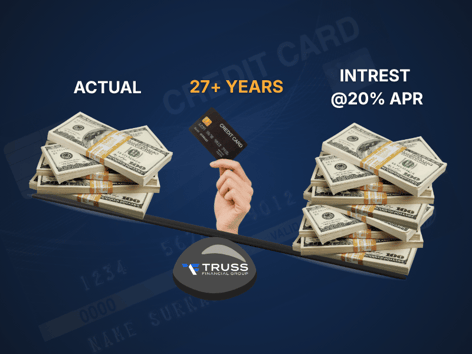
Before evaluating any solution, it helps to see the full cost of doing nothing. Pull up your credit card statement and look at two numbers: your outstanding balance and your minimum monthly payments. That combination tells the real story.
Credit card interest compounds daily. At 20% APR, a $10,000 balance making only minimum payments takes over 27 years to pay off and costs more than $16,000 in interest alone. At $25,000 and 22% APR, you're looking at 30+ years and over $43,000 in interest. The longer you owe money on high-interest cards, the more it costs you to borrow money over time.
|
Balance |
APR |
Monthly Minimum |
Years to Pay Off |
Total Interest Paid |
|
$10,000 |
20% |
~$200 |
27+ years |
$16,000+ |
|
$25,000 |
22% |
~$500 |
30+ years |
$43,000+ |
Making minimum payments on multiple credit cards is one of the most expensive financial positions you can be in, because the minimum is largely consumed by interest, leaving the outstanding balance nearly intact month after month. It's also one of the fastest ways to accumulate more debt without making a single new purchase.
Want to see your exact numbers? The CFPB's free credit card payoff calculator lets you model your own timeline before making any decisions.
Why Homeowners Have a Real Advantage Here?
Replacing high-interest revolving debt with a lower-rate home-secured product is one of the most effective ways to consolidate debt and save money on interest. The math is straightforward:
|
Debt Type |
Typical Rate |
|
Credit card APR |
20%+ |
|
Home equity loan |
7%–9% |
|
HELOC |
7%–9% (variable) |
|
Cash-out refinance |
Varies by market rate |
The trade-off is real, though. You're converting unsecured debt, where default damages your payment history and credit report, into home-secured debt, where default puts your property at foreclosure risk. That's not a reason to avoid these products. It's a reason to understand them fully before signing.
Three Mortgage Options To Pay Off Credit Card Debt Quickly
1. Cash-Out Refinance
A cash-out refinance replaces your existing mortgage with a new, larger single loan. The difference between your old balance and the new loan amount is paid out as cash, which you use to pay off all your debts on your credit card accounts in full.
Because it replaces your primary mortgage, you're left with one monthly payment. But that payment is on a larger loan, and if your current mortgage rate is lower than today's market rate, the math gets more complicated. Conventional and FHA cash-out refinances are capped at 80% LTV; VA-eligible borrowers can access up to 100%.
The hidden cost most borrowers miss is resetting the mortgage term. A borrower 10 years into a 30-year mortgage who cashes out refinances restarts the clock, potentially paying significantly more in lifetime interest even at a lower rate than their credit cards.
Best for: Homeowners who can refinance at a favorable rate, want a single consolidated payment, and have enough equity to cover the full payoff amount.
2. Home Equity Loan
A home equity loan is a second mortgage, a lump sum at a fixed interest rate, repaid on a set payment schedule alongside your existing mortgage. Because the rate is fixed, your monthly payment is predictable from day one.
Most lenders cap the combined loan-to-value (CLTV) at 80%–85%. Closing costs typically run 1%–5% of the loan amount. You'll carry two mortgage payments simultaneously, but your original mortgage terms stay untouched.
Best for: Homeowners with a defined credit card payoff amount who want rate certainty and don't want to disturb their existing mortgage.
3. Home Equity Line of Credit (HELOC)
A HELOC is a revolving line of credit secured against your home. During the draw period, typically 5 to 10 years, you pull funds as needed and pay interest only on what you draw. After that, you enter a repayment period on the full balance.
The variable rate is the critical risk here. A HELOC that opens at 8% can reset significantly higher if market rates rise, meaning your monthly payment can increase without warning. Annual fees and monthly fees are common, and early termination fees apply if you close the line within 3 years.
Best for: Homeowners with multiple credit card balances to pay off over time, or those who want a flexible financial buffer.
Side-By-Side: Which Option Fits Your Situation?
|
Feature |
Cash-Out Refinance |
Home Equity Loan |
HELOC |
|
Payout structure |
Lump sum |
Lump sum |
Revolving draw |
|
Rate type |
Fixed |
Fixed |
Variable |
|
Replaces existing mortgage? |
Yes |
No |
No |
|
Monthly payments |
Yes, on a new, larger loan |
Yes, two payments |
Interest only during draw |
|
CLTV maximum |
80% conventional; 100% VA |
80%–90% |
80%–85% |
|
Resets mortgage term? |
Yes |
No |
No |
|
Closing costs |
2%–5% |
1%–5% |
1%–5% |
|
Foreclosure risk |
Yes |
Yes |
Yes |
Does The Math Actually Work? Run The Numbers First
Here's a concrete before-and-after on a $25,000 credit card balance:
|
Scenario |
Credit Card Debt |
Home Equity Loan |
|
Balance |
$25,000 |
$25,000 |
|
Interest rate |
22% APR |
8.5% fixed |
|
Monthly interest cost |
~$458 |
~$177 |
|
Monthly savings |
N/A |
~$281 |
|
Total interest (5 years) |
~$15,000+ |
~$3,500 |
Factor in closing costs: at 2%, a $25,000 home equity loan costs $500 upfront, recovered within two months of interest savings. That's more money staying in your pocket every month rather than going to your credit card company.
To verify your own equity position, lenders use CLTV: divide your total home-secured debt by your home's appraised value. A home worth $400,000 with a $280,000 mortgage and a proposed $25,000 home equity loan sits at 76.25% CLTV, comfortably within the standard 80% ceiling. Note that lenders use a third-party appraisal to set that value, not an online estimate, and valuations can vary by 10%–15%.
Do You Qualify? What Lenders Evaluate
The interest rate math is compelling, but qualification determines whether a lender approves it. Here's the standard benchmark across home equity loans, HELOCs, and cash-out refinances:
|
Qualification Factor |
Typical Requirement |
Notes |
|
Credit Score |
620–680+ |
Higher scores unlock better rates and CLTV allowances |
|
Debt-to-Income Ratio (DTI) |
43%–45% maximum |
Includes the new home equity payment |
|
CLTV |
80%–85% maximum |
Some non-QM lenders extend to 90% |
|
Equity Retained Post-Withdrawal |
15%–20% minimum |
20% is the standard equity cushion |
|
Income Verification |
Required |
Tax returns, pay stubs, or bank statements |
|
Property Appraisal |
Required |
Lender-ordered, not an online estimate |
Lenders will also review your credit report and payment history across all accounts, not just your mortgage. Late payments or a pattern of trouble paying bills can affect approval, even if your credit score clears the minimum threshold. If you have a bad credit history, some non-QM lenders still have options, though rates will reflect the additional risk.
Mortgage brokers like Truss Financial Group work with borrowers across the qualification spectrum to find the right structure before anything goes to underwriting.
The Costs and Risks, Laid Out Plainly
Costs to account for:
- Home equity loan and HELOC closing costs: 1%–5% of the loan amount
- Cash-out refinance closing costs: 2%–5% of the new loan amount
- HELOC annual maintenance and monthly fees, plus early termination fees
- Appraisal fee: typically $300–$600, paid upfront regardless of outcome
- Late fees on any missed payments during the debt repayment period
Risks that matter:
|
Risk |
Product Affected |
What It Means |
|
Foreclosure |
All three |
Default on any home-secured product puts your property at risk |
|
Variable rate exposure |
HELOC |
Rising rates increase monthly payments with no ceiling |
|
Reset the loan term |
Cash-out refinance |
Restarting the clock increases the lifetime interest paid |
|
Lien complications |
Home equity loan, HELOC |
A junior lien position can block future refinancing |
|
Re-accumulation risk |
All three |
Paid-off cards become open credit, and new balances undo everything |
The Risk Nobody Talks About: Behavior
The most common failure mode with this strategy isn't the rate or the product. It's what happens after the cards hit zero.
Once you use home equity to pay off credit card balances, those accounts return to their full credit limit. For homeowners who haven't addressed the spending habits that created the debt, that's not a finish line. It's a reset button. A borrower who taps $25,000 in equity, then re-accumulates $20,000 in new card debt within 18 months, now carries both obligations and is in a worse financial situation than when they started.
Before using any home equity product for debt consolidation, make sure you've:
- Identified and closed the budget gap that caused the debt
- Built at least a 3-month emergency fund so you're not credit-reliant for unexpected expenses
- Consider reducing limits or closing paid-off credit card accounts if overspending is a concern
- Built a clear payment plan for the home equity product before signing
- Checked your credit utilization ratio post-payoff to understand its impact on your credit report
If the spending behavior hasn't changed, the product doesn't matter.
When This Move Makes Sense, And When It Doesn't
It makes sense when:
- The credit card APR is at least 10–12 percentage points above your available home equity rate
- You have sufficient tappable equity without breaching the 80% CLTV threshold
- Your DTI, credit score, and monthly gross income are comfortably within the qualification range
- The root cause of the debt has been identified and addressed
- Net savings after closing costs represent a meaningful benefit
It doesn't make sense when:
- Your DTI is already stretched; adding a home equity payment creates real repayment risk
- Local home values are flat or declining, and equity can erode faster than the loan repayments
- The rate difference is marginal, and closing costs may outweigh the savings
- You're approaching retirement, and new home-secured debt creates income risk
Frequently Asked Questions
1. Can I use a cash-out refinance to pay off credit card debt?
Yes. A cash-out refinance pays out the difference between your new loan amount and your existing mortgage balance as cash, which can be applied directly to credit card balances. The key consideration is whether the new mortgage rate is favorable relative to your current rate and whether resetting the loan term makes financial sense for your timeline.
2. Is it a good idea to use home equity to pay off credit card debt?
It depends on three things: whether the rate difference is meaningful, whether you qualify without overextending your DTI, and whether the spending habits that created the debt have been addressed. When all three conditions are met, it's one of the most effective debt reduction moves a homeowner can make.
3. Is the interest tax-deductible when used for debt consolidation?
Generally no. Under the 2017 Tax Cuts and Jobs Act, interest on home equity products is only deductible when used to buy, build, or substantially improve the home. Using the funds to pay off credit card debt does not qualify.
4. What happens if I pay off my cards with home equity and run them back up?
You're now carrying both the home-secured debt and new credit card balances, a worse financial situation than before, with your home now at foreclosure risk. This is the most common failure mode with this strategy, and it's why behavioral change has to come before the product.
5. What if I'm in financial trouble but don't qualify for a home equity product?
Start with a nonprofit credit counseling organization. A certified credit counselor can review your full financial situation, negotiate directly with creditors on your behalf, and set up a debt management plan with a structured payment schedule. This route doesn't require home equity, doesn't add more debt, and won't put your property at risk.
Ready To Put Your Equity To Work?
Using mortgage options to pay off credit card debt is one of the most powerful interest rate moves available to homeowners, but it works only when the equity math, the qualification picture, and the behavioral foundation are all aligned.
The homeowners who do this successfully aren't the ones who move fastest. They're the ones who understand exactly what they're accessing, what it costs, and what they're committing to before they sign.
Mortgage brokers like Truss Financial Group help homeowners evaluate their full equity position first, then structure the right product around their debt payoff goal, their qualification profile, and their long-term financial health before anything goes to underwriting. Reach out when you're ready to run the numbers.

.svg)

Discuss your unique requirements
Get direct answers and a roadmap for your future.
.png?width=202&height=202&name=image%20588255187%20(1).png)


.png?width=389&height=221&name=Blog%20covers%20(6).png)

.png?width=389&height=221&name=Blog%20covers%20(3).png)



.svg)

.svg)
.svg)