.svg)



%20(1).svg)
%20(2).svg)
.png?width=480&height=420&name=Img%20(1).png)
%20(3).svg)
%20(4).svg)

%20(5).svg)


 View all states

13 mins
In this blog
30-Year Mortgage vs 50-Year Mortgage vs Non-QM Mortgages: Which One Is Right for You?
When most people weigh 30-year mortgages vs. 50-year mortgages vs. non-QM mortgages, they default to the 30-year without thinking twice. It's familiar, it's available everywhere, and for a long time, it was enough. But the modern borrower looks very different from the one the 30-year was built for. Today's homebuyers include self-employed professionals, gig workers, real estate investors, and high-asset individuals whose income doesn't come in a neat W-2 package. For these borrowers, squeezing into a conventional loan structure isn't just difficult. It's often the wrong move entirely.
Understanding how mortgage rates work is a starting point. But the bigger question is which loan structure actually fits your financial situation, hold timeline, and long-term goals. This article breaks down all three mortgage options honestly, including where the 30-year and 50-year fall short, and explains why non-QM mortgages have become a powerful tool for borrowers who need a smarter fit.
Mortgage brokers like Truss Financial Group work with borrowers across all three of these structures every day. Here's what you need to know before you decide.
What Is a 30-Year Mortgage?
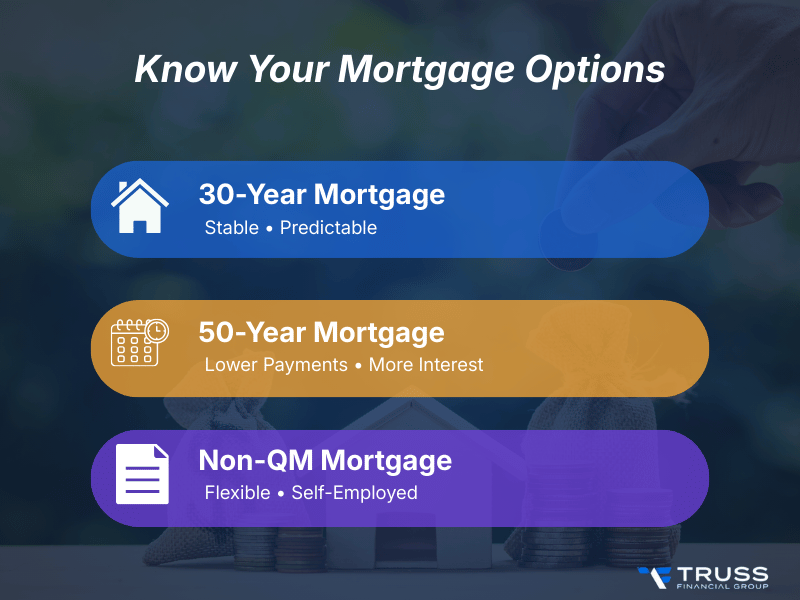
The 30-year mortgage locks in your interest rate at closing and holds it fixed for the life of the loan. Monthly mortgage payments stay consistent regardless of what happens with broader interest rates, which makes budgeting straightforward for borrowers with stable, predictable income.
It's the most widely held mortgage structure in the U.S., available across conventional, FHA, VA, and jumbo loan programs. The trade-off is a slow principal balance paydown in the early years. Most payments go toward interest up front, and total interest paid over three decades can dwarf the original loan amount. It's the benchmark for long-term financing, but that doesn't automatically make it the best fit for every borrower.
What Is a 50-Year Mortgage?
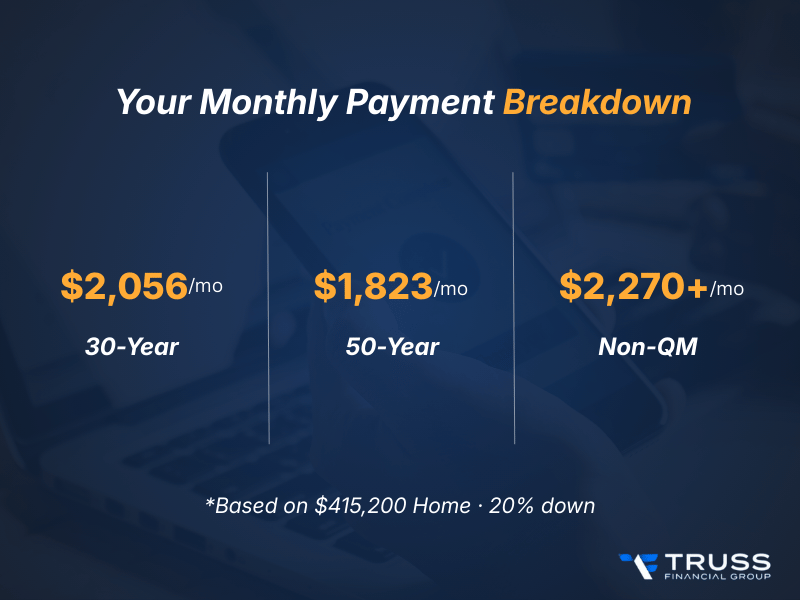
The initial reaction to a 50-year mortgage is usually the same: lower payments, more breathing room. And on that front, it delivers. On a home purchased at the current U.S. median sale price of $415,200 with 20% down at 6.3%, the monthly payment on a 30-year mortgage runs about $2,056. Extend that to half a century, and the payment drops to roughly $1,823, a monthly payment relief of about $233.
But the lifetime interest cost tells a different story. Total interest paid on the 50-year runs approximately 40% higher than on the 30-year, well over $160,000 in additional interest costs on a typical loan. Slower equity accumulation is the other side of that trade-off: equity growth is so minimal in the early years that the loan functions closer to an interest-only loan than a traditional amortizing mortgage, with interest payments making up nearly all of the early obligation and the loan balance barely moving.
There's also a regulatory reality to flag:
- The 50-year mortgage does not currently qualify as a qualified mortgage under the Dodd-Frank Act
- Fannie Mae, Freddie Mac, FHA, and VA cannot back it without changes to the existing policy framework
- The Federal Housing Finance Agency is aware of the concept, and the Trump administration floated the idea publicly, but the regulatory path remains unresolved
- Until that changes, many lenders face real liability exposure originating from these loans, which limits availability and is likely to push interest rates higher than their 30-year counterparts
For most borrowers, the 50-year is a product that trades long-term wealth for short-term affordability. Longer loans come with more risk, and that risk compounds quietly over time.
What Is a Non-QM Mortgage?
A non-QM (non-qualified mortgage) loan doesn't conform to CFPB standards that govern traditional lending. That's not a flaw. It's the point. Non-QM was designed specifically for borrowers whose financial profiles don't fit the conventional mold: self-employed borrowers, real estate investors, foreign nationals, gig workers, and asset-rich individuals whose income looks nothing like a W-2.
Instead of paystubs and tax returns, non-QM lenders accept alternative income documentation: bank statements, 1099s, DSCR calculations, asset depletion schedules, and rental income. The debt-to-income ceiling is also more flexible, reaching up to 50% compared to the 43% cap on qualified mortgages. In some cases, there's no mandatory waiting period after bankruptcy or foreclosure.
The trade-offs are real: interest rates typically run 1-2 percentage points above the prime 30-year fixed rate, down payment requirements are larger (usually 20-30%), and fewer consumer protections apply. But for the right borrower, non-QM isn't a compromise. It's a more accurate reflection of how they actually earn and build wealth, and it opens up home ownership and investment opportunities that conventional lending keeps out of reach.
Explore non-QM loan options to understand which product fits your profile best.
30-Year vs. 50-Year vs. Non-QM: What's the Difference?
Choosing between these three loan structures comes down to one question: which one is actually built for your situation? Payment stability, equity growth, cash flow, and underwriting approval all play out very differently depending on which path you take.
|
Feature |
30-Year Mortgage |
50-Year Mortgage |
Non-QM Mortgage |
|
Loan Term |
30 years |
50 years (extended term) |
Varies, can exceed 30 years |
|
Monthly Payment |
Moderate |
Lowest |
Varies by product |
|
Interest Rate |
Standard fixed rate |
Higher than 30-year (expected) |
Typically 1-2% above prime |
|
Equity Buildup |
Moderate |
Very slow |
Varies by structure |
|
Government Backing |
Yes (Fannie /Freddie /FHA /VA) |
Not currently |
No |
|
Income Documentation |
W-2s, paystubs |
Standard (evolving) |
Bank statements, 1099s, DSCR, assets |
|
DTI Limit |
Up to 43% |
TBD |
Up to 50% |
|
Down Payment |
3-20% |
TBD |
Typically 20-30% |
|
Lifetime Interest |
High |
Significantly higher (~40% more) |
Higher due to rate premium |
|
Best For |
Long-term, stable-income homeowners |
Affordability-focused buyers with a clear exit plan |
Self-employed, investors, complex-income borrowers |
|
Risk Level |
Low |
Moderate-High |
Moderate, depends on product |
How Each Mortgage Type Affects Your Monthly Payment and Long-Term Cost?
Using the current U.S. median home sale price of $415,200 with 20% down:
|
Loan Type |
Monthly P&I |
Estimated Total Interest |
|
30-Year Fixed (6.3%) |
~$2,056 |
~$407,000 |
|
50-Year Fixed (6.3%) |
~$1,823 |
$760,000+ |
|
Non-QM 30-Year (7.3-8.3%) |
~$2,270-$2,435 |
~$475,000-$540,000 |
The 50-year saves $233 a month but costs over $160,000 more across the extended term. Extended term loans make payments affordable on a monthly basis, but the interest rate risk compounds quietly over time as the loan balance decreases far more slowly than borrowers expect.
Non-QM borrowers pay a rate premium, but they gain something the 30-year and 50-year can't offer: access. For a self-employed borrower or real estate investor who otherwise wouldn't qualify at all, a slightly higher mortgage rate is a reasonable cost of entry, especially when the alternative is staying out of the housing market entirely. Lower payments aren't always the goal. Getting into the right loan structure is.
Which Mortgage Fits Your Situation?
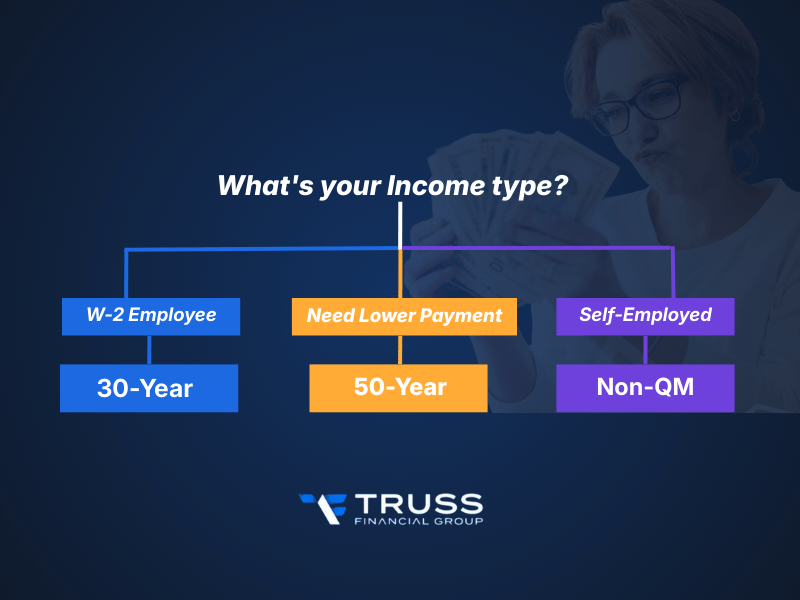
This is where borrower profile, financial goals, and hold timeline converge. There's no universal right answer, but there are clear fits:
- Long-term homeowner (10+ years) with stable W-2 income: 30-year for payment consistency and simplified budgeting
- First-time buyer stretching to meet a monthly payment threshold: A 50-year may lower the barrier, but only with a concrete refinancing plan before interest costs compound
- Short-term buyer (under 7 years): Compare the 50-year against an adjustable-rate mortgage. The ARM may offer lower payments without the same equity risk
- Self-employed borrower without traditional income documentation: Non-QM bank statement loan, structured around actual cash flow
- Real estate investor qualifying on rental income: Non-QM DSCR loan, which underwrites to the property's income, not personal tax returns
- Asset-rich borrower with irregular earnings: Non-QM asset depletion loan, which converts liquid assets into qualifying income
- Foreign national purchasing U.S. property: Non-QM foreign national loan, built for borrowers without a U.S. credit history
Many borrowers with multiple properties use different loan structures across their portfolio, matching each mortgage term and type to the specific property, strategy, and cash flow target. Mortgage brokers like Truss Financial Group's loan structuring expertise make a tangible difference: getting the right product in place before submission saves time, money, and significant stress.
Qualification Requirements
|
Criteria |
30-Year Mortgage |
50-Year Mortgage |
Non-QM Mortgage |
|
Min. Credit Score |
620+ |
TBD / evolving |
Varies; lower scores may qualify |
|
DTI Ratio |
Up to 43% |
TBD |
Up to 50% |
|
Income Documentation |
W-2s, paystubs |
Standard (evolving) |
Bank statements, 1099s, DSCR, assets |
|
Down Payment |
3-20% |
TBD |
Typically 20-30% |
|
Regulatory Backing |
Fannie /Freddie /FHA/VA |
Not currently QM-eligible |
Not CFPB-qualified |
|
Waiting Period (Bankruptcy) |
1-7 years |
TBD |
None in some cases |
One important note: self-employed borrowers and those with non-traditional income, including freelancers, investors, business owners, and gig workers, are almost always better served by non-QM loan options than by forcing a complex financial profile through conventional underwriting.
Not all applicants with high income and assets can meet QM standards, and that's exactly the gap non-QM was built to fill. Most lenders working within QM guidelines simply don't have the tools to evaluate these borrowers accurately.
Risks to Understand Before You Choose
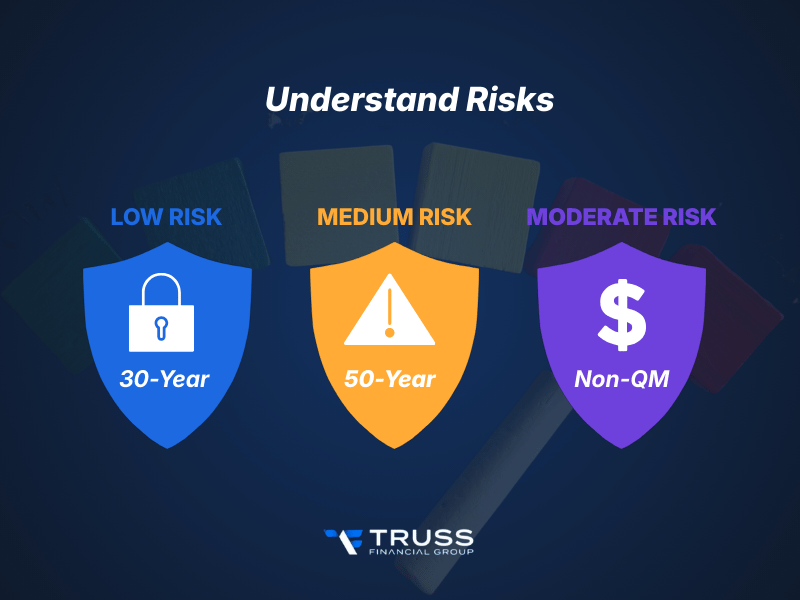
- 30-year risk: Locking in at a high rate without a refinancing plan is the primary exposure. Equity growth is slow in the early years, which limits flexibility if you need to sell or access home equity quickly.
- 50-year risk: Slower equity buildup increases the chance of going underwater if property values soften. Higher expected rates on top of an extended term loan structure mean total interest paid can be substantial. Urban development trends and local housing market conditions can further affect property values over half a century, adding another layer of increased risk for long-term holders. Refinancing out of a 50-year is a goal, not a guarantee.
- Non-QM risk: The rate premium and larger down payments increase the up-front cost. Balloon payments, interest-only periods, and negative amortization can appear in non-QM products, so reading the terms carefully matters. For most borrowers who qualify, the trade-off is well worth the access it provides.
Frequently Asked Questions
What is the difference between a 30-year and a 50-year mortgage?
A 30-year mortgage offers fixed payments over 30 years with government backing. A 50-year extension of the term lowers payments but increases lifetime interest significantly.
Is a 50-year mortgage available right now?
Not through government-backed channels. It doesn't meet qualified mortgage standards, and most lenders won't originate them without clearer regulatory backing.
Who should get a non-QM mortgage?
Self-employed borrowers, real estate investors, foreign nationals, and gig workers who can't meet conventional income documentation or DTI requirements benefit most from non-QM.
Are non-QM loans safe?
Yes, when properly structured. They're legal mortgage products, but carry fewer consumer protections than qualified loans. Review all terms carefully before signing.
Can I refinance from a 50-year mortgage into a 30-year mortgage?
Yes, but it's not guaranteed. Slow equity buildup over a 50-year period may limit refinancing options if home prices soften.
Can I refinance out of a non-QM loan into a conventional mortgage?
Yes. Many non-QM borrowers refinance into conventional loans once they establish qualifying income or improve their credit profile over time.
What is a DSCR loan, and who is it for?
A DSCR loan qualifies borrowers on rental income rather than personal income. It's built for real estate investors. Learn more about DSCR loans for investment properties.
What is a bank statement loan?
A non-QM mortgage that verifies income using 12-24 months of bank statements instead of W-2s. It's ideal for self-employed borrowers.
How much more interest do you pay on a 50-year mortgage vs. a 30-year?
Approximately 40% more. On a $415,200 home at 6.3%, the 50-year costs over $160,000 more in total interest paid.
What credit score do I need for a non-QM loan?
It varies by lender. Some non-QM products are accessible below 620. Higher scores still produce better rates and stronger underwriting approval outcomes.
Can real estate investors use a 30-year mortgage?
Yes, but it requires 15-25% down and strong credit. Most investors with complex income find non-QM DSCR loans more practical and accessible.
Which mortgage type builds equity the fastest?
The 30-year builds equity faster than the 50-year. Interest-only non-QM products build no equity early on, making slower equity buildup a key risk.
What is the difference between QM and non-QM mortgages?
QM loans meet CFPB repayment standards with DTI caps and documentation rules. Non-QM loans offer more flexibility with fewer built-in consumer protections.
What are the five types of mortgages?
Conventional, FHA, VA, USDA, and non-QM loans. Each supports fixed or adjustable-rate mortgage structures across varying loan terms and borrower profiles.
Can someone in their 50s get a 30-year mortgage?
Yes. Age isn't a legal basis for denial. Lenders evaluate income, creditworthiness, and ability to repay regardless of the borrower's age.
What are the two types of mortgages?
Fixed-rate and adjustable-rate. Fixed loans hold the same rate for the full term. Adjustable-rate mortgages reset periodically, introducing rate risk after the initial period.
Which Mortgage Is Right for You?
The 30-year works well for long-term homeowners with stable income who want payment consistency they can plan around. The 50-year offers lower monthly payments, but the lifetime interest cost and slower equity accumulation make it a product that demands a clear exit strategy, not just a lower number on a monthly statement.
Non-QM mortgages are in a category of their own, not because they carry more risk, but because they're built for a different kind of borrower entirely. If your income is real but unconventional, if your financial situation doesn't fit neatly into a tax return, or if you're an investor who needs underwriting approval based on cash flow rather than a W-2, non-QM isn't a workaround. It's the right tool.
Getting that decision right before you apply makes all the difference. Lenders like Truss Financial Group specialize in matching borrowers to the loan structure that actually fits, across all three mortgage types, from day one.

.svg)

Discuss your unique requirements
Get direct answers and a roadmap for your future.
.png?width=202&height=202&name=image%20588255187%20(1).png)


-2.png?width=389&height=221&name=Blog%20covers%20(7)-2.png)
%20(1)-1.png?width=40&height=40&name=image%20(65)%20(1)-1.png)



.svg)

.svg)
.svg)