.svg)



%20(1).svg)
%20(2).svg)
.png?width=480&height=420&name=Img%20(1).png)
%20(3).svg)
%20(4).svg)

%20(5).svg)


 View all states

14 mins

In this blog
Learning how to use home equity to pay off debt could save you thousands in interest charges. If you're juggling credit cards, medical bills, and personal loans, your home equity (the difference between your home's value and mortgage balance) offers a consolidation solution.
You can access equity through home equity loans (fixed lump sum) or HELOCs (revolving credit line). Consolidating high-interest debts into one lower-rate payment provides financial relief for disciplined borrowers with stable income.
The critical risk: your home becomes collateral. Miss payments and you risk foreclosure (converting unsecured debt into secured debt increases your stakes significantly).
Truss Financial Group specializes in flexible solutions for self-employed borrowers, real estate investors, and those with credit challenges who traditional banks reject.
What Is Home Equity?
Home equity is the portion of your home that you truly own (the difference between your home's current market value and your outstanding mortgage balance).
Here's a simple example: if your home is worth $400,000 and you owe $250,000 on your mortgage, you have $150,000 in equity. Most lenders allow you to borrow up to 80-85% of your home's value minus your mortgage balance, often leaving a 15-20% equity cushion; for this example, typically $120,000-$127,500 depending on lender and credit.
But remember: while home equity is a valuable asset, it's also collateral securing your loan. Using it means putting your home at risk if you encounter financial difficulties and can't make payments.

Home Equity Loan vs HELOC: Which Is Right for You?
Understanding the difference between these two products is critical for choosing the right debt consolidation strategy.
Home Equity Loan
A home equity loan provides a lump sum with a fixed interest rate and fixed monthly payments over a set term, typically 10-20 years. Interest accrues on the full amount from day one.
Best for: Borrowers who know exactly how much debt they need to pay off and want completely predictable payments that never change.
HELOC
A HELOC provides a revolving line of credit (similar to a credit card) with a variable interest rate. You get a draw period of 5-10 years during which you can borrow, repay, and borrow again while making interest-only payments. After the draw period ends, you enter a repayment period of 10-20 years where you pay both principal and interest. Some lenders offer fixed-rate conversion options.
Best for: Borrowers who want flexible ongoing access to funds or aren't sure of the exact amount they'll need.
Comparison at a Glance
|
Feature |
Home Equity Loan |
HELOC |
|
Payment Structure |
Lump sum |
Revolving credit |
|
Interest Rate |
Fixed |
Variable (fixed options available) |
|
Monthly Payment |
Fixed for the entire term |
Interest-only during draw, then principal + interest |
|
Best Use |
One-time debt payoff |
Flexible borrowing needs |
|
Predictability |
Complete |
Lower during the draw period |
Choose a home equity loan if you need a one-time payoff with completely predictable payments. Choose a HELOC if you want flexible ongoing access to funds. Learn more about how HELOCs work for debt consolidation.
Why Use Home Equity to Pay Off Debt?
When used strategically, home equity can deliver substantial financial benefits:
- Lower interest rates save thousands: Credit cards currently carry a national average of 19.60% APR, though rates can reach as high as 30% for those with lower credit scores. In comparison, national average HELOC rates are approximately 7.31%, while 10-year home equity loans average 8.08% for qualified borrowers.
- Simplified payments reduce stress: One predictable payment monthly instead of juggling multiple bills with varying due dates and rates.
- Fixed-rate protection (for home equity loans): Your payment never changes regardless of market conditions.
- Faster debt payoff: Lower interest rates mean more of your payment goes toward principal.
- Tax benefits: Interest on home equity products used for home improvements may be tax-deductible if you itemize deductions (consult a tax advisor).
The 2025 One Big Beautiful Bill Act (OBBBA) made the previous TCJA interest deductibility rules permanent. For the 2026 tax year, interest remains deductible only if the funds are used for substantial home improvements.
However, new provisions now allow for the deduction of Private Mortgage Insurance (PMI) and an expanded $40,000 State and Local Tax (SALT) cap, which may increase the overall tax benefit of itemizing for many homeowners.
Risks and Downsides
Home equity consolidation isn't right for everyone. Understand these risks before proceeding:
- Your home is collateral: Miss payments and you risk foreclosure (something impossible with credit card debt).
- Converts unsecured to secured debt: Credit card companies can't take your house; your home equity lender can.
- Temptation for new debt: Paying off cards often leads to reusing them, creating a cycle with both home equity debt and new credit card balances.
- Upfront costs: $2,000-$5,000+ in appraisal, title, origination, and closing fees eat into savings, especially for smaller debt amounts.
- Longer repayment timeline: Stretching debt over 10-20 years means paying more total interest despite the lower rate.
- Variable HELOC rates: Payments can increase when interest rates rise, potentially becoming unaffordable.
This strategy only works for disciplined borrowers committed to avoiding new debt and making consistent payments for many years.
What Debt Should You Consolidate?
Not all debt belongs in a home equity consolidation strategy.
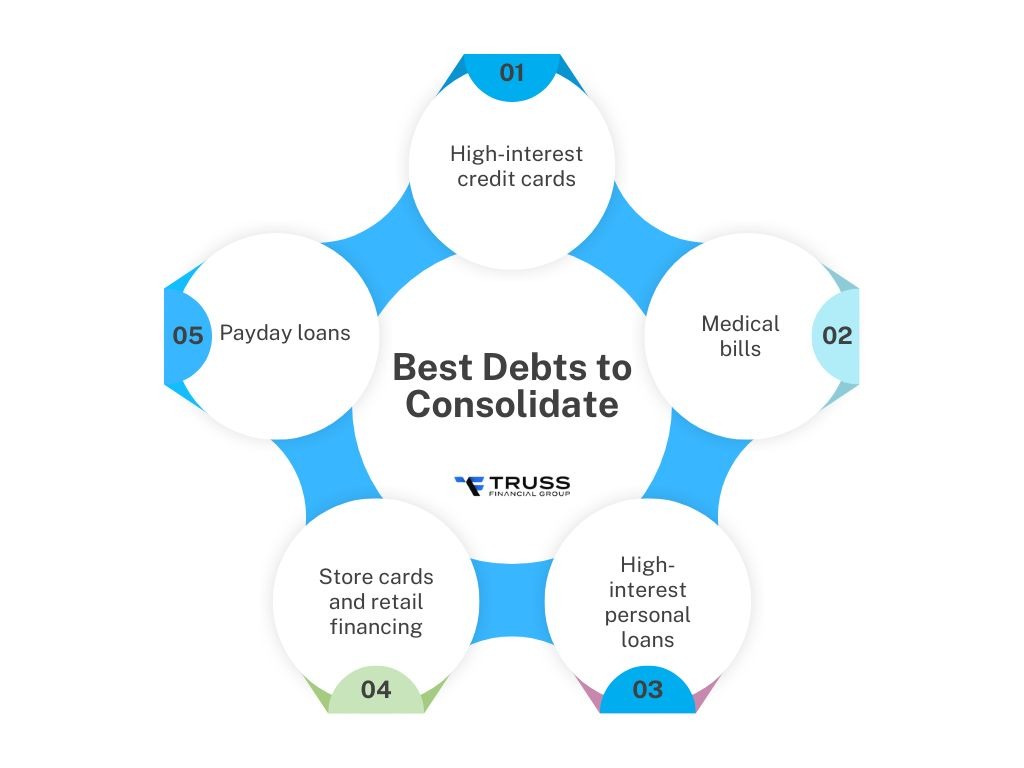
Best Debts to Consolidate
- High-interest credit cards (19.60% APR): The primary target for home equity consolidation
- Medical bills: Especially those in collections or charging high interest rates
- High-interest personal loans (10-15%+ APR): Worth consolidating if you can secure a significantly lower rate
- Store cards and retail financing: Often charge rates comparable to credit cards
- Payday loans: Extremely high-interest predatory products that should be eliminated immediately
Debts to Avoid Consolidating
- Car loans: Vehicles depreciate rapidly, and you risk owing more than the car is worth
- Federal student loans offer specialized protections, including the new Repayment Assistance Plan (RAP) launching in July 2026. These programs often provide income-based payments and forgiveness after a set term, benefits that are permanently lost if the debt is consolidated into a private home equity loan.
- Private student loans under 7%: If your rate is already competitive, don't risk your home
- Short-term debt payable in 6-12 months: Closing costs make consolidation inefficient for small amounts
- Vacations or luxury purchases: Never risk your home for discretionary spending
- Risky investments: Using home equity to invest is speculation, not consolidation
Home equity consolidation works best for high-interest unsecured debts you've been carrying for a while, not for secured debts, low-interest obligations, or discretionary spending.
How to Qualify for Home Equity Debt Consolidation
Traditional lenders typically require:
- Credit score: 620-680 at most banks
- Equity remaining: At least 15-20% after borrowing
- Debt-to-income ratio (DTI): 43% or lower, but specialized and online lenders may accept ratios as high as 50%, particularly for borrowers who can demonstrate significant monthly residual income after all obligations are met.
- Property type: Primary residences qualify most easily; second homes are harder; investment properties face significant restrictions at traditional banks
- Income verification: W-2 employees provide pay stubs and tax returns; self-employed borrowers traditionally need 2 years of tax returns (which often show low income due to business write-offs)
Alternative Qualification Paths for Non-Traditional Borrowers
Many homeowners don't fit traditional bank requirements but still qualify through specialized lenders:
- Self-employed borrowers: Use bank statement loans that evaluate deposits and cash flow instead of tax returns, recognizing that business write-offs lower reported income.
- Real estate investors: Access DSCR loans that qualify you based on rental property income rather than personal income, or tap equity from investment properties that traditional banks won't touch.
- Credit challenges: Work with lenders who approve borrowers at 620+ credit scores instead of requiring 680+.
- High DTI ratios: Access networks of 90+ lenders who evaluate your complete financial picture, not just DTI.
Truss Financial Group specializes in these flexible underwriting approaches for borrowers who don't fit traditional bank boxes, offering solutions when conventional lenders say no.
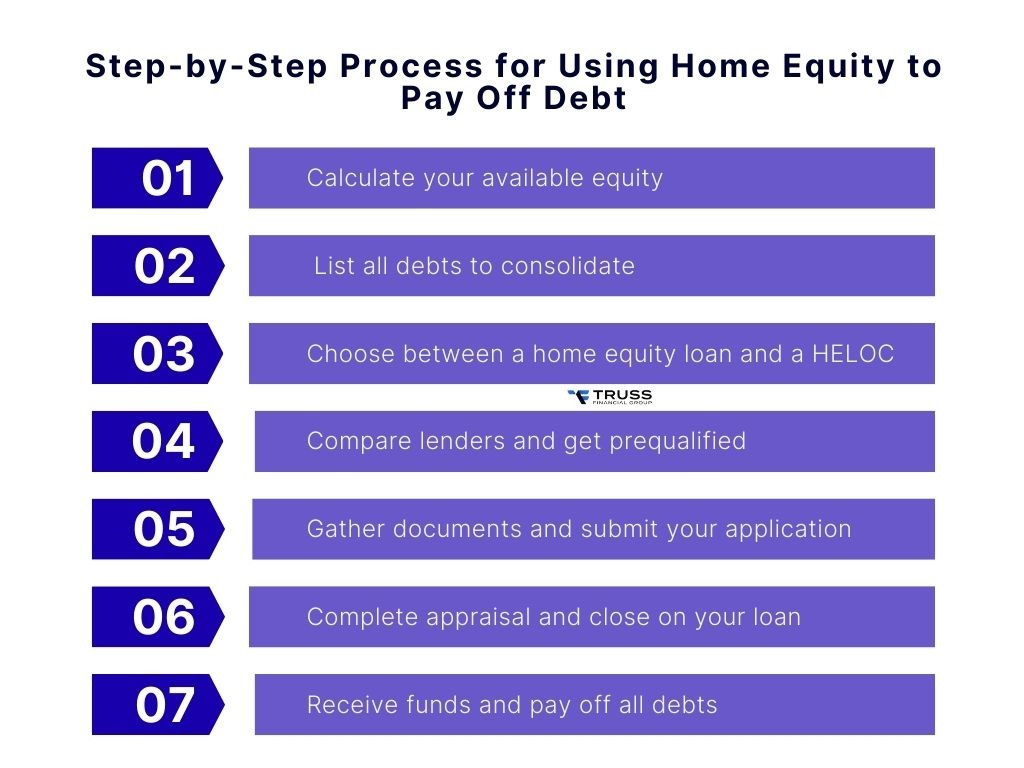
Step-by-Step Process for Using Home Equity to Pay Off Debt
Step 1: Calculate your available equity
Determine your home's current market value (use Zillow, Redfin, or similar sites for estimates), subtract your outstanding mortgage balance, then subtract your mortgage from 80-90% of the home value (CLTV limit) to estimate. Example: 85% of $400K = $340K max liens; minus $250K mortgage = $90K available (varies by lender).
Step 2: List all debts to consolidate
Create a detailed spreadsheet: lender name, current balance, interest rate, and monthly payment for each debt. This helps you determine exactly how much you need to borrow.
Step 3: Choose between a home equity loan and a HELOC
Based on whether you need a one-time fixed payment or flexible ongoing access to funds.
Step 4: Compare lenders and get prequalified
Shop rates with at least three lenders. Prequalification doesn't impact your credit score and gives you accurate rate and term estimates. For faster access to funds with streamlined HELOCs, consider lenders offering accelerated timelines.
Step 5: Gather documents and submit your application
You'll need recent pay stubs, tax returns (or bank statements for self-employed), mortgage statements, and property tax bills. Many lenders now offer digitally streamlined home equity applications that speed up the process.
Step 6: Complete appraisal and close on your loan
Traditional lenders typically take 2-6 weeks to close. However, some lenders and mortgage brokers can close in as little as 7-10 business days, and may offer HELOCs without traditional appraisals for qualifying borrowers. Review all closing disclosures carefully, sign documents, and pay closing costs.
Step 7: Receive funds and pay off all debts
Federal law requires a 3-day right of rescission for home equity loans on primary residences, meaning funds aren't available until at least 3 business days after closing. Once you receive funds, immediately pay off all target debts, confirm payoffs appear correctly on your credit report within 1-2 months, set up autopay on your new loan, and create a financial plan to avoid accumulating new debt.
Alternatives to Home Equity for Debt Consolidation
Home equity isn't the only option. Consider these alternatives:
- Balance transfer credit cards: 0% intro APR for 12-21 months, 3-5% transfer fee, requires 700+ credit, best for debt payable within 12-18 months.
- Personal loans: Unsecured, 8-15%+ rates, $50K-$100K max, 1-3 day funding, best for smaller amounts without home risk.
- Debt settlement: Negotiate a 40-60% payoff, severe 7-year credit damage, 15-25% fees, and forgiven debt is taxable, best for severe distress.
- Credit counseling: Nonprofit agencies negotiate 8-10% rates, structured 3-5 year plans, must close cards, best for professional guidance.
- Cash-out refinance: Replace mortgage with larger loan for cash difference, only worthwhile if lowering rate simultaneously. Learn more about cash-out refinance options.
Common Mistakes to Avoid
- Not addressing the root cause: If overspending or lack of emergency savings caused your debt, consolidation won't fix the underlying problem
- Running up new credit card balances: Paying off cards, then using them again, creates a dangerous cycle, leaving you with both home equity debt and new credit card debt
- Borrowing more than needed: Taking extra cash for non-essentials increases risk without solving your debt problem
- Not comparing multiple lenders: Rates and fees vary significantly; shopping around saves thousands
- Ignoring closing costs in calculations: Factor $2,000-$5,000+ in fees when calculating whether consolidation makes financial sense
- Choosing the wrong product: Match the product (loan vs HELOC) to your actual needs rather than choosing based on rate alone

When NOT to Use Home Equity for Debt Consolidation
Skip home equity consolidation if:
- Minimal equity: You have less than 20% equity remaining after borrowing
- Small manageable debt: Under $5,000-$10,000 in debt, where closing costs exceed savings
- Selling soon: Planning to sell your home within 1-2 years makes the upfront costs inefficient
- Lack of financial discipline: Honest concern that you'll accumulate new debt after paying off cards
- Severe financial hardship: Job loss, major income reduction, or overwhelming debt where even lower payments aren't manageable
- Credit too low: An under-620 credit score makes qualifying difficult and rates prohibitively expensive
- Unstable income: Irregular income makes consistent long-term payments risky
Frequently Asked Questions
Can I use a home equity loan to pay off credit cards?
Yes, this is one of the most common uses. You'll replace high-interest credit card debt (typically 19.60% APR, as of February 2026) with lower-interest home equity debt (typically 7.3-8.1%), potentially saving thousands in interest. However, your home becomes collateral, so you risk foreclosure if you can't make payments.
What's the difference between a home equity loan and a HELOC for debt consolidation?
The difference between a home equity loan and a HELOC for debt consolidation is that a home equity loan provides a lump sum with fixed rates and fixed payments (best for one-time debt payoffs). A HELOC provides revolving credit with variable rates and flexible access (best for ongoing borrowing needs or uncertain amounts).
How much can I borrow with a home equity loan?
Most lenders allow borrowing up to 80-90% combined LTV on home value (e.g., 15-20% equity remaining after). Some specialized lenders offer high-limit home equity solutions up to $3 million for qualifying borrowers.
What credit score do I need?
Traditional banks typically require 680+ credit scores. However, specialized lenders work with borrowers at 620 or slightly above, particularly for home equity options for self-employed borrowers or those with non-traditional income.
How long does it take to get a home equity loan?
Traditional lenders typically take 2-6 weeks to close. Some lenders can close in as little as 7-10 business days with streamlined processes. Remember that primary residences have a mandatory 3-day rescission period after closing before funds are available.
Are there closing costs?
Yes, expect $2,000-$5,000+ in appraisal fees, title searches, origination fees, and other closing costs. Some lenders waive certain fees or offer no-closing-cost options where costs are rolled into the loan rate.
Can self-employed borrowers get home equity loans?
Yes, though traditional banks make it difficult by requiring tax returns that show artificially low income due to business write-offs. Specialized lenders offer bank statement programs that evaluate actual deposits and cash flow instead.
Can I use equity from an investment property?
Traditional banks severely restrict or prohibit using equity from rental properties to consolidate debt. However, specialized lenders offer DSCR programs that qualify you based on property income rather than personal income.
What happens if I can't make payments?
You risk losing your home to foreclosure since it's collateral for the loan. Contact your lender immediately if you anticipate payment problems—many offer hardship programs or temporary modifications.
Should I consolidate student loans with home equity?
Generally no. Federal student loans offer low rates, flexible repayment options, and potential forgiveness programs you'll lose by paying them off. Private student loans under 7% typically aren't worth the risk of securing them with your home.
Can I use a HELOC to pay off a car loan?
You can, but it's rarely advisable. Car loans typically have reasonable rates, and vehicles depreciate rapidly. Converting auto debt into home-secured debt adds unnecessary risk without significant benefit.
Final Thoughts
Home equity consolidation can save thousands in interest, but requires discipline to avoid new debt. Your home becomes collateral, creating real foreclosure risk.
This works best for homeowners with stable income and commitment to long-term payments. For those rejected by traditional banks, Truss Financial Group offers bank statement loans and DSCR programs.
Compare all options before deciding. Success depends on addressing debt's root causes and maintaining financial discipline. Ready to explore your options? Check eligibility with no credit impact for a no-obligation consultation.

.svg)

Discuss your unique requirements
Get direct answers and a roadmap for your future.
.png?width=202&height=202&name=image%20588255187%20(1).png)







.svg)

.svg)
.svg)