.svg)



%20(1).svg)
%20(2).svg)
.png?width=480&height=420&name=Img%20(1).png)
%20(3).svg)
%20(4).svg)

%20(5).svg)


 View all states

15 mins

In this blog
-
Foreign buyers purchased $56 billion of U.S. existing homes from April 2024 through March 2025, according to the National Association of Realtors. Almost half paid cash, but that still leaves a substantial group of international buyers who need financing built around foreign income, foreign assets, limited U.S. credit, or all three.

The challenge is especially familiar to self-employed foreign nationals. A business owner may have strong deposits, valuable assets, and years of profitable operations abroad, yet still be unable to produce a U.S. W-2, U.S. tax return, or domestic credit score. A conventional lender sees missing boxes. A foreign national loan program looks at the financial evidence that actually exists.
This guide explains who foreign national mortgages are for, how self-employed international buyers can document income, when a bank statement or DSCR loan may fit, what lenders review, and how to compare the real costs before financing U.S. real estate.
What is a Foreign National Loan Program?
A foreign national loan is a specialized mortgage for a non-U.S. citizen whose permanent residence, income, or primary credit history is outside the United States. It is commonly used to purchase or refinance an investment property, second home, or vacation home when the borrower cannot qualify through standard agency underwriting.
These loans generally sit within the Non-QM mortgage market. Non-QM does not mean unregulated or that the lender ignores repayment ability. The Consumer Financial Protection Bureau's ability-to-repay rule still requires a reasonable, good-faith determination that a borrower can repay a covered residential mortgage. The difference is that a Non-QM lender may use documentation and underwriting methods that do not fit the Qualified Mortgage or agency framework.
Who Qualifies for a Foreign National Mortgage?

The strongest candidates are usually borrowers who can document a stable financial profile even though that profile is based outside the United States. Depending on the lender and program, eligible borrowers may include:
- Non-resident foreign citizens buying a U.S. rental property, second home, or vacation home
- Self-employed international business owners whose income is earned and deposited abroad
- Entrepreneurs, consultants, freelancers, and executives paid in a foreign currency
- Global real estate investors financing one-to-four-unit residential property
- Expats living abroad who want to acquire or refinance U.S. property
- Borrowers without a U.S. FICO score who can document foreign credit or acceptable credit references
Eligibility is not based on nationality alone. Lenders also consider the borrower's country of residence, sanctions and compliance restrictions, property use, source of funds, available reserves, business history, and whether documents can be independently verified. Program availability varies by lender and state.
| Borrower profile | Common financing path | Income location | Typical identification |
|---|---|---|---|
| Non-resident foreign national | Foreign national Non-QM loan | Primarily outside the U.S. | Foreign passport; visa if applicable |
| ITIN borrower living in the U.S. | ITIN or alternative-documentation mortgage | Often U.S.-based | ITIN and government-issued identification |
| Lawful permanent or eligible non-permanent resident | May qualify for agency or Non-QM financing | Usually U.S.-based | Residency or legal-presence documentation |
An Individual Taxpayer Identification Number is issued for federal tax purposes to certain people who need a U.S. taxpayer identification number but are not eligible for a Social Security Number. The IRS explains that an ITIN does not provide immigration status or work authorization. Having an ITIN can affect which mortgage programs are available, but it does not by itself determine residency or loan eligibility.
How Can a Self-Employed Foreign National Qualify?
Self-employed foreign national borrowers rarely have a clean U.S. payroll trail. Their income may move through a foreign corporation, partnership, professional practice, e-commerce business, consulting firm, or multiple accounts in different currencies. That does not make the income unusable, but it does make the documentation strategy central to the loan.
The right path depends on the property and the evidence available. A lender may use one of the following methods, or combine several of them:
Foreign Bank Statements
A lender may review 12 to 24 months of personal or business statements to identify recurring deposits and estimate usable income. This resembles a U.S. bank statement mortgage, but foreign currency conversion, translation, and verification add another layer.
CPA Letter and Business Financials
A licensed accountant may confirm ownership, time in business, and income. The lender may also request a year-to-date profit and loss statement, balance sheet, business registration, or client contracts. See Truss's guide to CPA letters for self-employed borrowers.
DSCR for Investment Property
A DSCR loan evaluates whether the property's rental income can support its housing obligation. Because qualification centers on the property rather than personal earnings, this can be a strong fit for a self-employed foreign national buying a rental.
Asset-Based Qualification
High-net-worth borrowers may qualify using verified liquid assets, reserves, or an asset-depletion calculation. The lender will still review ownership, accessibility, source, currency, and whether the funds can legally be transferred for closing.
For a deeper look at why conventional tax-return analysis can understate business income, read why self-employed buyers struggle to get mortgages. The point is not to avoid verification. It is to match verifiable cash flow, business strength, assets, or property income to the lender program designed to use it.
What Documents Do Foreign National Mortgage Lenders Request?
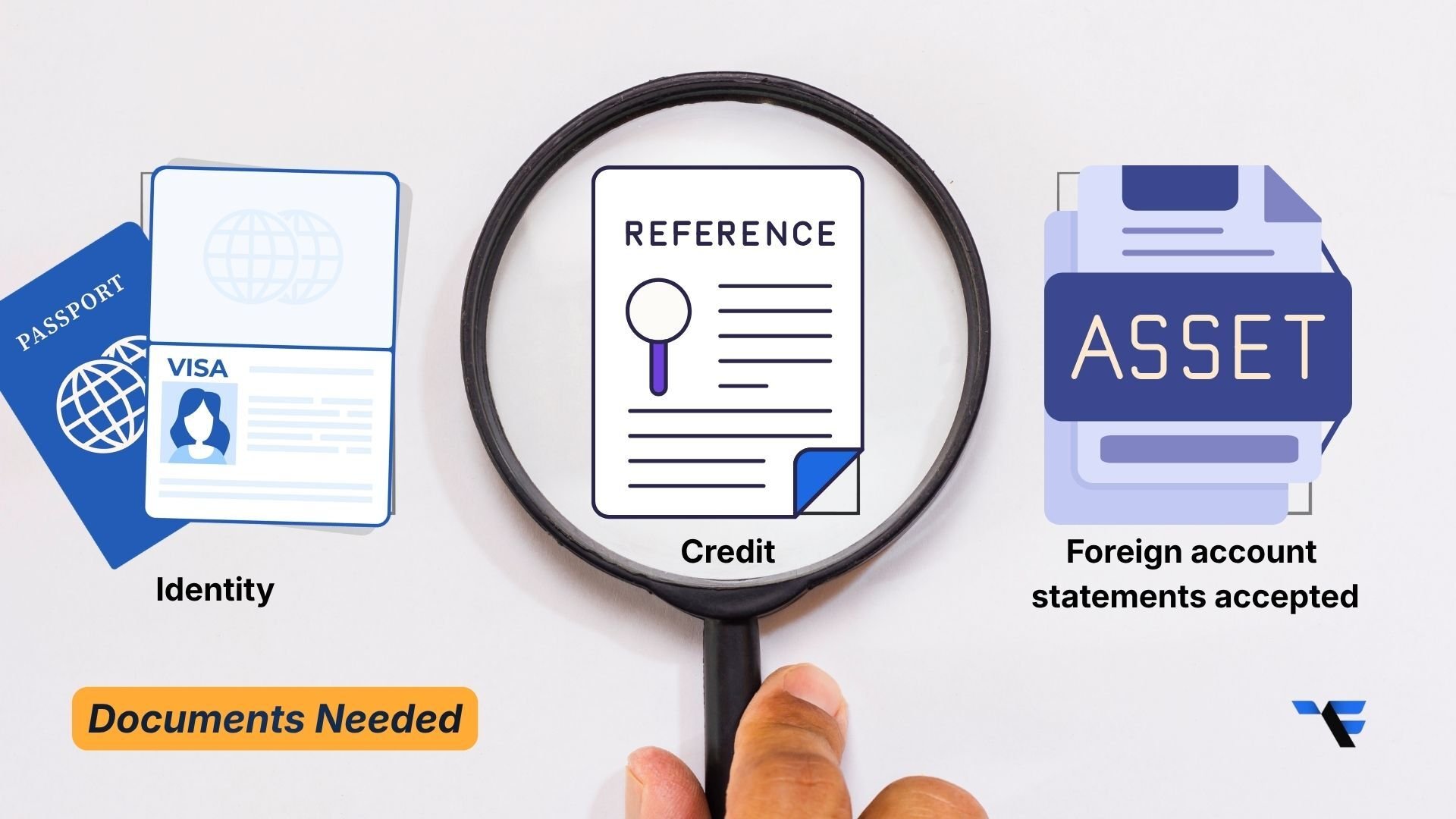
The final checklist depends on the lender, country, property, and qualification method. A well-prepared file commonly includes the following categories.
Identity and Residency
- Valid foreign passport
- Visa, entry record, or other residency documentation when applicable
- ITIN or other U.S. tax identification documentation if the program requires it
Credit History
- Foreign credit report from an accepted provider
- Credit reference letters from banks or other financial institutions
- Housing payment history or alternative trade references when permitted
Self-Employment and Income
- Business registration, ownership records, or professional license
- CPA or accountant verification letter
- 12 to 24 months of personal or business bank statements when using deposit-based qualification
- Profit and loss statement, balance sheet, invoices, or active contracts when requested
- Lease, market-rent analysis, or short-term rental data when using DSCR qualification
Assets and Source of Funds
- Recent statements for accounts holding the down payment, closing costs, and reserves
- Documentation for large deposits, transfers, gifts, or sale proceeds
- Currency conversion and transfer records
- Evidence that funds are seasoned, accessible, and owned by the borrower
Complete statements matter. Missing pages, unexplained transfers, mixed personal and business activity, and documents that cannot be authenticated are common sources of delay. Truss's guides to showing proof of self-employed income and preparing bank statements for mortgage review can help you organize the file before underwriting begins.
How the Foreign National Loan Process Works
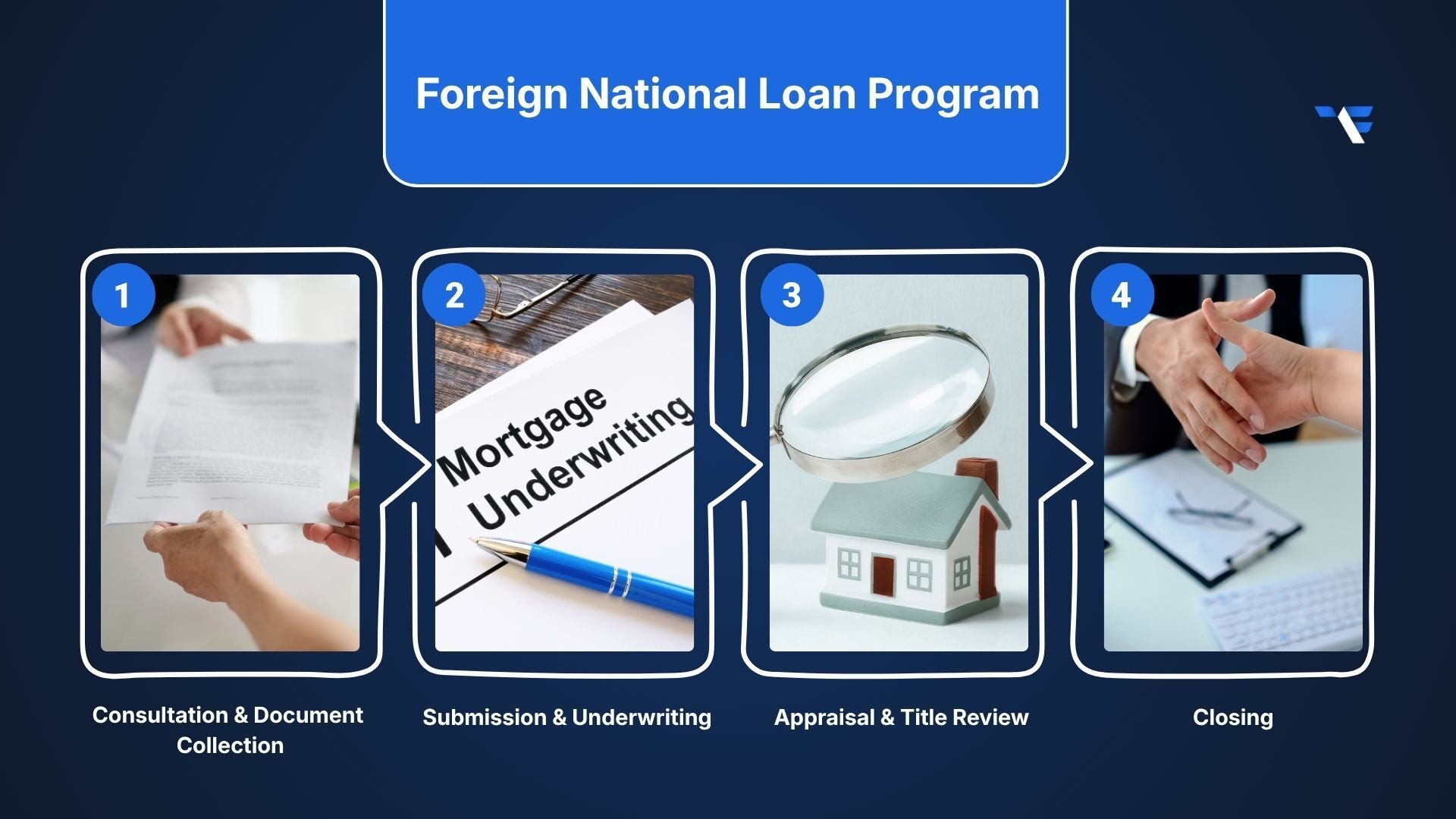
- Classify the borrower and property. The loan officer confirms residency, citizenship, income location, intended occupancy, property type, and whether foreign national, ITIN, agency, bank statement, asset-based, or DSCR underwriting is the logical starting point.
- Choose the documentation path. A self-employed borrower may be stronger with bank deposits and business records, while an investor may be better served by rental-income qualification. Choosing the method before collecting documents prevents wasted work.
- Verify credit, assets, and source of funds. The lender reviews foreign credit or references, down-payment funds, reserves, large transfers, and required compliance documentation. Translation and independent verification should begin early.
- Underwrite the property and loan. The appraisal, title work, insurance, and property eligibility are reviewed alongside the borrower's file. A DSCR loan adds analysis of rent and housing expense.
- Prepare for closing and international funds transfer. Confirm wiring instructions directly with the closing agent, allow time for international transfer controls, and keep a clear paper trail from the originating account to the closing account.
Timing note: there is no universal seven-day closing promise for foreign national loans. A complete, readily verifiable file can move quickly, but translation, foreign credit, appraisal, title, entity review, and international fund transfers can extend the timeline. Ask for a transaction-specific schedule before writing financing deadlines into a purchase contract.
Foreign National Loan Requirements and Typical Program Parameters
Foreign national mortgage requirements vary more than conventional guidelines. The following ranges are planning benchmarks, not a rate sheet or approval commitment. Current terms depend on the lender, property, transaction type, country, credit evidence, reserves, and documentation method.
| Requirement | Common program treatment | What can change it |
|---|---|---|
| Down payment | Often 25% or more | Property use, credit evidence, reserves, and loan size |
| Maximum LTV | Up to 75% on select purchase programs | Purchase versus refinance, property, and borrower strength |
| Loan amount | Jumbo and multi-million-dollar options may be available | Lender limits, property value, liquidity, and location |
| U.S. FICO | Not always required | Foreign credit, references, and lender rules |
| U.S. tax returns | Not required on select foreign national, bank statement, asset, or DSCR paths | Income method and borrower tax status |
| Reserves | Several months of housing payments are commonly required | Loan amount, DSCR, property count, and risk profile |
| Property use | Investment property, second home, or vacation home on many programs | Occupancy, unit count, and lender eligibility |
Truss's current Non-QM program overview lists foreign national options using alternative income such as bank statements, asset imputation, and rental DSCR, with select purchase LTVs up to 75%. Those are program-level examples, not universal terms. A personalized quote should be based on the complete file.
Foreign National Loan vs. Conventional Mortgage
| Feature | Foreign national mortgage | Conventional mortgage |
|---|---|---|
| Credit | Foreign credit or reference letters may be accepted | Standard U.S. credit underwriting |
| Self-employed income | Foreign bank statements, CPA letter, business financials, assets, or DSCR may be used | Typically tax-return analysis under agency rules |
| Down payment | Usually higher | Lower-down-payment options may be available |
| Pricing | Often higher because of portfolio and documentation risk | Agency market pricing for eligible files |
| Best fit | Non-resident buyers with foreign income, assets, or credit | Borrowers who meet agency residency, credit, income, and property rules |
If your residency and documentation support an agency loan, compare that option first because it may provide better pricing and a smaller down payment. Truss's guides to conventional loans and Fannie Mae and Freddie Mac explain the standard market. A foreign national loan is valuable when the standard framework does not recognize the borrower's real profile, not simply because the borrower holds a foreign passport.
The Honest Tradeoffs for Self-Employed International Buyers
- More cash is usually required. A larger down payment and stronger reserves reduce lender risk but tie up more of your capital at closing.
- Rates and fees may be higher. Foreign national mortgages are often portfolio or private-market products with less standardized pricing than agency loans.
- Verification is different, not absent. A no-U.S.-tax-return path can still require extensive foreign statements, business evidence, translations, and source-of-funds documentation.
- Currency movement affects the plan. Exchange rates can change the dollar value of income, assets, reserves, and the eventual payment burden.
- Tax and ownership questions are cross-border issues. Entity choice, rental-income taxation, estate planning, and eventual sale treatment should be reviewed with qualified U.S. and home-country professionals.
Nonresident owners of U.S. rental property can face specific federal tax and withholding rules. The IRS explains the general treatment and the possible election to treat qualifying rental income as effectively connected income on its page for nonresident aliens with U.S. real property. Mortgage guidance is not tax or legal advice, so coordinate the financing structure with professionals who understand both jurisdictions.
How to Strengthen a Self-Employed Foreign National Mortgage Application
- Separate personal and business accounts. Clean records make recurring income and owner transfers easier to understand.
- Prepare complete statements. Download every page for the full period requested and explain unusual deposits before the lender asks.
- Document business continuity. Registration records, accountant letters, contracts, and current financials help establish that the business is active.
- Keep extra liquidity. Do not plan to use every available dollar for the down payment; reserves can materially affect approval and pricing.
- Start translations early. Ask the lender which documents require certified translation and whether the translator must meet specific standards.
- Model the property before applying. Investors should calculate expected rent, taxes, insurance, HOA dues, management, vacancy, and maintenance rather than relying on gross rent alone.
- Compare written offers. The CFPB recommends comparing the rate, monthly payment, upfront costs, lender credits, cash to close, and five-year borrowing cost shown on Loan Estimates. See its guide to comparing mortgage offers.
If you are still deciding whether personal income or property income is the stronger route, use the self-employed mortgage calculator as an initial planning tool and then have a mortgage professional review the actual documentation. A calculator can organize the conversation; it cannot determine final eligibility.
Frequently Asked Questions
1. Can a self-employed foreign national get a mortgage in the United States?
Yes. Depending on the property and lender, a self-employed foreign national may qualify using foreign bank statements, an accountant letter, business financials, verified assets, foreign credit references, or DSCR qualification based on rental income. Approval still depends on the complete borrower and property profile.
2. Do foreign national mortgage lenders require U.S. tax returns?
Not on every program. Select foreign national, bank statement, asset-based, and DSCR programs may qualify a borrower without U.S. tax returns. The lender will still require documentation that supports income, assets, rental cash flow, and the ability to repay under the selected program.
3. Can foreign bank statements be used to qualify for a mortgage?
They may be accepted by certain foreign national and Non-QM lenders. Expect the lender to review statement completeness, recurring deposits, business expenses, currency conversion, ownership, translation, and independent verification. Requirements vary by lender and country.
4. Does a foreign national need a U.S. credit score or Social Security Number?
Not necessarily. Some foreign national mortgage programs accept a foreign credit report, bank reference letters, or alternative credit evidence and do not require a U.S. FICO score. Identification and tax-number requirements depend on the lender, borrower classification, and transaction.
5. Is an ITIN loan the same as a foreign national loan?
No. An ITIN is a U.S. federal tax-processing number, and ITIN mortgage programs commonly serve borrowers who live or earn in the United States but do not have an SSN. Foreign national programs generally serve non-resident borrowers whose income, assets, and credit are primarily outside the United States. Some borrowers could fit more than one category, so classification matters.
6. Can a foreign national use a DSCR loan for a U.S. rental property?
Yes, on programs that permit foreign national borrowers and eligible investment properties. A foreign national DSCR loan focuses on the property's expected or documented rental income relative to its housing obligation, reducing reliance on the borrower's personal tax returns.
7. How much down payment does a foreign national need?
Many programs require at least 25% down, and some require more. The final requirement depends on property use, loan amount, credit evidence, reserves, documentation type, and lender guidelines. Confirm the required cash to close before making an offer.
8. What properties can a foreign national finance?
Investment properties, second homes, and vacation homes are common. Many programs focus on one-to-four-unit residential properties, while select lenders offer broader options. Primary-residence eligibility depends heavily on residency, occupancy, documentation, and the specific loan program.
9. How long does a foreign national mortgage take to close?
The timeline varies. A complete file with readily verifiable documents may move quickly, while translation, foreign credit, entity review, appraisal, title, insurance, and international fund transfers can add time. Ask the lender for a file-specific timeline rather than relying on a universal closing promise.
10. Are foreign national mortgage rates higher than conventional rates?
They often are because foreign national loans commonly use portfolio or Non-QM underwriting and require different credit, income, and asset verification. Compare the interest rate, APR, points, lender fees, prepayment terms, monthly payment, and total cash to close rather than judging an offer by rate alone.
Build the Loan Around the Financial Profile You Actually Have
A self-employed foreign national does not need to manufacture a U.S. W-2 profile to finance U.S. real estate. The better approach is to identify the strongest verifiable evidence already available: business deposits, an accountant's analysis, liquid assets, foreign credit, or the rental income of the property itself.
Truss Financial Group helps international buyers and business owners compare foreign national, bank statement, asset-based, and DSCR mortgage options without forcing every file into the same documentation model. The right program depends on residency, property use, income location, credit evidence, reserves, and the way the transaction is structured.
Get a foreign national mortgage review built around your situation.
Tell the Truss team where you live, how your income is earned, and what type of U.S. property you want to finance.

.svg)

Discuss your unique requirements
Get direct answers and a roadmap for your future.
.png?width=202&height=202&name=image%20588255187%20(1).png)

.png?width=389&height=221&name=Blog%20covers%20(55).png)

.png?width=389&height=221&name=Blog%20covers%20(34).png)




.svg)

.svg)
.svg)