.svg)



%20(1).svg)
%20(2).svg)
.png?width=480&height=420&name=Img%20(1).png)
%20(3).svg)
%20(4).svg)

%20(5).svg)


 View all states

11 mins
In this blog
You can run a profitable business, make consistent deposits, and still have a harder time qualifying for a mortgage than a W-2 employee who earns less. That is one of the most frustrating realities of buying a home while self-employed.
The issue is usually not that a business owner cannot afford the payment. It is that traditional mortgage underwriting is designed to prove stable, documentable income over time. For entrepreneurs, freelancers, contractors, and partners in a business, that proof rarely arrives in one clean pay stub.
Quick Answer: Why Do Self-Employed Buyers Struggle to Get Mortgages?
Traditional lenders qualify borrowers on documented, stable income, not simply on gross revenue or the cash that moves through a business. Tax deductions, uneven monthly income, recent business changes, and more complex records can make a strong borrower look weaker on paper.
- Conventional financing can work when tax returns and business trends support the requested payment.
- Bank statement and Non-QM programs can evaluate income differently when tax returns understate real cash flow.
- Assets, credit, reserves, and property type still matter. Alternative documentation is not a shortcut around sound underwriting.
Why Strong Businesses Can Look Weak on a Mortgage Application
For a traditional loan, the lender is not only asking, "How much did this business bring in?" The lender is asking whether the income is stable, likely to continue, available to the borrower, and sufficient after existing debts are considered. Fannie Mae's self-employment guidance requires a lender to evaluate business stability, financial strength, and the ability of the business to keep generating enough income for the borrower to meet the proposed mortgage payment.
That is why a buyer can feel financially comfortable and still receive a lower approval amount than expected. The underwriting file needs to tell a consistent story from the tax returns, business records, bank statements, debt profile, and the buyer's ownership in the company.

Tax Planning Can Lower Qualifying Income
A well-run business often uses legitimate deductions for equipment, travel, payroll, home-office costs, depreciation, and other expenses. Those deductions may be smart tax planning, but they can reduce the net income a traditional lender uses to qualify you. The difference between gross and net income for self-employed borrowers matters because gross revenue alone is not the figure that determines mortgage eligibility.
Some expenses may be added back under applicable agency or lender rules, but not every deduction can be treated that way. The right question is not, "How much revenue did I make?" It is, "What income will this loan program recognize after its analysis?"
Underwriters Need a Track Record, Not Just a Great Recent Month
A salary is usually verified with recent pay stubs and a W-2. Self-employment income is more involved. Fannie Mae generally calls for a two-year earnings history, while allowing some borrowers with a shorter self-employment history to be considered when their prior experience and documentation support the case. A new contract, a busy season, or one exceptional year may be encouraging, but it does not automatically establish a durable qualifying trend.
Business Income Is Not Always Personal Income
Partnership, S-corporation, and LLC income can be more complicated than a sole proprietor's income. The business may retain cash for payroll, inventory, expansion, or operating reserves. A lender needs to understand whether income shown on a return was actually distributed, or whether taking it out of the company would weaken the business. This is why self-employed mortgage files often need more context than a simple income total.
Uneven Income Creates More Questions, Not an Automatic Denial
Seasonal revenue, commission-heavy work, client turnover, and a recent drop in profit can all require a closer look. Lenders examine the direction of gross income, expenses, and taxable income over time. A clean explanation and orderly records can help. So can separating personal and business activity instead of asking an underwriter to untangle every deposit and transfer.
What Traditional Mortgage Underwriting Actually Reviews
The exact checklist changes by loan program, ownership structure, and lender, but a conventional self-employed mortgage file often includes more than a personal tax return. Fannie Mae's guidance illustrates why: lenders may analyze personal and business tax returns, earnings history, the viability of the business, and income trends before determining what can be used to qualify.
| What the lender reviews | Why it matters |
|---|---|
| Personal and business tax returns | Shows reported income, expenses, ownership structure, and multi-year trends. |
| Business income and expenses | Helps determine whether the business can continue to support the income used for qualifying. |
| Ownership and business existence | Confirms the borrower's role, share of income, and self-employment history. |
| Current financial activity | May show whether the business is operating consistently with the income reported in the file. |
| Debt, credit, assets, and reserves | Income is only one part of the lender's assessment of capacity and risk. |
For a sole proprietor, a Schedule C is one of the common records that shows business profit or loss on the individual tax return. The IRS explains the role of Schedule C, but it is important to remember that a mortgage underwriter applies loan-program rules, not tax advice, when calculating qualifying income.
Mortgage Loans for Self-Employed Buyers: Which Paths Can Fit?
Being self-employed does not automatically mean you need an alternative mortgage. Many buyers still qualify through a conventional, jumbo, FHA, or VA path when their documented income supports it. The best option is the one that reflects the way you actually earn, not the one with the shortest document list.
1. Conventional Financing When Tax Returns Tell the Full Story
A conventional mortgage can be a strong fit when your income is stable or improving, your tax returns show enough qualifying income, and the business has a clear operating history. The broader self-employed mortgage guide is the right next read if you want a program-by-program overview before comparing quotes.
2. Bank Statement Loans When Deposits Tell a More Accurate Story
A bank statement loan is designed for borrowers whose tax returns understate their usable income. Rather than relying primarily on W-2s and tax returns, the lender analyzes a set period of personal or business deposits, commonly 12 or 24 months, and applies the program's approach to business expenses and ownership. It can suit consultants, freelancers, agency owners, realtors, and other borrowers with stable deposits but aggressive, legitimate deductions.
3. Asset Depletion When Wealth Is Stronger Than Taxable Income
For a buyer with substantial liquid assets but limited qualifying income, an asset depletion loan may convert eligible assets into a qualifying income stream under the program's formula. This is often worth exploring for business owners who have accumulated cash, brokerage assets, or retirement funds but do not want a mortgage decision to rest entirely on a low taxable income figure.
4. Non-QM Programs When the Conventional Box Is the Problem
A Non-QM mortgage is not one single loan. It is a category of programs that can use alternative documentation or more flexible structures when conventional agency rules do not fit. The tradeoff may be a higher rate, larger down payment, stronger reserve requirement, or a different loan term, so compare the total cost and the long-term fit, not just the approval amount.
How to Make Your Mortgage File Easier to Underwrite
The best time to organize a self-employed mortgage file is before you are negotiating on a house. A borrower who understands their qualifying income early can shop with a more realistic price range and avoid changing loan programs at the last minute.
- Separate business and personal activity. Clean accounts make it easier to identify recurring income, explain transfers, and document the actual health of the business.
- Know your net income, not just your revenue. Review how deductions affect the income a conventional lender may use before you set a purchase budget.
- Prepare records before preapproval. Depending on the path, that can include tax returns, business returns, bank statements, a year-to-date profit and loss statement, proof of ownership, and asset statements.
- Do not ignore debt and credit. A lower debt-to-income ratio, a strong credit profile, and adequate reserves can improve the available options even when income documentation is complex.
- Match the program to the actual income source. A buyer paid mainly through 1099s may need a different discussion than a shareholder with retained earnings or an entrepreneur with meaningful liquid assets. See the guide to getting a mortgage as a 1099 contractor for a more specific example.
A Better First Step Than Guessing
Use Truss's self-employed mortgage calculator to model a starting point from your deposit history, then have a mortgage professional review the real documentation before you make an offer. A calculator can help with planning; it cannot replace underwriting.
When an Alternative Mortgage Is an Upgrade, Not a Shortcut
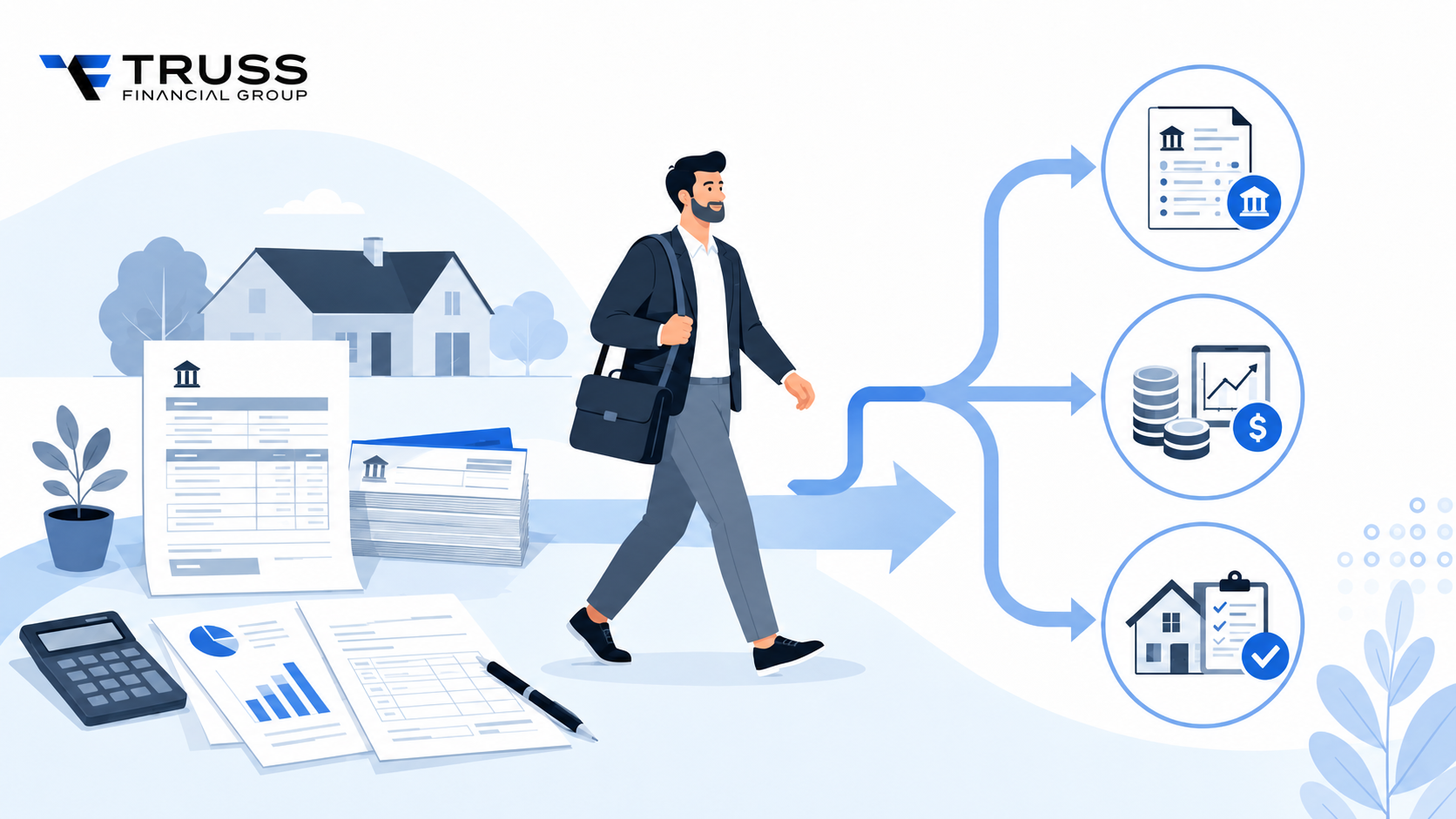
Alternative qualification is useful when it measures a real financial picture more accurately. It is not a way to sidestep the responsibility to repay. Lenders still evaluate credit, property value, down payment, debt, reserves, and the consistency of whatever income or assets the program recognizes.
A bank statement loan may be worth the additional cost when it lets a buyer qualify on sustainable cash flow rather than an artificially low tax-return figure. An asset depletion loan may make sense when wealth is already in place. The best choice depends on your timeline, how long you expect to own the home, and whether the payment remains comfortable under the loan's actual terms.
Frequently Asked Questions
1. Can a self-employed person qualify for a mortgage?
Yes. Many self-employed buyers qualify with conventional financing, while others use bank statement, asset depletion, or other Non-QM programs. The right path depends on how income is documented, the business history, credit, debt, assets, and the property being financed.
2. How long do I need to be self-employed to get a mortgage?
Many conventional files use a two-year history. Some borrowers with at least one full year in the current business may be considered when they can document prior experience in the same or a similar field. Exact requirements vary by program and lender.
3. Do business tax deductions hurt my mortgage approval?
They can lower the taxable income used in a traditional mortgage analysis. Some deductions may be treated differently under lender guidelines, but gross revenue alone does not become qualifying income. Review the loan analysis before assuming that revenue translates into buying power.
4. Are bank statement loans more expensive than conventional mortgages?
They can carry a higher rate, larger down payment, or stronger reserve requirements because the income verification method is different. Compare the full pricing, payment, fees, and expected holding period against the benefit of qualifying on a more accurate income picture.
5. Can freelancers and 1099 contractors get mortgage loans?
Yes. Freelancers and 1099 contractors can qualify when their income history and documentation meet the selected program's rules. Tax returns may work for some borrowers; bank statements or a program designed around 1099 income may fit others better.
6. What documents should a self-employed buyer prepare before preapproval?
Start with recent personal and business tax returns if available, bank statements, a current profit and loss statement, proof of business ownership, identification, and asset statements. A lender can then narrow the final checklist based on the loan program and business structure.
Your Income Is Complex. Your Mortgage Strategy Should Be Clear.
A self-employed buyer should not have to choose between an unrealistic approval amount and a loan that does not fit. Truss Financial Group helps business owners, freelancers, and contractors compare conventional and alternative mortgage paths around the way they actually earn.

.svg)

Discuss your unique requirements
Get direct answers and a roadmap for your future.
.png?width=202&height=202&name=image%20588255187%20(1).png)


%20(1)-1.png?width=40&height=40&name=image%20(65)%20(1)-1.png)


.svg)

.svg)
.svg)