.svg)



%20(1).svg)
%20(2).svg)
.png?width=480&height=420&name=Img%20(1).png)
%20(3).svg)
%20(4).svg)

%20(5).svg)


 View all states

14 mins
-1.png)
In this blog
If you pay taxes in the United States but don't have a Social Security Number (SSN), you may have assumed homeownership was out of reach. It isn't. An ITIN mortgage loan (a home loan that uses your Individual Taxpayer Identification Number in place of an SSN) is a real and legitimate home financing option that has helped thousands of resident aliens and non-U.S. citizens purchase their dream home across the country.
Mortgage lenders like Truss Financial Group specialize in helping non-traditional borrowers navigate exactly this path. This guide covers everything you need to know: how ITIN home loans work, what it takes to qualify, what the process looks like from application to closing, and how these mortgage options compare to traditional mortgages. By the end, you'll know exactly where you stand and what to do next.
What Is an ITIN, and How Does an ITIN Loan Work?
What Is an ITIN?
An Individual Taxpayer Identification Number (ITIN) is a nine-digit tax processing number issued by the Internal Revenue Service to individuals who are required to file U.S. federal tax returns but are not eligible for a Social Security Number. It is issued regardless of immigration status; both documented and undocumented individuals may hold one.
To apply for an ITIN, borrowers submit:
- IRS Form W-7 along with proof of identity and foreign status
- Valid options include a passport, driver's license, visa, or military ID
The IRS Taxpayer Assistance Center can also help with in-person ITIN applications. The individual tax identification number does not authorize work in the U.S. and carries no inference about immigration status. Its purpose is tax compliance, full stop.
The scale of ITIN usage in the United States is significant. According to a 2026 Treasury Inspector General for Tax Administration (TIGTA) assessment, the IRS has issued approximately 31 million ITINs since the program's inception, with roughly 5 million currently active and nearly 470,000 new numbers issued in a single calendar year. In 2022 alone, approximately 3.8 million tax returns included an ITIN, representing $14.4 billion in taxable income and $6.5 billion in Social Security and Medicare taxes paid, a figure that underscores just how deeply embedded ITIN filers are in the U.S. economy.
How Does an ITIN Loan Work?
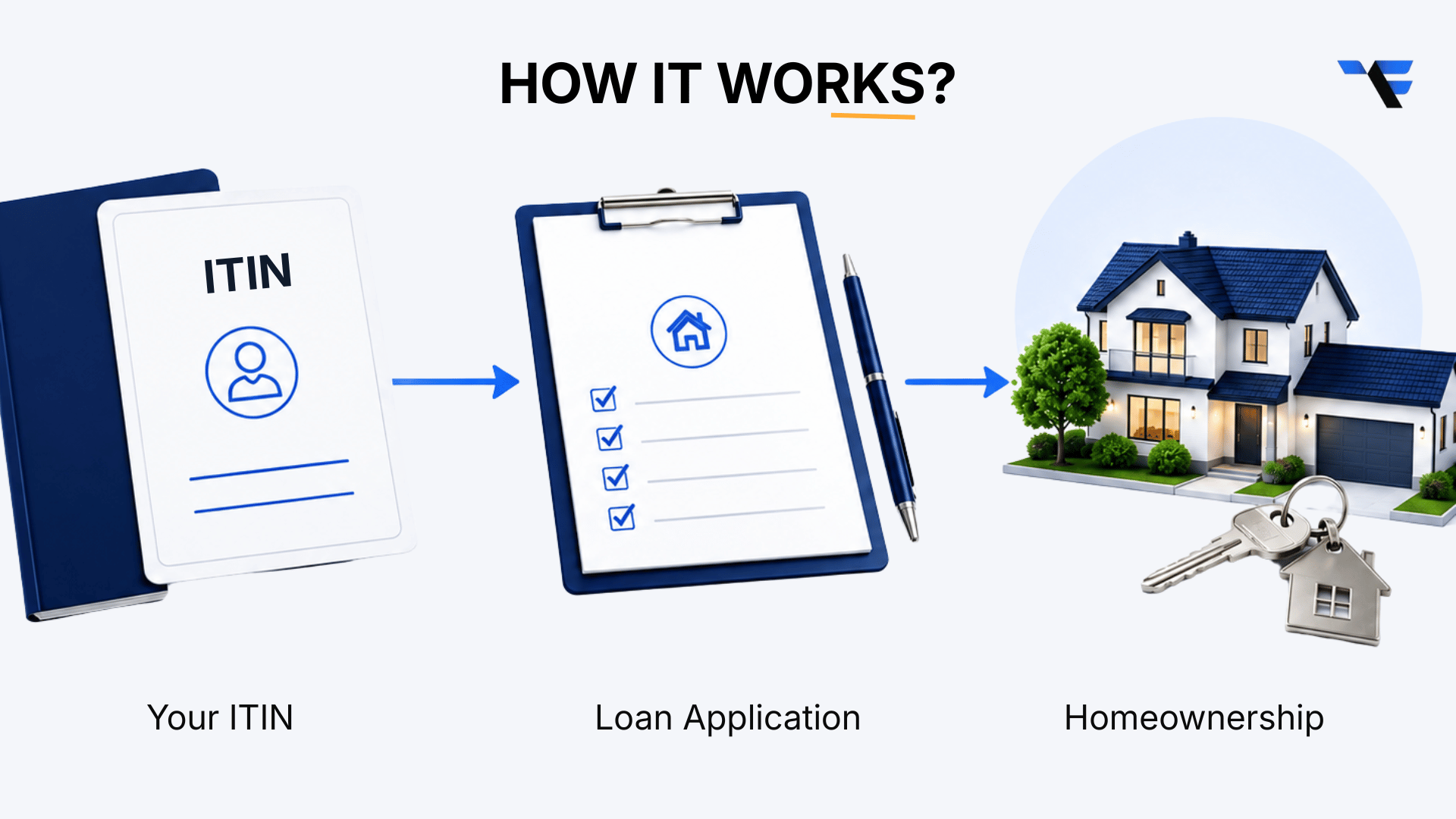
An ITIN mortgage loan uses your ITIN in place of an SSN on a home loan application. Because these loans fall outside the standard underwriting guidelines set by Fannie Mae and Freddie Mac, they are classified as non-qualified mortgages (non-QM). That designation doesn't mean high-risk or predatory; it simply means the loan is evaluated using alternative documentation criteria rather than the government-backed template. Here is how the process works at a high level:
- The borrower applies using their ITIN in place of an SSN, with no Social Security Number, green card, or citizenship required.
- The lender evaluates the application using alternative documentation: tax returns, bank statements, employment history, and credit profile.
- The loan is underwritten against non-QM criteria rather than Fannie Mae or Freddie Mac standards.
- If approved, the borrower receives financing to purchase an eligible property, typically a primary residence.
- Monthly mortgage payments are reported to the major credit bureaus, building U.S. credit history over time.
Select banks, credit unions, and non-QM lenders offer ITIN loans. Unlike FHA, VA, and USDA loans, which require a valid SSN, ITIN mortgage loans open the door to qualified borrowers who would otherwise have no path to home financing. For many, this is the right loan to gain access to homeownership despite the financial challenges that come with building a life in a new country.
What Are the Eligibility Requirements for an ITIN Mortgage Loan?
-1.png?width=1920&height=1080&name=Blog%20Graphics%20(1)-1.png)
ITIN loan eligibility runs on two tracks:
- The loan
- The borrower
Most programs are for primary residences, though some lenders extend to second homes or investment properties. Eligible property types typically include single-family homes, condos, townhouses, and 2-4 unit multi-family properties.
On the borrower side, lenders generally require:
- a minimum credit score of 640-660
- two years of U.S. credit history (or an international credit report)
- two years of consistent employment
- two years of tax returns filed using the ITIN
- a higher down payment of 15-25% compared to traditional mortgages.
DTI should sit at or below 43-50%. No SSN, green card, or citizenship required.
Meeting these ITIN loan requirements demonstrates proof of financial stability, and borrowers with a thin U.S. credit file may supplement with rent payment history, utility bills, or recurring insurance payments to satisfy income requirements.
|
Requirement |
Typical Threshold |
|
Minimum credit score |
640-660 (some programs require 700) |
|
Down payment |
15-25% depending on credit score and lender |
|
Employment history |
Minimum 2 years (pay stubs, W-2, or bank statements) |
|
Tax returns |
2 years filed using ITIN |
|
Debt-to-income ratio |
Generally 43-50% maximum |
|
SSN required |
No |
|
Green card required |
No |
What Documents Do You Need to Apply for an ITIN Home Loan?
The ITIN mortgage application has stricter documentation requirements than a standard conventional loan, not because the process is more complicated, but because lenders are verifying financial credibility through alternative means. Understanding these documentation requirements and knowing what to gather before you contact a lender makes the pre-approval process significantly smoother.
Here is what most ITIN lenders will ask for:
- Valid ITIN (ITIN card or IRS letter confirming the number)
- Government-issued photo ID: passport, visa, military ID, driver's license, or USCIS-issued identification
- Two years of U.S. federal tax returns filed using the ITIN
- Recent pay stubs or an employer verification letter (or 12-24 months of bank statements for self-employed borrowers)
- Bank or investment account statements showing proof of down payment funds
- Gift letters if any portion of the down payment is coming from a family member
- Rent payment history or utility bills for borrowers with a thin U.S. credit file
Some lenders may also request additional proof of creditworthiness or additional documentation specific to their credit approval process. Assembling everything before you approach a lender, not after, signals that you are a prepared, serious buyer and avoids the back-and-forth delays that slow down underwriting.
Are ITIN Loans Available for Self-Employed Borrowers?
Yes, and this is one of the areas where ITIN lending is genuinely well-suited to the borrower's reality. A significant share of ITIN holders are self-employed: freelancers, contractors, small business owners, and sole proprietors who earn and file taxes but can't verify income through pay stubs or W-2s.
Most ITIN lenders accommodate this through bank statement programs, reviewing 12 to 24 months of personal or business statements to calculate average monthly income. Alongside those, borrowers should expect to provide a business license and a CPA letter verifying the nature and duration of the business.
Lenders may apply a slightly higher credit score or down payment threshold to self-employed applicants, but self-employment is not a disqualifier; it's a documentation question, and one experienced ITIN lenders know how to work with.
How Do ITIN Loans Compare to Conventional Mortgages?
-1.png?width=1920&height=1080&name=Blog%20Graphics%20(2)-1.png)
Both ITIN loans and conventional mortgages let you buy a home and build equity; the monthly repayment structure, amortization schedule, and fixed payoff date work the same way. The differences lie in eligibility, cost, and who the loan is designed for.
|
ITIN Loan |
Conventional Mortgage |
|
|
SSN required |
No |
Yes |
|
Government-backed |
No (non-QM) |
Yes (Fannie Mae / Freddie Mac) |
|
Minimum down payment |
15-25% |
3-5% |
|
Interest rate |
Typically 1-3% above conventional |
Standard market rate |
|
Closing costs |
2-6% of loan amount |
2-6% of loan amount |
|
FHA / VA / USDA eligible |
No |
Yes |
|
Refinance path available |
Yes, once SSN obtained |
N/A |
For most ITIN borrowers, the honest comparison isn't between an ITIN loan and a conventional mortgage; it's between an ITIN loan and continuing to rent indefinitely as home prices keep rising. Framed that way, the higher rate and larger down payment look different. Major banks and online lenders rarely offer ITIN products, which is why working with a specialist matters.
And once you obtain an SSN and build credit, refinance options into a conventional mortgage become available, substantially reducing your rate and monthly payment.
What Interest Rates and Costs Should You Expect on an ITIN Loan?
Interest Rates
ITIN mortgage rates are higher than conventional rates. That's the honest starting point. The premium typically runs 1-3 percentage points above standard market rates, reflecting the non-QM underwriting model and the alternative documentation profile of most ITIN borrowers.
Some lenders offer competitive interest rates within the non-QM space, so the maximum loan amount and rate you can access will vary depending on your credit score, loan-to-value ratio, loan amount, and the individual lender's pricing. They are not standardized, which makes comparison shopping across ITIN lenders genuinely worthwhile.
Costs to Expect at Closing
The down payment is 15-25% of the purchase price. Closing costs, covering origination fees, appraisal, title search, prepaid interest, and taxes and insurance, typically run 2-6% of the loan amount, consistent with conventional mortgage closing costs.
Some lenders accept gift funds from family members to cover part or all of the down payment and closing costs, which can meaningfully reduce the cash required at closing. There are no special ITIN-specific fees. The higher cost of borrowing comes from the rate premium and larger down payment, not from hidden charges.
Private mortgage insurance (PMI) may apply if the loan-to-value ratio exceeds 80%, though the 20-25% down payment most ITIN programs require is specifically designed to clear that threshold. Whether PMI applies and how it is structured varies by lender.
How Do You Apply for an ITIN Mortgage, and What Does the Process Look Like?
The ITIN loan process follows the same basic arc as any conventional mortgage. What's different is the documentation phase, which is longer and more involved. Starting it early, before you're actively searching for a home, is the single most practical thing you can do to keep the timeline on track.
Here is how the process works, step by step:
- Identify a lender that offers ITIN programs: Not all lenders do. Working with one that has direct experience with ITIN mortgage underwriting matters.
- Get pre-approved: Submit your ITIN, tax returns, income documentation, and bank statements for an initial credit and financial review. The pre-approval letter tells sellers you are a serious, qualified buyer.
- Make offers on eligible properties: With a pre-approval in hand, you can make competitive offers on qualifying homes: single-family, condo, townhouse, or 2-4 unit multi-family properties in most programs.
- Submit a full loan application: Once your offer is accepted, complete the formal application and submit any remaining documentation the lender requests during underwriting.
- Go through underwriting: The lender verifies income, employment, credit, and the property appraisal. ITIN underwriting can take slightly longer than conventional due to the documentation volume, so budget for this.
- Close the loan: Sign all required documents, pay the down payment and closing costs, and receive your keys.
Is an ITIN Loan the Right Move, or Should You Wait?
Research from the Harvard Joint Center for Housing Studies documents the unique barriers immigrants face in accessing homeownership, including limited credit history, alternative employment structures, and restricted access to conventional financing. ITIN loans exist precisely to address this gap, but they are the right tool only when the numbers work.
The loan makes sense when you have:
- stable income
- a credit score at or above 640
- sufficient savings for the 15-25% down payment
- two years of tax returns on file
- and you want to build equity now rather than wait.
It may not be the right move if:
- your score is below 640
- your savings aren't yet at 15%
- your DTI is too high
- you're close enough to obtaining an SSN that a conventional product is within reach in 12-18 months.
Borrowers still working through financial challenges, such as limited credit or irregular income, may benefit from first resolving those factors rather than taking on a personal loan or mortgage with less favorable terms.
Lenders like Truss Financial Group specialize in exactly these scenarios, covering non-traditional borrower situations where the right answer isn't always obvious. If you're not sure whether an ITIN loan or waiting makes more financial sense, that's the conversation to have before committing to either path.
Frequently Asked Questions
1. Can I buy a house with an ITIN number if I'm undocumented?
Yes. ITIN loans do not require legal immigration status, a green card, or an SSN. The loan is evaluated on financial qualifications: income, credit history, and down payment. The IRS issues ITINs regardless of immigration status, and once your ITIN application is complete, lenders offering these loan types evaluate borrowers on that same financial basis, not immigration status.
2. What is the minimum down payment for an ITIN loan?
Most ITIN programs require a minimum down payment of 15-25% of the purchase price, depending on the lender and the borrower's credit score. Borrowers with stronger credit profiles may qualify at the lower end of that range.
3. Can I qualify for an ITIN home loan with no U.S. credit history?
Some lenders will consider borrowers with limited or no U.S. credit file by accepting alternative documentation, including consistent rent payments, utility bills, recurring insurance payments, or an international credit report from the borrower's country of origin. Options are more limited, and terms may be less favorable, but it is possible.
4. What banks or lenders offer ITIN loans?
ITIN loans are offered by select banks, credit unions, and non-QM mortgage lenders. Not all financial institutions offer them. Working with a lender that has direct ITIN mortgage experience is important for a smooth process.
5. Can I refinance an ITIN loan later?
Yes. Once you obtain a Social Security Number and meet standard conventional underwriting criteria, refinancing into a conventional mortgage is a realistic and common next step, one that can meaningfully reduce your rate and monthly payment.
6. Does getting an ITIN loan affect my credit score?
The application involves a hard credit inquiry, which may temporarily reduce your score by a small amount. Over time, consistent on-time mortgage payments build your U.S. credit history and improve your score.
7. Are there government assistance programs for ITIN homebuyers?
Federal programs (FHA, VA, USDA) require an SSN and are not available to ITIN-only borrowers. Some state and local down payment assistance programs may be accessible depending on jurisdiction and residency status; this varies significantly by location and is worth confirming with a local lender or HUD-approved housing counselor.
Ready to Find Out If an ITIN Loan Is Right for Your Situation?
An ITIN mortgage loan is a legitimate, accessible path to homeownership for non-U.S. citizens who have the income, credit history, and savings to qualify, even without a Social Security Number. The question is never whether these loans exist; it's whether the numbers work for your specific loan scenario, credit profile, and financial situation.
Mortgage brokers like Truss Financial Group work with borrowers in exactly this position every day, looking at the actual loan scenario and giving a straight answer about whether an ITIN mortgage, a waiting strategy, or a different approach is the right move.

.svg)

Discuss your unique requirements
Get direct answers and a roadmap for your future.
.png?width=202&height=202&name=image%20588255187%20(1).png)


-3.png?width=389&height=221&name=Blog%20covers%20(1)-3.png)

-2.png?width=389&height=221&name=Blog%20covers%20(7)-2.png)



.svg)

.svg)
.svg)