.svg)



%20(1).svg)
%20(2).svg)
.png?width=480&height=420&name=Img%20(1).png)
%20(3).svg)
%20(4).svg)

%20(5).svg)


 View all states
As a First-Time Homebuyer, Can I Use My 401(k) for a Down Payment?

6 mins
.png)
In this blog
Saving for down payment is one of the biggest worries when one plans to invest in a home. The rising property prices, closing costs, and competitive bidding situations are also a consideration for several homebuyers, making people wonder: can you use your 401k to buy a house?
401 (k) is a practical source of funds for most first time homebuyers, a 401(k) given that these accounts contain years of retirement savings and is easier to access instead of waiting to save and then entering the housing market. A retirement account for a home purchase has some financial implications like income taxes, tax penalties, reduced retirement growth, and repayment obligations. If you decide to use your 401 k for a property purchase, it is essential to understand the difference between a 401 k loan and an early withdrawal, in addition to how each option hampers the long-term retirement security.
Can You Use Your 401k to Buy a House?
Yes, one can use 401 k to buy their first property, where one is struggling to pay the down payment and do not have adequate cash reserves. Basis the employer’s retirement plan, one can either:
- Take a 401 k loan
- Make a hardship withdrawal
- Withdraw funds permanently through an early withdrawal
Every option has its own rules, repayment structures, and tax consequences.
A financial advisor or tax professional enables first time homebuyers to assess if using their retirement funds is apt given one’s income, age, and future goals.

Using a 401 K Loan for a Down Payment
It is very common to go for 401k loan when one considers using a 401 k for purchasing a home. This allows homebuyers to borrow from one’s own retirement account instead of withdrawing money permanently.
Most employer-sponsored plans enable one to withdraw up to 50% of the vested balance or a maximum loan amount of $50,000, whichever is lower. These funds can be used towards down payment, closing costs, and other housing expenses.
Benefits of a 401 K Loan
- No immediate application of income taxes
- Preventing early withdrawal penalties
- Quicker access to funds
- No traditional credit check
- Better repayment rates repayment in comparison to many low interest loans
When borrowing from one’s own savings, the rate of interest paid on the loan is returned to one’s own account rather than to a lender.
What Can Be the Challenges?
When funds are borrowed, it no longer is part of savings and decreases the account’s long-term growth potential and overall retirement growth.
What Happens During a Hardship Withdrawal?
Certain financial plans provide hardship withdrawal for purchase of primary residence. This allows one to withdraw money permanently from the retirement savings unlike traditional loans.
One other drawback is the amount that is withdrawn becomes taxable income. So if one is below the retirement age, one may face early withdrawal penalties.
There are some IRS exceptions like permanent disability but buying a home doesn’t always exempt you from penalties.
Choosing to take money through a hardship withdrawal may provide immediate access to cash, but it can leave you with significantly less money for retirement later.
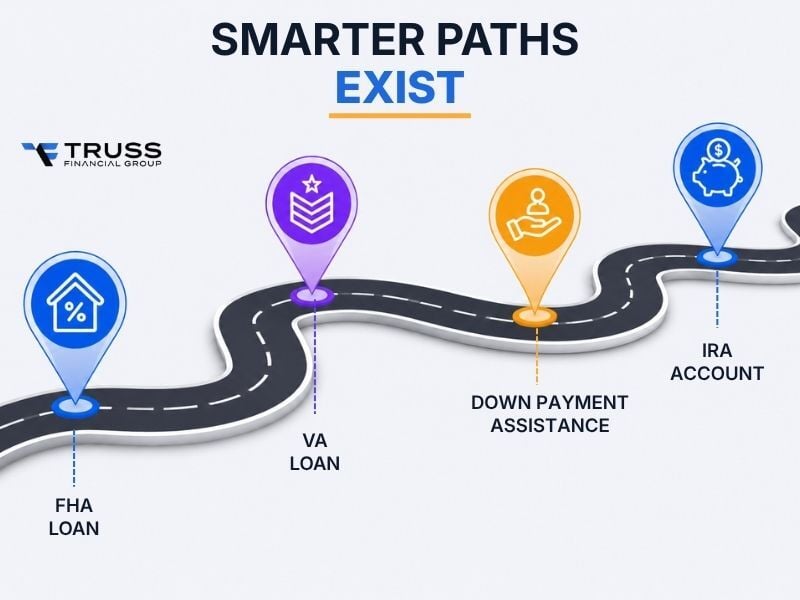
Alternatives to Using Retirement Funds
When one plans to withdraw funds from the retirement savings, it is recommended to look for other financing opportunities specially formulated for first time homebuyers.
FHA Loans and Low Down Payment Loans
Federal Housing Administration backed FHA loans are commonly preferred by most buyers with moderate savings or relatively lower credit scores. These loans require smaller down payments to be paid for unlike conventional loans.
Most borrowers also would need to pay mortgage insurance premiums that helps increase monthly mortgage payments.
VA Loans for Eligible Buyers
United States Department of Veterans Affairs guaranteed VA loans are apt for eligible veterans and few active duty service members and help eliminate the need for a down payment altogether.
Down Payment Assistance Programs
Several state and local governments offer down payment assistance programs for eligible buyers which include:
- Grants
- Deferred-payment assistance
- Forgivable loans
- Specialized payment assistance programs
These grants options help conserve one’s retirement security and allows one to buy a house sooner.
Can IRA Accounts Be a Better Option?
Few buyers also explore IRA accounts instead of only 401(k). A traditional IRA and ROTH IRA offer different withdrawal rules for first-time buyers.
Certain first-time homebuyer exceptions are applicable for IRA withdrawals although rules may vary according to the type of account and holding period. These decisions may also affect future tax obligations hence one must consult a tax professional when planning to withdraw funds.
Important Financial Factors to Review
When planning to use retirement savings for a property purchase, it is essential to consider the following:
Impact on Retirement Goals
Every dollar removed from the retirement account reduces future compounding opportunities with an impact on long-term savings significantly.
Ability to Handle Loan Payments
For those looking for 401 k loan, the repayment schedule fits well in their budget alongside future mortgage payments.
Current Housing Market Conditions
Accessing retirement savings in a competitive housing market enables homebuyers to possess a home sooner with effective planning and avoiding long-term strain.
Tax Consequences
Once it's decided how one plans to access funds, one may need to pay taxes, cover penalty fees, or report additional taxable income to the Internal Revenue Service.
Final Decision – Should We Use 401 (k) for down payment?
Homebuyers, especially the first time ones, only reflect on the question if it's okay to use 401(k) to purchase a first home. While using 401 (k) can help homebuyers quickly access funds to fund their down payment and purchase a home, it can also result in depletion of retirement savings and funds. This decision should be taken after evaluating the financial stability, number of years left for retirement as well as the present income. Whether one plans to go for a lump sum withdrawal, a personal loan, or a structured 401 k loan, knowing more about the long-term impact on your retirement plan is essential.
It is essential to explore mortgage options, review payment options, and seek guidance from experienced financial advisors like Truss Financial Group to assess smart financing strategies customized to homeownership goals while balancing long-term financial well-being.
Frequently Asked Questions
1. Can I use my 401(k) to buy a house without penalties?
A 401 k loan generally avoids early penalties if repaid on time, but withdrawals may trigger taxes and penalties.
2. How much can I borrow from my 401(k)?
Most plans allow borrowing up to 50% of your vested balance or $50,000 as the maximum loan amount.
3. Does using a 401(k) affect retirement savings?
Yes. Removing or borrowing money may reduce long-term retirement growth and future savings potential.
4. Are there alternatives to using retirement funds?
Yes. Buyers can explore payment assistance, FHA loans, VA loans, and local housing grants.
5. Should I speak to a financial advisor before withdrawing funds?
Yes. A financial advisor or tax professional can explain tax implications, repayment risks, and better financing alternatives.

.svg)

Discuss your unique requirements
Get direct answers and a roadmap for your future.
.png?width=202&height=202&name=image%20588255187%20(1).png)

-3.png?width=389&height=221&name=Blog%20covers%20(1)-3.png)
.png?width=389&height=221&name=Blog%20covers%20(9).png)

%20(2).png?width=389&height=221&name=Blog%20covers%20(3)%20(2).png)



.svg)

.svg)
.svg)