.svg)



%20(1).svg)
%20(2).svg)
.png?width=480&height=420&name=Img%20(1).png)
%20(3).svg)
%20(4).svg)

%20(5).svg)


 View all states

16 mins
.png)
In this blog
Key Takeaways:
- Most beginner real estate investors fail not because they choose bad properties, but because their financing doesn't align with how lenders measure risk
- Knowing mortgage options like DSCR loans, bank statement loans, and asset depletion loans before you search for properties prevents deal rejection
- Starting small with clear financial discipline and realistic cash flow projections protects you from the hidden costs that derail new investors
Real estate investing for beginners starts with understanding that this involves the purchase, management, and sale or rental of properties for profit. As the world's largest asset class valued at $393.3 trillion, real estate accounts for approximately 67% of global real assets or net worth. The appeal is clear: rental income provides monthly cash flow, property appreciation builds equity, and real estate serves as an inflation hedge.
But here's what most educational content won't tell you upfront: most beginner investors don't fail because they picked the wrong property. They fail because their financing doesn't match how lenders measure risk.
You can find a rental property with strong fundamentals and attractive numbers on a spreadsheet. But if the debt service coverage ratio falls below what underwriters require, or your income documentation doesn't meet loan guidelines, the deal dies before closing.
This guide explains how to start real estate investing for beginnes by addressing financing realities first, then walking through investment strategies, property selection, and common mistakes. Whether you work with lenders like Truss Financial Group or explore other financing options, the goal is to help you structure deals correctly so they actually close and generate positive cash flow.
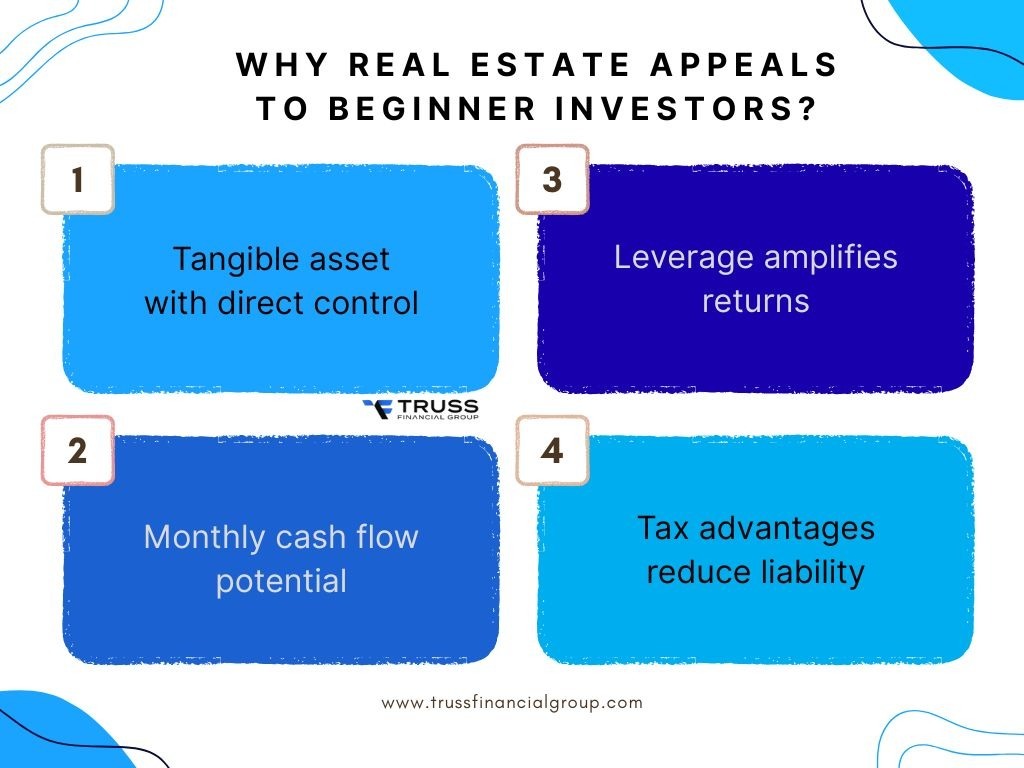
Why Real Estate Appeals to Beginner Investors?
Real estate offers benefits that distinguish it from stocks, bonds, or mutual funds:
- Tangible asset with direct control: Unlike the stock market, where you depend entirely on market forces and corporate decisions, real estate investors can directly influence property values through renovations, improved property management, or strategic repositioning in the local market.
- Leverage amplifies returns: Real estate investment allows you to use borrowed capital to control assets worth significantly more than your down payment. A conventional loan requiring 20% down means your $50,000 controls a $250,000 property, and rental income from tenants helps cover the mortgage payment while you benefit from property appreciation on the full value.
- Monthly cash flow potential: Rental properties generate passive income when rent exceeds operating expenses and debt service. This income can supplement employment earnings, fund additional real estate deals, or provide financial freedom in retirement.
- Tax advantages reduce liability: Depreciation reduces taxable income, mortgage interest is deductible, and strategies like 1031 exchanges allow you to defer capital gains when selling investment property. A cost segregation calculator can help estimate how accelerating depreciation on building components may improve early-year cash flow.
While tax advantages like depreciation are powerful, navigating the complexities of tax compliance and corporate tax planning is essential to ensure you are maximizing your deductions while staying fully compliant. A proactive tax strategy is often the difference between a good investment and a great one. While tax advantages like depreciation are powerful, navigating the complexities of corporate tax planning is essential to ensure you are maximizing your deductions while staying fully compliant. A proactive tax strategy is often the difference between a good investment and a great one.
But real estate investing carries responsibility and risk. Vacancies eliminate rental income while mortgage payments continue. Property maintenance, insurance, and property taxes never stop. Market downturns can reduce property values and make refinancing difficult.
Unlike mutual funds or stocks, where losses are primarily on paper, real estate involves ongoing financial obligations regardless of market conditions. The real estate industry rewards preparation and punishes optimism unsupported by data-driven analysis.
How Beginners Typically Start Investing in Real Estate?
New real estate investors typically enter the market through one of several proven paths:
Buying a Rental Property
Purchase single-family homes or small multifamily properties, place tenants, and hold long-term for cash flow and appreciation. Works when rental income exceeds all expenses.
House Hacking
Purchase a duplex or triplex, live in one unit while tenants cover your mortgage payment. Allows you to build wealth while living nearly rent-free.
Long-Term Buy-and-Hold
Focus on steady appreciation and reliable rental income over years. Property generates positive cash flow while you benefit from loan paydown and appreciation.
Flipping Houses
Purchase distressed properties below market value, renovate quickly, and resell for profit. Requires hard money loans with higher interest rates and shorter terms.
Passive Investing Through REITs
Real Estate Investment Trusts (REITs) allow you to invest in commercial real estate, shopping malls, office buildings, or apartment complexes without directly managing properties. REITs trade like stocks, provide liquidity, and pay dividends from rental income. The Securities and Exchange Commission requires REITs to distribute 90% of taxable income to shareholders, creating reliable income streams.
Regardless of strategy, financing determines what is actually possible. Without the right mortgage option that aligns with your income documentation and property cash flow, the deal won't close.

Mortgage and Financing Options for Real Estate Beginners
Financing options before you search for properties prevent wasted time and deal rejection. Each loan type serves different borrower profiles and property characteristics. The right loan is not necessarily the cheapest loan. It's the one aligned with how lenders evaluate risk and how the property actually performs.
DSCR Loans (Debt Service Coverage Ratio)
DSCR loans are one of the most powerful financing options for rental property owners, evaluating deals based on the property's net operating income rather than the borrower's personal income. This makes them ideal for self-employed borrowers, real estate investors with multiple properties, or anyone whose tax returns don't accurately reflect their cash flow.
Debt Service Coverage Ratio compares the property's net operating income to its debt obligations. A DSCR of 1.25 means the property generates $1.25 in income for every $1.00 of debt service. Most conventional lenders require DSCR ratios at or above 1.0 to approve financing.
But what happens when your property has strong fundamentals and solid rental potential, but the DSCR falls below 1.0?
While most lenders reject properties when the rental income doesn't fully cover the mortgage payment, mortgage brokers like Truss Financial Group find ways to get you approved. They do this by:
- Looking at your savings and liquid assets - not just your monthly income
- Reviewing your actual bank deposits and cash flow - what you really make, not what tax returns show
- Considering your full financial picture - strong credit, cash reserves, and investment experience
- Understanding the property's potential - properties needing small improvements or in growing markets with rising rents
Ready to explore DSCR financing for your rental property? Contact us today to discuss how we can help you qualify, even with a DSCR below 1.0.
Conventional Investment Property Loans
Conventional loans are mortgages backed by Fannie Mae or Freddie Mac with standardized underwriting guidelines. For investment properties, these loans typically require down payments of 15% to 25%, with 20% generally considered standard for favorable terms.
Strong credit scores above 620 (preferably 700+) and documented income through W-2s or tax returns showing stable employment are also required. The challenge for many beginner real estate investors is meeting strict debt service coverage ratio requirements.
Lenders want proof that rental income exceeds the mortgage payment plus property taxes, insurance, and HOA fees by a comfortable margin. Many beginner deals fail because investors focus on finding properties before understanding their financing constraints.
Asset Depletion Loans
Asset depletion mortgages convert liquid assets into qualifying income for loan approval. Lenders divide your total assets by a specific number (commonly 84 or 120 months) to create a monthly income figure used in debt-to-income calculations. This financing option serves investors with substantial savings, investment accounts, or retirement funds, but limited documented income.
Retirees, business owners who write off significant expenses, or investors who've built wealth outside W-2 employment often benefit. The strategy works particularly well when combined with properties showing strong fundamentals but moderate cash flow, supporting investment property purchases that would otherwise fail conventional underwriting.
Bank Statement Loans for Self-Employed Investors
Bank statement mortgages evaluate income based on deposits in your business or personal accounts rather than tax returns. Lenders typically review 12 to 24 months of bank statements, apply an expense ratio (often 25% to 50%), and use the remaining amount as qualifying income. Self-employed real estate investors, freelancers, contractors, and small business owners benefit because tax returns intentionally minimize reported income through legitimate deductions.
The trade-offs involve higher interest rates and more documentation requirements. But for beginner investors who've built successful businesses outside traditional employment, bank statement mortgages open doors to real estate investing that would otherwise remain closed.
Hard Money and Short-Term Loans
Hard money loans are short-term, high-interest mortgages secured by the property itself rather than the borrower's creditworthiness. These loans typically last 6 to 12 months with interest rates from 8% to 15% plus origination points. Real estate investors use hard money for fix-and-flip projects where they purchase distressed properties, renovate quickly, and sell for profit. Hard money closes quickly (sometimes within days) but carries a high cost. Approach cautiously with detailed budgets and clear exit strategies.
Short-Term Rental Property Loans
Short-term rental (STR) property loans are specifically designed for investors purchasing properties intended for vacation rentals, Airbnb, or VRBO listings. These loans differ from traditional rental property financing because they account for the higher income potential and seasonal variability of short-term rentals.
Lenders evaluate STR properties based on projected rental income from comparable short-term listings in the area rather than traditional long-term lease rates. This often allows investors to qualify for larger loan amounts since short-term rentals typically generate 2 to 3 times more income than long-term rentals in desirable vacation markets.
|
Loan Type |
Best For |
Down Payment |
Key Feature |
|
Conventional |
W-2 employees with strong credit |
20-30% |
Strict DSCR and DTI requirements |
|
DSCR Loan |
Self-employed or multiple properties |
20-25% |
Approval based on property income |
|
Asset Depletion |
High net worth, low reported income |
20-30% |
Assets converted to qualifying income |
|
Bank Statement |
Self-employed with business deductions |
20-25% |
Income based on deposits, not tax returns |
|
Hard Money |
Fix-and-flip investors |
10-20% |
Fast closing, short-term, high interest |
|
Short-Term Rental |
Airbnb/vacation rental investors |
20-25% |
Approval based on STR income potential |
The right loan is not the cheapest loan. It's the one aligned with how lenders evaluate risk and how the property actually performs. Understanding these financing options before searching for investment properties prevents months of wasted effort pursuing deals that were never viable given your financial profile.
Working with experienced mortgage brokers like Truss Financial Group can help you identify which loan products match your income documentation and property characteristics before you start your search.
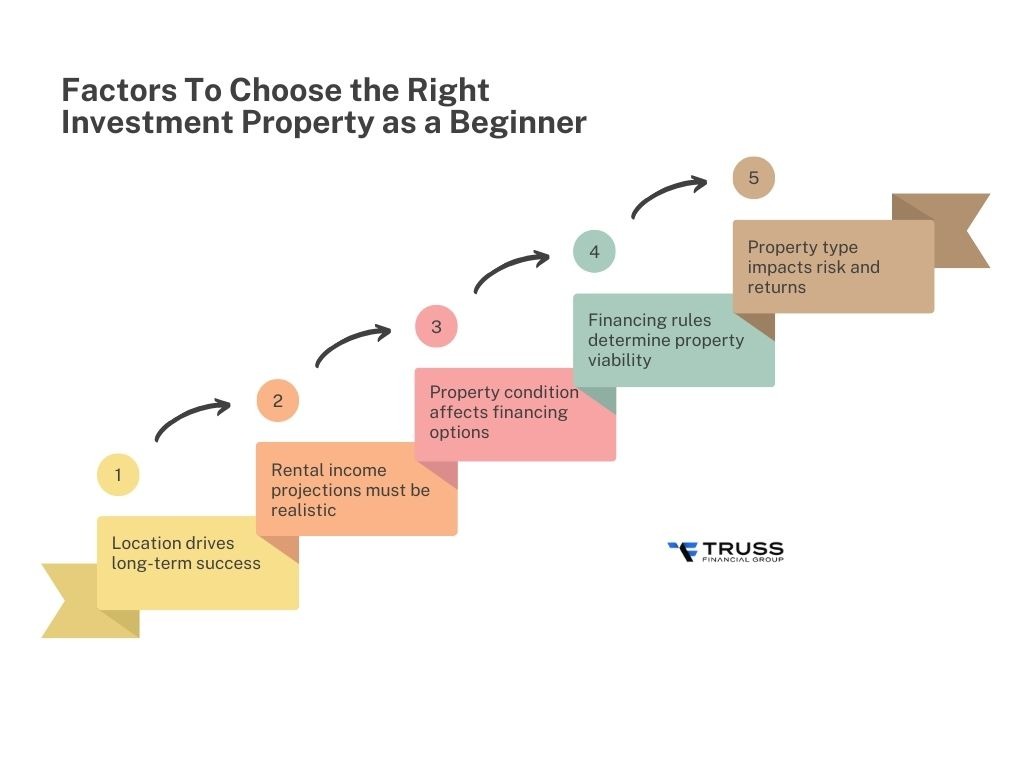
Factors To Choose the Right Investment Property as a Beginner
Finding your first investment property requires balancing location fundamentals, rental demand, and financing realities. The property that generates the strongest returns on paper may fail to close if financing doesn't align with the deal structure.
Key factors to evaluate:
- Location drives long-term success: Properties in areas with job growth, population increases, quality schools, and low crime rates appreciate faster and maintain higher occupancy rates. Neighborhoods near universities, hospitals, or major employers show stable rental demand.
- Rental income projections must be realistic: Review actual rental comps for similar properties in the immediate area, not aspirational listings that sit vacant. Factor vacancy rates of at least 8% annually and build maintenance reserves of 1% to 2% of property value.
- Property condition affects financing options: Turnkey properties require minimal upfront capital for repairs but command higher prices. Distressed properties offer lower entry costs but demand renovation expertise, contractor relationships, and often hard money financing until repairs are complete.
- Financing rules determine property viability: DSCR requirements mean some properties won't qualify for financing regardless of purchase price. Before making offers, run preliminary underwriting scenarios using actual loan products available based on your income documentation and credit profile.
- Property type impacts risk and returns: Single-family homes appreciate faster, but vacancies eliminate 100% of rental income. Multifamily properties spread risk across units, but require larger down payments and more intensive property management as you scale. Investors considering multifamily properties may also evaluate opportunities such as South Carolina multifamily investments when comparing markets and potential portfolio strategies.
The real estate investing journey starts with properties that match your financing capabilities and management capacity. Stretching for deals that barely qualify or require expertise you haven't developed yet creates unnecessary risk in an already complex investment.
Beginner-Friendly Real Estate Investment Strategies
Selecting the right strategy depends on your capital, risk tolerance, and financing options:
- Buy and Hold: Long-term rental properties generating monthly cash flow and appreciation
- House Hacking: Live in one unit of a multifamily property while tenants cover the mortgage (FHA 3.5% down)
- Flipping Houses: Purchase distressed properties, renovate, sell quickly (requires hard money loans)
- REITs: Passive investment in commercial real estate portfolios without property management
- Crowdfunding: Pool capital with other investors for larger commercial deals
Each strategy requires different financing approaches, which is why understanding loan options before choosing your strategy is critical for success. If you're planning to expand from single-family investing into commercial properties, commercial real estate training can help you strengthen your understanding of underwriting, DSCR analysis, lender expectations, and other skills needed to evaluate larger investment opportunities.
Common Mistakes New Real Estate Investors Make
These mistakes that beginner investors make help you avoid expensive lessons that derail portfolios before they start generating returns. These do not stem from a lack of intelligence but from underestimating complexity and overestimating initial projections.
- Underestimate True Costs: Calculate only mortgage, taxes, insurance and assume the remaining rent is profit (reality includes maintenance reserves, management fees, vacancy allowances, capital expenditures)
- Overestimate Rental Income: Review asking rents for nicest properties and assume yours commands the same rates instead of researching recently leased comparables
- Choose Loans Before Understanding Requirements: Lock into conventional pre-approvals requiring W-2 verification, then discover rental properties don't meet DSCR requirements
- Make Emotional Decisions: Fall in love with aesthetics or neighborhood appeal instead of analyzing whether numbers actually work
- Skip Due Diligence: Skip professional inspections and tenant history reviews, creating expensive surprises after closing
- Not Building a Professional Team: Start without established property manager, contractor, and agent relationships before problems arise
- Ignore Tax Benefits: Miss substantial tax advantages through depreciation by not structuring ownership correctly or maintaining proper documentation

Frequently Asked Questions About Real Estate Investing for Beginners
How do beginners invest in real estate?
Start by purchasing single-family rental properties or house-hacking multifamily properties. Understand financing options that match your income documentation: conventional loans for W-2 employees, DSCR loans for self-employed investors, or asset depletion loans for those with substantial savings. Get pre-approved first, then search for properties with positive cash flow.
Is $5,000 enough to invest in real estate?
Direct property ownership typically requires $15,000 to $30,000 for a down payment and closing costs. However, $5,000 can start your journey through real estate investment trusts that trade like stocks, real estate crowdfunding platforms, or partnerships where multiple investors pool capital. Some use $5,000 as earnest money while securing financing for the full purchase.
How can I invest in real estate with little or no money?
House hacking through FHA loans requires only 3.5% down. Partnerships let you contribute expertise, while others provide capital. Seller financing sometimes requires smaller down payments. However, approaches claiming "no money down" often involve high risk or unrealistic projections that experienced investors avoid.
What is the best real estate investment for a beginner?
Single-family rental properties in stable markets with strong employment offer the best starting point. They're easier to finance, appreciate well, attract long-term tenants, and require less complex property management than multifamily properties. Start with one manageable property to learn fundamentals before scaling.
Is real estate investing risky for beginners?
All investing carries risk. You can lose money through property value declines, vacancies, major repairs, or problem tenants. However, real estate offers more control than stocks. Start with realistic projections, maintain adequate cash reserves, and understand how lenders evaluate risk before committing capital.
Is it hard to invest in real estate as a beginner?
Real estate demands active involvement but offers greater control than passive investing. Success requires coordinating property search, financing, tenant management, and maintenance. Build a team of professionals, including agents, property managers, contractors, and attorneys. Starting small with one property makes the process manageable.
What is the best real estate investment for a beginner?
The best investment matches your capital, risk tolerance, and time commitment. Single-family rentals offer appreciation and manageable property management. House hacking provides the lowest entry cost. Real estate investment trusts suit passive investors seeking exposure to commercial properties like apartment complexes and office buildings. Choose based on which financing options align with your income documentation.
How can I invest in real estate with little or no money down?
FHA loans for house hacking require 3.5% down. VA loans offer 0% down for eligible veterans on primary residences, including multifamily up to fourplex. Partnerships, seller financing, or assuming existing mortgages provide alternatives. Focus on saving an adequate down payment while building knowledge and relationships.
Start Smart as a Real Estate Beginner
Real estate investing for beginners succeeds when education and structure take priority over hype. Most investors fail because their financing doesn't align with how lenders measure risk, not because they choose bad properties.
Start small with one well-researched rental property that teaches you fundamentals without risking everything. Understand your financing options before searching for deals. Build a professional team early. Walk away from properties that don't meet your criteria, no matter how appealing they seem.
Truss Financial Group helps investors structure deals lenders can actually approve (particularly for self-employed borrowers and DSCR-constrained properties where traditional lending falls short).

.svg)

Discuss your unique requirements
Get direct answers and a roadmap for your future.
.png?width=202&height=202&name=image%20588255187%20(1).png)





.svg)

.svg)
.svg)