.svg)



%20(1).svg)
%20(2).svg)
.png?width=480&height=420&name=Img%20(1).png)
%20(3).svg)
%20(4).svg)

%20(5).svg)


 View all states

7 mins
-1.jpg)
In this blog
A bad credit is a deterrent always, especially when one wants to avail a bank loan. And this question comes more when one wants to get a HELOC. To answer the commonly asked question; can I get a HELOC with bad credit - the answer is yes but it has its own conditions. A good credit score means higher chances to get better loan approvals with lower interest rates. Yet few heloc lenders assess a loan applicant’s profile from other aspects beyond just the credit score. For instance, if an applicant has sufficient home equity, a stable income, and a manageable debt to income ratio, he can qualify for a home equity line. While loan lenders may consider, getting the loan approval isn’t always guaranteed. Most often the application with poor credit score undergoes stringent scrutiny with stricter terms.

What Lenders Look for When You Apply for a HELOC with Bad Credit
Loan lenders, when they receive an application for HELOC with bad credit, assess the entire financial position instead of only considering the fico score. Several lenders often look for a fair credit score above 680 while others look for a minimum credit score of around 620. At times, few loan lenders also consider a credit score lower than this range provided the financial indicators are strong.
One important attribute most home lenders consider is home equity. If at least 20% equity is available, loan approval may be considered as it defines a meaningful ownership stake. Along with home equity, debt to income ratio is also evaluated. The lower the ratio, the better the chances and ease of monthly payments. This reduces the monthly risk.
Additionally, the payment history as well as overall credit history are also evaluated. For instance, if an applicant has a bad credit history especially with recent payments, it may affect the loan approval. In this scenario, it is recommended to work on reducing credit card balances to enhance the chances of loan approval. Several loan lenders cap the combined loan to value ratio to about 70% for borrowers with low credit score, to make sure there is adequate equity available backing the loan.
Is It Really Possible to Get a HELOC with Bad Credit?
Availing a HELOC with bad credit is possible depending on one’s financial profile. Few lenders specifically provide loan options like cash out refinance for applicants with lower scores of 550-620. When consistent income is shown with controlled existing debts, and a steady payment history, lenders provide approvals for the loan application.
Interest Rates and Costs You Should Expect
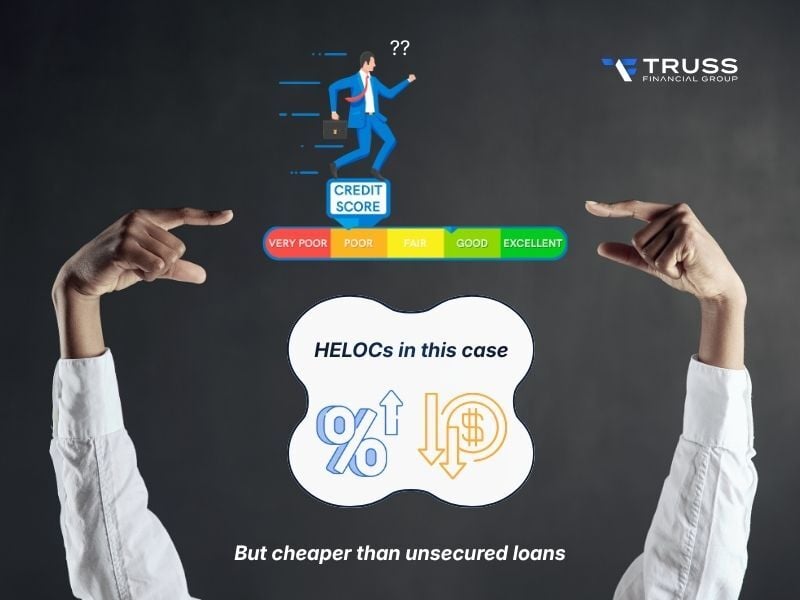
Lenders often assess the cost of borrowing when approving a HELOC with bad credit. Given the higher risk, there is also a higher interest rate. This interest can also fluctuate given the variable rate of HELOC affecting the monthly payments during the repayment period. It may also happen that an applicant receives a lower credit limit or smaller loan amounts in comparison to borrowers with strong credit profiles. Despite these challenges, HELOCs may still offer lower interest rates than an unsecured loan or high-interest credit card balances, making them a viable option in certain cases.

HELOC vs Home Equity Loan: Which Is Better for Bad Credit?
For those exploring home equity financing, it’s recommended to compare a HELOC with a home equity loan as both enable one to borrow money against the home equity, although they work differently.
A HELOC works as an equity line of credit, providing one access to funds during a draw period. One can withdraw as needed and pay interest only on the withdrawn amount. A home equity loan on the other hand allows borrowers to take the entire lump sum upfront . It also comes with fixed monthly payments and a stable interest rate making it easier to plan one’s finances over the loan term.
For borrowers with bad credit, the structured nature of a home equity loan may feel more manageable, while a HELOC offers flexibility but less certainty.
Challenges You May Face During Approval
Applying for the HELOC loan with bad credit poses few challenges. Lenders follow a stringent scrutiny process, asking for detailed proof of income, stable employment with clean records of managing existing debts. When one has a poor history of late payments or high outstanding balances, the changes of approval look risky.
One must also consider the fact that your home becomes the collateral. Any delays in payment obligations can be risky in terms of the property ownership.
How to Improve Your Chances of Getting a HELOC
Even with low credit, there are ways to strengthen the application. Improving credit history by reducing credit card balances and avoiding new debt can make a noticeable difference. Correcting errors in the credit report is another simple but effective step.
Increasing home equity also helps. This can be done by paying down your current mortgage or investing in home improvement projects that raise the value of property. At the same time, lowering the debt to income ratio by managing existing debts or increasing your income improves the financial profile. Lenders value consistency, so demonstrating a stable payment history over time can significantly improve the chances of loan approval.
Alternatives If You Don’t Qualify for a HELOC
If you're unable to get a HELOC, there are other options worth considering. A cash out refinance allows one to replace the primary mortgage with a larger one and access cash, sometimes with more flexible credit requirements. A bank statement loan may also be an option for self-employed borrowers who have difficulty documenting traditional income. For smaller funding needs, other forms of credit may be available, but they often carry higher costs. Choosing the right option depends on the ability to manage monthly payments and long-term financial goals.
So, can I get a HELOC with bad credit? Yes, but it requires a strong overall financial profile. Lenders consider your home equity, debt to income ratio, and payment history alongside credit score when reviewing the HELOC application.
While it is possible to access funds through a home equity line, the trade-off often includes higher interest rates and stricter loan terms. Since your home is used as collateral, it is important to approach this option carefully. If you are unsure whether this is the right step, seeking guidance can help. Experts at Truss Financial Group can assist you in evaluating your eligibility and choosing a financing option that aligns with your needs while helping you manage risk effectively.
Frequently Asked Questions
1. What is the minimum credit score required for a HELOC?
Most lenders prefer a credit score above 680, but some accept a minimum credit score of around 620, depending on other factors.
2. Can I qualify for a HELOC with poor credit?
Yes, borrowers with poor credit can still qualify if they have strong home equity, stable income, and a low debt to income ratio.
3. Are interest rates higher for bad credit HELOCs?
Yes, borrowers with a bad credit score typically face higher interest rates due to increased lender risk.
4. Is a home equity loan better than a HELOC for bad credit?
A home equity loan offers fixed monthly payments and a stable interest rate, which may be easier to manage than a variable-rate HELOC.
5. What should I do if my HELOC application is denied?
Review your credit report, reduce existing debts, improve your payment history, and speak with your lender to understand how to improve your chances.

.svg)

Discuss your unique requirements
Get direct answers and a roadmap for your future.
.png?width=202&height=202&name=image%20588255187%20(1).png)


-1.png?width=389&height=221&name=Blog%20covers%20(7)-1.png)

-1.jpg?width=389&height=221&name=Blog%20covers%20(6)-1.jpg)


.svg)

.svg)
.svg)