.svg)



%20(1).svg)
%20(2).svg)
.png?width=480&height=420&name=Img%20(1).png)
%20(3).svg)
%20(4).svg)

%20(5).svg)


 View all states

13 mins

In this blog
Shopping for a mortgage can feel like a strange mix of simple math and complete guesswork. You know you need a loan, but then come the rates, loan programs, lender fees, underwriting rules, closing costs, and a pile of paperwork that somehow keeps getting bigger. One option is to contact a bank or direct lender yourself. Another is to work with a mortgage broker who can look across several lending options and help you find one that fits your situation.
So, what is a mortgage broker, and is working with one actually worth it?
A mortgage broker can save you time by narrowing down lenders and loan programs, and that can be especially helpful when your finances aren't completely straightforward. But using a broker doesn't automatically mean you'll get a lower rate, lower costs, or an easier approval. Those things depend on the loan, the lender, your financial profile, and the mortgage options available at the time.
The better approach is to understand what a broker actually does, how the compensation works, and how to compare the final loan offers you're given. Let’s discuss.
What Is a Mortgage Broker?
A mortgage broker acts as an intermediary between a borrower and mortgage lenders. Instead of offering loans from just one institution, a broker generally works with multiple lenders and looks for loan programs that may fit the borrower's circumstances. In practical terms, the broker can take some of the legwork off your plate.
You may discuss your income, assets, credit history, down payment, property, and borrowing goals with the broker. They can then review their available lender relationships, identify potentially suitable programs, and help you move through the application process.
Depending on the transaction, a broker may help with:
- Reviewing your financial information
- Finding potentially suitable loan programs
- Comparing lender options
- Gathering documents
- Submitting the mortgage application
- Communicating with the lender during underwriting
- Helping coordinate the loan through closing
There's one distinction worth remembering: the broker isn't the party making the final credit decision. The lender is. A broker's lender network also isn't the entire mortgage market. Some lenders only work directly with borrowers, while others may not be part of a particular broker's network. That's why asking about the lender panel matters.
There are also companies that operate as both brokers and lenders. Truss Financial Group, for example, may act as a broker or lender depending on the transaction. The role applicable to your specific loan should be reflected in the relevant loan documents.
Mortgage Broker vs Lender vs Loan Officer
These terms often get thrown around as though they mean the same thing. They don't.
| Role | What the Role Does | What You Should Check |
|---|---|---|
| Mortgage broker | Searches its lender network and helps place a loan | Lender access, relevant experience, compensation and licensing |
| Mortgage lender | Provides or funds the mortgage and handles underwriting and pricing | Loan programs, costs, requirements, service and closing ability |
| Loan officer | Helps guide a borrower through the application process for a lender or brokerage | Employer, NMLS record, experience and communication |
A loan officer may work directly for one lender, while a broker generally has relationships with multiple lenders. That difference can affect how many loan paths you can explore through that professional.
How Does a Mortgage Broker Work?
The process usually starts with a conversation. You explain what you're trying to do, and the broker looks at the financial and property details behind the request.
Maybe you're buying your first home. Perhaps you're refinancing. Or your situation is a little more complicated because you're self-employed, buying an investment property, or working with a property that doesn't fit neatly into standard lending guidelines.
The broker reviews the information and searches the lenders available through their network. From there, the process generally moves through several stages:
- Financial information and documentation: The broker may review your income, assets, debts, credit profile, down payment, property details and desired loan amount.
- Lender search: The broker considers programs that could potentially work based on the information you've provided. This can narrow down a search that would otherwise require contacting several lenders individually.
- Comparison: Once you have options, you'll need to compare them. Don't look only at the interest rate. Fees, APR, lender credits, monthly payment and cash required at closing all matter.
- Review: After you select an option, the application and supporting documentation can be submitted to the lender. Underwriting then begins. The lender reviews the file and may request additional documentation or impose conditions before the loan can move forward.
There's another important point here: pre-approval isn't the same as final approval. A pre-approval can be useful when you're shopping for a home, but the transaction still has to go through the lender's full underwriting process. The property, appraisal, title, insurance, verified documentation, and other requirements can affect the final outcome.
How Do Mortgage Brokers Get Paid?
The question of mortgage broker fees comes up for good reason. Borrowers want to know what they're paying and whether that cost is worthwhile. Broker compensation can generally come from the borrower or the lender. The amount and structure can vary from one transaction to another, so it's better to avoid assuming that every broker charges the same percentage or fee.
Ask directly:
- Who pays your compensation?
- What fees could I be responsible for?
- How will those costs appear in my disclosures?
- What services are included?
- Are there lender credits?
- How does the compensation affect the overall cost of the loan?
Don't fall into the trap of thinking lender-paid compensation means there is no cost involved. The useful comparison is the complete mortgage offer, not whether a particular fee happens to come out of your pocket directly.
The Loan Estimate is particularly helpful here. For most covered mortgage transactions, it gives you a standardized way to review important terms, including the projected payment, interest rate, APR, origination charges, lender credits and estimated cash to close.
If two loans have different rates and fee structures, looking at the whole picture can reveal differences that aren't obvious from the advertised rate.
Benefits of Using a Mortgage Broker
There are some very practical reasons borrowers choose a mortgage broker, particularly when shopping for a loan feels complicated.
More Lender Options to Consider
Instead of contacting several institutions one by one, you can work with a broker who has relationships with multiple lenders. That doesn't mean you'll see every mortgage available in the market. You won't. But having multiple options in one place can make the initial comparison easier.
Help With Less-Standard Financial Situations
A borrower with a conventional salaried job and straightforward finances may have a relatively simple application. Someone who is self-employed, has multiple income sources, owns investment property, needs a larger loan, or is considering a non-QM loan may have more variables to deal with.
A broker familiar with self-employed mortgage options, for instance, may be able to identify lenders whose requirements are more compatible with the documentation involved. That's not a promise of approval. It's simply a more targeted way to approach the search.
One Person Coordinating the Process
Mortgage applications involve a surprising number of moving pieces. Documentation has to be collected. Questions come up. Underwriting conditions need responses. Timelines have to be watched. Having one person help coordinate communication can be useful, especially if you're not familiar with the process.
Familiarity with Different Lender Guidelines
Lenders don't necessarily evaluate every borrower or scenario in exactly the same way. Their programs, documentation requirements and underwriting policies can differ. A broker who regularly works with multiple lenders may have a better sense of which options are worth investigating for a particular scenario.
Still, don't confuse experience with a guarantee. A broker can help with the search, but the lender ultimately decides whether the loan meets its requirements.
Drawbacks and Limits to Consider
Using a broker has advantages, but there are trade-offs too:
- Cost: Depending on the transaction, broker compensation may be paid by you or by the lender. Either way, it should be considered when comparing the total cost of the loan.
- Lender access: A broker can only offer the programs and lenders available through its network. A direct lender may have an option that the broker simply doesn't have access to.
- Service quality: One broker may communicate frequently and explain each step clearly. Another might leave you wondering whether your paperwork disappeared into a black hole.
Before choosing someone, ask who will actually manage your file, how often you'll receive updates, and what happens if an issue comes up close to closing. Finally, remember that early quotes aren't carved in stone. Interest rates can change. Verified income can differ from initial estimates. Property details, appraisal results and underwriting findings can all affect the final terms.
Should I Use a Mortgage Broker?
Maybe. It depends on what you're trying to accomplish and how comfortable you are handling the mortgage search yourself. A broker may be worth considering if you:
- Want to compare several lender or program options
- Have self-employed or nontraditional income
- Are purchasing an investment or unusual property
- Need a specialty loan
- Have a more complicated financial profile
- Prefer having someone help coordinate the mortgage process
Going directly to a lender may be perfectly reasonable if you already know what program you need, have a strong offer you're comfortable with, or simply prefer dealing with the lender yourself. There's no prize for choosing the more complicated route.
The most useful test is to compare actual offers. Put a broker-sourced loan next to a direct lender's offer and look at them using equivalent assumptions – same loan amount, same term, and similar down payment. Compare rate-lock status, and then examine the costs.
Questions to Ask a Mortgage Broker
Before moving ahead, get specific. Vague answers at the beginning can become frustrating problems later. Ask whether the broker is licensed in your state and request the NMLS information so you can verify the professional or company. Then ask which lenders they work with. More importantly, ask whether there are relevant lenders they don't work with.
You should also understand the compensation arrangement. Who pays the broker? What fees might you pay? Why was a particular loan recommended? What alternatives were considered? A few other useful questions:
- What could change between the initial quote and closing?
- Who will actually handle my file?
- How often will I receive updates?
- What is the expected timeline?
- How does the rate-lock process work?
- What happens if a rate-lock extension is needed?
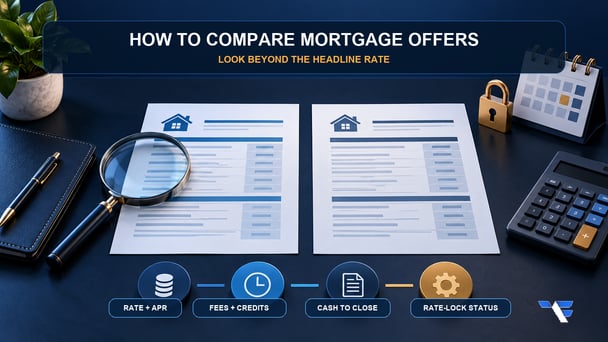
How to Compare Mortgage Offers
Comparing mortgages gets much easier when the offers are based on the same assumptions.
Start with the basics: loan amount, loan program, term, down payment and quote date. Check whether the interest rate is locked and whether either offer includes discount points or lender credits. Then move past the headline rate.
Look at the projected monthly payment, APR, origination charges, lender credits and cash to close. The Loan Estimate also provides a five-year cost comparison on page 3 that can be useful when evaluating the longer-term financial impact.
And don't ignore service. A mortgage offer that looks slightly cheaper on paper isn't necessarily the better option if communication is poor or the lender can't meet an important contractual closing date. Price matters, obviously. But so do reliability, clarity and whether the loan actually fits your circumstances.

FAQs (Frequently Asked Questions)
What does a mortgage broker do?
A mortgage broker helps borrowers find and compare mortgage lenders or loan programs available through the broker's network. They may assist with the application and communication, but the lender makes the final underwriting decision.
Is it better to use a mortgage broker or a bank?
A mortgage broker vs. bank comparison doesn't have one universal winner. A broker may provide access to multiple lenders, while going directly to a bank or lender may be simpler for someone who already knows what they want. Compare the actual loan terms and costs before deciding.
Who pays a mortgage broker?
The borrower or lender may pay the broker's compensation, depending on the transaction. Ask who pays, what the compensation covers and how it appears in the loan disclosures.
Can a mortgage broker get me a lower rate?
A broker may find competitive pricing through its lender network, but there is no guarantee that a broker will offer the lowest rate. Compare APR, fees, credits and overall loan costs rather than focusing on the interest rate alone.
Can I get a mortgage without a broker?
Yes. You can apply directly with a bank, credit union, direct lender or online lender. Working with a broker is an option, not a requirement.
Does a mortgage broker guarantee approval?
No. A broker cannot guarantee final mortgage approval. The lender makes the underwriting decision, and factors such as verified financial information, appraisal results, property details and other loan conditions can affect the outcome.
How do I check a mortgage broker's license?
You can use NMLS Consumer Access to look up licensing information for mortgage professionals and companies. It's a useful step before you decide who you want handling your application.
A Practical Next Step
If you're still weighing whether a mortgage broker makes sense, start with your specific situation rather than trying to pick a winner in the broker-versus-bank debate. Your income, credit profile, property, loan amount and financing goals all influence which mortgage options are realistic. That's especially true if your situation falls outside the standard borrower profile.
You can explore Truss Financial Group's mortgage options or speak with a loan officer about your goals, documentation and property scenario. The idea isn't to promise a particular rate or approval. It's to understand which mortgage paths may be available and then compare them on their actual terms.

.svg)

Discuss your unique requirements
Get direct answers and a roadmap for your future.
.png?width=202&height=202&name=image%20588255187%20(1).png)




.jpg?width=389&height=221&name=Blog%20covers%20(3).jpg)
%20(1)-1.png?width=40&height=40&name=image%20(65)%20(1)-1.png)


.svg)

.svg)
.svg)