.svg)



%20(1).svg)
%20(2).svg)
.png?width=480&height=420&name=Img%20(1).png)
%20(3).svg)
%20(4).svg)

%20(5).svg)


 View all states
HELOC Broker vs. Credit Union vs. Online Lender: Which Wins?

14 mins
In this blog
Key Takeaways
- Where you get your HELOC matters as much as the rate you're quoted: the right lender type depends on your credit profile, timeline, and how much guidance you want along the way.
- HELOC brokers offer the broadest market access and the most flexibility for complex borrower profiles, making them the strongest choice for most homeowners who want to find the best available deal rather than settling for a single lender's offer.
- Credit unions typically offer lower rates and fewer fees than banks; online lenders prioritize speed and convenience, but neither gives you the full-market perspective a broker can.
You already know you want a home equity line of credit. What you're trying to figure out is who to get it from, and whether that decision actually matters. It does, more than most borrowers realize. Whether you're funding home improvements, covering educational costs, handling unexpected expenses, or looking to consolidate debt, a HELOC broker, a credit union, and an online lender all give you access to the same product, but through very different routes, with real differences in rate, total cost, approval flexibility, and the experience of getting from application to funding.
Mortgage brokers like Truss Financial Group help borrowers navigate exactly this decision every day. This guide covers how each lender type actually works, how they compare across the factors that matter most, and how to determine which path fits your specific situation.
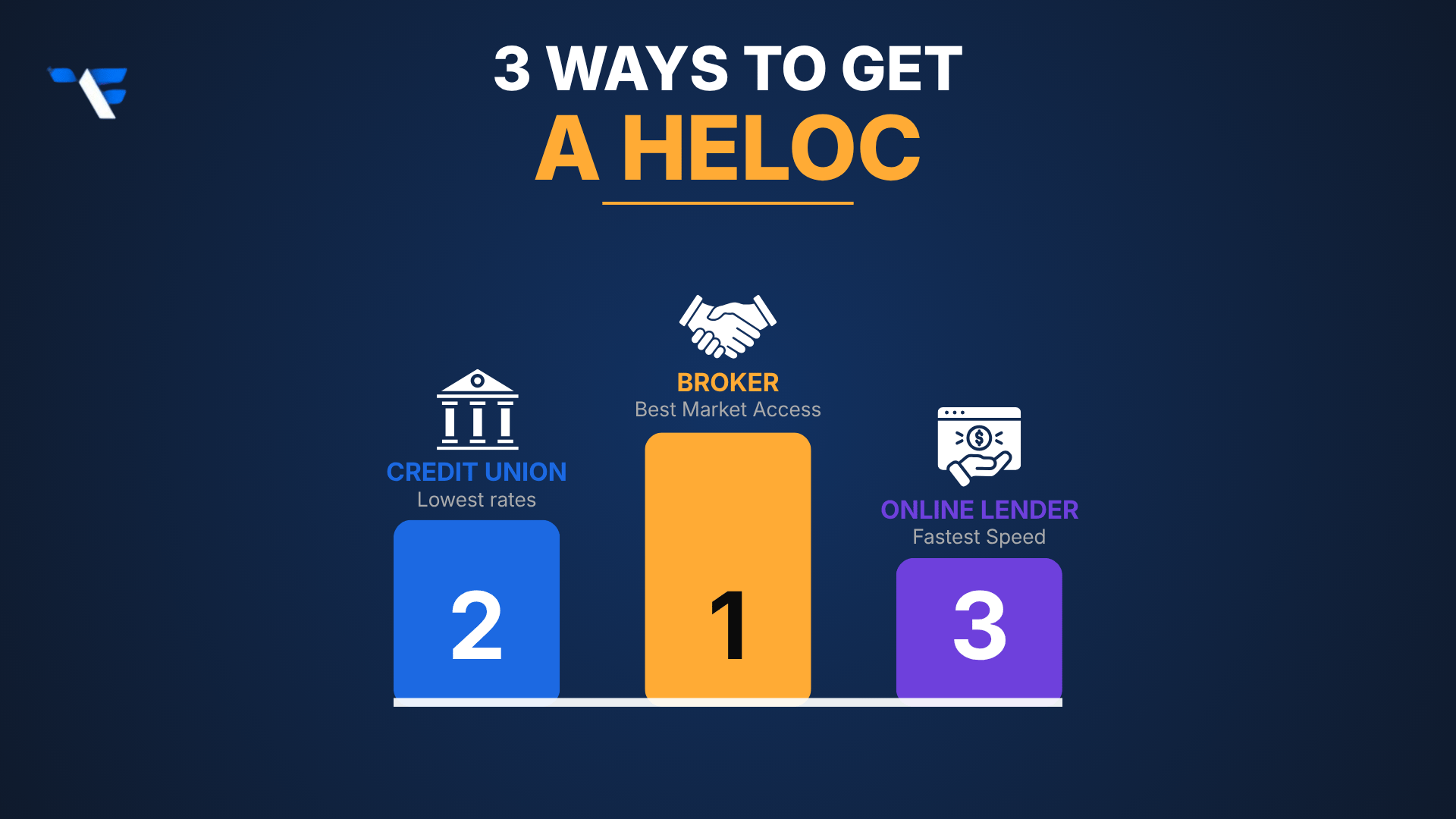
What's the Difference Between a HELOC Broker, a Credit Union, and an Online Lender?
Understand where each lender type sits in the market as the starting point for making a smart choice.
| HELOC Broker | Credit Union | Online Lender | |
|---|---|---|---|
| Funds the loan directly? | No - intermediary | Yes | Yes |
| Ownership structure | Commission-based | Member-owned, not-for-profit | For-profit |
| Market access | Multiple lenders | Single institution | Single institution |
| Interest rates | Full market range | Below-bank average | Competitive, often above CU |
| Fees | Varies by lender | Low, often waived | Varies widely |
| Approval flexibility | Highest - matches profile to lender | High - flexible underwriting | Lower - standard profiles preferred |
| Speed | Moderate | Moderate | Fastest |
| Best for | Complex profiles, market comparison | Rate/fee savings, relationship banking | Speed, convenience, strong credit |
A HELOC broker doesn't lend money: they shop your profile across multiple lenders and present the options that fit, with compensation typically coming from the lender rather than you.
A credit union is a member-owned, not-for-profit cooperative that funds the loan directly and, because it isn't answerable to shareholders, can offer lower rates and more flexible underwriting.
An online lender is a digital-first platform built for speed; pre-qualification in minutes, approvals in days, but with limited guidance and underwriting that favors clean, standard profiles. These three paths aren't competing on the same thing, which is exactly why the right choice depends on what you're optimizing for.
How Do HELOC Brokers, Credit Unions, and Online Lenders Actually Compare?
The gap between lender types isn't just about the interest rate on the day you close. It runs through cost structure, approval flexibility, speed, and the quality of the experience; factors that compound over the life of your draw period. Here's how each one breaks down across what actually matters.
Which Option Typically Offers the Lowest HELOC Rate Discounts?
According to National Credit Union Administration data, credit unions consistently offer lower HELOC rates than banks, with the spread widening to 61 basis points as of December 2025, a direct result of their not-for-profit structure.
Online lenders are competitive but typically price at or slightly above bank rates, often using promotional introductory rates and interest rate discounts that reset higher once the introductory period ends.
Brokers don't set their own rate; they access the full market, which means they can potentially surface a lower rate than any single institution
| HELOC Broker | Credit Union | Online Lender | |
|---|---|---|---|
| Rate positioning | Access to full market | Below-bank average | Competitive, often above CU |
| Rate type | Variable or fixed (lender-dependent) | Primarily variable | Primarily variable |
| Introductory rates | Varies by lender | Occasionally | Common |
| Rate negotiability | High - broker shops on your behalf | Moderate | Low |
The current average HELOC rate sits at 7.44% for a $30,000 line based on a 700 credit score and 80% combined LTV, though what any individual borrower receives depends on their profile and which lenders a broker can reach.
Across all three types, most HELOCs carry a variable rate tied to the prime rate; fixed rate HELOCs with a fixed interest rate and fixed monthly payments exist but are less common, and worth asking about directly. For borrowers weighing a HELOC against a cash-out refinance, the rate differential between lender types is often what tips the decision.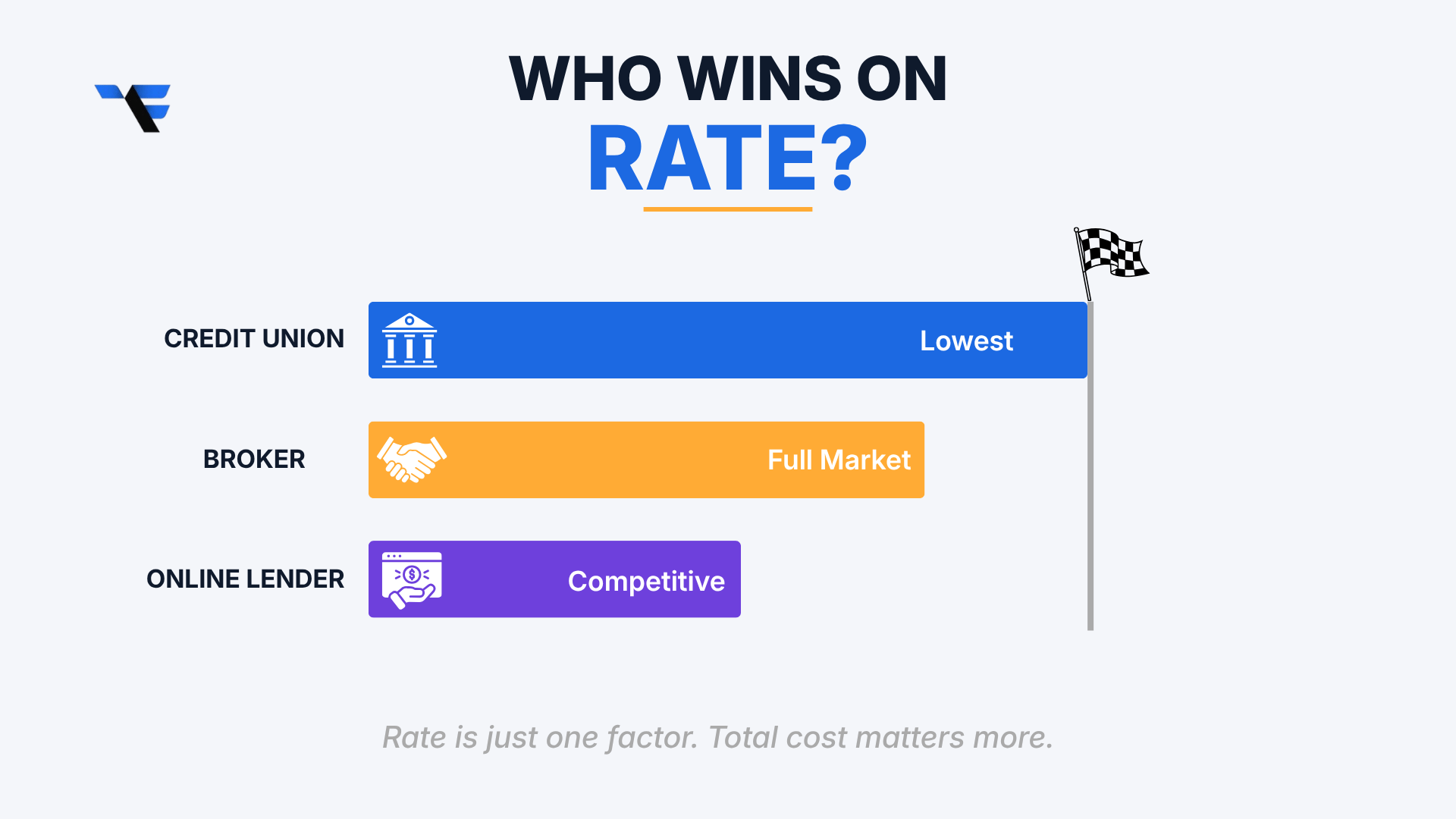
How Do Annual Fees and Closing Costs Compare Across Lender Types?
The lender with the lowest advertised rate isn't always the cheapest option once total costs are factored in. Closing costs on a home equity line of credit typically run 2–5% of the credit limit, though credit unions and select online lenders regularly come in well below that range. Many credit unions waive appraisal fees, origination fees, and annual fees outright, particularly for single-unit primary residences, and many impose low fees across the board with no prepayment penalties. Most lenders also require proof of property insurance and, in flood zones, flood insurance, before finalizing the credit line.
Online lenders vary significantly. Some compete on low or no closing costs as a differentiator; others carry a standard fee structure that erodes the apparent rate advantage. The Consumer Financial Protection Bureau recommends comparing the full cost picture, including application fees, appraisal fees, and any early closure fee, rather than rate alone. Minimum loan amounts vary too; most lenders set a minimum loan of 10,000–25,000, so it's worth confirming the minimum loan amount before applying.
Can You Get Pre-Approved for a HELOC Faster Through a Broker, Credit Union, or Online Lender?
Online Lender
Online lenders are the fastest path from application to decision. Some platforms offer pre-qualification within minutes and full credit approval within a few business days: the clearest practical advantage for borrowers who need HELOC funds quickly.
Credit Union
Credit unions can be competitive for existing members with clean profiles, but the process is more relationship-driven and may involve a branch visit, a phone consultation, or additional document requests that extend the timeline.
HELOC Broker
Brokers add a step at the front end, shopping your application before presenting options, but they handle the comparison work on your behalf. The net timeline is often comparable to going direct once you factor in the time spent researching and applying to multiple lenders individually.
Regardless of which path you take, a full HELOC application requires income verification, a credit check, and a home appraisal. The appraisal is typically the longest step in any process, and it applies equally across all three lender types.
Which HELOC Lender Type Has the Most Flexible Qualification Criteria?
Most HELOC lenders across all three types share the same baseline requirements: minimum credit score around 660, debt-to-income ratio below 43%, and LTV no higher than 80-85%. How much equity you have, based on your home's value and your current mortgage balance, determines both whether you qualify and your maximum loan amount.
Most lenders use an estimated property value from an appraisal to calculate the available credit line and set the loan amount for your initial draw. During the initial draw period, which typically runs 10 years, you make interest-only payments on what you've drawn rather than the full credit line, keeping your minimum monthly payment low.
Once the draw period ends, you enter the repayment period, usually 10–20 years, and begin paying down the principal balance alongside interest, resulting in higher fixed monthly payments. Flexible repayment terms vary by lender and are worth asking about, particularly if you anticipate changes in your cash flow. How strictly those standards are applied is where the lender types diverge.
Credit Union
- Most flexible underwriting of the three; they can make exceptions banks and online lenders typically can't
- Hold most loans on their own books rather than selling them, giving them more control over approval decisions
- The Federal Reserve's 2024 household survey notes that access to home equity products varies significantly by financial profile; credit unions have historically served a broader borrower range than for-profit institutions
- Strong option for borrowers with non-traditional income or credit scores at the lower end of the eligible range
Online Lender
- Optimized for clean, standard profiles; strong credit, verifiable W-2 income, straightforward equity position
- Least flexible of the three for borrowers outside the standard box
- Self-employment, recent job changes, or a credit score in the low-to-mid 600s significantly reduce approval odds
HELOC Broker
- Matches your profile to the lender most likely to approve it, rather than applying and being declined before starting over
- Saves time and protects your credit score by avoiding unnecessary hard inquiries
- Most practical path for anyone who has already been turned down by a direct lender
Which Is the Better Home Equity Investment: Broker, Credit Union, or Online Lender?
There is no universal answer, but there is a right answer for most borrowers, and it tilts toward working with a broker. Here's how to place yourself in the right scenario. Before locking in, it's worth noting that a home equity loan is a related but distinct option; unlike a HELOC's revolving credit line, it delivers a lump sum at a fixed interest rate, which may suit borrowers who want predictable monthly payments for a one-time expense like debt consolidation or a major renovation.
HELOC Broker: Best for Most Borrowers
A HELOC broker gives you access to the full market while having someone in your corner who understands underwriting and can advocate for your application; something no single institution can offer. Rather than being limited to one institution's product, a broker acts as your guide through reviewed lenders and other lenders across the market to find the best HELOC lender for your specific profile. Choose a broker if:
- You want to compare rates and terms across multiple lenders without applying to each one individually
- Your financial profile is complex; self-employed, recently changed jobs, or credit score outside the top tier
- You've already been declined by a direct lender and need someone to match you to the right fit
- You've locked in a low rate on your primary mortgage and want a broker to find the most favorable second-lien terms without touching your existing loan
- You're a first-time HELOC borrower who wants a knowledgeable advocate guiding the process
Lenders like Truss Financial Group work as brokers, shopping the full market on your behalf rather than offering a single product and calling it a day. That means your credit profile, your financial goals, and your timeline all factor into the recommendation. If a direct application to a credit union is genuinely the right move for your situation, a broker worth working with will tell you that.
Credit Union: Best for Rate and Fee Savings
A credit union is a strong option if you're already a member or willing to join one, and you're optimizing for the lowest possible rate and minimal fees. Well-known credit lenders like Navy Federal Credit Union offer competitive HELOC products alongside savings account and online banking access, making them a full-service option for eligible members. Choose a credit union if:
- You're an existing member or qualify for membership
- Your credit score and income are within the standard range
- You prefer a relationship-based process with a consistent point of contact
- You're not in a rush and value long-term savings over speed
- Your financial profile is slightly non-standard, and you need flexible underwriting
Online Lender: Best for Speed and Convenience
An online lender is the right call when your profile is clean, you know what you want, and getting funded quickly matters more than anything else. Most platforms let you manage your credit line entirely through online banking and transfer funds directly to your account within days of approval. Choose an online lender if:
- Your credit score is strong, and your income is straightforward to verify
- You're comfortable with a fully digital, self-service application process
- You need funding within days, not weeks
- You've already done the comparison work and just want to execute quickly
According to the IRS, HELOC interest may be tax deductible when proceeds are used to buy, build, or substantially improve the home securing the loan, a meaningful financial benefit that applies regardless of which lender type you use. Consult a tax advisor to determine whether your intended use qualifies.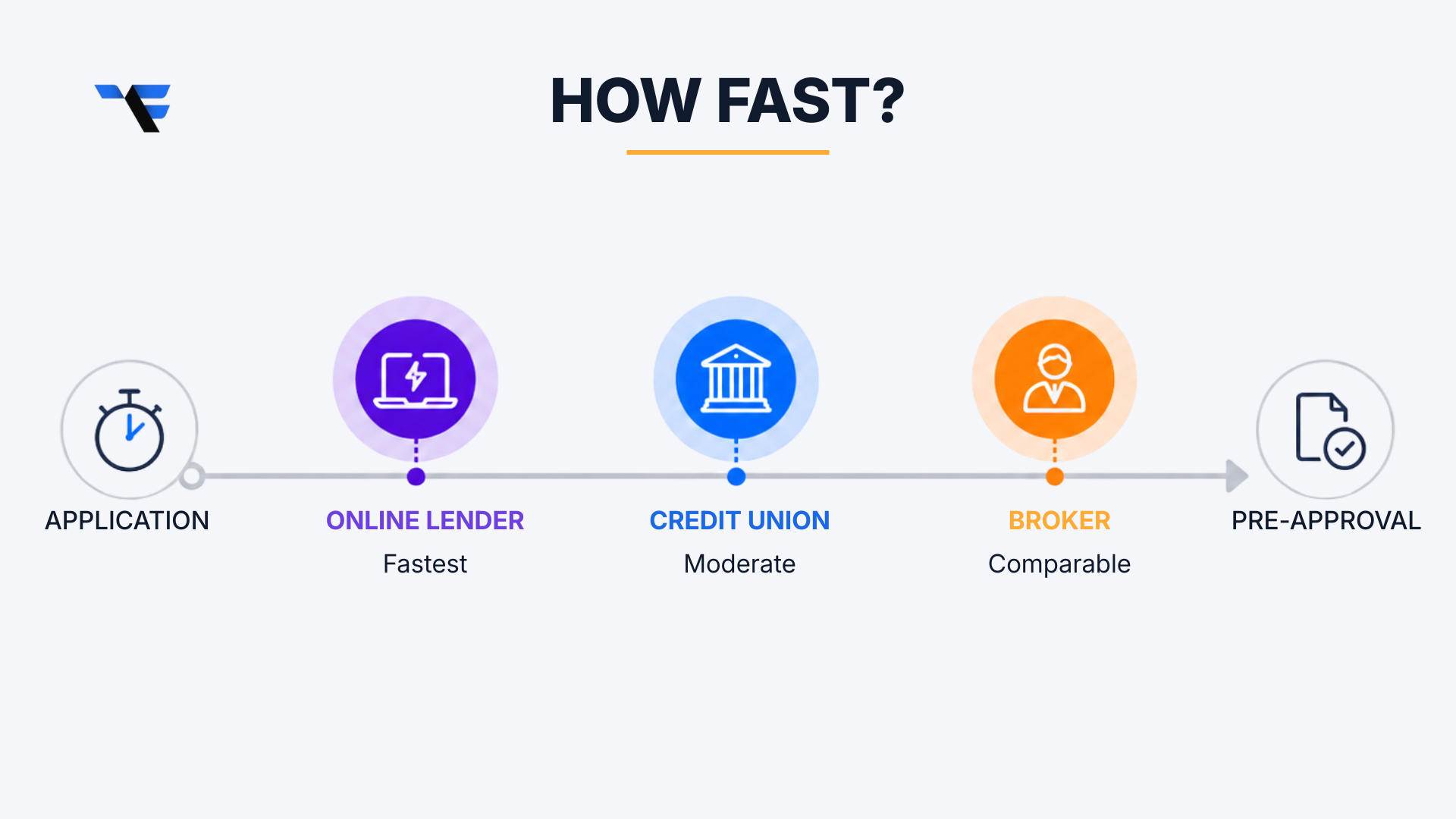
Frequently Asked Questions
1. What is the main difference between a HELOC broker, a credit union, and an online lender?
A broker acts as an intermediary who shops your application across multiple lenders; they don't fund the loan themselves. A credit union is a member-owned, not-for-profit institution that funds the loan directly. An online lender is a digital-first platform that also funds directly, with a process built around speed and self-service.
2. Which option typically offers the lowest HELOC interest rates?
Credit unions tend to offer below-bank rates due to their not-for-profit structure. Brokers can potentially access the lowest rate in the market by shopping across lenders. Online lenders are competitive but typically price in line with or above bank rates. The NCUA data shows credit union HELOC rates running meaningfully below bank averages, though a broker with broad market access can often surface comparable or better terms.
3. Does using a HELOC broker affect my interest rate?
Not directly. Most brokers earn a lender-paid commission rather than charging the borrower a separate fee, but that compensation is typically factored into the rate offered. Always ask a broker upfront how they're compensated and how it affects the rate you're being quoted.
4. Which lender type has the most flexible qualification criteria for variable interest rates and minimum credit score?
Credit unions are the most flexible on underwriting, particularly for borrowers with lower credit scores or non-traditional income. Brokers offer a different kind of flexibility; they can match you to the lender most likely to approve your specific profile, which is especially valuable for borrowers who have been declined elsewhere.
5. How long does HELOC approval typically take with each lender type?
Online lenders are the fastest, with some offering decisions in days. Credit unions are comparable for existing members with straightforward profiles. Brokers add time at the front end but handle the market comparison on your behalf. The home appraisal, required across all three, is typically the longest step in any process, often adding one to two weeks.
6. Is HELOC interest tax deductible?
It may be, depending on how you use the funds. Per the IRS, interest on a HELOC is generally deductible only when the proceeds are used to buy, build, or substantially improve the home securing the loan. Consult a tax advisor for guidance specific to your situation.
7. Should a first-time borrower use a HELOC broker?
A broker is often the strongest choice for first-time HELOC borrowers, particularly those who find the landscape confusing or have a financial profile that doesn't fit neatly into one institution's criteria. The ability to compare options across the full market, with a knowledgeable advocate doing the work, removes much of the friction that makes the process intimidating.
Ready to Find Out Which HELOC Path Makes Sense for Your Situation?
The lender type you choose isn't a small detail; it shapes the rate you get, the total cost you pay, whether you get approved at all, and how smooth the process feels from application to funding. The real question isn't which type of lender is theoretically better. It's which one fits your credit profile, your timeline, and your financial goals right now.
Mortgage brokers like Truss Financial Group look at your actual situation before recommending anything, considering your loan, your credit profile, and your goals, rather than defaulting to a single product. Whether a direct lender, a credit union, or a full market comparison is the right move for your home equity line of credit, the answer should come from your numbers, not a script.

.svg)

Discuss your unique requirements
Get direct answers and a roadmap for your future.
.png?width=202&height=202&name=image%20588255187%20(1).png)

-3.png?width=389&height=221&name=Blog%20covers%20(9)-3.png)

.png?width=389&height=221&name=Blog%20covers%20(1).png)

.png?width=389&height=221&name=Blog%20covers%20(2).png)


.svg)

.svg)
.svg)