.svg)



%20(1).svg)
%20(2).svg)
.png?width=480&height=420&name=Img%20(1).png)
%20(3).svg)
%20(4).svg)

%20(5).svg)


 View all states

15 mins

In this blog
How Self-Employed Borrowers Use HELOCs When Fannie Mae Income Guidelines Don’t Work
You have equity, good credit, and real cash flow, but Fannie Mae's income guidelines still say no. For self-employed borrowers, that's not an edge case. It's the default. Tax returns loaded with legitimate deductions consistently understate what business owners, freelancers, and 1099 earners actually earn.
A HELOC operates outside Fannie Mae's framework entirely. As a portfolio product, lenders set their own underwriting criteria. Bank statements, CPA letters, and asset documentation all qualify. Specialized lenders like Truss Financial Group help self-employed borrowers find the right HELOC structure when conventional options fall short. Here's exactly how it works.
The Fannie Mae Income Problem: What the Guidelines Actually Require
Fannie Mae doesn't lend money directly. It purchases mortgages from lenders, bundles them into mortgage-backed securities, and sells them to investors, which is why lenders must follow Fannie Mae's underwriting guidelines when originating conforming loans. The Federal Housing Finance Agency (FHFA) oversees Fannie Mae and sets the conforming loan limits that determine how large a loan can be before it falls outside these guidelines. Those rules are detailed, rigid, and designed around predictable W-2 income.
For self-employed borrowers, the documentation requirements are in a different category entirely.

Who counts as self-employed under Fannie Mae?
Any borrower with 25% or greater ownership interest in a business. That includes sole proprietors, LLC members, S-corp shareholders, partners, and corporate owners above that threshold. Once that classification applies, the standard income verification process goes out the window.
The two-year requirement
Fannie Mae generally requires lenders to obtain a two-year history of self-employment income, verified through signed federal tax returns, both personal and business returns, with all applicable schedules attached. The logic is income stability: two years of returns demonstrate a pattern of earnings that the borrower can reliably continue.
The Form 1084 problem
Lenders use Fannie Mae's Cash Flow Analysis (Form 1084) to calculate qualifying income. The process starts with net income from the tax return and adds back certain non-cash items like depreciation, depletion, and amortization, but every legitimate business deduction and write-off still reduces the final number.
The more aggressively a borrower manages their tax liability through their business, the lower their qualifying income appears. This directly impacts the borrower's ability to meet Fannie Mae's thresholds, even when real cash flow is strong.
Here's what that looks like in practice:
|
Monthly Reality |
Fannie Mae's View |
|
$15,000 in bank deposits |
$7,200 qualifying income after Form 1084 |
|
720 credit score |
Meets minimum threshold |
|
$200,000 in home equity |
Meets LTV requirement |
|
Actual DTI: 28% |
Fannie Mae DTI: 58%, over the 45%–50% cap |
The borrower's DTI ratio is where most self-employed borrowers stall. Fannie Mae allows a DTI ratio of up to 45%–50%, but that ratio is calculated against qualifying income, not actual cash flow. A borrower depositing $15,000 a month who only shows $7,200 in qualifying income will breach the DTI ceiling on a loan whose monthly mortgage payment poses no real strain on.
Documentation requirements also vary by business structure:
|
Business Structure |
Required IRS Documentation |
|
Sole Proprietorship |
Form 1040 + Schedule C |
|
Partnership |
Form 1065 + Schedule K-1 |
|
S Corporation |
Form 1120-S + Schedule K-1 |
|
LLC |
Form 1065 or 1120-S + Schedule K-1 |
|
Corporation |
Form 1120 |
Each structure requires a different set of forms, and lenders must analyze the borrower's business separately for each income source. For borrowers with multiple businesses or income streams, this compounds quickly.
Then there's the Desktop Underwriter wall. Fannie Mae's automated underwriting system evaluates the calculated income figure, not the actual bank balance, not the business revenue, not what the borrower deposits each month. If the loan doesn't clear DU, manual underwriting on a conventional loan is rarely an option, and the underwriting decision stalls the application entirely.
This is not a credit problem or an equity problem. It is a documentation framework that was built for one type of borrower and applied to another.
Why a HELOC Lives Outside Fannie Mae's Rules?
A HELOC, or Home Equity Line of Credit, is a revolving line of credit secured by your home equity, functioning as a first lien or subordinate lien depending on whether an existing mortgage is in place. During the draw period, typically five to ten years, you access funds as needed up to your credit limit and make HELOC payments on what you draw. After that, you enter the repayment period and pay down the outstanding balance. Unlike personal loans or installment debt, a HELOC gives you ongoing access to financing rather than a fixed lump sum.
What makes it structurally different from a conventional mortgage is where it lives after closing. A HELOC is a portfolio product. Lenders hold it on their own books rather than selling it to Fannie Mae or Freddie Mac. Because Fannie Mae never purchases it, it never has to meet Fannie Mae's underwriting guidelines.
No Form 1084. No Desktop Underwriter threshold. No two-year tax return mandate. The lender sets the rules.
|
Aspect |
Fannie Mae Conventional Loan |
HELOC (Portfolio Product) |
|
Sold to Fannie Mae |
Yes |
No |
|
Income Verification |
2 years of tax returns required |
Bank statements, assets, or alt-docs |
|
Qualifying Income Basis |
Net income after deductions |
Deposits, assets, or lender-defined method |
|
DTI Cap |
45%–50% |
Varies by lender and program |
|
Appraisal Required |
Generally yes |
AVM options available |
|
Self-Employed Flexibility |
Rigid, Form 1084 required |
High, program-dependent |
For self-employed borrowers, that flexibility is the entire difference between qualifying and not.
HELOC Programs Built for Self-Employed Borrowers
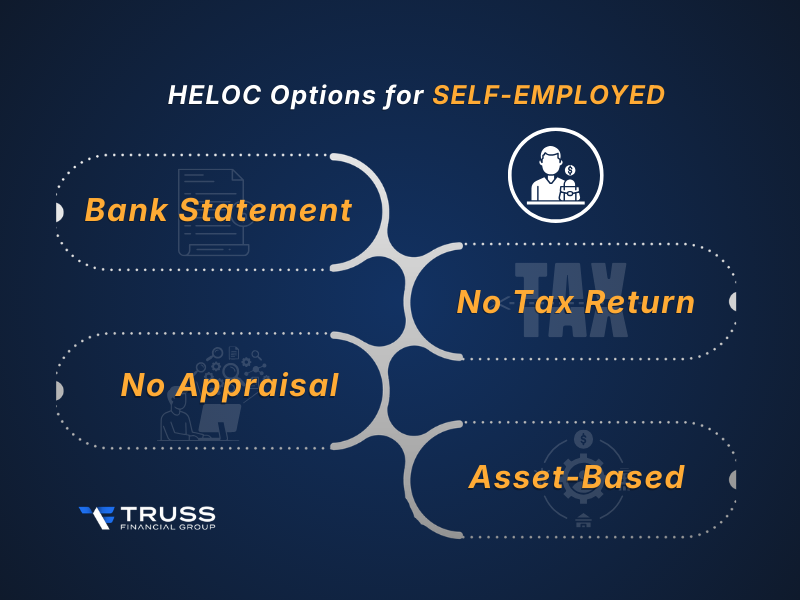
Not all HELOCs are created equal. Some lenders still require full tax return documentation, essentially replicating Fannie Mae's framework on a portfolio product. Others have built programs specifically for borrowers whose income doesn't fit a W-2 mold. The four programs below are the most relevant for self-employed borrowers who can't or don't want to qualify through conventional income documentation.
1. Bank Statement HELOC
Instead of tax returns, the lender uses 12 to 24 months of bank deposit history to verify income in a bank statement HELOC. Deposits are reviewed, an expense ratio is applied, and the remainder becomes qualifying income.
How the calculation works:
- Personal bank statements: lenders typically count 80–100% of deposits as qualifying income
- Business bank statements: an expense ratio of 50% or higher is applied to total deposits, and the remainder counts as income
- Example: $20,000/month in business deposits × 50% expense ratio = $10,000 qualifying monthly income, compared to $6,000–$7,000 under Fannie Mae's Form 1084 analysis
Key details:
- No tax returns required; bank statements replace IRS filings entirely
- Minimum credit score: typically 620–680
- Combined loan-to-value (CLTV) cap: typically 80–85%
- Rate premium: approximately 0.25–0.75% over fully documented HELOCs
- Self-employment seasoning: typically 2 years
- Available at portfolio lenders, credit unions, and non-QM specialists
This is the most widely available alternative program for self-employed borrowers. It works best when the bank account tells the real story that the tax return can't.
2. No Tax Return HELOC
A no-tax-return HELOC accepts alternative documentation in place of IRS filings. This is not a no-documentation loan; the lender is still verifying income, just through a different lens using equivalent documentation that reflects true earning power.
Common alternatives lenders accept:
- Year-to-date profit and loss statement, typically CPA-prepared
- 1099-NEC or 1099-MISC forms from clients
- A CPA or accountant verification letter confirming income level and business viability
- Bank statements as supplemental support
These programs are most common at portfolio lenders and non-QM mortgage companies. The rate premium typically runs 0.25–1.00% over standard programs, and a stronger payment history or larger equity position can offset lighter documentation. This option works well for borrowers with recent income growth not yet reflected on a filed return, or heavy deductions that misrepresent actual cash flow.
2. No Appraisal HELOC
A no-appraisal HELOC uses an automated valuation model (AVM), a data-driven estimate of the subject property's value based on comparable sales and market data, instead of a full in-person appraisal. No appraiser, no scheduling delay, no additional upfront closing costs.
For a self-employed borrower who has already navigated the income documentation process, removing the appraisal eliminates the last major friction point. Closing timelines are faster, and the process is simpler end-to-end.
Practical considerations:
- AVM eligibility depends on market data availability and property type
- May carry slightly tighter LTV limits depending on the lender
- Not available in every market
- Can often be combined with a bank statement or alternative documentation for income verification
This program fits best for borrowers in data-rich markets who want the fastest, lowest-friction path to their home equity.
3. Asset-Based HELOC Qualification
Asset-based qualification, also called asset depletion, lets borrowers qualify using liquid financial assets instead of income. The lender divides total verified liquid assets by a set number of months to derive a hypothetical monthly income figure.
Example: $600,000 in liquid assets ÷ 360 months = $1,667/month qualifying income.
Eligible assets typically include savings accounts, brokerage accounts, and retirement funds at a discount. Unlike revolving accounts or installment debt obligations, these assets are evaluated purely for their ability to support recurring monthly debt obligations over time. This approach requires no income documentation; qualification rests entirely on asset strength. As a result, lenders typically require a credit score of 700 or higher, apply lower CLTV limits, and this program is less widely available than bank statement options.
It's the right fit for self-employed borrowers or semi-retired business owners with a strong balance sheet but income that is irregular, seasonal, or deliberately minimized on paper.
Which HELOC Program Fits Your Profile?
The right program isn't about which one sounds most appealing. It's about which one matches how your income actually looks on paper versus how it flows into your account.
|
Your Situation |
Best Program |
Why |
|
Strong deposits, heavy write-offs, clean bank history |
Bank Statement HELOC |
Deposits reflect real income; tax returns don't |
|
Recent income growth is not yet on a filed return |
No Tax Return HELOC |
A CPA letter or P&L captures current earnings |
|
Good credit, strong equity, want fast closing |
No Appraisal HELOC |
AVM removes the biggest remaining bottleneck |
|
Strong balance sheet, irregular income on paper |
Asset-Based HELOC |
Financial assets don't qualify if the work income is not |
|
Partially qualifies under Fannie Mae guidelines |
Conventional cash-out refinance is worth comparing |
Only if touching your primary mortgage rate makes sense |
The wrong program wastes time, triggers unnecessary credit inquiries, and can delay access to equity by weeks. The right one gets structured correctly before anything goes to underwriting.
This is where working with a specialized lender like Truss Financial Group makes the difference, matching the program to the borrower profile before the application, before the credit pull, before a single document is submitted.
What Self-Employed Borrowers Need to Qualify?
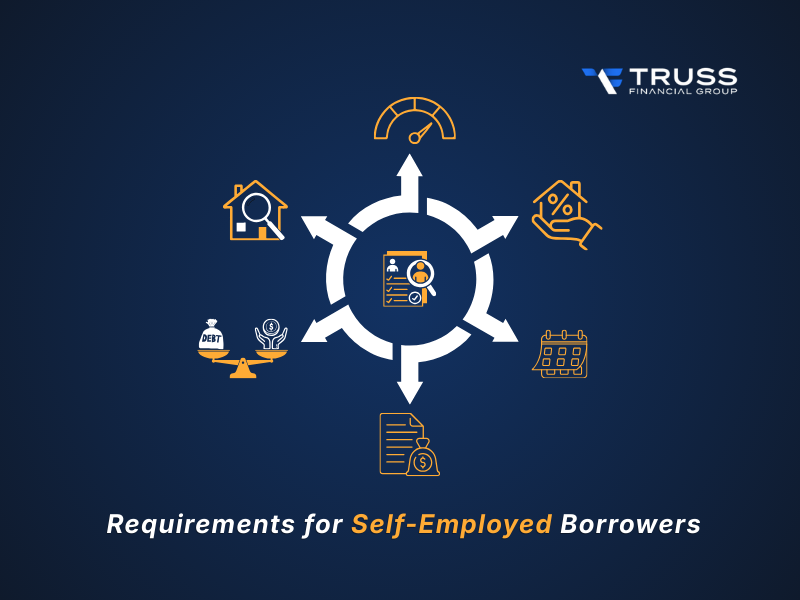
Regardless of which program fits best, lenders evaluate a consistent set of baseline factors across all self-employed HELOC applications. Knowing these before approaching a lender puts you in a stronger position from the first conversation.
|
Requirement |
Typical Range |
Notes |
|
Credit Score |
620–700+ |
A higher score compensates for lighter documentation |
|
CLTV |
80–85% max |
Lower for alt-doc and asset-based programs |
|
Self-Employment Seasoning |
2 years |
Some lenders accept less with strong compensating factors |
|
Income Documentation |
Varies by program |
Tax returns, bank statements, P&L, or assets |
|
DTI Ratio |
Varies by lender |
Calculated on program-specific qualifying income |
|
Appraisal |
Required or AVM |
Depends on the program and market |
A home equity loan is worth comparing here as well. Unlike a HELOC, it delivers a lump sum at a fixed rate with predictable monthly mortgage payments, but the same income documentation challenges apply. For self-employed borrowers who prefer fixed monthly payment amounts over a revolving line, it's a reasonable alternative, though it offers less flexibility than a HELOC line of credit.
Rental income from investment property can sometimes be factored into qualifying income, depending on the program and lender, which may improve the borrower's DTI ratio calculation.
These are market-range benchmarks. Individual lender criteria vary based on borrower profile, equity position, and program availability.
Frequently Asked Questions
Can self-employed borrowers get a HELOC?
Yes. Self-employed borrowers can qualify for a HELOC, provided they meet the lender's equity, credit, and income requirements. The key difference from conventional loans is that many HELOC lenders offer alternative income verification programs, including bank statements, asset documentation, or CPA letters, that work around the tax return limitations that trip up self-employed borrowers under Fannie Mae's guidelines.
Why do Fannie Mae's guidelines make it difficult for self-employed borrowers to qualify?
Fannie Mae calculates qualifying income using a cash flow analysis (Form 1084) applied to tax returns. Because self-employed borrowers reduce taxable income through legitimate business deductions, their qualifying income often comes out significantly lower than their actual cash flow. When lenders apply Fannie Mae's 45%–50% DTI cap to that reduced income figure, borrowers who can comfortably afford the monthly mortgage payments don't qualify on paper.
What is a bank statement HELOC?
A bank statement HELOC is a program that uses 12 to 24 months of bank deposit history instead of tax returns to verify income. The lender reviews deposits, applies an expense ratio to account for business costs, and uses the remainder as qualifying income. It's the most common alternative program for self-employed borrowers with strong cash flow and significant write-offs.
Do I need two years of tax returns to get a HELOC?
Not necessarily. The two-year tax return requirement is specific to Fannie Mae's conventional loan guidelines and does not automatically apply to HELOCs. Portfolio lenders and non-QM lenders can accept bank statements, profit and loss statements, 1099s, or equivalent documentation instead. Requirements vary by lender and program.
What credit score do I need for a self-employed HELOC?
Most HELOC lenders require a minimum credit score of 620 to 680. Alternative documentation programs, including bank statements, no-doc, and asset-based options, may require 680 to 700 or higher, since a stronger credit profile and clean payment history help offset lighter income documentation. A higher score generally yields better rates and terms across all programs.
What is a no-appraisal HELOC?
A no-appraisal HELOC uses an automated valuation model (AVM) instead of a full in-person appraisal to determine the subject property's value and calculate CLTV. It typically closes faster and carries lower closing costs than a standard HELOC, though AVM availability depends on the market and property type.
What is the difference between a HELOC and a cash-out refinance for self-employed borrowers?
A cash-out refinance replaces the existing mortgage with a new, larger loan, and the borrower receives the difference as a lump sum. It still goes through standard mortgage underwriting, which means Fannie Mae's income guidelines apply if the loan is conforming. A HELOC is a separate line of credit secured by home equity. It doesn't disturb the existing mortgage, and as a portfolio product, it can be underwritten on the lender's own terms. For self-employed borrowers who can't clear Fannie Mae's income hurdle, a HELOC is often the more accessible financing path.
Can I qualify for a HELOC if my tax returns show a business loss?
It depends on the program. Under a standard documented HELOC, a business loss reduces qualifying income and can make approval difficult or impossible. Under a bank statement program, the lender uses deposit history rather than tax return income, so a business loss on the return doesn't automatically disqualify the borrower if deposits show consistent cash flow. Asset-based qualification is another option if the balance sheet is strong.
You Have the Equity. Here's How to Actually Use It.
Fannie Mae's income framework was built for W-2 earners. For self-employed borrowers, the same financial discipline that protects the borrower's business, the deductions, the write-offs, the tax strategy, becomes the barrier to qualifying for a conventional loan. That's not a flaw in the borrower. It's a mismatch between the guidelines and the reality of how self-employment income works.
A HELOC isn't a workaround. For self-employed borrowers with real equity, solid credit, and genuine cash flow, it's often the structurally correct product, one designed around how money actually moves, not just what a tax return shows.
Mortgage brokers like Truss Financial Group specialize in helping self-employed borrowers find the HELOC program that fits how they actually earn. Whether that's a bank statement HELOC, a no-tax-return option, or an asset-based qualification path, the right structure gets matched to the right borrower before anything goes to underwriting.

.svg)

Discuss your unique requirements
Get direct answers and a roadmap for your future.
.png?width=202&height=202&name=image%20588255187%20(1).png)

.png?width=389&height=221&name=Blog%20covers%20(53).png)



.svg)

.svg)
.svg)