.svg)



%20(1).svg)
%20(2).svg)
.png?width=480&height=420&name=Img%20(1).png)
%20(3).svg)
%20(4).svg)

%20(5).svg)


 View all states

29 mins
.png)
In this blog
Introduction to Self-Employed Borrowing
Qualifying for a mortgage as a self-employed borrower has always been trickier than it should be. You might earn more than many W-2 employees, but the way your income appears on paper, after business expenses, deductions, write-offs, and year-to-year variability, often tells a completely different story.
Fannie Mae’s updated guidelines shine a brighter light on this problem. They focus heavily on tax-return-based income, income stability, and detailed documentation, which can create unexpected hurdles for entrepreneurs, freelancers, contractors, and small business owners.
Understanding these rules isn’t just “nice to know”, it’s essential.
Because under Fannie Mae:
-
Your taxable income is what counts, not your gross receipts.
-
Business write-offs can make your income look artificially low.
-
Even successful business owners can appear “unqualified” on paper.
This is exactly why so many self-employed borrowers get stuck during the mortgage process.
Fannie Mae’s goal with these updated guidelines is to create standardized, predictable underwriting. Your goal, however, is simpler: to understand how your income will be evaluated and what your options are if traditional guidelines don’t fit your real financial picture.
Later in this guide, we also cover what you can do if your tax returns don’t tell your full story, including alternative loan options designed specifically for self-employed borrowers.

Business Income and Structure Under Fannie Mae
When you’re self-employed, the way your business is structured directly determines how lenders evaluate your income. Fannie Mae doesn’t treat all forms of entrepreneurship equally, each structure has different documentation requirements, different income calculations, and different risk considerations.
Understanding where you fall is the first step to knowing how your income will be analyzed.
Sole Proprietorship (Schedule C Filers)
If you file a Schedule C on your personal tax return, Fannie Mae treats you as a sole proprietor. This category includes freelancers, gig workers, small business owners, coaches, trainers, consultants, and anyone who receives 1099s.
Key details:
-
Income is calculated using net profit after all expenses
-
High write-offs → dramatically lower qualifying income
-
Year-over-year stability is heavily scrutinized
-
Declining income requires explanations and may reduce eligibility
Why many fail? Schedule C borrowers often write off business expenses aggressively, which reduces taxable income, even when real cash flow is strong.
Partnerships (Form 1065 + Schedule K-1)
Borrowers with ownership in a partnership must provide:
-
K-1 forms
-
1065 business returns
-
Proof of ownership percentage
-
Possibly business bank statements or a CPA letter
Fannie Mae analyzes:
-
Your share of ordinary business income
-
Guaranteed payments
-
Distributions (if they are consistent and supported by business liquidity)
-
Whether the business can actually afford to distribute income to you
Risk factor:
If the partnership shows losses or thin liquidity, lenders may exclude K-1 income entirely.
Partnerships (Form 1065 + Schedule K-1)
Borrowers with ownership in a partnership must provide:
-
K-1 forms
-
1065 business returns
-
Proof of ownership percentage
-
Possibly business bank statements or a CPA letter
Fannie Mae analyzes:
-
Your share of ordinary business income
-
Guaranteed payments
-
Distributions (if they are consistent and supported by business liquidity)
-
Whether the business can actually afford to distribute income to you
Risk factor:
If the partnership shows losses or thin liquidity, lenders may exclude K-1 income entirely.
S-Corporations (Form 1120S + Schedule K-1)
Self-employed borrowers who run S-Corps have the most complex documentation:
-
1120S business tax returns
-
K-1 showing ownership percentage
-
W-2 (if you pay yourself a salary)
-
Business financial statements (in some cases)
Lenders consider both:
-
W-2 wages paid to yourself
-
Pass-through income from the S-Corp
But they also examine:
-
Business stability
-
Whether income distribution is sustainable
-
Year-over-year trends in revenue and expenses

1099 Contractors (Independent Workers)
1099 income earners are technically “self-employed,” even without a formal business entity.
Fannie Mae looks at:
-
Consistency of contract income
-
Length of time earning 1099 income (usually 2 years preferred)
-
Whether contracts are ongoing or seasonal
-
Volume and stability of deposits
Issue:
Large fluctuations in 1099 income often trigger more documentation requests.
Why Your Business Income Trends Matter
Regardless of structure, Fannie Mae looks for:
-
Stable or increasing income over the last 24 months
-
Explanations for declines
-
Predictability of future income
-
Proof that the business is financially healthy
If income is:
-
Increasing → favorable
-
Stable → acceptable
-
Declining → often a red flag
Even strong businesses can fail Fannie Mae guidelines if the tax returns show volatility.
Accurate Books and Records Are Non-Negotiable
Fannie Mae requires clear, verifiable financials because self-employment carries more risk.
You must be ready to provide:
-
Complete business tax returns
-
Accurate P&L statements
-
Balance sheets (if requested)
-
Bank statements supporting business activity
If financial statements don’t match tax returns, or if the business appears unstable, underwriters may discount or reduce qualifying income.
Income Verification Requirements
Verifying income for self-employed borrowers is more involved than for W-2 employees. Fannie Mae requires a deeper look into how your business operates, how predictable your income is, and how accurately it’s reflected in your tax filings.
Here’s what lenders focus on when verifying income under Fannie Mae’s updated guidelines:
Recent Federal Tax Returns (Personal + Business)
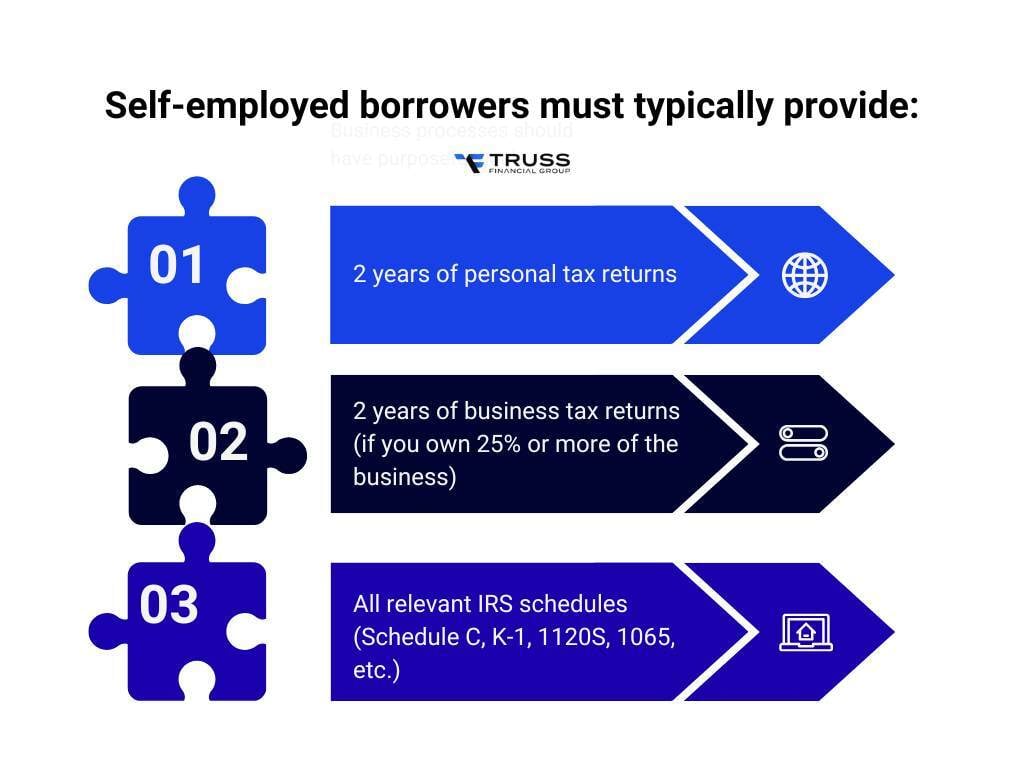
Self-employed borrowers must typically provide:
-
2 years of personal tax returns
-
2 years of business tax returns (if you own 25% or more of the business)
-
All relevant IRS schedules (Schedule C, K-1, 1120S, 1065, etc.)
In some cases, if income is stable and straightforward, Fannie Mae allows only 1 year of returns, but this is not common for complex or fluctuating businesses.
Proof of Ongoing Self-Employment
Lenders need to confirm that your business is still active and generating income.
They may request:
-
A business license
-
A CPA letter
-
Business bank statements
-
An active website or invoices
-
Year-to-date P&L statements
This verifies that your income source hasn’t changed since the last tax filing.
Stability of Income
Fannie Mae emphasizes predictability, not just the dollar amount.
Underwriters check for:
-
Consistency over the past 24 months
-
Year-over-year increases or decreases
-
Whether income fluctuations are normal for your industry
-
Any signs of business decline
If income has dropped significantly, they may average the lowest year or question future stability.
Profit and Loss (P&L) Statements
A P&L may be required when:
-
The most recent tax return is more than 12 months old
-
Income appears inconsistent
-
Business cash flow is unclear
-
Underwriters need clarity on recent performance
A CPA-prepared P&L carries more weight, but borrowers can sometimes provide self-prepared versions if supported by bank statements.
Additional Income Verification Documents
Depending on your business type and income complexity, lenders may also request:
-
Balance sheets
-
Business bank statements
-
Statements showing owner draws or distributions
-
Letters explaining unusual business expenses or losses
-
A written income analysis prepared by your CPA or loan officer
These documents help underwriters match business performance with the tax returns.
Why Verification Is Stricter for Self-Employed Borrowers
Fannie Mae places a higher verification burden on self-employed applicants because:
-
Income can vary unpredictably
-
Business expenses reduce taxable income
-
Write-offs make earnings appear much lower
-
Cash flow may not equal taxable net income
-
Business liabilities can affect stability
This is precisely why many self-employed borrowers look less qualified on paper than they actually are and why Non-QM alternatives often become necessary.
Documentation Requirements for Self-Employed Borrowers
Because self-employed income is more complex and less predictable than W-2 income, Fannie Mae requires a deeper and more comprehensive set of documents. These help verify not just how much you earn, but how reliable and stable that income is over time.
Below are the specific documents lenders review under Fannie Mae’s guidelines.
Required IRS Schedules and Tax Forms
1. Schedule C (Sole Proprietorships)
Used for individuals running unincorporated businesses.
Lenders review:
-
Gross receipts
-
Business expenses
-
Net profit (this is the qualifying income)
-
Add-backs such as depreciation or mileage
-
Year-over-year trends
2. Schedule K-1 (Partnerships + S-Corps)
Required for borrowers who own 25% or more of a partnership or S-Corporation.
Underwriters use it to verify:
-
Ownership percentage
-
Ordinary business income
-
Guaranteed payments
-
Distributions (only counted if they are consistent and supported by business liquidity)
3. Form 1120S (S-Corporations)
Details the company’s revenue, expenses, and financial health. Lenders analyze:
-
Net business income
-
W-2 wages paid to the borrower (if applicable)
-
Officer compensation
-
Carryover losses and depreciation
-
Debt obligations affecting income stability
Why these matter:
These schedules reveal whether taxable income is stable, rising, or declining, and whether the borrower’s share of business income is sustainable.
Business Ownership Verification
Lenders must confirm that the borrower actually owns the share of the business reported.
Verification may include:
-
Articles of incorporation
-
Partnership agreements
-
Operating agreements
-
Shareholder statements
-
CPA letters verifying ownership percentage
This determines whether business tax returns are required.

Minimum Months of Self-Employment Required
Fannie Mae typically requires:
-
At least 24 months of self-employment history
-
12–24 months may be acceptable if the borrower previously worked in the same field with similar income
-
Less than 12 months of self-employment is rarely acceptable
Longevity shows stability, the biggest underwriting concern for entrepreneurs.
When Lenders Require Audited P&L Statements
An audited or CPA-prepared profit and loss (P&L) statement may be required when:
-
The most recent tax return is older than 12 months
-
The business has inconsistent or declining income
-
Deposits in business bank statements do not match reported income
-
Large write-offs or losses require explanation
-
Business liquidity is unclear
-
The loan amount is high relative to income
A CPA-signed P&L adds credibility and reduces questions from underwriters.
Additional Documentation in Certain Cases
Some situations trigger extra scrutiny and documentation requests, such as:
-
Business losses → proof the business is still solvent
-
Declining income trends → written explanations
-
Unusual expenses → supporting receipts or letters
-
High owner draws → evidence the business can sustain them
-
Recent incorporation → proof of prior experience in the same field
-
Industry volatility → additional financial statements
Lenders may also request:
-
Business bank statements (to support the P&L)
-
Balance sheets
-
CPA letters
-
Proof of ongoing business activity (license, website, invoices)
These documents help confirm that income shown on tax returns is accurate and representative of current business performance.
How Fannie Mae Calculates Monthly Self-Employed Income
For self-employed borrowers, Fannie Mae does not use “gross receipts” or the money deposited into your account. Instead, qualifying income is based almost entirely on your taxable net income, adjusted using Fannie Mae’s specific rules.
This analysis is done using Form 1084: Cash Flow Analysis, or an equivalent lender worksheet.
Below is exactly how the calculation works.
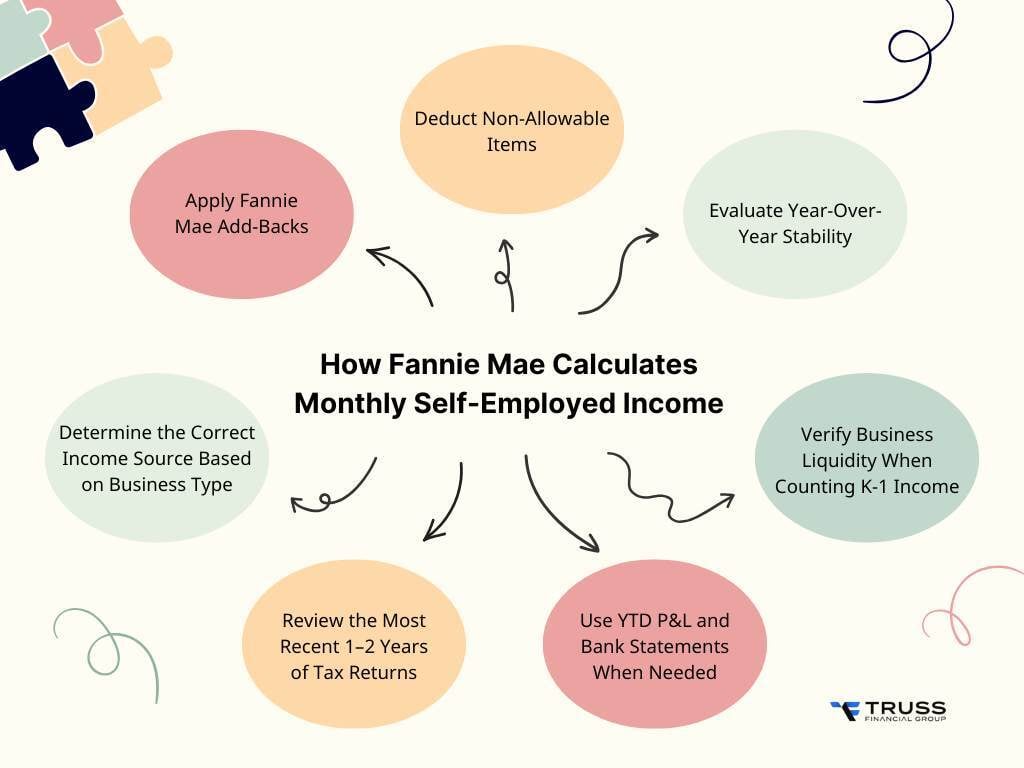
Step 1: Review the Most Recent 1–2 Years of Tax Returns
Fannie Mae requires:
-
Two years of personal tax returns (unless one year is allowed)
-
Two years of business returns if borrower owns ≥25% of the business
Underwriters compare:
-
Year 1 net income
-
Year 2 net income
-
Year-to-date performance (if needed)
Income must be stable or increasing.
If declining, lenders use the lower of the two years.
Step 2: Determine the Correct Income Source Based on Business Type
-
Schedule C (sole proprietors) → use net profit
-
Partnerships (1065 + K-1) → use “ordinary business income” + guaranteed payments
-
S-Corps (1120S + K-1) → use pass-through income + W-2 wages to owner
-
Corporations (1120) → borrower must draw W-2 wages to use income
Income must be supported by business health and liquidity.
Step 3: Apply Fannie Mae Add-Backs
These items are added back to income because they’re non-cash expenses:
-
Depreciation
-
Amortization
-
Depletion
-
Business use-of-home deduction (if applicable)
-
Extraordinary one-time expenses with documentation
Add-backs increase qualifying income.
Step 4: Deduct Non-Allowable Items
These items must be subtracted because they reduce usable cash flow:
-
Meals & entertainment over allowed limits
-
Amortized business expenses
-
Business losses
-
Non-recurring income
-
Income from businesses with insufficient liquidity
-
Owner distributions unsupported by business cash flow
If a company shows losses, the borrower may receive zero qualifying income from that business.
Step 5: Evaluate Year-Over-Year Stability
Fannie Mae has strict rules:
-
Income increasing → average 24 months
-
Income stable → average 24 months
-
Income declining → use the most recent, lower year
-
Income declining significantly → borrower may be ineligible
A meaningful decline requires written explanation AND strong YTD business performance.
Step 6: Verify Business Liquidity When Counting K-1 Income
For partnerships and S-Corps:
-
If the borrower receives actual distributions, underwriters must confirm the business can support them.
-
If distributions are not consistent with claimed income → income may be disallowed.
This prevents borrowers from qualifying using “paper income” the business cannot actually pay out.
Step 7: Use YTD P&L and Bank Statements When Needed
A year-to-date profit and loss statement is required when:
-
The last tax return is more than 12 months old
-
Income has declined
-
Underwriters cannot determine current performance
Bank statements must substantiate the revenue shown on the P&L.
If YTD performance contradicts tax returns → income may be reduced.
Example: How a Successful Business Owner Can Appear to Earn Less
A borrower with:
-
$180,000 in annual gross business receipts
-
$130,000 in business expense write-offs
-
Net taxable income: $50,000
Fannie Mae evaluates income based on that $50,000, not the real cash flow.
This is why many high-earning entrepreneurs fail conventional qualification, even when they earn multiple six figures.
Summary: Fannie Mae Only Uses Tax-Return-Based Income
Even strong business cash flow does not increase qualifying income unless:
-
It shows up on IRS returns, and
-
It meets Fannie Mae’s stability and liquidity rules.
This is the core reason so many self-employed borrowers turn to Non-QM, Bank Statement Loans, Asset Depletion, or No-Doc HELOCs when Fannie Mae calculations don’t reflect their actual earning power.
Business Financials and Assets Considered by Fannie Mae
When underwriting self-employed borrowers, Fannie Mae examines much more than just taxable income. The financial health of the business, its liquidity, stability, debt load, and ability to sustain the borrower’s income, is a core part of the evaluation. This protects lenders against borrowers whose businesses generate strong top-line revenue but limited usable cash flow.
Here are the key business financial factors lenders review.
Liquidity Requirements (Business Cash Flow Matters)
Business liquidity refers to how much cash or liquid assets the business has available to operate. Lenders review:
-
Business bank account balances
-
Working capital
-
Current assets vs. current liabilities
-
Cash reserves
-
Whether the business can afford distributions to the owner
Why it matters:
If the business does not have sufficient liquidity, income reported on paper (K-1, Schedule C, 1120S, etc.) may be considered unreliable.

When Business Assets Can and Cannot Be Used
Business assets can be used if:
-
They are necessary to support the borrower’s actual income
-
The borrower can document access (for example, owner draws)
-
The business has enough liquidity to remain operational after withdrawing assets
Business assets cannot be used if:
-
The business would be harmed by withdrawing funds
-
The assets are needed to cover business debts or payroll
-
The borrower’s distributions exceed what the business can realistically support
Fannie Mae is strict here: they only count income or assets if the business remains stable afterward.
Impact of Cash Reserves
Cash reserves make a big difference, especially for self-employed borrowers.
Strong reserves:
-
Reduce perceived risk
-
Allow underwriters to overlook minor fluctuations
-
Support the sustainability of distributions
-
Strengthen approval chances in marginal cases
However, reserves cannot replace income.
Good reserves do not increase qualifying income if the taxable income is low.
Role of Business Debts and Liabilities
Business debt impacts eligibility when:
-
The borrower is personally liable
-
The business debt appears on the borrower’s credit report
-
The business cash flow cannot support its liabilities
Underwriters analyze:
-
Loan payments
-
Credit lines
-
Business credit card balances
-
Long-term loans
-
Business expenses carried by the owner
If liabilities strain business performance, lenders may reduce or invalidate usable income.
Why Strong Business Assets Don’t Help if Taxable Income Is Low
This is a crucial point most borrowers misunderstand:
Fannie Mae does not qualify self-employed borrowers based on gross receipts or total business assets.
They qualify you based on:
-
Net taxable income
-
Stability
-
Liquidity
-
Sustainable distributions
Even if a business has:
-
High revenue
-
Strong brand
-
Excellent cash flow
-
Significant assets
…it does not increase qualifying income unless the taxable income supports it.
This is why high-earning entrepreneurs often fail conventional loans while qualifying easily for Non-QM or Bank Statement programs.
Comparison to Freddie Mac
Fannie Mae and Freddie Mac follow similar philosophies when underwriting self-employed borrowers, but there are important differences in how they evaluate income, documentation, and business stability. In some cases, borrowers who don’t qualify under Fannie Mae may fit Freddie Mac, but not always.
Below are the meaningful differences that can affect qualification.
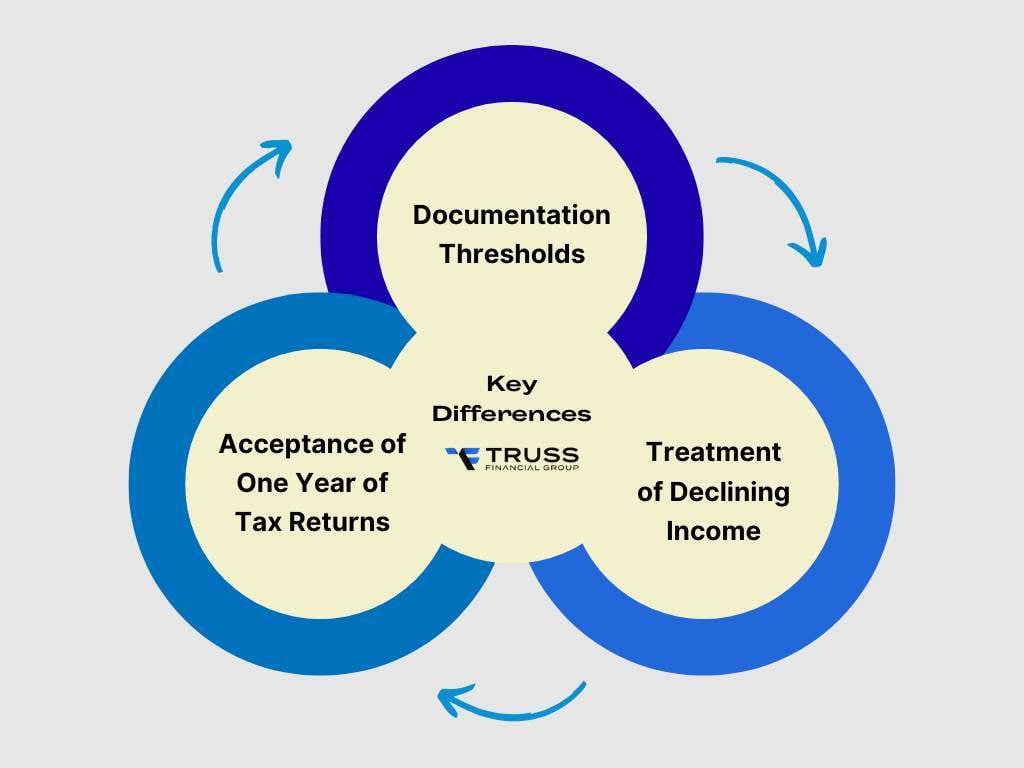
Key Differences in Self-Employment Guidelines
1. Treatment of Declining Income
-
Fannie Mae: Stricter. A decline requires using the most recent lower year of income. Significant declines may trigger denial.
-
Freddie Mac: May allow more flexibility if the decline is minor and can be fully explained.
2. Acceptance of One Year of Tax Returns
-
Fannie Mae: Allows 1 year only if the borrower has stable income and strong financials.
-
Freddie Mac: More open to accepting one year of tax returns when income is stable or increasing.
3. Documentation Thresholds
Freddie Mac sometimes requires:
-
Fewer months of self-employment history in select cases
-
Different trending analysis for P&L statements
-
Slightly more flexible rules for business liquidity
Both agencies use similar worksheets, but the interpretation can differ by lender.
Differences in Income Treatment
Fannie Mae:
-
Heavily tax-return based
-
Requires strict stability of net income
-
Requires strong business liquidity if using K-1 / S-Corp income
-
Stricter about "paper income" unsupported by distributions
Freddie Mac:
-
Can be more flexible with stable income
-
Sometimes treats certain pass-through items differently
-
May allow certain add-backs that Fannie rejects
-
Slightly more accommodating with borrowers who pay themselves W-2 wages through their business
But both follow the exact same principle: Taxable income rules all.
Which Borrowers Are Better Suited for Freddie Mac?
Borrowers may fit Freddie Mac better if:
-
Their income is stable but not significantly increasing
-
They only have one year of self-employment tax returns
-
Their partnership or S-Corp distributions are irregular, but business liquidity is strong
-
The lender prefers Freddie’s worksheet for their type of business
In these cases, Freddie Mac can provide a slightly smoother path.
Why Many Still Fail Both Fannie Mae and Freddie Mac If Taxable Income Is Low
Both agencies share the same limitation:
They do not care about gross receipts, revenue, or cash flow unless it shows up as stable, taxable income.
This means:
-
Large business write-offs → lower taxable income → lower qualifying income
-
Strong business revenue → irrelevant if taxable net income is weak
-
High cash flow → ignored unless proven and stable
-
Big year-over-year swings → treated as higher risk
Even if a borrower earns six figures in real cash flow, aggressive tax deductions can reduce qualifying income to $0.
This is why many self-employed borrowers end up exploring Non-QM loans, such as Bank Statement Loans, DSCR Loans, and No-Doc HELOCs.
Tax Implications for Self-Employed Borrowers
Because Fannie Mae and Freddie Mac rely directly on IRS-reported income, taxation plays a central role in qualification. Self-employment gives borrowers flexibility in deductions, but these deductions reduce mortgage-qualifying income as well.
How Business Write-Offs Lower Taxable Income
Write-offs reduce your tax burden, but they also reduce the income lenders use.
Common deductions that reduce qualifying income:
-
Business mileage
-
Equipment
-
Depreciation
-
Home office deductions
-
Utilities, supplies, travel
-
Meals & entertainment
-
Vehicle write-offs
Many borrowers who “save on taxes” unintentionally disqualify themselves from conventional loans.
How Lenders View Year-Over-Year Income Changes
Underwriters evaluate:
-
Increasing income → positive
-
Stable income → acceptable
-
Small fluctuations → explainable
-
Declining income → red flag
-
Large declines → often disqualifying
Any decline requires:
-
A written explanation
-
A strong YTD P&L
-
Evidence business performance has stabilized
If income is still declining YTD, lenders may not allow it.
What Happens If Taxes Are Amended
Amended tax returns undergo extra scrutiny because:
-
Borrowers may try to artificially increase income
-
The IRS must accept the amended return
-
Lenders need a transcript showing the amendment was processed
Underwriters will require:
-
IRS transcripts confirming acceptance
-
A letter of explanation
-
CPA documentation supporting the change
Amending taxes right before applying can delay or derail approval.

Why Schedule C Borrowers Are Scrutinized More Heavily
Schedule C borrowers face tighter scrutiny because:
-
They have the most flexible deductions
-
Their businesses are usually small or single-operator
-
Their income is tied directly to personal productivity
-
Their net income is often heavily reduced by write-offs
-
Losses directly reduce qualifying income
A Schedule C borrower with $200K revenue but $150K write-offs may qualify on only $50K, even if their cash flow is much higher.
Importance of Accurate IRS Filings
Accurate tax filings are essential because:
-
Lenders use them to calculate income
-
Discrepancies raise red flags
-
Incorrect filings slow the process
-
Multiple amendments make the borrower appear high-risk
Accurate, clean tax returns = stronger qualification.
Role of CPA Letters and Tax Transcripts
Lenders may request:
CPA letters for:
-
Verifying business ownership
-
Confirming ongoing business activity
-
Explaining unusual fluctuations
-
Supporting add-backs or non-cash expenses
IRS Tax Transcripts for:
-
Verifying income filed with IRS
-
Confirming tax return accuracy
-
Checking for undisclosed amendments
-
Ensuring no fraudulent filings
A clean transcript reassures underwriters that the income calculations are legitimate.
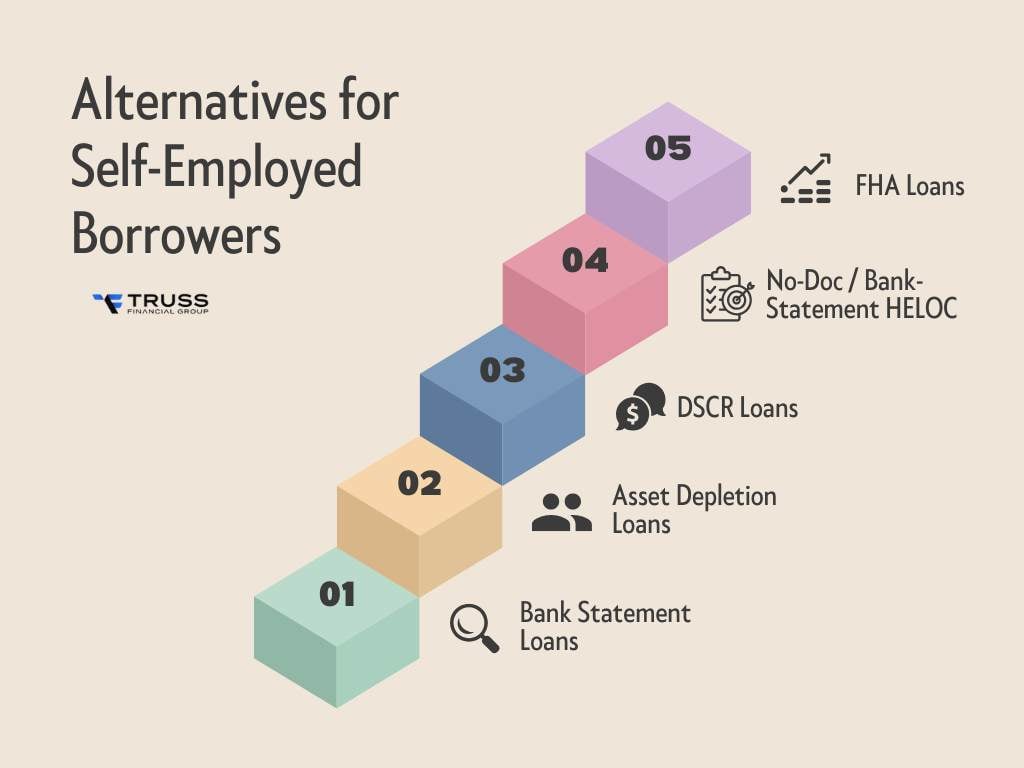
What to Do If You Don’t Qualify Under Fannie Mae? (Alternatives for Self-Employed Borrowers)
If Fannie Mae’s tax-return-based guidelines don’t reflect your real income, or if your deductions make your taxable income appear lower than your actual cash flow, you still have strong financing options.
These Non-QM programs were created specifically for self-employed borrowers, entrepreneurs, investors, and business owners whose financial lives don’t fit into traditional underwriting boxes.
Below are the most practical alternatives that thousands of self-employed borrowers use every year to buy homes, refinance, or access equity.
1. Bank Statement Loans (Best for Low Taxable Income)
Bank Statement Loans are designed for entrepreneurs who earn strong revenue but show low taxable income due to deductions.
Why it works for self-employed borrowers:
-
Uses 12–24 months of business or personal bank statements
-
Approves income based on actual deposits, not tax returns
-
No W-2s, no pay stubs, no traditional income verification
-
Perfect for borrowers who reinvest heavily or write off expenses
-
Ideal for sole proprietors, 1099 workers, S-Corp owners, and freelancers
If your tax returns don’t reflect your true earning power, this is usually the fastest path to approval.
2. Asset Depletion Loans (Best for Borrowers With Strong Assets)
Asset Depletion Loans help borrowers who have substantial assets but limited taxable income. Instead of using employment income, lenders convert your assets into monthly qualifying income.
Eligible assets include:
-
Savings and checking accounts
-
Retirement accounts (401k, IRA)
-
Investment portfolios
-
Cash reserves
Why it works:
-
No need to show high taxable income
-
Ideal for retirees, business sellers, high-net-worth borrowers
-
Underwriters calculate income using a formula based on your asset balances
If you maintain strong assets, this product can outperform both Fannie Mae and Freddie Mac for qualification purposes.
3. DSCR Loans (Best for Real Estate Investors)
Debt-Service Coverage Ratio (DSCR) loans allow investors to qualify solely based on rental income from the property, completely ignoring personal income.
Key features:
-
No tax returns required
-
No employment verification
-
Approval based on rental income vs. mortgage payment
-
Ideal for Airbnb, long-term rentals, and multi-property investors
This program is perfect for investors whose personal tax returns don’t reflect their real cash flow.
4. No-Doc / Bank-Statement HELOC (Tap Equity Without Tax Returns)
If your main goal is to access home equity, a Non-QM HELOC can be far easier than a full refinance. This option is ideal for business owners needing liquidity, investors looking to expand, or anyone wanting fast access to cash.
Why this works:
-
No tax returns required
-
Minimal documentation
-
Fast digital approval options
-
Access equity even if your taxable income is low
-
Available for primary homes, second homes, and investment properties
-
No-appraisal HELOC options for qualified borrowers
A No-Doc HELOC is one of the easiest ways for self-employed borrowers to unlock the value of their home without the paperwork burden of conventional loans.
5. FHA Loans (If DTI or Credit Is the Issue, Not Income)
FHA loans can be a useful alternative when a borrower’s taxable income is solid, but other factors prevent them from qualifying under Fannie Mae.
FHA is a good fit when:
-
Your taxable income is strong and stable
-
Your credit score does not meet Fannie Mae requirements
-
Your debt-to-income ratio (DTI) is slightly higher than what conventional loans allow
-
You need flexible down payment options
-
You have limited credit history
FHA underwriting is more forgiving on:
-
Credit scores (can qualify with lower FICO)
-
DTI (higher back-end DTI allowed)
-
Down payments (as low as 3.5%)
However, borrowers must still meet full documentation requirements.
When FHA is not the right solution
FHA does NOT solve the core problem for most self-employed borrowers:
FHA still requires full tax returns and uses taxable income, not gross receipts, for qualification.
This makes FHA unsuitable if:
-
You have low taxable income due to write-offs
-
Your business deductions reduce your net income
-
Your cash flow is strong, but your tax returns show low net profit
-
You want to avoid tax-return-based underwriting altogether
In these cases, Non-QM loans (Bank Statement, Asset Depletion, DSCR, No-Doc HELOC) are far more appropriate.
Special Considerations for Self-Employed Borrowers
Self-employed borrowers often fall outside the standard employment patterns lenders expect. Fannie Mae allows flexibility, but underwriters must evaluate certain scenarios more carefully.

Borrowers With Less Than 2 Years of Self-Employment History
You may still qualify if:
-
You previously worked in the same field
-
Your income is stable or increasing
-
You can show a strong YTD P&L
This depends heavily on experience, industry stability, and prior employment.
Recently Incorporated Businesses
If you converted from sole proprietor → LLC → S-Corp:
-
Lenders may request both old returns + new business documents
-
They must ensure your income stream did not fundamentally change
-
A CPA letter may be required to confirm continuity
Declining Income
Any noticeable decline triggers:
-
Written explanation
-
YTD P&L
-
Proof of business stability
-
Bank statements supporting current revenue
Significant declines may lead lenders to deny or reduce qualifying income.
Co-Borrower Income Mixing
When combining incomes:
-
Both incomes must be individually stable
-
Both must meet documentation requirements
-
One weak income source can drag down the entire file
Co-borrowers do NOT “cancel out” each other’s issues.
Business Debt Appearing on Personal Credit Reports
If business loans appear on your credit report, underwriters must determine:
-
Whether the business or borrower pays the debt
-
Whether the business has been paying the debt for 12 months
-
Whether removing the debt affects debt-to-income ratios
If payment responsibility is unclear, the borrower may be held liable.
When Lenders Require CPA Statements
CPA verification may be needed when:
-
Income fluctuates significantly
-
The business is newly formed
-
Depreciation or write-offs need explanation
-
K-1 distributions seem inconsistent
-
Ownership percentage is disputed
-
The business’s financial health is unclear
CPA letters often act as stability documentation in borderline cases.

Conclusion
Fannie Mae’s guidelines aim to ensure lending consistency and protect the integrity of the mortgage system. But for many self-employed borrowers, especially those who rely heavily on tax deductions, these rules can be limiting.
The reality is simple:
You can be earning strong real-world income and still look “unqualified” on paper if your taxable income is low.
That’s exactly why alternative lending programs exist.
If taxable income isn’t enough, the most effective options include:
-
Bank Statement Loans – qualify using deposits, not tax returns
-
Asset Depletion Loans – qualify using assets as income
-
DSCR Loans – qualify using rental income only
-
No-Doc or Bank-Statement HELOCs – access equity without tax returns
-
FHA Loans – for credit/DTI issues (but not low taxable income)
These programs give entrepreneurs, investors, and contractors real paths to homeownership and liquidity, even when traditional guidelines fall short.
Frequently Asked Questions
1. Can I qualify for a mortgage if I'm self-employed?
Yes, self-employed borrowers can absolutely qualify for a mortgage under Fannie Mae, Freddie Mac, FHA, or Non-QM programs. The key difference is documentation: self-employed borrowers must provide personal and business tax returns, profit and loss statements, business bank statements, and proof of consistent income. If your taxable income is too low due to write-offs, programs like Bank Statement Loans, Asset Depletion Loans, and No-Doc HELOCs offer alternative pathways to qualify.
2. What is the 30% rule for self-employed people?
The “30% rule” refers to the idea that self-employed individuals often need to show at least 30% more income than a W-2 borrower to qualify for the same mortgage amount. This is because self-employed borrowers typically have business deductions, write-offs, and fluctuating income that lower their taxable income, which is what lenders use. Even if your gross cash flow is high, a large percentage of write-offs can significantly reduce your qualifying income under Fannie Mae guidelines.
3. In which of the following scenarios would a self-employed borrower be able to qualify for a conventional mortgage using only 1 year of personal and business tax returns?
A self-employed borrower may qualify with only one year of personal and business tax returns if:
-
The borrower has been self-employed for at least 2 years, OR
-
The borrower has 1 year of self-employment in the same field as a prior W-2 job with comparable or increasing income
-
The business shows stable or increasing income trends
-
The borrower has strong financial reserves and good credit
Fannie Mae and Freddie Mac allow 1-year returns only when risk is low and income stability is clear.
4. How do lenders verify self-employed income?
Lenders verify self-employed income using:
-
Personal tax returns (1040)
-
Business tax returns (1120S, 1065, 1120)
-
Schedules C, K-1, E
-
Profit and loss (P&L) statements
-
Business bank statements
-
Form 1084 (Fannie Mae) to calculate qualifying income
-
Year-to-date (YTD) financials
-
CPA letters verifying ongoing operations
They review income stability, business liquidity, year-over-year trends, and whether the business can sustain distributions.
5. Does self-employment count for a mortgage?
Yes, self-employment absolutely counts for a mortgage. Lenders treat self-employment income as eligible income, but it must be:
-
Stable
-
Verified
-
Reported on tax returns
-
Supported by business financials
If your taxable income is low due to deductions, conventional loans may be difficult, but Bank Statement Loans, DSCR Loans, and Asset Depletion programs can qualify you based on real cash flow instead of tax-return income.
6. How to get approved for a mortgage as self-employed?
To get approved:
-
Provide 2 years of tax returns (or 1 year when eligible)
-
Maintain stable or increasing income
-
Limit aggressive write-offs if planning to qualify conventionally
-
Prepare YTD P&L + business bank statements
-
Strengthen credit score and reserves
-
If taxable income is low → consider Bank Statement, Asset Depletion, DSCR, or No-Doc HELOCs
The key to approval is matching your loan type to your actual financial profile, not just your tax returns.
7. Does Fannie Mae require tax transcripts for self-employed borrowers?
Fannie Mae may require IRS tax transcripts to verify:
-
The accuracy of the tax returns provided
-
That no amendments are pending
-
That income was actually filed with the IRS
Transcripts are often required when income appears inconsistent, recently amended, or when additional verification is needed.
8. What is Form 1084 and how is income calculated?
Form 1084 is Fannie Mae’s Cash Flow Analysis worksheet used to calculate qualifying income for self-employed borrowers. Lenders use it to:
-
Review 1–2 years of tax returns
-
Add back non-cash deductions (depreciation, amortization, depletion)
-
Subtract non-allowable expenses
-
Evaluate year-over-year income trends
-
Determine stable monthly qualifying income
Form 1084 is the core tool for calculating eligibility under Fannie Mae’s self-employed guidelines.
9. How do I get approved for a mortgage as a self-employed borrower?
You can get approved by:
-
Showing consistent income on tax returns
-
Providing complete business returns and schedules
-
Demonstrating business stability with YTD financials
-
Maintaining strong credit and reserves
-
Avoiding large write-offs before applying
-
Using Non-QM loans (Bank Statement, DSCR, Asset Depletion) when taxable income is too low
Matching your loan product to your income structure is the fastest path to approval.
10. How do I get approved for a mortgage as a self-employed borrower?
To qualify:
-
Ensure your taxable income meets Fannie Mae requirements
-
Provide two years of verified self-employment documentation
-
Show stable or increasing earnings
-
Prepare profit and loss statements supported by bank statements
-
Strengthen your credit profile and savings
-
Use Bank Statement Loans or Alternative Income Loans if your tax returns don’t reflect your real cash flow
Self-employed borrowers qualify every day, the key is choosing the loan program that fits how you actually earn money.

.svg)

Discuss your unique requirements
Get direct answers and a roadmap for your future.
.png?width=202&height=202&name=image%20588255187%20(1).png)





.svg)

.svg)
.svg)