.svg)



%20(1).svg)
%20(2).svg)
.png?width=480&height=420&name=Img%20(1).png)
%20(3).svg)
%20(4).svg)

%20(5).svg)


 View all states
Fixed-Rate vs. Adjustable-Rate Mortgages: Which One Is Right for You?

12 mins
In this blog
Choosing a mortgage isn't just a paperwork decision. It's a financial commitment that follows you for years. And for most borrowers, the decision starts with one fundamental question: fixed-rate vs. adjustable-rate mortgage, which one actually fits your situation?
Both are legitimate, widely used mortgage options. Both can serve you well. But they're built for different borrowers, different timelines, and different financial goals. Pick the wrong one, and you're not just leaving money on the table. You could be setting yourself up for payment shock, refinancing stress, or years of above-market interest rates.
This guide cuts through the noise. We'll break down how each mortgage type actually works, what the real differences are and most importantly, which structure fits your situation. No fluff, no generic rate comparisons. Just a clear framework to help you make a smarter call, the kind experienced mortgage brokers like Truss Financial Group walk borrowers through every day.
What Is a Fixed-Rate Mortgage?
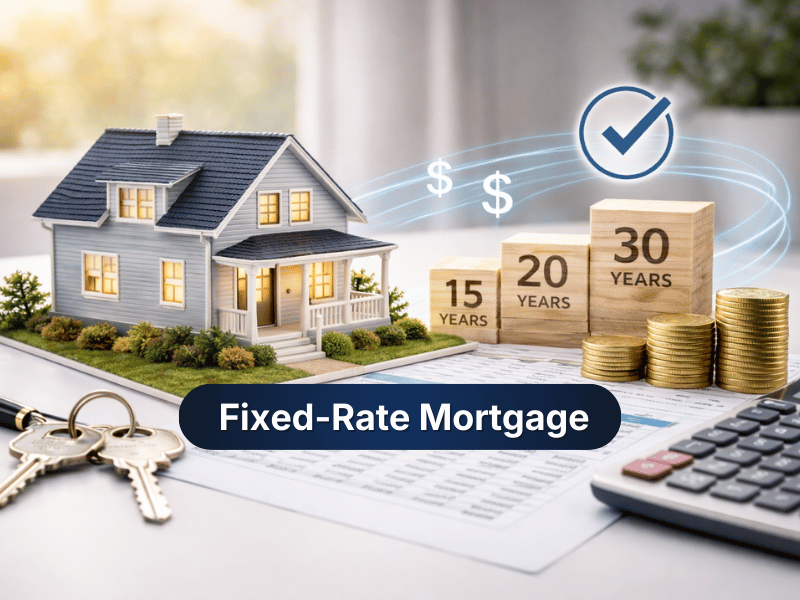
A fixed-rate loan does exactly what the name says. Your fixed interest rate is locked in at closing and stays the same for the entire loan term. Whether the Federal Reserve raises rates five times or cuts them to the floor, your monthly principal and interest payment never changes.
Most borrowers choose between 15, 20, or 30-year terms. Fixed-rate mortgages are available across conventional, FHA, and VA loan programs, making them the most widely held mortgage type in the U.S. For first-time homebuyers or anyone buying their forever home, the predictability alone is worth a lot. The trade-off is simple: you pay a slightly higher initial rate in exchange for complete payment stability over the life of the loan.
If interest rates decline after you close, you're not benefiting automatically, but refinancing is always an option. Just factor in the closing costs before assuming it makes financial sense.
What Is an Adjustable-Rate Mortgage?
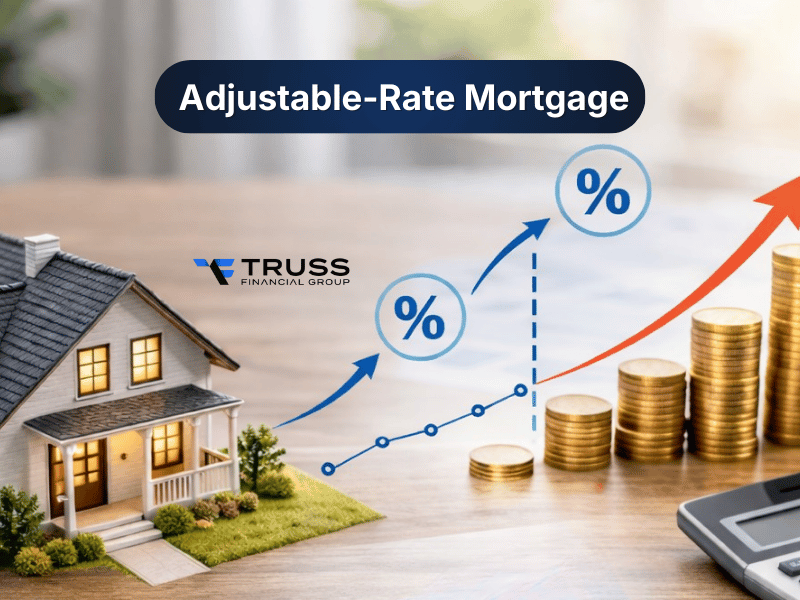
An adjustable-rate mortgage (ARM) starts with a fixed introductory period, typically 5, 7, or 10 years, during which your rate stays the same. After that initial fixed period, the rate adjusts periodically based on a benchmark financial index plus a fixed margin set by your mortgage lender. The new rate equals the index plus margin, subject to caps.
ARM loans are named by their structure. A 5/1 ARM is fixed for five years, then adjusts annually. Most ARMs follow this same pattern, and most ARM holders know exactly when their first adjustment hits. The lower initial interest rates are the primary draw, but the rate you start with is not the rate you keep.
Two built-in protections limit how much your rate can move. Adjustment caps restrict how much the rate can change at each adjustment period, and lifetime caps set the maximum rate over the life of the loan. Subsequent adjustments after the first reset are also capped, so future adjustments don't come as a complete surprise. Understand all of this before you sign.
ARMs tend to skew toward younger, higher-income borrowers carrying larger loan balances. These borrowers are better positioned to absorb rate risk while benefiting from lower monthly payments during the initial period.
Fixed-Rate vs. Adjustable-Rate Mortgage: What's the Difference?
Both loan types use the same basic qualification mechanics. What differs is how the interest rate behaves over time, what that does to your monthly mortgage payments, and which financial situation each one is actually built for. Here's a side-by-side look:
|
Feature |
Fixed-Rate Mortgage |
Adjustable-Rate Mortgage |
|
Interest Rate |
Locked in at closing, never changes |
Fixed initially, then adjusted periodically |
|
Initial Rate |
Higher than the ARM introductory rate |
Lower than a fixed-rate mortgage |
|
Monthly Payment |
Stays the same for the life of the loan |
Can increase or decrease after the initial period |
|
Best For |
Long-term homeowners, stable budgeters |
Short-term holds, investors, income growers |
|
Rate Predictability |
Full, no surprises |
Partial, capped but not fixed after reset |
|
Adjustment Caps |
N/A |
Per-period and lifetime caps apply |
|
Refinancing Option |
Yes, if rates drop |
Yes, especially before the first reset |
|
Loan Terms Available |
15, 20, 30 years |
Varies, 5/1, 7/1, 10/1 ARM common |
|
Risk Level |
Low |
Moderate to high, depending on the hold timeline |
How Each Mortgage Type Affects Your Monthly Payment?
Numbers make this real. Take a $350,000 loan. On a 30-year fixed-rate mortgage at 7%, your monthly principal and interest payment is roughly $2,329 in year one and year fifteen. It never moves.
On a 5/1 ARM at an introductory rate of 5.75%, that same loan starts at around $2,043 per month. That's lower monthly payments of nearly $300 a month during the initial period, and over five years, that's close to $17,000 in short-term savings.
But when the ARM adjusts, the math shifts. If the index climbs and your rate moves to 8%, your monthly payment jumps to around $2,560. That's more money out of pocket every single month, on the same loan balance. Even a modest 1 to 2 percentage points increase on a large balance creates real financial pressure.
The fixed-rate borrower never faces that moment. Stable payments make budgeting straightforward and protect against housing market volatility moving against you.
Which One Fits Your Situation?
This is where the decision gets personal. There's no universal right answer, only the right fit for your plan.
- Long-term homeowner (10+ years): Fixed-rate. Stable payments, no surprises, simplified long-term planning.
- Short-term buyer (under 7 years): ARM. Capture the lower initial rate during your hold period and exit before the first adjustment.
- First-time homebuyers on a tight budget: Fixed-rate. Avoid the risk of higher payments down the road when your personal finance situation may still be building.
- High-income borrower with an aggressive paydown plan: ARM. Use the lower initial interest rates to pay down principal faster before the rate resets.
- Real estate investor with a defined exit strategy: ARM or interest-only ARM to maximize early cash flow and keep monthly obligations low during the hold.
- Borrower in a rising-rate environment: Fixed-rate. Lock in before mortgage rates climb further and protect your payments long-term.
Many experienced investors use different structures across their portfolio, matching the fixed rate and adjustable options to the specific property, hold timeline, and cash flow goal. That's where working with a trusted lender like Truss Financial Group makes a real difference. Getting the structure right before submission saves time, money, and avoids costly course corrections later.
Qualification Requirements
Core requirements are similar across both loan types:
- Credit score: 620+ minimum credit score for most lenders
- Employment history: At least two years of stable employment
- Debt-to-income ratio: Most lenders prefer a 28 to 36% of gross income toward housing
- Down payment: Varies by loan program and mortgage lender, not strictly tied to fixed vs. ARM
- ARM qualification can be slightly more accessible in some scenarios since lenders don't always underwrite to a worst-case adjusted rate
- Larger loan amounts, common with ARMs, typically require stronger credit profiles and larger cash reserves
- Self-employed borrowers or those with non-traditional income may benefit from non-QM loan options regardless of which rate structure they choose
Risks to Understand Before You Choose
- Locking in too high: With a fixed-rate loan, if mortgage rates decline significantly after closing, you're stuck paying above-market until you refinance, and that comes with its own costs and qualification requirements.
- Misjudging your timeline: ARM borrowers who plan to sell in a few years but stay longer will hit rate adjustments they never budgeted for. The initial fixed period ends whether you're ready or not.
- Counting on refinancing: It's a possibility, not a guarantee. Home values can drop, credit situations can shift, and the exit you planned may not be available when you need it.
- Payment shock: Even with lifetime caps in place, a meaningful rate adjustment on a large balance can add hundreds to your monthly payment overnight.
These risks are manageable, but only with realistic timelines, proper deal analysis, and the right loan structure from the start.
Frequently Asked Questions
1. What is the main difference between a fixed-rate and an adjustable-rate mortgage?
A fixed-rate mortgage keeps the same interest rate for the entire loan term. An adjustable-rate mortgage ARM starts with a lower initial rate that resets periodically after an introductory period based on a financial index plus a lender's margin.
2. Which mortgage type has a lower interest rate?
ARMs typically offer lower initial interest rates than fixed-rate mortgages. However, that rate is not permanent. After the fixed period ends, it adjusts with market conditions and can rise significantly.
3. Is a fixed-rate mortgage always the safer choice?
For most long-term homeowners, yes. But for borrowers with a defined short-term plan and strong risk tolerance, an ARM can be the smarter financial move, as long as they understand what happens after the introductory period ends.
4. Can I refinance out of an ARM into a fixed-rate mortgage?
Yes, but refinancing isn't guaranteed. You'll need sufficient home equity, a qualifying credit score, and favorable market conditions. Don't treat refinancing as a fallback plan. Treat it as a possibility worth preparing for.
5. Who should get an adjustable-rate mortgage?
Borrowers with a short-term hold strategy, investors optimizing for early cash flow, and high-income borrowers who plan to aggressively pay down their loan before the first rate reset.
6. Who should get a fixed-rate mortgage?
Long-term homeowners, first-time homebuyers building financial stability, and anyone who needs the same monthly payment every month to plan effectively for the future.
7. What are adjustment caps and lifetime caps on an ARM?
Adjustment caps limit how much your rate can increase or decrease at each predetermined interval. Lifetime caps set the maximum rate your loan can ever reach. Both protect against extreme rate swings, but they don't eliminate rate risk entirely.
8. Are fixed-rate mortgages available for investment properties?
Yes. Fixed-rate mortgages are available for investment properties through conventional loan programs, though rates and requirements differ from primary residence financing.
9. Can I get an ARM on an investment property or rental?
Yes. ARMs are commonly used for investment properties, particularly for investors with shorter hold timelines who want to benefit from lower monthly payments before selling or refinancing.
10. What is the risk of choosing an ARM in a rising rate environment?
In a rising rate environment, your ARM rate will likely adjust upward after the initial fixed period, increasing your monthly payment, sometimes significantly. If you haven't sold or refinanced by then, you'll need to absorb those higher payments from your income or rental cash flow.
11. What is the difference between a fixed-rate DSCR loan and an adjustable-rate DSCR loan?
Both qualify based on the property's rental income rather than personal income. The difference is in the rate structure. A fixed-rate DSCR loan offers payment stability for long-term holds, while an adjustable-rate DSCR loan offers a lower initial rate suited for investors with a defined short-term exit strategy. Learn more about types of DSCR loans here.
12. What is better, a fixed or adjustable-rate mortgage?
Neither is universally better. Fixed-rate suits long-term plans and stable budgeters. ARM suits short-term strategies and borrowers who can absorb rate risk. The right answer depends entirely on your hold timeline, financial goals, and risk tolerance.
13. Do you need 20% down for an ARM?
Not always. Down payment requirements vary by lender and loan program. Some ARMs are available with less than 20% down, though a larger down payment typically means better terms and no private mortgage insurance.
14. What is the 3 7 3 rule in mortgage?
The 3/7/3 rule refers to federal disclosure timing requirements in the mortgage process. Specific documents must be delivered within 3 business days of application, 7 business days before closing, and 3 business days before consummation. It's a compliance guideline, not a loan structure.
Which Mortgage Is Right for You?
Long-term and want certainty? Fixed-rate. Short-term strategy with room for rate risk? ARM. Investor with a specific hold and exit plan? Let the property and strategy drive the structure, not the other way around.
The right mortgage doesn't just get you into a home. It protects your monthly budget, your equity, and your long-term financial plan. Truss Financial Group helps borrowers make that call with clarity and confidence from day one.

.svg)

Discuss your unique requirements
Get direct answers and a roadmap for your future.
.png?width=202&height=202&name=image%20588255187%20(1).png)

.jpg?width=389&height=221&name=Blog%20covers%20(3).jpg)

-3.png?width=389&height=221&name=Blog%20covers%20(9)-3.png)




.svg)

.svg)
.svg)