.svg)



%20(1).svg)
%20(2).svg)
.png?width=480&height=420&name=Img%20(1).png)
%20(3).svg)
%20(4).svg)

%20(5).svg)


 View all states

14 mins

In this blog
Key Takeaways
- A portfolio mortgage is a loan a lender keeps on its own balance sheet instead of selling to the secondary market, which means the lender sets its own rules, giving borrowers with complex income, unusual properties, or recent credit events a realistic path to financing.
- Portfolio loans typically come with higher interest rates and closing costs than conventional mortgages, but for borrowers the conventional market can't serve, that trade-off is often the only one available.
- Not every lender offers portfolio products, and terms vary widely; understanding what you're getting into before you apply is the difference between a loan that works and one that costs you more than it should.
If the conventional mortgage market has already told you no, or you already know it will, a portfolio mortgage may be the most direct path to financing. A portfolio mortgage is a type of mortgage loan a lender originates and holds on its own balance sheet rather than selling on the secondary market. Because it never passes through Fannie Mae or Freddie Mac, the lender isn't bound by the same eligibility criteria that traditional loans must meet, which means they can work with borrowers and properties that traditional guidelines exclude.
This is most relevant for self-employed borrowers, real estate investors, foreign nationals, and anyone with unique financial circumstances whose profile doesn't translate cleanly into the documentation conventional lenders require. Understanding portfolio loans, how they're structured, and which mortgage options they open up is the focus of this guide. Lenders like Truss Financial Group specialize in exactly these scenarios, helping borrowers find the right financing path when conventional options fall short.
What Is a Portfolio Mortgage, and How Does It Work?
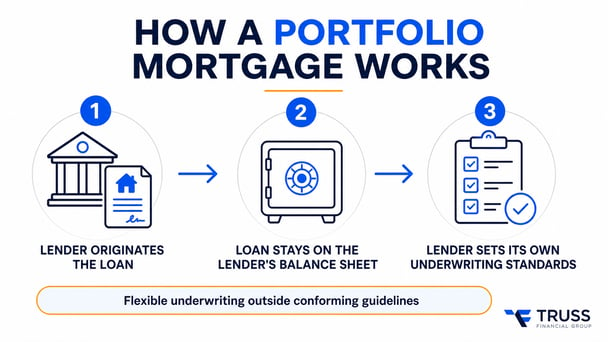
A portfolio mortgage is a loan a lender originates and keeps on its own balance sheet rather than selling to investors on the secondary market. Most mortgages don't work this way; after closing, they're typically packaged and sold through a process overseen by government-sponsored entities Fannie Mae and Freddie Mac.
To be eligible for that sale, loans must meet a strict set of conforming standards:
- minimum credit scores
- maximum debt-to-income ratios
- specific documentation requirements
- loan limits set annually by the Federal Housing Finance Agency (FHFA)
A portfolio mortgage bypasses that process entirely. The lender originates the mortgage loan and holds it on its own balance sheet for the life of the loan, which means it never needs to conform to secondary market standards. Because the lender takes on the additional risk, they also get to set their own underwriting criteria and repayment structures. Here's how that plays out in practice:
- Alternative income documentation accepted: bank statements, P&L statements, and asset-based qualification in place of W-2s and tax returns
- Non-standard properties financed: non-warrantable condos, multi-family buildings, mixed-use properties, and homes needing significant rehabilitation
- Flexible credit thresholds: the lender sets its own minimum credit score rather than following Fannie Mae or Freddie Mac guidelines
- No conforming loan limits: loan amounts aren't capped by FHFA limits, which matters in high-cost markets and for larger investment properties
It's worth being precise here: portfolio loans are non-conforming by definition, but not every non-conforming loan is a portfolio loan. The defining characteristic is where the loan is held, not just what it doesn't comply with. According to the Urban Institute's Housing Finance at a Glance report, portfolio lenders originated 27.6% of all U.S. home loans in 2023, a figure that reflects how mainstream this lending model has become for borrowers outside the conventional market.
How Do Portfolio Loans Differ from Conventional Mortgages?
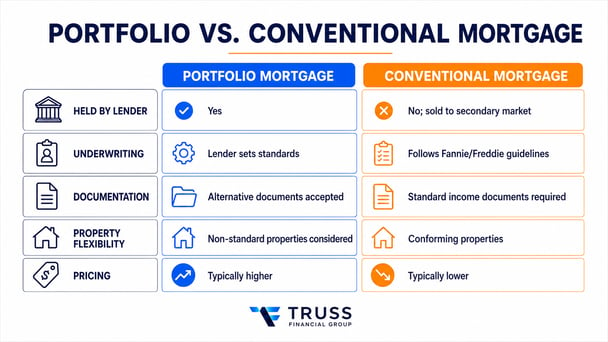
Both loan types finance property purchases and refinances, but how they're structured, priced, and underwritten diverges significantly. Conventional mortgages must meet Fannie Mae and Freddie Mac's conforming standards, including the 2025 baseline loan limit of $806,500, strict DTI ratios, and W-2 income documentation. Government-backed options like FHA loans, VA loans, and USDA loans follow similarly rigid criteria set by the Federal Housing Administration and other agencies; portfolio loans are not bound by any of these.
Because traditional lenders offload the risk to the secondary market, rates are lower. Portfolio loans retain that risk in-house, which means higher interest rates, higher origination fees, and higher closing costs, but with no loan limits, no rigid documentation requirements, and often no mortgage insurance requirement. The table below captures the key differences at a glance.
|
|
Portfolio Mortgage |
Conventional Mortgage |
|---|---|---|
|
Held by lender |
Yes |
No; sold to secondary market |
|
Follows Fannie/Freddie guidelines |
No |
Yes |
|
Credit flexibility |
Lender sets own standards |
Minimum scores required |
|
Documentation |
Alternative docs accepted |
W-2s, tax returns required |
|
Loan limits |
No set cap |
Conforming limits apply |
|
Interest rate |
Generally higher |
Generally lower |
|
Mortgage insurance |
Often not required |
Required if LTV > 80% |
|
Closing costs |
Typically 3%–4% |
Typically 2%–3% |
Are Portfolio Mortgages a Good Option for Self-Employed Borrowers?
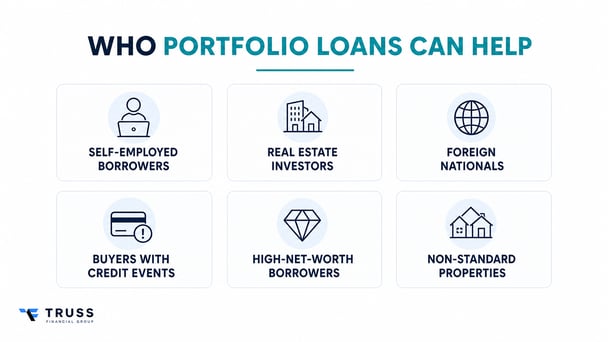
Yes, self-employed borrowers are among the most natural fits for portfolio lending precisely because of how their income is structured. A business owner who legitimately writes off significant expenses may show a net income on their tax return that's far lower than their actual earnings. A freelancer with variable monthly deposits may not hit the documented income thresholds that traditional lenders require, even if their annualized earnings are strong.
According to the Bureau of Labor Statistics, approximately 16.5 million Americans were self-employed as of 2023, a segment of the workforce whose income documentation rarely fits the conventional mold. Portfolio lenders can evaluate 12 to 24 months of bank statements in place of tax returns, review a profit-and-loss statement prepared by a CPA, or assess total asset strength for high-net-worth borrowers with limited documented income.
Who Else Does Portfolio Lending Serve?
But self-employed borrowers aren't the only ones portfolio lending is built for. The common thread across all of these profiles isn't financial weakness; it's a financial situation that doesn't translate into the documentation framework conventional underwriting requires.
- Foreign nationals purchasing U.S. property without a domestic credit history
- Real estate investors financing properties that fail conventional property standards: non-warrantable condos, multi-family buildings above four units, or properties requiring significant rehabilitation
- Borrowers recovering from a credit event (bankruptcy, foreclosure, or short sale) who have since stabilized financially but haven't yet cleared the conventional waiting periods
What Are the Typical Underwriting Standards for Portfolio Loans?
Portfolio lending is flexible, but it isn't a free-for-all. Financial institutions still need confidence that the borrower can repay the loan, and the underwriting process reflects that. The flexibility is in the type of evidence accepted, not in whether evidence is required.
Credit Score
Unlike traditional loans, portfolio lenders don't apply the same eligibility criteria across every borrower. Minimum credit score requirements vary by lender; some will work with scores as low as 580, others set their floor at 620 or higher, and terms improve meaningfully for borrowers with good credit above 680. The Consumer Financial Protection Bureau's mortgage data consistently shows that credit score remains one of the strongest predictors of loan performance; portfolio lenders account for this through pricing and down payment requirements rather than blanket exclusions.
Down Payment
Down payments typically run higher than for conventional loans, commonly 10% to 30% depending on the lender, the borrower's overall profile, and the property type. Investment properties and unusual property types tend to sit at the higher end of that range.
Income Documentation
This is where the real flexibility lives. Bank statements, CPA-prepared P&L statements, 1099s for contract workers, and asset depletion models for high-net-worth borrowers are all accepted by various portfolio lenders, though requirements vary by lender.
Property Type
Portfolio lenders can finance what conventional underwriting excludes: non-warrantable condos, multi-family properties with more than four units, mixed-use buildings, and properties that need significant work. Some lenders also offer interest-only payment structures or adjustable rates that wouldn't pass conforming standards, giving borrowers more flexibility in how repayment is structured.
What Are the Benefits of Choosing a Portfolio Mortgage Over a Traditional Mortgage?
The case for a portfolio mortgage isn't that it's better than a conventional loan; it's that for a specific set of borrowers and properties, it's often the only viable option. That distinction matters.
- Access: Portfolio lending opens financing to borrowers and properties that the conventional market excludes outright. For a self-employed borrower who's been turned down twice, or an investor trying to finance a mixed-use building, that access isn't a minor convenience; it's the entire ballgame.
- Documentation flexibility: Being able to substitute bank statements or asset statements for W-2s and tax returns removes the structural barrier that blocks a significant share of otherwise creditworthy borrowers from conventional financing.
- Loan size: Portfolio lenders aren't bound by conforming loan limits, which matters in high-cost markets and for investors acquiring larger properties.
- Speed: Because approval decisions are made entirely in-house without secondary market review, portfolio loans can close faster, often critical in competitive markets or time-sensitive investment situations.
- No mortgage insurance requirement: Many portfolio lenders don't require mortgage insurance even for lower down payments, removing one of the ongoing costs that conventional borrowers under 20% equity have to carry.
The trade-off is real: higher interest rates, higher fees, higher servicing costs, and potentially balloon payments or prepayment penalties depending on the lender. Unexpected costs like these are worth clarifying upfront with any mortgage professional before signing. The math only favors a portfolio loan when the conventional market genuinely isn't an option.
What Documents Are Needed to Qualify for a Portfolio Mortgage?
Documentation requirements for portfolio loans vary more widely than for conventional loans, because each lender sets its own standards. There's no universal checklist, which means the most useful first step is always a direct conversation with the lender about what they need for the specific situation.
That said, the most common documentation categories look like this:
- Income: 12–24 months of personal or business bank statements; a CPA-prepared profit-and-loss statement; 1099s for contract or freelance income; or an asset depletion calculation for borrowers relying on investment holdings
- Creditworthiness: A credit report will still be pulled in most cases, though the score threshold is more flexible than conventional lending
- Property: An appraisal is typically still required to establish value and loan-to-value ratio, even for non-standard property types
- Reserves: Lenders often want to see sufficient cash reserves post-closing, particularly for investment properties, where the expectation of ongoing carrying costs is built into the underwriting
Unlike a conventional mortgage application, there's no income verification in the traditional sense for many portfolio borrowers. The lender is evaluating the full financial picture: income type, asset strength, payment history, missed payments if any, and property characteristics; rather than checking boxes against a conforming checklist. A steady income stream of any type, documented through the right channels, is often sufficient to qualify borrowers who multiple lenders have previously turned away.
When Is a Portfolio Mortgage the Right Move, and When Isn't It?
When a portfolio mortgage makes the clearest sense:
- Your income is real but undocumentable through conventional channels: self-employed individuals, business owners, contractors, and gig workers who can demonstrate financial strength through bank statements or assets but not W-2s
- You're financing a property that conventional underwriting excludes: non-warrantable condos, multi-family buildings above four units, mixed-use buildings, or properties with structural issues
- You've experienced a credit event and have since stabilized, but your timeline hasn't cleared the conventional waiting periods for bankruptcy or foreclosure
- You're a real estate investor who needs to move quickly on a property type that conforming lenders won't touch, or who is financing multiple investment properties simultaneously
When a portfolio mortgage is likely not the right move:
- You qualify for a conventional loan; the higher rates and fees on a portfolio loan generally aren't justified, as the savings from conventional pricing compound significantly over a 30-year term
- Your primary goal is the lowest possible interest rate; a portfolio loan isn't designed to compete there
- The down payment requirement would leave your cash reserves uncomfortably thin, and the liquidity risk is worth weighing carefully before committing
Mortgage lenders like Truss Financial Group work with borrowers across all of these profiles and will tell you upfront, based on your actual loan, income type, and property, whether a portfolio mortgage, a conventional loan, or another product is the right fit for your situation. That conversation costs nothing and typically saves a significant amount of time.
Frequently Asked Questions
1. What exactly is a portfolio mortgage?
A portfolio mortgage is a loan that a lender originates and holds on its own balance sheet rather than selling to investors on the secondary market. Because the lender retains the loan, they set their own underwriting standards, which means more flexibility on credit score, income documentation, property type, and loan amount than conventional lending allows.
2. How do portfolio loans differ from standard mortgages?
The core difference is where the loan ends up after closing. Standard mortgages are sold to secondary market investors and must meet the conforming guidelines set by Fannie Mae and Freddie Mac. Portfolio loans stay with the originating lender, who sets their own loan terms; more flexibility on the borrower side, but typically higher interest rates and fees as a result.
3. Are portfolio mortgages a good option for self-employed individuals?
Yes, self-employed borrowers are among the most common users of portfolio loans because their income often doesn't translate into the documented W-2 earnings conventional lenders require. Portfolio lenders can evaluate bank statements, P&L statements, or asset strength instead, which makes qualifying significantly more accessible for business owners and freelancers.
4. Can I get a portfolio mortgage with less-than-perfect credit?
Possibly. Portfolio lenders set their own minimum credit score thresholds, and some will work with scores as low as 580. Terms vary based on the full financial picture; credit score is one factor among several, not the only deciding variable.
5. What is the average down payment required for portfolio mortgages?
Down payment requirements are generally higher than for conventional loans, typically 10% to 30%, depending on the lender, the borrower's credit and income profile, and the property type. Investment properties and non-standard property types tend to sit at the higher end of that range.
6. Can portfolio mortgages be used for investment properties or vacation homes?
Yes, financing investment properties and non-standard property types is one of the primary use cases portfolio lending is built for. Multi-family buildings, vacation homes, non-warrantable condos, and mixed-use properties that conventional underwriting excludes are all commonly financed through portfolio lenders.
7. How do I find a lender that offers portfolio loans?
Portfolio loans are most commonly offered by community banks, credit unions, and specialist non-QM lenders rather than large national banks. A mortgage broker or real estate agent familiar with non-conforming lending can help identify financial institutions whose programs fit your personal finance profile. Working with a knowledgeable mortgage professional gives you access to multiple lenders at once, making it easier to compare terms, interest payments, and origination fees side by side. Verify that any lender you work with is listed with the NMLS Consumer Access registry before proceeding.
Ready to Find Out If a Portfolio Mortgage Fits Your Situation?
A portfolio mortgage is one of the most flexible financing tools in the mortgage market, but it's built for specific situations, not as a general-purpose alternative to conventional lending. The real question isn't whether portfolio loans work in theory. It's whether your income type, property, credit profile, and loan size make you a genuine fit, and what that actually costs you compared to your alternatives.
Lenders like Truss Financial Group specialize in exactly this kind of evaluation, looking at the full picture of your situation and giving you a straight answer on whether a portfolio mortgage, a conventional loan, or something else is the right path forward.

.svg)

Discuss your unique requirements
Get direct answers and a roadmap for your future.
.png?width=202&height=202&name=image%20588255187%20(1).png)


-1.png?width=389&height=221&name=Blog%20covers%20(25)-1.png)



.svg)

.svg)
.svg)