.svg)



%20(1).svg)
%20(2).svg)
.png?width=480&height=420&name=Img%20(1).png)
%20(3).svg)
%20(4).svg)

%20(5).svg)


 View all states

13 mins
In this blog
You found your dream condo. The location is right, the price works, and you're ready to move forward. Then your lender calls with one word: non-warrantable. For most buyers, that's where the confusion starts.
Yes, you can still finance a non-warrantable condo. What it means is that conventional lenders who sell loans to Fannie Mae and Freddie Mac can't originate it, because the condo project doesn't meet their eligibility criteria. When a project falls outside those guidelines, the loan can't be sold on the secondary market, and most traditional lenders won't touch it. That doesn't close the door. It means you need a different type of lender and a different loan product.
This guide covers everything you need to make that call confidently, covering what makes a condo non-warrantable, which loan options are actually available, what they cost, and how to determine whether this path makes sense for your situation. Mortgage brokers like Truss Financial Group specialize in exactly these scenarios, connecting borrowers with the right lender for the right project.
What Does It Mean When a Condo Is Non-Warrantable?
The term "warrantable" refers to whether a condo project meets the eligibility criteria set by Fannie Mae and Freddie Mac, the government-sponsored enterprises that purchase mortgages from lenders on the secondary market. When a project qualifies, lenders can originate a conventional mortgage and sell it, freeing up capital to lend again. When it doesn't, that secondary market exit disappears, and most conventional lenders simply won't originate the loan.
What matters here is that the non-warrantable designation says nothing about the quality of the unit itself or your financial strength as a borrower. A luxury high-rise, a beachfront vacation property, a new development that's 60% sold, all can carry the non-warrantable label. It's a project-level designation, not a verdict on you or the property's value.
Practically speaking, what it means is a narrower lender pool, different loan products, and typically higher costs. The rest of this article unpacks each of those.
Why Would a Condo Project Be Considered Non-Warrantable?
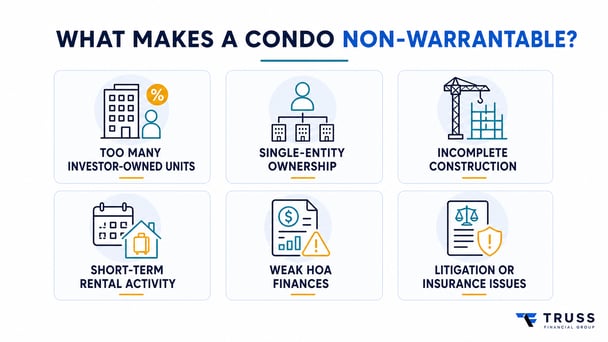
It only takes one project-level issue to push a condo outside conventional eligibility. According to Fannie Mae's Selling Guide (B4-2.1-03), the following conditions make a condo project ineligible for conventional financing:
- More than 50% of units are investor-owned or non-owner-occupied (Fannie Mae's threshold drops to 35% for certain project types)
- A single person or entity owns more than 10% of the total units in the project
- The development is still under construction or has future phases not yet complete
- Less than 10% of the annual HOA budget is allocated to reserves
- The condo association is involved in active or pending litigation
- More than 20% of the project's square footage is used for commercial or mixed-use purposes
- The community permits short-term rentals (Airbnb, VRBO), which is common in resort and vacation markets
- The developer has not yet transferred HOA control to unit owners
Some of these are permanent features of the project, like high investor concentration in a vacation market, for example, rarely changes. Others are temporary. A new development that's non-warrantable because it's mid-construction and still in future phases may become warrantable once the project completes and owner-occupancy stabilizes, opening the door to a refinance into conventional financing later.
Can You Get a Mortgage on a Non-Warrantable Condo?
Yes, through lenders who don't sell loans to Fannie Mae or Freddie Mac. These fall into two main categories: portfolio lenders, who hold loans on their own balance sheets and set their own project eligibility criteria, and Non-QM lenders, who use alternative underwriting frameworks that don't require conformity to agency guidelines.
The flexibility is real, but it's not free. Because the lender is keeping the loan on its own books rather than offloading it to the secondary market, it carries more risk and prices that risk into the rate and down payment. The trade-off is access: these lenders can approve loans on projects that conventional lenders can't touch, on a case-by-case basis.
Working with a lender who specializes in this space matters. Not every portfolio bank offers non-warrantable condo financing, and not every one that does will approach the same project issues the same way.
What Are Your Loan Options for a Non-Warrantable Condo?
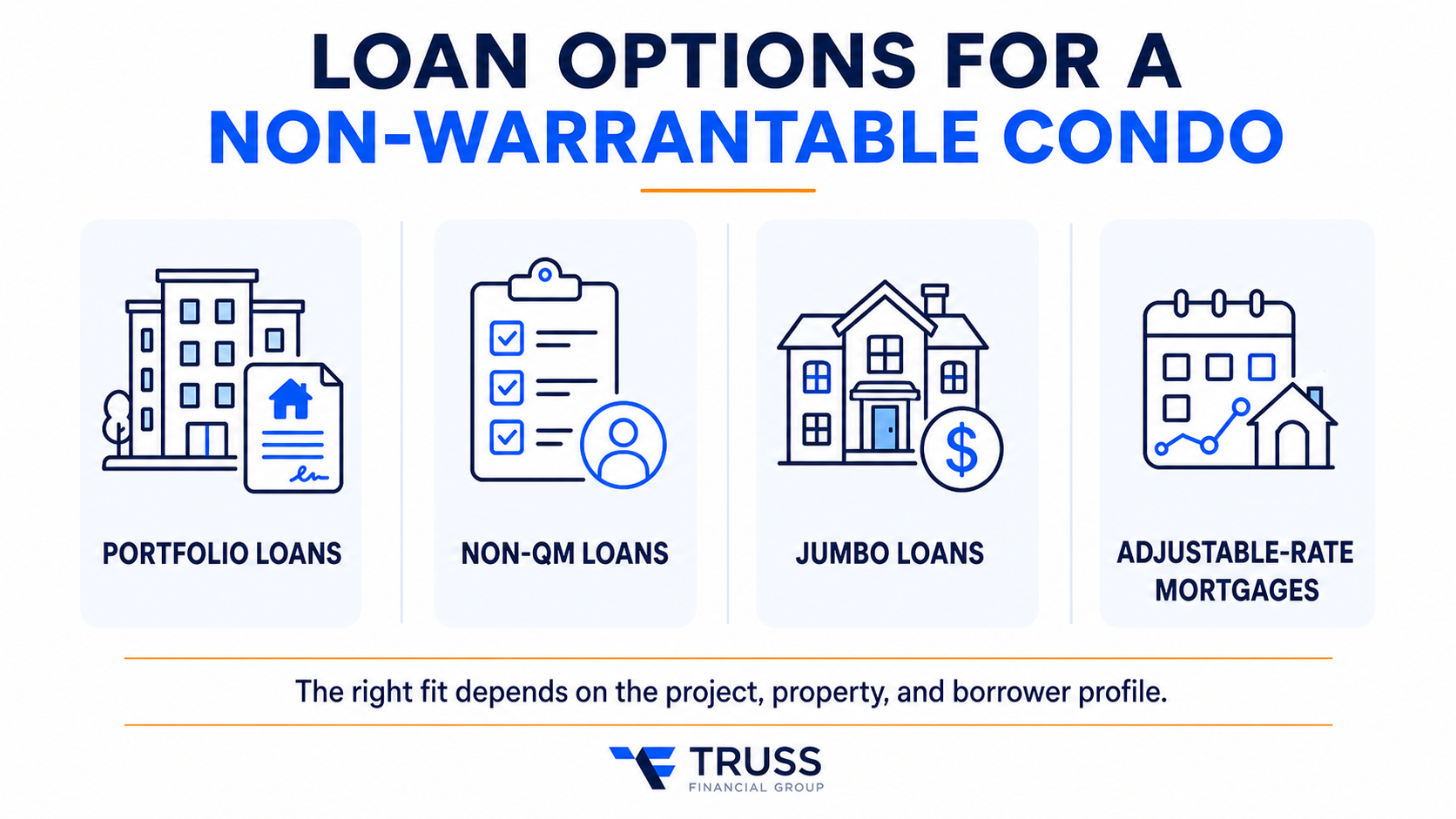
Portfolio Loans
The most common vehicle for financing non-warrantable condos. Held on the lender's own books rather than sold to Fannie Mae or Freddie Mac, portfolio loans let the lender set its own condo project eligibility standards. High investor concentration, HOA reserve shortfalls, and pending construction phases- factors that would disqualify a project from conventional financing- can all be acceptable under a portfolio lender's internal review, depending on the specific lender and project.
Non-QM Loans
Use alternative underwriting criteria, making them particularly suited to borrowers with non-traditional income: self-employed buyers, real estate investors, or ITIN borrowers. Products within this category that apply here include bank statement loans for self-employed borrowers, DSCR (Debt Service Coverage Ratio) loans that qualify investors based on rental income rather than personal income, and asset-based lending programs. Some Non-QM lenders can finance up to 80% LTV with loan amounts up to $3,000,000.
Jumbo Loans
Can apply in higher-priced markets where the loan amount exceeds conforming limits. Some jumbo lenders carry more flexibility on condo project criteria than conforming lenders, though policies vary significantly.
Adjustable-Rate Mortgages (ARMs)
Offered by some portfolio lenders on non-warrantable condos and can carry a lower initial rate than a fixed product, relevant for buyers who plan to sell or refinance within a defined timeframe.
One important note: government-backed loans, FHA, VA, and USDA, are generally not available for non-warrantable condominiums. The FHA has its own condo approval process, and spot approvals exist in limited cases, but most non-warrantable projects cannot meet those requirements either.
What Are the Down Payment and Rate Requirements for a Non-Warrantable Condo?
Non-warrantable condo financing carries a cost premium in both down payment and interest rate, because the lender is absorbing the risk of a loan it can't sell on the secondary market.
Down payment:
- Minimum 20% required by most portfolio and Non-QM lenders
- Many require 25% or more depending on the project's specific issues and the borrower's profile
- According to the Federal Reserve's Senior Loan Officer Opinion Survey (January 2025), lending standards for non-QM residential loans remained more restrictive than conventional categories, consistent with what borrowers encounter on non-warrantable projects
Interest rate:
- Expect a premium of roughly 0.5%–1.5% above a comparable warrantable condo with conventional financing
- The spread depends on the lender, loan type, LTV, credit score, and the severity of the non-warrantability issues
- That premium is the cost of access, and for the right property and market, it's often a workable trade-off
How Do You Qualify for a Non-Warrantable Condo Loan?
Lenders evaluate two things in parallel: the borrower's financial profile and the condo project itself.
Borrower requirements:
- Credit score typically 620–680 minimum, with better pricing at 700+
- Down payment of at least 20–25%
- DTI evaluated; many Non-QM lenders allow up to 50–55%
- Income documentation varies: full doc for portfolio loans, bank statements for self-employed borrowers, or DSCR analysis for investment property buyers
Project documentation to prepare:
- HOA financial statements and annual budget
- Reserve funding documentation
- Meeting minutes
- Insurance certificates
- Current owner-occupancy data
- Disclosure of any pending litigation or special assessments
According to U.S. Census Bureau data from the 2024 American Community Survey, approximately 21.6 million owned U.S. households paid either a condo or HOA fee in 2024, a market large enough that lenders who specialize in this space have developed efficient review processes for these projects. The key is finding a lender with the experience to evaluate your specific project's issues, not just apply a blanket policy.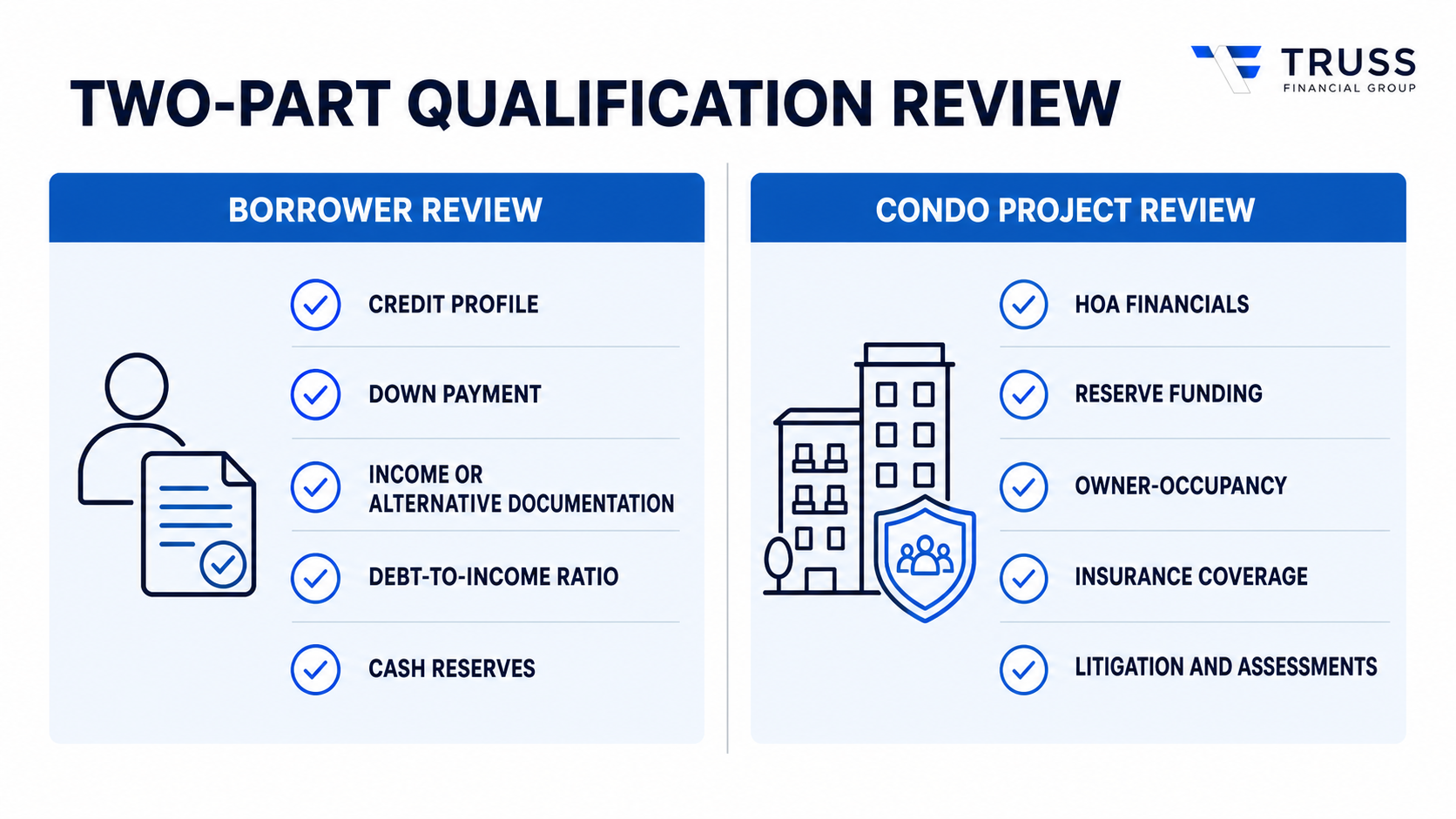
Is Financing a Non-Warrantable Condo Worth It, and Who Is It Really For?
The honest answer depends on three things:
- The property itself
- The project's specific non-warrantability issues
- Your financial situation
It makes the most sense for investors in resort markets where non-warrantable inventory is the norm, buyers in new developments where the designation is temporary, and anyone set on a specific unit who can absorb the rate premium.
It may not be the right move when the premium strains the budget, the resale market is thin, or the non-warrantability stems from serious HOA financial or legal issues that signal real underlying risk.
If you're unsure where your situation falls, lenders like Truss Financial Group will review the actual project and give you a straight answer on which path makes sense.
What Fees and Costs Should You Expect Beyond the Rate?
Here's what to factor into your total cost picture before committing to a non-warrantable purchase:
|
Cost Item |
What to Expect |
|---|---|
|
Interest rate premium |
Roughly 0.5%–1.5% above a comparable conventional loan |
|
Down payment |
Minimum 20%, often 25%+ depending on project issues and borrower profile |
|
Origination fees |
Broadly comparable to conventional; some Non-QM products run higher |
|
Closing costs |
Similar to conventional loans |
|
Condo project review fee |
Varies by lender; not universal |
|
PMI |
Generally not required at 20%+ down |
The Harvard Joint Center for Housing Studies' State of the Nation's Housing 2025 report notes that affordability continues to be a central constraint for buyers across property types. Understanding the full cost picture, not just the rate, is essential before committing to a non-warrantable purchase.
Which Lenders Actually Finance Non-Warrantable Condos?
The lender landscape here breaks into two categories: portfolio banks that keep loans on their own books, and Non-QM brokers and lenders who access wholesale lending partners. Both can finance non-warrantable condos, but they serve different borrower profiles and carry different product menus.
Truss Financial Group
A California-based mortgage broker with access to 90+ wholesale lenders, specializing in Non-QM products including DSCR loans, bank statement loans, and no-doc options. Non-warrantable condos are explicitly permitted across its investor loan programs, with loan amounts from $100,000 to $3,000,000.
First National Bank of America (FNBA)
A portfolio bank offering Non-QM loans for non-warrantable condos, financing up to 80% of property value with loan amounts up to $3,000,000. Accepts ITIN and SSN borrowers, primary residence and second home. Only 12 months of income history required, DTI up to 55%.
Gulf Coast Bank & Trust
A regional portfolio bank with a dedicated non-warrantable condo program, particularly active in resort markets like New Orleans and the Gulf Coast, where a large share of condo inventory carries the non-warrantable designation.
The Federal Savings Bank
A national bank with an explicit non-warrantable condo loan offering, including properties with deferred maintenance or condition issues. Reviews each project individually rather than applying a blanket standard.
Superior National Bank
A portfolio bank with a non-warrantable condo program. Minimum credit score of 660, DTI up to 43%, and a 10% minimum down payment, one of the more accessible entry points for down payment requirements.
Advancial Federal Credit Union
A Dallas-based federally chartered credit union licensed in all 50 states, with a dedicated non-warrantable condo and condotel program. Finances up to 80% LTV for owner-occupied and second homes, investment properties up to 60% LTV, loan amounts from $100,000 to $3,000,000. Max DTI of 43%. Offers upfront project review and two-week rush closings.
Lender policies on non-warrantable condos vary, not just in rates, but in which project issues they'll accept. The right lender depends as much on the project's specific non-warrantability factors as it does on your financial profile.
Frequently Asked Questions
Does Fannie Mae allow non-warrantable condos?
No. Fannie Mae and Freddie Mac do not purchase loans on non-warrantable condos. Their guidelines require projects to meet specific criteria around owner-occupancy, HOA financial health, litigation status, and construction completion before a loan is eligible for the secondary market. Borrowers need a portfolio or Non-QM lender.
How do I find out if a condo is non-warrantable?
The most reliable way is to ask your lender to run a condo project review early in the process, before you're deep into a purchase. Key things to look for: owner-occupancy rates, reserve funding levels, any active litigation, short-term rental policies, and single-entity ownership concentration. An experienced loan officer can often identify red flags quickly from the HOA documents.
Are non-warrantable condos hard to sell?
They can be, because the next buyer will face the same financing constraints. In resort areas or vacation markets where non-warrantable condos are common, the resale impact is limited; buyers there expect portfolio financing. In markets where non-warrantable condos are the exception, the narrowed buyer pool can affect time on market and negotiating leverage.
Can you refinance a non-warrantable condo?
Yes, through the same portfolio and Non-QM lenders that originate these loans. If the project's warrantability status changes over time (construction completes, owner-occupancy improves, litigation resolves), refinancing into a conventional loan may also become an option.
Is it a bad idea to buy a non-warrantable condo?
Not inherently, but it requires clear-eyed decision-making. The financing is more expensive, the lender pool is smaller, and the resale market is narrower. For the right buyer in the right market, the trade-offs are manageable. The question is whether the opportunity justifies the premium for your specific property, market, and financial profile.
What is the minimum down payment for a non-warrantable condo?
Most lenders require a minimum of 20% down, with many requiring 25% or more depending on the project's issues and the borrower's profile. Some Non-QM lenders finance up to 80% of property value on qualifying projects.
Ready to Finance a Non-Warrantable Condo? Here's Your Next Step.
Financing a non-warrantable condo is entirely possible; it just requires a lender who works outside conventional guidelines and knows how to evaluate a condo project on its actual merits. The real question isn't whether the financing exists; it's whether it makes sense for this specific property, this project's issues, and your financial situation.
Mortgage brokers like Truss Financial Group look at the full picture and give you a straight answer on whether a portfolio loan, a Non-QM product, or another path is the right fit.

.svg)

Discuss your unique requirements
Get direct answers and a roadmap for your future.
.png?width=202&height=202&name=image%20588255187%20(1).png)

-1.png?width=389&height=221&name=Blog%20covers%20(25)-1.png)

-2.png?width=389&height=221&name=Blog%20covers%20(7)-2.png)
%20(1)-1.png?width=40&height=40&name=image%20(65)%20(1)-1.png)


.svg)

.svg)
.svg)