.svg)



%20(1).svg)
%20(2).svg)
.png?width=480&height=420&name=Img%20(1).png)
%20(3).svg)
%20(4).svg)

%20(5).svg)


 View all states
Home Loans for Doctors: Physician Mortgage Guide

14 mins
In this blog
- What are today’s average mortgage rates in Ohio? → Add updated daily figure
- What’s the minimum credit score for an Ohio home loan? → 580–620 depending on loan
- How much down payment is required? → 0–5% depending on program
- What’s the average home price in Ohio? → Add statewide median
- Are there programs for first-time homebuyers? → Yes, through OHFA (Ohio Housing Finance Agency)
-
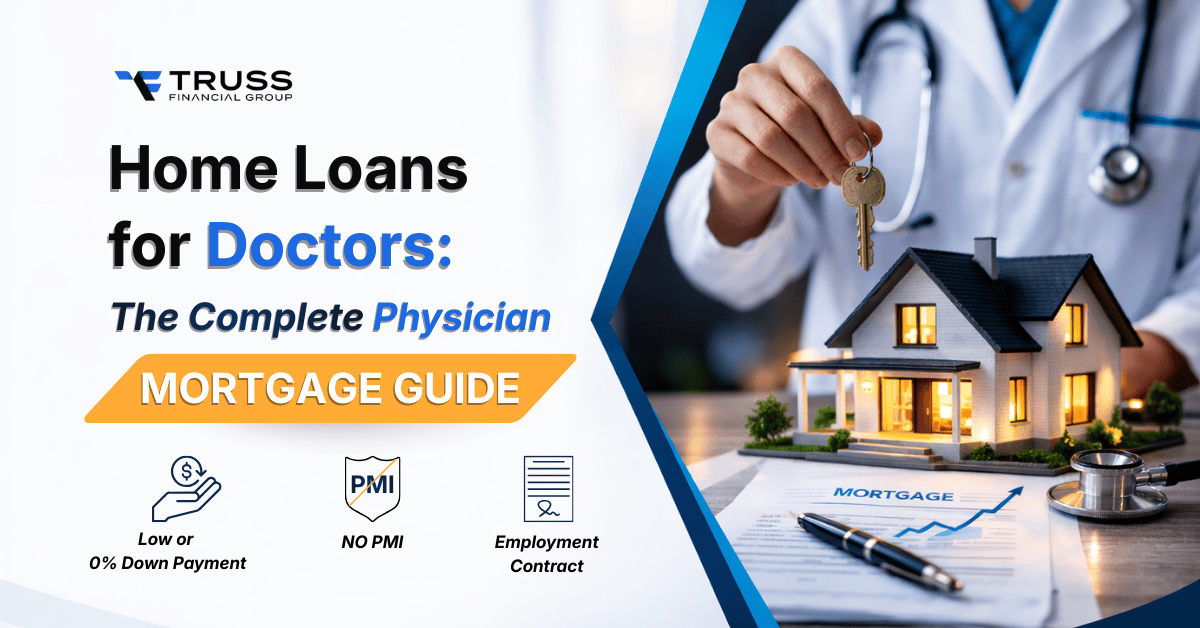
Physician mortgage loans, also called doctor loans, are built for licensed medical professionals who carry high student loan balances, have limited savings, or haven't received their first paycheck yet; eligible borrowers can purchase a home with low down payments and no PMI
-
Unlike conventional loans, doctor mortgage loans treat student loan payments more favorably, accept an active employment contract as proof of income, and offer loan amounts up to $2,000,000, making them especially practical for residents, fellows, and new attendings
- A physician loan isn't the right fit for every doctor. The best structure depends on your career stage, income profile, and financial goals; this guide walks you through how to decide
You've spent a decade in school and training. You're carrying over $200,000 in student loan debt, and the median debt for the Class of 2025 was $200,000 for medical school alone. You may not have your first paycheck yet, and you're trying to buy a home. Run that profile through a standard mortgage application, and it falls apart fast. Conventional mortgage financing wasn't designed for how doctors start their careers.
That's exactly why physician mortgage loans or home loans for doctors exist. Lenders recognize that doctor mortgage loans carry a very low default rate because high student loan balances during residency don't reflect where a physician's future income comes from. Some mortgage lenders, like Truss Financial Group, specialize in helping eligible medical professionals find the home loan structure that fits their actual situation. This guide covers everything you need to know before you talk to a loan officer.
What Are Physician Loans and How Are They Different?
A physician mortgage loan, sometimes called a doctor loan or medical professional loan, is a specialty mortgage financing program built around the unique financial circumstances of licensed medical doctors and other healthcare professionals. Where conventional mortgages treat high student loan balances and limited employment history as red flags, physician loans treat them as part of the territory.
The core benefit is straightforward: qualified borrowers can purchase a primary residence with low down payments and no private mortgage insurance (PMI), even while carrying substantial debt from medical school. The loan is available as both fixed-rate and adjustable-rate mortgages, giving physicians the flexibility to match the structure to their timeline and financial plan.
This isn't a niche product. It's a widely used doctor loan program offered by mortgage lenders who understand the physician borrower profile, and it fills a real gap that conventional loans, FHA loans, and VA loans simply don't address for most healthcare professionals.
How Do Physician Mortgage Loans Work for Medical Professionals?
The mechanics are what set this loan apart. Here's what actually works differently under a physician loan program:
- No mortgage insurance required, even without 20% down: Conventional loans require private mortgage insurance if you put down less than 20%. PMI typically costs between 0.50% and 2% of the loan amount annually, so on a $700,000 loan, that's $3,500 to $14,000 per year in pure insurance cost that benefits the mortgage lender, not you. Physician loans eliminate that entirely.
- Student loan payments are treated differently: If your student loans are in an income-driven repayment (IDR) program like IBR or PAYE, lenders use the lower IDR student loan payments when calculating your debt-to-income ratio, not the fully amortizing payment a conventional lender would use. Loans deferred for 12 or more months from loan closing may be excluded from the DTI calculation altogether.
- An active employment contract is accepted as income: You don't need W-2s, pay stubs, or two years of employment history to close. An executed employment contract with a confirmed employment start date is sufficient, which means residents and fellows can buy before their first day of work. Some doctor mortgage loan lenders will close up to 90 days before the start date.
- Higher loan limits: Physician loans go up to $2,000,000, well above the 2025 conventional conforming limit of $806,500. In high-cost-of-living markets, this makes a meaningful difference for high-income professionals buying their dream home.
- On rates: Physician loans typically carry a slightly higher interest rate than conventional loans, generally in the range of 0.25% to 0.50% above conventional rates. A large loan balance, that affects your monthly payment and adds up over time. But for most licensed medical professionals without 20% saved, the eliminated PMI offsets much of that difference in the early years of the loan.
- On loan closing costs: Closing costs on a physician loan are generally comparable to other mortgage loan options. It's worth asking your mortgage loan officer upfront what to expect so there are no surprises at the table.
Credit Score Requirements and Eligibility
At least one borrower on the application must hold one of the following professional designations:
- Medical Doctor (MD)
- Doctor of Osteopathic Medicine (DO)
- Doctor of Dental Science or Surgery (DDS), including dental surgery specialists
- Doctor of Dental Medicine (DMD)
- Doctor of Pharmacy (PharmD)
- Doctor of Veterinary Medicine (VMD)
- Doctor of Podiatric Medicine (DPM)
- Certified Registered Nurse Anesthetist (CRNA)
- Medical residents, fellows, and interns with the above degrees
Beyond credentials, here's what the credit and collateral approval profile looks like:
- Minimum credit score: 680
- Credit score requirements: stronger profiles qualify for better terms
- Maximum DTI: up to 50%
- LTV: minimum 90.01%, up to 100% for eligible borrowers
- Property type: primary residence, 1-unit only
- Non-occupying co-borrowers: allowed
- Gift funds: eligible for reserves; bank statements may be required to document the source
- Transaction types: purchase and rate & term refinance
One thing worth noting: residents and fellows are explicitly included under most doctor loan programs. You don't have to be a practicing attending to qualify. If you have a degree and an active employment contract, you may be eligible to close.
Pros and Cons of a Doctor Mortgage Loan
No loan is universally the right answer. Here's an honest breakdown:
Pros:
- Low down payments required, as low as 0% for eligible borrowers
- No mortgage insurance required, regardless of down payment amount, which means meaningful savings on your monthly payment
- High student loan balances in IDR programs are treated favorably; deferred loans may be excluded from DTI
- Active employment contract accepted as proof of income, so no pay stubs or two-year work history needed
- Loan amounts up to $2,000,000, well above conventional limits
- Non-occupying co-borrowers allowed; gift funds eligible for reserves
- Flexible underwriting that accounts for the unique financial profile of licensed medical professionals
- Available for purchase and rate & term refinance
Cons:
- The interest rate is typically slightly higher than that of a conventional loan. On a $500,000 loan, a 0.25% rate difference translates to roughly $25,500 in additional interest over 30 years
- Limited to primary residence, 1-unit property only; investment properties don't qualify under this program
- Starting with 0% down means no immediate equity buffer if home values decline
- Self-employed physicians or those with complex income structures may find standard credit approval documentation requirements limiting
- Loan closing costs and fees should still be factored into your financial plan before committing
The tradeoff is real. For physicians without a down payment saved, the physician loan is often the most practical financial solution for entering homeownership. For those who can put 20% down, a conventional loan may offer a lower total cost over the life of the loan. The right answer depends on where you are right now.
Physician Loans vs. Conventional Loans
The table below breaks down how physician loans and conventional loans compare across the factors that matter most to medical professionals.
|
Feature |
Physician Loan |
Conventional Loan |
|
Down Payment |
As low as 0% |
Typically 3–20% |
|
PMI Required |
No |
Yes, if less than 20% down |
|
Loan Limit |
Up to $2,000,000 |
$806,500 (2025 conforming limit) |
|
Student Loan Treatment |
IDR payment used; deferred loans may be excluded |
Fully amortized payment used |
|
Income Verification |
Active employment contract accepted |
Pay stubs and a 2-year history required |
|
DTI Maximum |
Up to 50% |
Typically 43–45% |
|
Interest Rate |
Slightly higher (0.25–0.50% above conventional) |
Lower for strong credit profiles |
|
Best For |
Residents, fellows, and new attendings with student debt |
Established physicians with 20%+ saved |
For physicians without a down payment saved or with high student loan balances still in repayment, the physician loan wins on access and the monthly payment structure. For established doctors who can put 20% down and show two years of income, conventional loans will typically offer a lower rate and lower total cost over the life of the loan.
Understand Debt-to-Income Ratio and Student Debt Under a Physician Loan
The debt-to-income ratio, or DTI, is one of the most important numbers in any mortgage application. It measures your total monthly debt payments against your gross monthly income. Most conventional loans cap DTI at 43%, and FHA loans follow similar guidelines, which creates a real problem for physicians carrying significant student debt on a resident's salary.
Physician loans handle this differently. With a maximum DTI of up to 50% and the option to use lower income-driven repayment amounts for student loan payments rather than the fully amortized figure, the debt-to-income ratio calculation works in your favor.
For a resident earning $65,000 a year with $250,000 in student debt, this distinction is often the difference between qualifying and not qualifying at all. FHA loans, by contrast, would factor in a higher student loan payment and a stricter DTI ceiling, making them a much harder path for most early-career doctors.
Is a Physician Mortgage Loan Right for You?
The loan exists for a reason, but it's not the right fit for every doctor. Here's how to think through it based on your actual situation:
- Resident or fellow with an active employment contract, no pay stubs yet: This is exactly who the physician loan was designed for. Conventional financing is nearly impossible to qualify for at this stage, and doctor loan programs accept your contract and employment start date as proof of income.
- New attending with high student loan balances and limited savings: A strong fit. The IDR-friendly DTI calculation and no-PMI structure address both of your biggest hurdles directly. This is the home-buying process where a physician loan earns its value most clearly.
- Established physician with 20% or more saved: Worth running the numbers both ways. A conventional loan will likely offer a lower rate and lower monthly payment over time. The mortgage benefits of a physician loan matter less when you have equity and employment history to show.
- Physician relocating to a high cost-of-living market: The $2,000,000 loan limit and low down payment options make the physician loan the most practical choice when conventional limits fall short of what the market demands.
- Self-employed physician or locum tenens doctor: Standard credit approval and income documentation requirements under a physician loan may not work for your income structure. Non-QM loan options are often the better path for licensed medical professionals with non-traditional income, and getting this right from the start saves significant time with your loan officer.
- Physician looking to build a real estate portfolio: Physician loans are for primary residences only. If you're looking to finance investment properties, a DSCR loan is the appropriate tool, one that qualifies the property on rental income rather than personal income.
This is where working with a specialized mortgage loan officer at a firm like Truss Financial Group makes a real difference. Getting the right loan structure matched to your actual profile before loan closing isn't just about convenience; it's about avoiding mistakes that cost real money.
Frequently Asked Questions About Physician Mortgage Loans
What is a physician mortgage loan?
A physician mortgage loan is a specialty home financing program designed for licensed medical professionals. It allows eligible borrowers to purchase a primary residence with low down payments and no PMI, even while carrying high student loan balances.
Who qualifies for a doctor's mortgage loan?
Eligible designations include MD, DO, DDS, DMD, PharmD, VMD, DPM, and CRNA, as well as medical residents, fellows, and interns with these degrees. A minimum credit score of 680 and a maximum DTI of 50% apply.
Do physician loans require a down payment?
Not always. Eligible borrowers can finance up to 100% of the purchase price with no down payment required. The minimum LTV threshold is 90.01%, meaning low down payments can range from 0% to just under 10%.
Can I get a physician mortgage loan as a medical resident or fellow?
Yes. Residents, fellows, and interns with qualifying degrees are explicitly eligible. An active employment contract with a confirmed employment start date is accepted as proof of income in place of pay stubs.
What credit score do I need for a physician home loan?
The minimum credit score requirement is 680. Stronger credit approval profiles may qualify for more favorable terms.
How is student loan debt treated on a physician's mortgage application?
Lenders use the lower income-driven repayment (IDR) student loan payments rather than the fully amortizing payment when calculating DTI. High student loan balances deferred for 12 or more months from loan closing may be excluded from the DTI calculation entirely.
Can I use an employment contract to qualify for a doctor loan?
Yes. An active employment contract with a confirmed employment start date is accepted as proof of income. You do not need pay stubs, W-2s, or two years of employment history to proceed with credit and collateral approval.
Are physician mortgage loans available as fixed-rate and adjustable-rate mortgages?
Yes. Fixed-rate terms are available in 15, 20, 25, and 30-year options. Adjustable-rate structures include 5/6, 7/6, and 10/6 ARM configurations.
What is the maximum loan amount for a physician mortgage loan?
Up to $2,000,000 for eligible borrowers, well above the 2025 conventional conforming loan limit of $806,500. Jumbo loans may be an option for loan needs above this threshold.
Is mortgage insurance required on a physician's home loan?
No. Private mortgage insurance is not required regardless of down payment amount, which is one of the most significant mortgage benefits of the physician loan program.
Can a self-employed physician qualify for a doctor mortgage loan?
Standard credit approval documentation in a physician loan may not accommodate self-employed or complex income structures. Non-QM loan options are typically the better fit for licensed medical professionals in this situation.
Can I use a physician loan to buy an investment property?
No. Physician loans are limited to primary residences. For investment property mortgage financing, a DSCR loan qualifies the property based on rental income rather than personal income, making it a better structure for physician investors.
What are typical loan closing costs on a physician mortgage?
Closing costs on physician loans are generally comparable to other mortgage loan options, typically ranging from 2% to 5% of the loan amount. Your mortgage loan officer can provide a detailed loan estimate early in the process so you can factor this into your financial plan.
Find the Right Home Loan for Doctors and Get It Structured Correctly
A physician mortgage loan is built for the financial reality doctors actually live, not the one a standard loan application assumes. High student loan balances, no pay stubs yet, low down payments: none of those are disqualifiers here. They're exactly the circumstances this doctor loan program was designed to address.
That said, the right structure still depends on where you are in your career, what your income looks like, and how long you plan to stay. Getting that wrong costs real money over the life of the loan.
Trusted lenders like Truss Financial Group work with physicians, residents, and licensed medical professionals to match the right mortgage financing to the right profile, whether that's a physician loan, a non-QM option, or a DSCR loan for investment property, before anything goes to underwriting.
Share this article:

.svg)

Discuss your unique requirements
Get direct answers and a roadmap for your future.
.png?width=202&height=202&name=image%20588255187%20(1).png)





.png?width=389&height=221&name=White%20Gray%20Monochrome%20Business%20Company%20Blog%20Banner%20(8).png)


.svg)

.svg)
.svg)