.svg)



%20(1).svg)
%20(2).svg)
.png?width=480&height=420&name=Img%20(1).png)
%20(3).svg)
%20(4).svg)

%20(5).svg)


 View all states

6 mins
.jpg)
In this blog
Real estate investors often have strong property income but complicated tax returns. Depreciation, repairs, management fees, mortgage interest, and business deductions can reduce taxable income, even when the rental portfolio has meaningful cash flow.
That creates a common problem: an investor wants to use equity from a rental property, but traditional income documentation does not tell the whole story. A HELOC for an investment property without tax returns may help, but it is more specialized than a primary-residence HELOC and usually comes with stricter lender requirements.
The right structure depends on the property, available equity, credit profile, rental income, reserves, and whether the lender accepts alternative documentation such as bank statements, property cash flow, or asset statements.
Quick Answer: Can You Get an Investment Property HELOC Without Tax Returns?
Sometimes. Certain lenders may allow an investment property HELOC without tax returns if the borrower can support repayment through rental income, bank statements, property cash flow, assets, credit strength, and sufficient equity.
- More difficult than a primary-home HELOC: investment properties carry more lender risk.
- Alternative docs matter: bank statements, leases, rent history, and reserves can strengthen the file.
- Compare options: an investor HELOC, DSCR loan, or cash-out refinance may each fit a different goal.
What Is a No Tax Return HELOC for an Investment Property?
A no tax return investment property HELOC is a revolving home equity line secured by a rental or investment property where the lender may use alternative documentation instead of full personal tax returns.
It is different from a lump-sum home equity loan because a HELOC allows you to draw funds as needed during the draw period, repay, and potentially borrow again. That flexibility can be useful for renovation budgets, vacancy reserves, repairs, or timing a new acquisition.
Investors may compare this with a no tax return HELOC, no doc loan, DSCR loan, or DSCR home equity loan for investment properties, depending on how the property cash flow is documented.

Why Real Estate Investors Use HELOCs Without Tax Returns
Investors do not always borrow because they are short on income. Often, they borrow because their capital is tied up in equity. A HELOC can help unlock that equity without selling the property or fully refinancing the existing mortgage.
A rental-property HELOC can be useful for:
Renovations
Fund repairs or upgrades in stages rather than taking one large lump sum.
Liquidity
Keep funds available for vacancies, repairs, or timing issues.
Portfolio Growth
Use available equity toward another investment, if the numbers still work.
The FTC's HELOC guidance explains the basic risk clearly: the home or property secures the line. Investors should treat that risk seriously, especially when rental income fluctuates.

How Lenders Verify Eligibility Without Tax Returns
When tax returns are not the main source of income documentation, lenders still need to prove the loan is sustainable. They may look at the borrower and the property together.
- Bank statements: deposits, revenue trends, and available cash flow.
- Rental income: lease agreements, rent rolls, payment history, or property income statements.
- DSCR analysis: whether the property income can cover debt service. Learn how this works in Truss's DSCR mortgage guide.
- Assets and reserves: savings, brokerage accounts, and liquidity to cover repairs or vacancies.
- Credit and mortgage history: payment reliability across existing mortgages and debts.
For tax-related questions, investors should understand that home equity interest rules depend on how funds are used. IRS Publication 936 explains the federal rules for home mortgage interest deductions. Truss can help structure the loan conversation, but tax treatment should be handled carefully based on the borrower's situation.
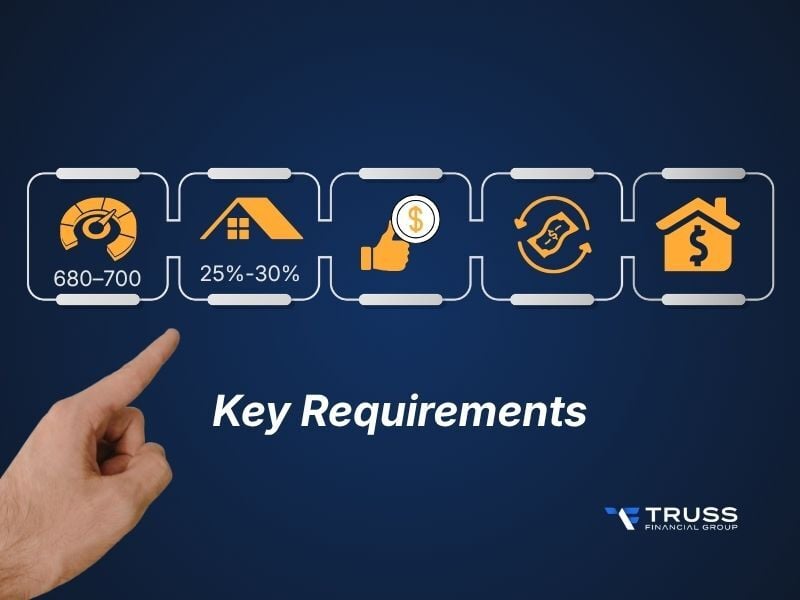
Key Requirements for Investment Property HELOCs
| Requirement | Why It Matters |
| Higher Credit Standards | Investment property HELOCs often require stronger credit than primary-residence HELOCs. |
| More Equity | Many lenders are more conservative on investor CLTV limits. Review how to calculate home equity and LTV. |
| Rental Income Stability | Vacancy, tenant turnover, and repairs can affect repayment ability. |
| Cash Reserves | Reserves help cover months where rental income is lower or costs are higher. |
| Property Eligibility | Property type, condition, occupancy, and title structure all matter. |
Common Uses for Investment Property HELOC Funds
Renovation
Pay for improvements that may support rent growth or property value.
Acquisition
Use funds toward a down payment if the new property still cash flows.
Debt Strategy
Consolidate higher-interest debt only when the repayment plan is clear.
If a HELOC is not the right fit, investors may compare refinancing a rental property, DSCR cash-out refinance, or other investment property loan options.
Frequently Asked Questions
1. Can I get a HELOC on an investment property without tax returns?
Some lenders may allow it if you can support the file with bank statements, rental income, reserves, credit strength, and sufficient equity.
2. Is an investment property HELOC harder to get than a primary residence HELOC?
Usually yes. Lenders often require stronger credit, more equity, and better reserves because rental properties carry more risk.
3. Can rental income help me qualify?
Yes. Lease agreements, rent history, and property cash flow can help support repayment ability, depending on the lender.
4. Can I use the funds to buy another rental property?
Often, yes, but the lender may review the full risk profile and whether the additional property purchase is financially sustainable.
5. Are rates higher on investment property HELOCs?
They can be. Investment properties and reduced-documentation loans often carry higher risk, which may affect pricing.
6. What if I cannot qualify for a HELOC?
You may compare DSCR loans, cash-out refinance options, bridge loans, or other investor financing structures.
Investor Next Step
Use Equity Without Letting the Loan Structure Work Against You
Truss Financial Group can help investors compare no tax return HELOCs, bank statement HELOCs, DSCR options, and rental-property refinance paths based on equity, cash flow, and portfolio goals.

.svg)

Discuss your unique requirements
Get direct answers and a roadmap for your future.
.png?width=202&height=202&name=image%20588255187%20(1).png)

-1.jpg?width=389&height=221&name=Blog%20covers%20(3)-1.jpg)



.png?width=389&height=221&name=Untitled%20design%20(1).png)


.svg)

.svg)
.svg)