.svg)



%20(1).svg)
%20(2).svg)
.png?width=480&height=420&name=Img%20(1).png)
%20(3).svg)
%20(4).svg)

%20(5).svg)


 View all states
What is Cap Rate on Rental Property? And How to Calculate it?

26 mins
.png)
In this blog
When real estate investors analyze a rental property, one of the first numbers they look at is the cap rate. Short for capitalization rate, cap rate is a quick way to estimate how much income a property generates relative to its value.
At Truss Financial Group (TFG), cap rate is treated as a starting metric, not a shortcut. It’s widely used because it allows investors to compare rental properties quickly, even across different markets, by stripping a deal down to a simple question: How much income does this property produce for every dollar invested?
That simplicity is also its limitation. Cap rate reflects performance for a single year, does not include financing, and does not predict future cash flows. Used correctly, it helps investors screen opportunities; used in isolation, it can lead to incomplete conclusions.
In this guide, we’ll break down what cap rate means for rental properties, how to calculate it, what’s considered a good cap rate in today’s market, and how experienced investors working with financing strategies like DSCR loans and DSCR HELOCs at TFG, use it to evaluate real-world deals.
What Is Cap Rate in Real Estate Investing
Cap Rate Meaning for Rental Properties
The capitalization rate, or cap rate, measures the relationship between a rental property’s income and its value. In plain terms, it shows the percentage return a property generates based on its income alone.
Cap rate is calculated using a property’s net operating income (NOI) and its current market value. Because it ignores mortgage payments and financing structure, it allows investors to evaluate the property itself, not the borrower.
For income-producing properties, cap rate helps investors:
- Compare two properties with different prices
- Evaluate relative risk across markets
- Estimate how long it may take to recover the purchase price through income
A 10% cap rate, for example, roughly implies it would take about 10 years of stable income to recover the investment, assuming no growth, no leverage, and no major changes.
Why Cap Rate Is a Useful Starting Point (and Nothing More)
Cap rate is best understood as a first filter, not a final verdict.
It works well for:
- Long-term rental properties
- Stabilized income-producing assets
- Side-by-side property comparisons
It does not work well for:
- Short-term or vacation rentals with seasonal income
- Transitional or value-add properties
- Deals where appreciation is the primary goal
Most importantly, the cap rate does not include debt. Two investors can buy the same property at the same cap rate and have completely different outcomes depending on loan terms, interest rates, and leverage.
That’s why experienced investors use cap rate to screen deals, then rely on cash flow analysis and metrics like DSCR (Debt Service Coverage Ratio) to determine whether a property can actually support financing.
Cap Rate Formula: How Cap Rate Is Calculated?
Understanding the cap rate formula is essential for real estate investors evaluating a rental property. Cap rate calculations focus on the relationship between a property’s net operating income (NOI) and its current market value, allowing investors to assess an income-producing property without factoring in financing or mortgage payments.
Because cap rate looks only at income and value, it provides a standardized way to compare properties across different price points and rental markets.
The Basic Cap Rate Formula Explained
At its core, the capitalization rate uses a simple ratio to measure how efficiently a property generates income.
Cap Rate = Net Operating Income ÷ Current Market Value
In this formula:
- Net operating income (NOI) represents the annual income a rental property generates after subtracting operating expenses.
- Current market value reflects what the property is worth in today’s market, not necessarily the original purchase price.
The result is expressed as a percentage, showing the property’s income yield for a single year.
It’s important to note that cap rate calculations intentionally exclude financing costs, mortgage payments, and capital expenditures. This allows investors to evaluate the property’s performance on its own, independent of how it is financed.
Cap Rate = Net Operating Income ÷ Current Market Value
Seeing the formula in action makes it easier to understand how cap rate works in real estate investing.
Cap Rate Calculation Example for a Rental Property
Assume a rental property generates $120,000 in gross annual income. The property’s operating expenses,including property taxes, insurance, maintenance costs, and management fees, total $40,000 per year.
That leaves the property with a net operating income (NOI) of:
$120,000 (gross income) − $40,000 (operating expenses) = $80,000 NOI
If the current market value of the property is $1,000,000, the cap rate calculation would look like this:
$80,000 ÷ $1,000,000 = 0.08, or an 8% cap rate
This means the rental property produces an annual income equal to 8% of its market value, before accounting for financing, loan terms, or future cash flows.
Real estate investors use this percentage to compare similar investment opportunities and assess relative value within the local market.
What Is Net Operating Income (NOI)?
Net operating income (NOI) represents the annual income a rental property generates after deducting its normal operating expenses. It is one of the most important figures in real estate investing because it sits at the center of cap rate calculations and property valuation.
NOI focuses strictly on how a property performs as an income-producing asset. It measures the strength of the income stream before debt, taxes on ownership, or long-term capital decisions come into play.
Because cap rate is calculated using NOI and current market value, even small errors in NOI can significantly distort a property’s perceived value.
What Counts Toward NOI
To calculate net operating income accurately, investors must understand which sources of income and expenses are included.
Rental Income and Additional Income
The starting point for NOI is a property’s gross income. This typically includes:
- Base rental income collected from tenants
- Additional income such as parking fees, laundry income, storage fees, or pet rent
- Any recurring income the property reliably generates as part of normal operations
Only income that is consistent and repeatable should be counted. One-time payments or irregular income should not be included, as NOI is intended to reflect stable annual performance.
Operating Expenses (Taxes, Insurance, Maintenance)
From gross income, investors subtract operating expenses to arrive at net operating income. Common operating costs include:
- Property taxes
- Insurance premiums
- Maintenance and routine repair costs
- Property management fees
- Utilities paid by the owner
- HOA dues, if applicable
Operating expenses are the costs required to keep the property functioning and generating rental income. Accurately estimating these expenses is critical, as underestimating them can artificially inflate NOI and lead to misleading cap rate results.
What Is NOT Included in NOI
Just as important as knowing what counts toward NOI is understanding what does not belong in the calculation.
Mortgage Payments and Financing Costs
Mortgage payments, loan interest, and other financing costs are not included in net operating income. NOI is calculated before debt service, which allows investors to evaluate the property independently of how it is financed.
This distinction is crucial. Two investors may purchase the same rental property with different loan structures, but the property’s NOI remains the same. Financing decisions affect cash flow and DSCR, not NOI.
Capital Improvements and One-Time Costs
Capital improvements and irregular, one-time expenses are also excluded from NOI. These may include:
- Major renovations or property upgrades
- Roof replacements
- Structural repairs
- Large, non-recurring capital costs
Because NOI is designed to reflect normal annual operations, including one-time capital costs would distort the property’s true operating performance.
Why NOI accuracy matters
Net operating income directly influences cap rate, property value, and an investor’s ability to evaluate investment opportunities realistically. Inflated income or understated expenses can make a deal appear stronger than it actually is.
Once NOI is clearly understood, investors can move on to interpreting cap rate ranges and understanding what qualifies as a good cap rate in different markets.
What Is a Good Cap Rate on a Rental Property?
There is no single “good” cap rate that applies to every rental property. What qualifies as a good cap rate depends on property location, local market conditions, risk tolerance, and the investor’s overall strategy.
In general, cap rates fall within predictable ranges that reflect the tradeoff between risk and return. Lower cap rates usually indicate lower risk and stronger demand, while higher cap rates often signal higher cash flow paired with greater uncertainty.
Typical Cap Rate Ranges in Today’s Market
|
Cap Rate Range |
Risk Level |
Market Characteristics |
Investor Profile |
|
5%–6% |
Lower risk |
High-demand, competitive markets with strong property values |
Conservative investors prioritizing stability |
|
7%–8% |
Moderate risk |
Balanced markets with steady rental income and reasonable pricing |
Investors seeking a mix of cash flow and appreciation |
|
9%–10%+ |
Higher risk |
Weaker or transitional markets with lower property prices |
Cash-flow-focused investors willing to accept more risk |
This table provides a starting framework, not a rulebook. The same cap rate can mean very different things depending on the rental market and asset class.
5%–6% Cap Rate (Lower Risk, Competitive Markets)
A 5%–6% cap rate is common in desirable urban or suburban markets where demand is strong and property prices are high. These properties often benefit from:
- Stable rental income
- Lower vacancy risk
- Strong long-term appreciation potential
The tradeoff is lower immediate cash flow. Many investors accept this because the lower cap rate reflects lower risk, not a poor investment.
7%–8% Cap Rate (Balanced Risk and Return)
A 7%–8% cap rate is often considered a middle ground. These properties tend to be located in solid rental markets that offer:
- Reliable income streams
- Reasonable acquisition costs
- Balanced exposure to risk and return
For many real estate investors, this range represents a practical balance between cash flow, relative value, and long-term growth.
9%–10%+ Cap Rate (Higher Risk, Higher Cash Flow)
A 9%–10% or higher cap rate typically signals increased risk. These properties may be located in weaker markets or face challenges such as:
- Higher vacancy rates
- Greater operating costs
- Slower appreciation or market volatility
While higher cap rates often mean stronger cash flow, they also demand more careful analysis. Investors must closely examine operating expenses, local market trends, and long-term sustainability.
A critical reminder about “good” cap rates
Cap rate alone does not determine whether a property is a good investment. It does not account for financing, interest rates, or whether rental income can comfortably support debt.
That’s why experienced investors use cap rate to compare properties, then rely on metrics like cash flow and DSCR to evaluate financing feasibility, especially in markets where lower cap rates are common but leverage still plays a critical role.
Why “Good” Cap Rates Depend on Property Location and Risk
A “good” cap rate cannot be defined in isolation. The same cap rate can signal very different levels of risk depending on property location, local market conditions, and the stability of the rental income.
For example, a 6% cap rate in a high-demand suburban market may reflect strong tenant demand, low vacancy risk, and stable property values. That same 6% cap rate in a weaker rental market could indicate limited growth potential or elevated downside risk.
Cap rates also reflect how investors price uncertainty. Markets with stronger job growth, population inflows, and rental demand tend to trade at lower cap rates because investors are willing to accept lower immediate returns in exchange for stability. Conversely, properties in declining or transitional markets often require higher cap rates to compensate for greater risk.
This is why cap rates should always be evaluated relative to the local market, not against a universal benchmark.
Higher vs Lower Cap Rate: Which Is Better for Investors?
There is no inherently “better” cap rate. The right choice depends on an investor’s risk tolerance, income goals, and long-term strategy.
Cap Rate Risk Comparison
|
Cap Rate Profile |
Typical Risk Level |
Common Market Traits |
Investor Tradeoff |
|
Higher Cap Rate |
Higher risk |
Lower property values, weaker or transitional markets |
Higher cash flow, greater volatility |
|
Lower Cap Rate |
Lower risk |
Strong demand, competitive rental markets |
Stable income, lower immediate yield |
This framework helps investors align cap rate expectations with their strategy rather than chasing yield blindly.
Higher Cap Rates and Increased Risk
Higher cap rates are typically associated with higher cash flow, but they rarely come without tradeoffs. Properties with elevated cap rates often face one or more of the following challenges:
- Weaker or less predictable rental demand
- Higher vacancy rates
- Increased operating or repair costs
- Slower appreciation or market volatility
In many cases, the higher cap rate exists precisely because the market requires compensation for these risks. While these properties may generate stronger near-term income, they demand more active management and closer scrutiny of operating expenses and tenant stability.
Lower Cap Rates and Stable Income
Lower cap rates usually indicate lower perceived risk. These properties are often located in competitive markets where demand is strong and property values are high.
Common characteristics of lower cap rate properties include:
- Stable rental income
- Lower vacancy risk
- Strong long-term demand fundamentals
The tradeoff is reduced immediate cash flow. Investors choosing lower cap rate properties are often prioritizing income stability and preservation of capital over maximum yield.
Why Cap Rate Alone Should Never Decide an Investment
Cap rate measures a property’s income relative to its value but it leaves out critical factors that determine real-world outcomes.
Cap rate does not account for:
- Financing structure or loan terms
- Interest rates
- Cash flow after debt service
- Whether rental income comfortably covers payments
Two investors can buy identical properties at the same cap rate and experience completely different results depending on leverage, financing costs, and market timing.
That’s why cap rate should be treated as a screening metric, not a decision tool. Experienced investors use it to narrow options, then rely on cash flow analysis and financing metrics, such as DSCR to determine whether a deal actually works.
Factors That Affect Cap Rates
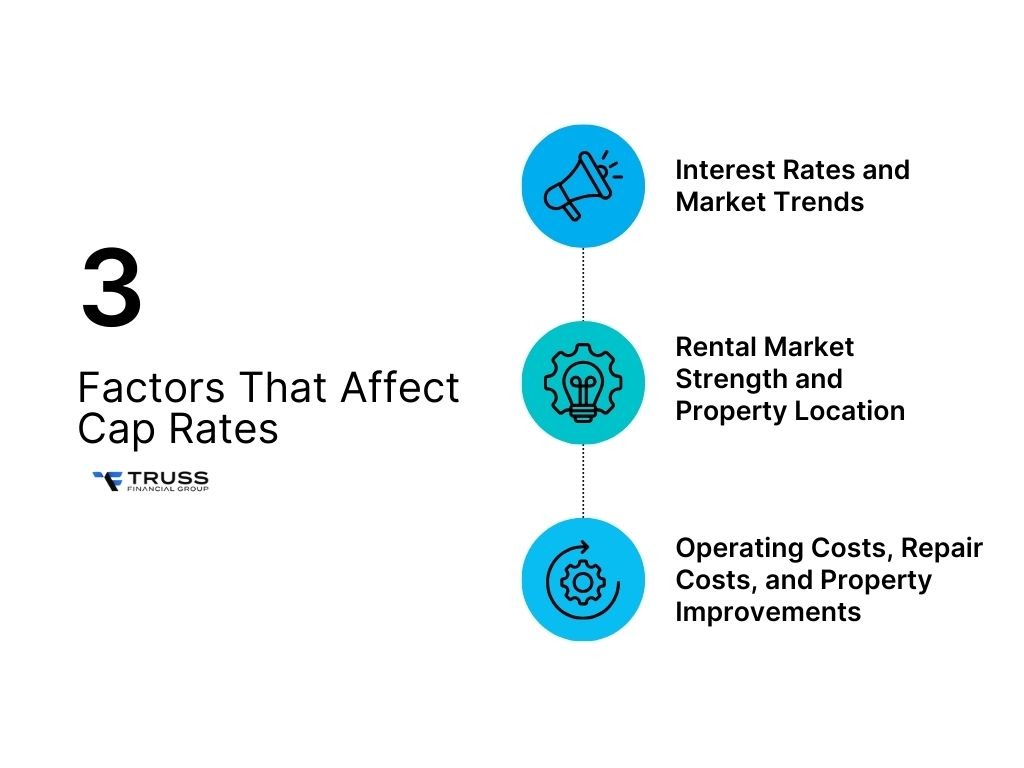
Cap rates are not fixed numbers. They change in response to market conditions, property performance, and investor expectations. Understanding what drives cap rates helps investors interpret whether a deal looks attractive because it is genuinely strong or simply because risk is being priced in.
Several key factors consistently influence how cap rates move across rental markets.
Interest Rates and Market Trends
Interest rates play a major role in cap rate behavior. When interest rates rise, borrowing becomes more expensive, which often puts downward pressure on property prices. As prices decline or income expectations adjust, cap rates tend to rise.
When interest rates fall, the opposite effect often occurs. Cheaper financing increases demand for income-producing property, driving prices higher and leading to cap rate compression.
Broader market trends also matter. Economic growth, employment levels, and population migration patterns all influence rental demand and investor confidence. Strong markets with positive growth expectations typically trade at lower cap rates because investors are willing to accept lower yields in exchange for perceived stability.
Rental Market Strength and Property Location
The rental market and property location are among the strongest drivers of cap rate differences. Properties located in areas with high rental demand, limited housing supply, and strong tenant pools generally command lower cap rates.
Key location-based factors include:
- Job growth and economic stability
- Population inflows or outflows
- Vacancy rates and tenant turnover
- Local zoning and development constraints
A property in a competitive urban or suburban market may have a lower cap rate due to higher market value, even if rental income is strong. In contrast, properties in weaker or less predictable markets often require higher cap rates to compensate for elevated risk.
Operating Costs, Repair Costs, and Property Improvements
Operating expenses directly affect a property’s net operating income (NOI), which in turn impacts cap rate calculations. Higher ongoing costs reduce NOI and can increase a property’s effective cap rate if market value does not adjust accordingly.
Common cost drivers include:
- Maintenance and repair costs
- Property taxes and insurance
- Utilities and management fees
Property improvements can influence cap rates in different ways. Strategic upgrades that increase rental income or reduce operating costs may improve NOI and lower the cap rate over time. However, large capital improvements require careful analysis, as they do not automatically translate into higher market value.
Cap Rate Compression vs Cap Rate Expansion
Cap rate compression occurs when property values rise faster than income, often due to strong demand, lower interest rates, or increased investor competition. This typically signals confidence in the market but can also indicate reduced yields.
Cap rate expansion happens when property values fall or risk perceptions increase, leading investors to demand higher returns. Expansion often reflects rising interest rates, economic uncertainty, or weakening rental markets.
Understanding whether a market is experiencing compression or expansion helps investors assess timing, risk, and long-term strategy rather than relying solely on headline cap rate numbers.
Cap Rate by Property Type and Asset Class
Cap rates vary significantly depending on property type and asset class. Different properties carry different income stability, risk profiles, and operating structures, all of which influence how investors price them.
Understanding these differences helps investors avoid comparing cap rates that are not truly comparable.
Single-Family vs Multifamily Rental Properties
Single-family rental properties typically trade at lower cap rates than multifamily properties in the same market. This is largely due to perceived stability, broader buyer demand, and simpler management.
Single-family rentals often appeal to:
- Long-term tenants
- Owner-occupants turned investors
- Markets with strong resale demand
Multifamily properties, on the other hand, often carry slightly higher cap rates. While they benefit from multiple income streams, they also introduce:
- Higher operating complexity
- Greater management requirements
- Sensitivity to vacancy across units
Because multifamily assets generate more predictable aggregate income, they are often favored by professional investors, even when cap rates are higher.
Commercial Real Estate and Mixed-Use Properties
Commercial real estate properties including retail, office, and industrial assets generally trade at higher cap rates than residential rentals. These properties carry additional risks related to:
- Tenant concentration
- Lease rollover
- Economic cycles
Mixed-use properties fall somewhere in between, depending on the balance of residential and commercial income. Cap rates for these assets reflect both income stability and complexity.
Because commercial properties often involve longer leases and higher operating costs, investors demand higher cap rates to compensate for reduced liquidity and increased risk.
Why Cap Rates Don’t Work Well for Vacation Rentals
Cap rates assume stable, recurring income, which makes them less effective for properties with highly variable cash flow.
Vacation rentals and short-term rentals often experience:
- Seasonal income fluctuations
- Variable occupancy rates
- Unpredictable operating expenses
Because income is inconsistent, calculating a meaningful annual net operating income (NOI) becomes difficult. As a result, cap rate calculations for vacation rentals can be misleading and should be supplemented with cash flow modeling and stress testing.
Cap Rate vs Other Real Estate Investment Metrics
Cap rate is a useful screening tool, but it is not the only metric investors should rely on. Comparing cap rate with other valuation and performance measures provides a more complete picture of an investment’s viability.
Cap Rate vs Cash Flow
Cap rate measures income relative to property value, while cash flow measures income after all expenses, including debt service.
A property can have:
- A strong cap rate but weak cash flow due to high financing costs
- A lower cap rate but positive cash flow with favorable loan terms
Cash flow determines whether a property can sustain itself month to month, while cap rate helps investors compare asset value across opportunities.
Cap Rate vs Gross Rent Multiplier
The gross rent multiplier (GRM) compares property price to gross rental income, without accounting for operating expenses.
While GRM offers a quick snapshot, it lacks precision. Cap rate is generally more useful because it incorporates operating expenses and reflects actual income performance rather than top-line revenue.
GRM may help with early-stage filtering, but cap rate provides a more realistic assessment of income-producing potential.
Cap Rate vs DSCR (Debt Service Coverage Ratio)
Cap rate evaluates a property’s income relative to its value. DSCR (Debt Service Coverage Ratio) evaluates whether that income can support loan payments.
Key distinction:
- Cap rate ignores financing
- DSCR is entirely dependent on financing
A property can have an attractive cap rate and still fail to qualify for traditional financing if rental income does not adequately cover debt service. Conversely, some lenders, such as DSCR-focused lenders, evaluate deals based primarily on property cash flow rather than borrower income, including scenarios where DSCR is below 1.0.
This is why experienced investors use cap rate to compare properties, then rely on DSCR to determine whether and how a deal can be financed.
How Cap Rate and DSCR Work Together for Investors
Cap rate and DSCR answer two different questions. Cap rate helps investors compare properties. DSCR determines whether a deal can be financed. Used together, they separate the quality of the asset from the feasibility of the loan.
Why Cap Rate Does Not Include Debt or Loan Terms
Cap rate intentionally excludes debt. It looks only at a property’s net operating income relative to its market value, ignoring interest rates, loan structure, and leverage.
This makes cap rate useful for comparing two properties on equal footing, but it also means cap rate says nothing about whether the income will actually cover loan payments. Financing risk lives entirely outside the cap rate calculation.
How DSCR Measures Whether Rental Income Covers Debt
Debt Service Coverage Ratio (DSCR) measures whether a property’s rental income can support its debt obligations.
In simple terms, DSCR compares:
- Net operating income
- Against annual loan payments
A DSCR above 1.0 means the property generates enough income to cover debt. A DSCR below 1.0 means it does not, at least on paper.
Where cap rate evaluates the property, DSCR evaluates the deal structure.
Using Cap Rate to Screen Deals and DSCR to Finance Them
Most experienced investors use cap rate first and DSCR second.
Cap rate helps answer:
- Is this property priced reasonably for its income?
- How does it compare to similar properties in the same market?
DSCR then answers:
- Can this income support financing?
- Under what loan terms does the deal work?
This sequencing avoids over-optimizing for yield while ignoring financing reality.

Can You Finance a Property With a Low Cap Rate or DSCR Below 1.0?
Yes, but context matters.
What DSCR Below 1.0 Means for Real Estate Investors
A DSCR below 1.0 means the property’s current rental income does not fully cover its projected debt service. Under most conventional DSCR programs, this would result in a decline.
At Truss Financial Group, DSCR below 1.0 does not automatically disqualify a deal when the shortfall can be supported through asset depletion. This distinction matters.
Low-DSCR scenarios commonly occur in:
- High-cost, low-cap-rate markets
- Properties early in their rental lifecycle
- Assets with strong fundamentals but conservative in-place rents
In these cases, the question is not whether the property covers debt today, but whether the overall risk profile remains sound when assets are considered.
How TFG Approves DSCR Below 1.0 Using Asset Depletion
TFG evaluates low-DSCR deals differently by incorporating borrower assets into the qualification analysis through asset depletion.
Instead of relying solely on rental income, TFG may factor in:
- Verified liquid and retirement assets
- Asset longevity relative to loan term
- Property type and market stability
- Conservative loan structures
Asset depletion allows excess assets to offset temporary income shortfalls, enabling financing where traditional DSCR lenders would decline, even when DSCR falls below 1.0.
This approach is risk-based, not lenient. The goal is to ensure the loan remains sustainable without overstating rental income or ignoring market realities.
When DSCR Below 1.0 Still Makes Strategic Sense
DSCR below 1.0 can be a rational choice when:
- The investor has significant qualifying assets
- The property is stabilized but conservatively rented
- The market supports long-term value preservation
- Leverage is intentionally kept moderate
These scenarios are typically suited for experienced investors who understand cash flow dynamics and are prioritizing portfolio structure, liquidity, or long-term positioning over short-term yield.
At TFG, DSCR below 1.0 is not treated as a loophole, it is treated as a deliberate underwriting decision supported by assets, structure, and risk controls.
Cap Rate, DSCR Loans, and DSCR HELOCs
Cap rate explains how a property performs on paper. DSCR-based loan products determine how investors actually access capital against that performance. Together, they help investors separate property economics from financing strategy.
Using DSCR Loans for Rental Property Purchases
DSCR loans allow investors to qualify for rental property financing based primarily on the property’s income rather than personal income. Approval focuses on:
- Net operating income
- Property cash flow
- Debt service coverage
This makes DSCR loans particularly useful for investors who are self-employed, scaling portfolios, or structuring purchases around asset performance instead of W-2 income.
While cap rate helps investors compare rental properties, DSCR loans determine whether the income profile supports the loan structure being considered.
Using DSCR HELOCs to Access Equity Without Income Docs
DSCR HELOCs allow investors to access equity in rental properties without relying on traditional income documentation. Instead, qualification is driven by:
- Property cash flow
- Market value and equity position
- Risk-adjusted debt service coverage
This structure can provide flexible capital for reinvestment, property improvements, or portfolio management, especially for investors who prefer not to liquidate assets or refinance existing loans.
DSCR HELOCs are best understood as liquidity tools, not yield enhancers.
How Investors Use DSCR Calculators to Pre-Qualify Deals
Before applying, many investors use DSCR calculators to estimate whether a property is likely to qualify under DSCR-based programs.
These calculators help investors:
- Estimate debt service coverage
- Test different loan terms and rates
- Identify income shortfalls early
Using DSCR calculators during deal analysis helps investors avoid surprises and structure offers more realistically before committing capital.
When Cap Rate Can Be Misleading
Cap rate is a useful screening metric, but it relies on stable income assumptions that do not apply to every situation. In certain scenarios, cap rate can understate, or overstate, a property’s true investment potential.
Transitional or Value-Add Properties
Properties undergoing renovations or repositioning often have temporarily depressed net operating income. As a result, the cap rate may appear unattractive even when the long-term outlook is strong.
In these cases, cap rate reflects the property’s current state, not its intended performance after stabilization.
Short-Term or Seasonal Income Properties
Cap rate assumes consistent annual income. Properties with seasonal or short-term rental income often experience wide fluctuations in cash flow, making cap rate calculations less reliable.
For these properties, income volatility can distort NOI, leading to misleading cap rate conclusions.
Markets Driven More by Appreciation Than Cash Flow
In some markets, investor returns are driven primarily by property appreciation rather than rental income. These markets often exhibit lower cap rates because buyers are pricing in long-term value growth rather than immediate cash flow.
In such cases, cap rate alone fails to capture the full investment thesis and should be evaluated alongside market trends and financing strategy.
Frequently Asked Questions About Cap Rate
How Do I Calculate Cap Rate on a Rental Property?
To calculate the cap rate on a rental property, divide the property’s net operating income (NOI) by its current market value.
Cap Rate = Net Operating Income ÷ Current Market Value
NOI is calculated by taking annual rental income and subtracting operating expenses such as property taxes, insurance, maintenance, and management fees. Financing costs and mortgage payments are not included.
What Does a 7.5% Cap Rate Mean?
A 7.5% cap rate means the property generates annual net operating income equal to 7.5% of its market value, before financing.
In practical terms, this implies the property would take roughly 13 to 14 years to recover its value through income alone, assuming stable income and no leverage. Whether this is attractive depends on market conditions, risk, and investment strategy
Is a Higher Cap Rate Always Better?
No. A higher cap rate usually reflects higher risk, not a better deal.
Higher cap rates often appear in markets with weaker demand, higher vacancy, or greater income uncertainty. Lower cap rates typically signal stronger markets with more stable income and lower perceived risk.
Cap rate should always be evaluated alongside property location, operating costs, and financing strategy.
How Long Does It Take to Recover an Investment Using Cap Rate?
Cap rate offers a rough estimate of how long it may take to recover an investment through income.
For example:
- A 10% cap rate suggests approximately 10 years
- A 7.5% cap rate suggests roughly 13–14 years
- A 5% cap rate suggests about 20 years
This is a simplified estimate and does not account for financing, appreciation, rent growth, or changes in expenses. It should be used as a reference point, not a forecast.
Final Thoughts: How Smart Investors Actually Use Cap Rate
Cap rate remains one of the most widely used metrics in real estate investing because it simplifies comparison. But experienced investors understand its limits. Cap rate is most effective when it is treated as a starting point, not a verdict.
Cap Rate as a Screening Tool, Not a Decision Tool
Cap rate works best as a filter. It helps investors quickly compare rental properties, spot pricing inconsistencies, and identify deals that deserve deeper analysis.
What cap rate does well:
- Compares income-producing properties on equal footing
- Highlights relative value across markets
- Flags potential risk priced into a deal
What cap rate does not do:
- Account for financing or leverage
- Predict future cash flows
- Reflect loan structure or capital strategy
Used correctly, cap rate narrows the field. Used incorrectly, it can lead investors to overvalue yield while ignoring risk and financing reality.
Why Financing Strategy Matters as Much as Property Performance
A property’s performance on paper does not determine investment success on its own. Financing strategy plays an equally important role.
Two investors can buy the same property at the same cap rate and experience very different outcomes based on:
- Loan terms and interest rate
- Debt structure and flexibility
- Ability to support short-term cash flow gaps
This is why smart investors evaluate both the asset and the capital stack. Cap rate explains how the property performs. Financing determines whether that performance can be translated into sustainable ownership.
When cap rate and financing strategy are aligned, investors gain clarity, not just on what a property earns, but on how it fits into a broader portfolio plan.

.svg)

Discuss your unique requirements
Get direct answers and a roadmap for your future.
.png?width=202&height=202&name=image%20588255187%20(1).png)

%20(2).png?width=389&height=221&name=Blog%20covers%20(1)%20(2).png)


%20(1).png?width=389&height=221&name=Blog%20covers%20(6)%20(1).png)



.svg)

.svg)
.svg)