.svg)



%20(1).svg)
%20(2).svg)
.png?width=480&height=420&name=Img%20(1).png)
%20(3).svg)
%20(4).svg)

%20(5).svg)


 View all states
What Is the APR on a HELOC? Rates, Factors & How It Works

6 mins
.jpg)
In this blog
HELOC APR is one of the most important numbers to review before opening a home equity line of credit. The interest rate tells you the cost of borrowing the money you draw. APR, or annual percentage rate, gives a broader picture of borrowing cost because it can reflect rate plus certain lender fees and charges.
That difference matters. Two lenders can quote similar HELOC interest rates, but the APR can look different once closing costs, annual fees, introductory pricing, and fixed-rate conversion rules are considered. If you are comparing offers, APR helps you look beyond the headline rate.

Quick Answer: What Is the APR on a HELOC?
The APR on a HELOC is the annualized cost of borrowing. It may include the interest rate plus certain fees, so it is often a better comparison tool than the interest rate alone.
How APR Differs from the Interest Rate
The interest rate is the percentage used to calculate interest on the outstanding balance. APR is a broader cost measure. For a HELOC, the APR can be affected by the variable rate, lender margin, annual fee, application fee, closing costs, and whether the borrower qualifies for discounts.
The FTC's home equity guidance encourages borrowers to compare total costs, not only the advertised rate. That is especially useful with HELOCs because pricing may change after an introductory period.
Simple way to think about it: interest rate affects the monthly interest calculation; APR helps compare the broader cost of the credit line.
What Factors Affect HELOC APR?
HELOC APR is not the same for every borrower. Lenders price a line based on risk, equity, and program terms. The most common factors include:
Credit Profile
Higher scores and cleaner payment history can support better pricing.
Home Equity
More equity usually lowers lender risk and can improve available terms.
Loan-to-Value
A lower home equity LTV can lead to stronger approval odds.
Fees and Costs
Closing costs and annual fees can make the APR higher than the interest rate.
Lenders may also consider property type, occupancy, line amount, income documentation, and whether the borrower sets up autopay or qualifies for relationship discounts.
Variable APR, Introductory Rates, and Rate Caps
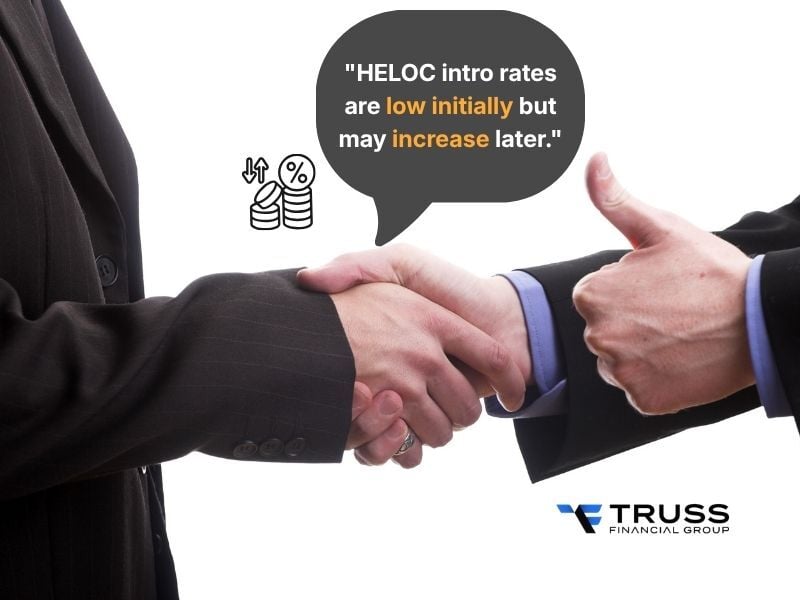
Most HELOCs have variable rates tied to a benchmark such as the prime rate plus a lender margin. That means the APR and payment can change over time. APR is also separate from any possible interest deduction; when HELOC funds are used for qualifying home purposes, IRS Publication 936 is the official source for mortgage and home equity interest rules.
Introductory offers can look attractive, but borrowers should ask what happens after the promotional period ends. Review the margin, index, minimum APR, maximum APR, annual fee, and whether the lender can freeze or reduce the line if property value or borrower circumstances change.
Fixed-Rate Conversion Options
Some lenders allow borrowers to convert part of a HELOC balance into a fixed-rate segment. This can make monthly payments more predictable, especially before the HELOC repayment period begins. The tradeoff is that fixed-rate segments may come with higher pricing or specific conversion rules.
How Fees and Closing Costs Affect APR
HELOC costs can include application fees, origination fees, appraisal or valuation fees, title fees, annual fees, recording fees, and early closure fees. Some lenders advertise no-closing-cost HELOCs, but costs may be offset through rate pricing or account conditions.
Before comparing offers, read the fee schedule and understand how HELOC closing costs are handled. A slightly higher rate with fewer fees may or may not be better than a lower rate with upfront costs, depending on how much you plan to draw and how long you expect to keep the line open.
How to Lower Your HELOC APR Before Applying
- Improve credit before applying by reducing revolving balances and avoiding late payments.
- Lower your CLTV by paying down the mortgage or requesting a smaller line amount.
- Compare total cost across rate, fees, annual charges, and fixed-rate conversion rules.
- Ask about autopay or relationship discounts if available.
- Use only what you need during the draw period so interest does not build unnecessarily.
If you are unsure how much equity is available, start with a realistic estimate of how much equity you need for a HELOC and then compare offers based on APR, not the interest rate alone.
Compare HELOC APR With the Full Cost in View
Truss Financial Group helps borrowers compare HELOC structures by looking at rate, APR, line size, draw strategy, closing costs, and repayment risk together. That gives you a clearer view than a rate quote alone.
Frequently Asked Questions
1. What is the APR on a HELOC?
It is the annualized borrowing cost of the credit line, often reflecting the interest rate plus certain fees and lender charges.
2. Is HELOC APR fixed or variable?
Most HELOC APRs are variable, though some lenders let borrowers convert part of the balance to a fixed-rate segment.
3. Why is APR higher than the interest rate?
APR can include certain fees and costs, so it may be higher than the stated interest rate used to calculate monthly interest.
4. Can I reduce my HELOC APR?
Yes. Stronger credit, lower CLTV, lower debt, and lender discounts may help reduce APR or improve available terms.
5. Does APR affect monthly HELOC payments?
Yes. A higher APR generally means higher borrowing cost and can increase payments, especially after the draw period ends.
6. Should I compare HELOCs by APR or interest rate?
Compare both. The rate shows the interest calculation, while APR helps compare total cost across lenders and fee structures.

.svg)

Discuss your unique requirements
Get direct answers and a roadmap for your future.
.png?width=202&height=202&name=image%20588255187%20(1).png)


-3.png?width=389&height=221&name=Blog%20covers%20(9)-3.png)



.svg)

.svg)
.svg)