.svg)



%20(1).svg)
%20(2).svg)
.png?width=480&height=420&name=Img%20(1).png)
%20(3).svg)
%20(4).svg)

%20(5).svg)


 View all states

14 mins
-1.png)
In this blog
You've decided a home equity line of credit is the right way to fund your project, whether that's home improvements, urgent home repairs, tuition, or a debt consolidation loan you've been putting off. Now comes a second decision that gets a lot less attention than the first: where do you actually get it?
A traditional bank, a local credit union, and an online lender can all offer a HELOC, and each will tell you they're the smarter choice. That's not spin so much as a byproduct of how differently these three types of financial institutions are built. Most comparisons stop at "credit unions have lower rates" without explaining why, or lean on "online lenders are fast" without mentioning the trade-offs that come with speed.
This piece breaks down how each lender type is structured, what that means for your interest rate and closing costs, how the application process and approval timeline differ, and how to think about eligibility requirements before you request quotes. Lenders like Truss Financial Group help homeowners compare these options side by side before applying. It's written for homeowners who are ready to apply for a HELOC and want a clear-eyed read on where to start.
Banks, Credit Unions, and Online Lenders: What Actually Sets Them Apart
%20(16)-1.png?width=1920&height=1080&name=blog%20graphics%20(169)%20(16)-1.png)
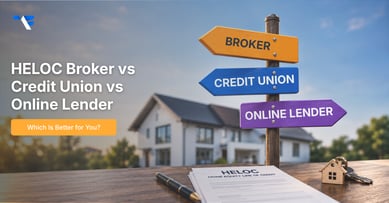
Whichever type of mortgage lender you're weighing, the important differences between a bank, a credit union, and an online lender start with ownership, and that single fact explains almost everything else in this comparison.
Bank
A bank is a for-profit institution, either privately held or publicly traded. Its pricing on mortgage products, auto loans, and personal loans is built to generate returns for shareholders alongside serving customers.
Credit Union
A credit union is the opposite structurally: a not-for-profit, member-owned institution. There are no outside shareholders, so surplus earnings get returned to members as lower rates, fewer fees, or better dividends. As Forbes Advisor explains, this for-profit versus not-for-profit divide is the root cause of nearly every product and service difference between the two.
The National Credit Union Administration, the federal agency that charters and supervises credit unions, confirms this directly: a credit union is a not-for-profit financial institution owned and controlled by its members, with deposits insured through the National Credit Union Share Insurance Fund rather than the FDIC.
Online HELOC Lender
An online HELOC lender is a different animal altogether: typically a non-depository fintech lender or a bank-backed digital platform with few or no branches. Lower physical overhead generally supports faster, more standardized underwriting, and often more transparent published rates, since there's no in-person negotiation built into the process. Some credit unions have also gone digital-first themselves, operating as online credit unions with fewer branches than a traditional institution, which blurs the line between categories a bit but doesn't change the underlying not-for-profit structure behind the HELOC loan itself.
However you apply, you're borrowing the same underlying product. The Consumer Financial Protection Bureau defines a HELOC as an open-end line of credit that lets you borrow repeatedly against your home equity, typically during a draw period, before you move into a separate repayment period. That definition doesn't change based on which type of lender originates the loan.
None of this means one type of lender is inherently better. It means the equity line of credit you eventually sign is the same product, no matter where it comes from. What changes is the pricing model, the paperwork, and who you talk to along the way.
How Rates and Fees Actually Compare
As of mid-2026, the national average HELOC interest rate sits around 7.43%, and most lenders price their HELOC amount off the prime rate, published daily by the Federal Reserve, plus a margin. Where that margin lands depends heavily on lender type and your own credit profile. Your credit limit and total loan amount will also vary by lender, since each sets its own limits based on your home's value and how much equity you have to borrow against.
Credit Union
Credit unions frequently undercut big banks on rates. Most credit unions offer competitive rates that run somewhere in the 0.25% to 0.75% range below for-profit institutions for similar borrower profiles, a direct result of the not-for-profit structure discussed above. Fewer fees tend to follow the same pattern: many credit unions waive origination fees entirely or charge a flat fee instead of a percentage, and annual maintenance fees are less common than at traditional banks.
Some credit unions also offer fixed-rate options, letting you lock in a fixed interest rate on all or part of your balance instead of riding the standard variable rate for the life of the line.
Bank
Banks compete differently. If you already hold a checking or savings account, a mortgage, or auto loans with a bank, you may qualify for a relationship discount of 0.25% to 0.50%, often tied to autopay enrollment. Big banks also occasionally run promotional introductory rates to win new HELOC business, though the standard variable rate that kicks in afterward is usually the number that determines your real long-term cost.
During the draw period, you typically pay interest only on what you've drawn, so your monthly payments stay lower until the repayment period begins and principal gets added back in. Comparing loan terms, not just the headline rate, is what actually tells you what you'll pay over the life of the loan.
Online Lender
Online lenders generally skip relationship pricing altogether: there's typically no existing account to base a discount on. But they tend to compete on upfront rate transparency and lower fees driven by reduced fees for overhead, appraisal, and processing.
The honest takeaway: no lender type is cheapest for every borrower. Getting real quotes matters more than assuming a category wins on rate before you've asked.
Bank vs. Credit Union vs. Online Lender: The Difference
%20(17)-1.png?width=1920&height=1080&name=blog%20graphics%20(169)%20(17)-1.png)
The table below lines up the attributes that matter most for informed financial decisions, side by side.
| Feature | Bank | Credit Union | Online Lender |
| Ownership structure | For-profit, shareholder-owned | Not-for-profit, member-owned institutions | Typically, fintech or bank-backed |
| Rate competitiveness | Moderate; relationship discounts available | Often the lowest starting rates | Competitive; varies by lender |
| Fee structure | More fees across the loan lifecycle | Lower fees or fee waivers are common | Streamlined, often lower fees |
| Credit limit/loan amount | Set by equity and lender policy | Set by equity and lender policy | Set by equity and lender policy |
| Approval process | Manual underwriting, appraisal required | Local underwriting, appraisal required | Automated valuation, digital underwriting |
| Typical funding timeline | 2–6 weeks | 2–6 weeks, sometimes faster locally | As fast as several days |
| Eligibility | Open to qualifying applicants | Membership requirements apply | Broad geographic access varies by state |
| Service style | Broad, sometimes less personal | Personalized, relationship-based | Digital-first, remote support |
| Branch and ATM access | Extensive branch and ATM networks | Fewer branches; often low or no ATM fees for members | No branches; ATM access varies by lender |
| Product breadth | Widest range of financial products | Narrower, core lending focus | Focused primarily on the loan product |
The right column for you depends less on which lender type looks strongest on paper and more on what you personally value. The sections below unpack that.
Approval Speed and the Application Process
%20(18)-1.png?width=1920&height=1080&name=blog%20graphics%20(169)%20(18)-1.png)
Here's how the application process typically plays out at each lender type:
- Bank: Manual underwriting with a required home appraisal, often routed through a centralized underwriting office rather than decided locally. The funding timeline typically runs two to six weeks.
- Credit union: Also involves a home appraisal and manual underwriting, but lending decisions are frequently made locally rather than at a distant processing center, which can shave time off that window compared to a large bank, though this varies by institution.
- Online lender: Uses automated valuation models and digital underwriting in place of a traditional in-person appraisal, which can compress the process down to a matter of days in some cases.
That speed is a genuine advantage for a time-sensitive expense, but it's worth remembering that faster underwriting also means less room for a human to work through an unusual credit or income situation on your behalf.
Service Style: Relationship, Local, or Remote
Here's how the service experience typically differs at each lender type:
- Bank: Offers the broadest range of mortgage products, credit lines, and deposit accounts, making it a convenient single point of contact if you already bank there, though the customer experience at a large national bank can feel less personal than at a smaller institution.
- Credit union: Tends to lean into personalized service, often pairing borrowers with a loan officer who works the file from application through closing rather than routing calls through a general service line. That relationship-driven approach is part of why credit union member satisfaction tends to poll well against traditional banks.
- Online lender: Offers digital-first support through chat, phone, or video consultation, with easy access to your application status at any hour. It's a strong fit for borrowers comfortable managing paperwork remotely, though it trades away the option of sitting across a desk from someone when a question gets complicated.
Lenders like Truss Financial Group help walk borrowers through how each service style would actually play out for their specific numbers, rather than leaving them to guess based on marketing copy. See the HELOC rates today!
Eligibility and Access
Here's how eligibility typically works at each lender type:
- Credit union: Limited to members who meet field-of-membership requirements, based on where you live, who you work for, or an association you belong to. Some credit unions have broadened these requirements considerably in recent years, but it's still an extra step that banks and online lenders don't require.
- Bank: Generally open to any qualifying applicant, and existing bank customers often move through the application process faster since their financial information is already on file.
- Online lender: Typically offers the widest geographic reach since there's no physical location limiting service area, though availability still varies by state and lender.
Underneath all three, the same fundamentals apply: credit score, loan-to-value ratio, and debt-to-income ratio still determine how much you can borrow and at what rate. Approval also depends on several factors specific to your property, including whether other liens already sit against the home, since a HELOC is generally subordinate to your first mortgage. A digital application doesn't lower the bar; it just changes how quickly you clear it, and it's still worth comparing loan terms across lender types rather than assuming they're interchangeable.
One factor that doesn't change based on where you borrow: HELOC interest is deductible only if the funds are used to buy, build, or substantially improve the home securing the loan, according to IRS Publication 936. A bank, a credit union, and an online lender all originate the same tax treatment: the deduction follows how you spend the money, not who lent it to you.
Which Lender Type Actually Fits You?
Credit Union
A credit union is a good fit if:
- You qualify for membership based on location, employer, or affiliation
- You want lower interest rates driven by a not-for-profit pricing model
- You value a personalized, relationship-based process
Bank
A bank is a good fit if:
- You already hold accounts there and may qualify for a relationship discount
- You want access to a wider range of financial products beyond the HELOC itself, home equity loans, personal loans, and first mortgage products included under one roof, which is useful if home improvements are just one of several financial goals you're juggling
- You prefer the scale and familiarity of a large institution
Online Lender
An online lender is a good fit if:
- Funding speed is your priority
- You want a transparent published interest rate without needing an existing banking relationship
- You live outside a credit union's field of membership or a bank's branch network
Whichever direction you lean, request real quotes from more than one type before committing. Published rate ranges and repayment terms vary enough between lenders that the only reliable comparison is the one built on your own numbers, your credit score, your home's market value, and your desired HELOC amount, whether you plan to draw it in one lump sum or across a flexible repayment options structure over the draw period.
Frequently Asked Questions
1. Is a credit union always cheaper than a bank for a HELOC?
Not always. Credit unions often price competitively due to their not-for-profit structure, but a bank's relationship discount for an existing customer can close or even eliminate that gap. Your actual rate depends on your credit and the specific offer in front of you.
2. Are online HELOC lenders safe to use?
Legitimate online HELOC lenders follow the same underwriting and disclosure rules as traditional lenders. The real trade-off isn't safety; it's the absence of in-person guidance, which suits some borrowers better than others.
3. Do I have to be a member to get a HELOC from a credit union?
Yes, in most cases. Credit unions generally require membership based on location, employer, or affiliation before you can apply, which can add a step compared to a bank or online lender.
4. Can I get a HELOC with a fixed interest rate instead of a variable one?
Some lenders, across all three lender types, offer fixed-rate options that let you lock in a fixed interest rate on part or all of your balance. Loan types and features like this vary by lender, so it's worth asking directly rather than assuming a HELOC only comes with a variable rate.
5. Which lender type funds a HELOC the fastest?
Online lenders generally fund the fastest, thanks to automated underwriting. Banks and credit unions typically involve an appraisal and manual review, which stretches the timeline to several weeks.
6. Can comparing lender types actually get me a lower interest rate?
Often, yes. Rate ranges vary meaningfully across lender types and by your own financial situation, so requesting quotes from a bank, a credit union, and an online lender before applying is generally worth the extra step.
Get Real Quotes Before You Choose
The lender that's "right" for your HELOC isn't a fixed answer: it depends on your rate, your timeline, how much you value personalized service, and whether a credit union's membership requirements even apply to you. There's no universal winner among a bank, a credit union, and an online lender, only the one that fits your financial goals best.
A borrower who compares real offers across all three is in a far better position than one who picks based on brand familiarity alone. Mortgage brokers like Truss Financial Group help walk borrowers through how each lender type would actually work for their equity, their credit, and their timeline. Getting real quotes lined up is the clearest path toward mortgage preapproval with an accurate picture of what a fixed-rate HELOC or variable option would really cost.

.svg)

Discuss your unique requirements
Get direct answers and a roadmap for your future.
.png?width=202&height=202&name=image%20588255187%20(1).png)

.png?width=389&height=221&name=Blog%20covers%20(23).png)
%20(1)-1.png?width=40&height=40&name=image%20(65)%20(1)-1.png)




.svg)

.svg)
.svg)