.svg)



%20(1).svg)
%20(2).svg)
.png?width=480&height=420&name=Img%20(1).png)
%20(3).svg)
%20(4).svg)

%20(5).svg)


 View all states

6 mins
%20(2)-2.png)
In this blog
Possessing a home comes with its own merits and demerits. While it’s great that the home value increases, it also brings a corresponding rise in taxes. The annual housing costs increase significantly as property values rise. This is specifically applicable in states where local taxes are used to fund schools and public services. This is the reason most homeowners look for different ways in which the yearly property tax can be reduced. From the different tools available, homestead exemption is one of the most valuable ones.
A homestead exemption minimizes the taxable portion of property’s value which enables homeowners to reduce their annual property tax bill. The amount saved can become substantial over a period of time and is dependent on the location, tax rate, and home’s value.
In different states like Texas, the local property taxes are important. Yet the Texas homestead exemption provides meaningful financial relief for homeowners managing their long-term housing costs.
Let us see how the exemption works and who qualifies for these tax exemption benefits.
What Is a Homestead Exemption?
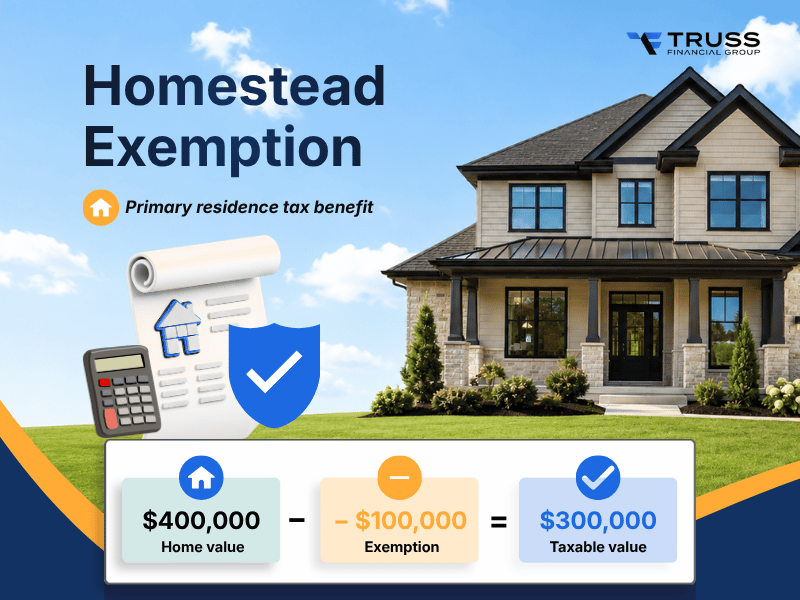
A homestead exemption is a tax benefit provided to homeowners legally to occupy a property as a primary residence or principal residence. One needn’t pay taxes on the full market value of the home enabling homeowners to pay taxes on a reduced taxable value.
For example:
If the home’s appraised value is $400,000
- And the exemption lowers taxable value by $100,000
- Taxes may only apply to $300,000
Because the exemption lowers the amount subject to taxation, homeowners typically see lower yearly tax bills. The exemption applies only to primary residences and not to rental properties, vacation homes, and investment properties.

How the Texas Homestead Exemption Works?
The homestead exemption in Texas offers different types of tax relief for qualifying homeowners. The standard general residence homestead exemption minimizes taxes that are attached to school districts and helps reduce obligations from certain local governments or taxing unit authorities.
To qualify, homeowners must adhere to the following:
- Be the owner of the property
- Make the home their primary residence
- Maintain an ownership interest
- Qualify for local residency requirements
Texas does not have traditional state property tax making homeowners rely on local exemptions to manage annual tax expenses.
The exemption applies to:
- School taxes
- Certain county taxes
- Other local taxing entities
Every taxing unit decides if optional exemption amounts must be levied according to the state defined limits.
How Much Can You Actually Save?
What one saves depends on:
- Tax rates defined locally
- Actual value of your home
- Exemption amounts as defined and permitted
- Additional local exemptions
Example of Potential Tax Savings
Suppose:
- Your home’s appraised value is $450,000
- Your local property tax rate is 2%
- You qualify for a $100,000 exemption on school district taxes
Without the exemption:
- Taxes apply to the full $450,000
With the exemption:
- Taxes apply to $350,000
This reduction could save approximately $2,000 annually on school-related taxes alone. For many homeowners, the long-term savings become significant, especially as property values continue increasing over time.
Additional Exemptions for Disabled Homeowners and Veterans
Few states also offer expanded property tax exemptions for eligible individuals that go beyond the standard exemption.
Disabled Person Exemption
A disabled person exemption provides additional tax reductions for homeowners who have certain disabilities.
These individuals benefit in follows:
- Minimized school taxes
- Tax ceilings
- Additional local tax relief
These exemptions help minimize the overall tax burden for disabled homeowners who run their expenses on fixed income.
Disabled Veterans Exemption
The disabled veteran’s exemption ensures tax savings for veterans on the basis of their disability rating. These qualifying disabled veterans may receive partial or full property tax exemptions.
In certain states, even the surviving spouse benefits from tax benefits under this scheme.
Additional programs such as a disabled veteran tax deferral may allow homeowners to postpone tax payments in specific situations.
How to Apply for a Homestead Exemption
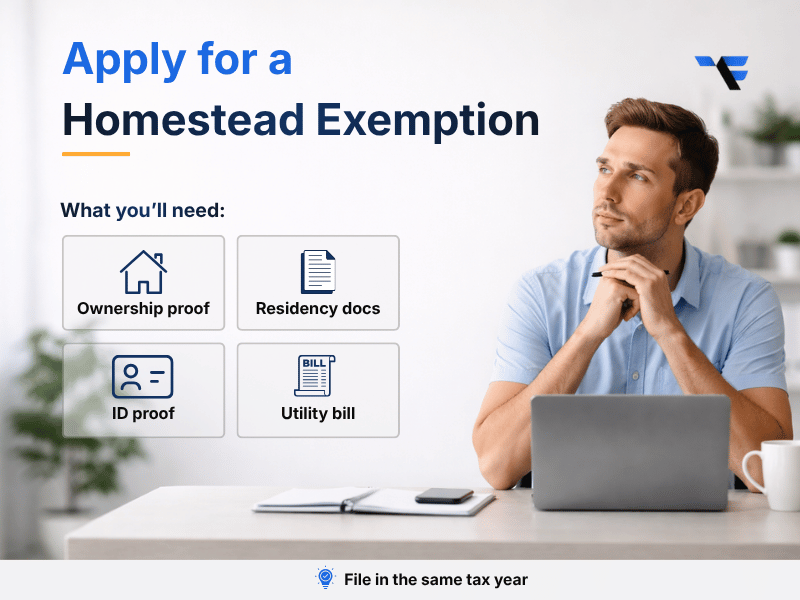
The application process is handled by the local county appraisal district or tax office. A standard homestead exemption application would require:
- Ownership proofs
- Documentation for showing residency
- Valid Texas driver's license
- Utility bill that helps in verifying the address
Most homeowners can avail only one homestead exemption at a time. Application for homestead exemption must be filed in the same tax year it ensures one avails the exemption benefits. Exempting typically continues as long as the property is the primary residence of the homeowner.
How Homestead Exemptions Help When Property Values Rise
One major benefit of a residence homestead exemption is protection against rapidly increasing property taxes.
As housing markets grow, the property's appraised value may increase significantly from year to year. Without exemptions, this often leads to much higher annual taxes. This helps homeowners, retirees, and families who plan to own the home for long periods of time and preserve affordability.
Final verdict On How Much Can a Homeowner Save using Homestead Exemption?
A homestead exemption can provide meaningful financial relief by lowering annual property tax obligations and helping homeowners manage rising housing costs.
Although the exact savings vary, many homeowners benefit from lower taxes, improved affordability, and long-term financial stability through these exemptions.
Understanding local rules, eligibility requirements, and additional tax-saving opportunities can help homeowners make smarter property-related financial decisions.
Truss Financial Group helps homeowners better understand mortgage planning, property-related financial decisions, and strategies that support long-term homeownership goals.
Frequently Asked Questions
1. How much money can a homestead exemption save?
Savings vary based on tax rates and property value, but many homeowners save hundreds or even thousands annually.
2. Does a homestead exemption apply to rental homes?
No. Most exemptions apply only to owner-occupied primary residences.
3. Can disabled veterans receive extra tax benefits?
Yes. Many states offer additional property tax exemptions based on disability rating and veteran status.
4. Where do homeowners apply for the exemption?
Applications are generally submitted through the local county appraisal district or tax office.

.svg)

Discuss your unique requirements
Get direct answers and a roadmap for your future.
.png?width=202&height=202&name=image%20588255187%20(1).png)

%20(1).png?width=389&height=221&name=Blog%20covers%20(1)%20(1).png)






.svg)

.svg)
.svg)