.svg)



%20(1).svg)
%20(2).svg)
.png?width=480&height=420&name=Img%20(1).png)
%20(3).svg)
%20(4).svg)

%20(5).svg)


 View all states
%20(1)-1.png?width=40&height=40&name=image%20(65)%20(1)-1.png)
13 mins
In this blog
At some point, managing individual mortgages on individual properties stops making sense.
You've got four rentals, four separate loans, four sets of closing costs, and four monthly payments. A fifth deal lands on your desk, and your conventional lender wants you to start the entire application process from scratch. Again.
This is exactly the problem a blanket mortgage loan is built to solve. Instead of financing each property in isolation, a blanket mortgage consolidates multiple properties under one loan, one payment, and one lender relationship. It's a financing structure built for real estate investors who think in portfolios, not individual transactions.
This article covers what a blanket mortgage is in real estate, how it works mechanically, what it costs, who it's right for, and how it compares to other loan options. Specialized lenders like Truss Financial Group work with real estate investors on exactly this structure, matching the right blanket loan program to the right portfolio before anything goes to underwriting.
What Is a Blanket Mortgage in Real Estate?
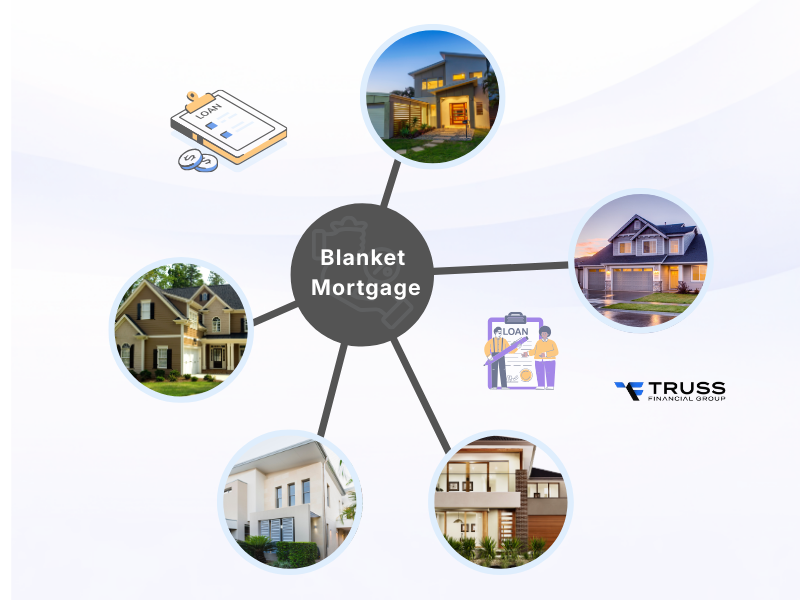
A blanket mortgage is a single loan that covers multiple properties under one structure. All properties serve as collateral collectively, meaning the lender holds a blanket lien across every asset covered by the loan.
Also called a blanket loan, the terms are used interchangeably. The defining characteristic is simple: one mortgage, multiple properties, one set of various costs at closing instead of many.
It's not a retail product. Blanket mortgages live in the commercial and non-QM lending space, and some lenders offer them as high as $50 million. The borrowers who use them are typically experienced real estate investors scaling a rental portfolio, real estate developers acquiring large tracts or multiple parcels, house flippers running parallel projects, and businesses financing multiple operating locations.
What a blanket mortgage is not: a product for first-time buyers, owner-occupants, or anyone financing a primary residence. Compared to a traditional mortgage, the qualification bar is significantly higher, and the risk profile is fundamentally different.
How Does a Blanket Mortgage Work?
The mechanics are straightforward:
- The borrower pools multiple properties under one loan, and each property serves as collateral for the full loan amount, not just its individual share.
- Instead of juggling separate amortization schedules and servicers, there's one monthly payment and one lender relationship across the entire portfolio.
- For a property owner buying multiple properties, this consolidation alone can save thousands in origination fees and professional services compared to taking out multiple mortgages separately.
- The feature that makes this structure work for active investors is the release clause.
- When a property sells, the borrower repays the balance attributed to that property, it's released from the lien, and the remaining properties stay under the original loan untouched.
No refinancing. No new application. The loan travels with the investor.
Here's a simple example of how this plays out:
|
Scenario |
Detail |
|
Properties financed |
4 rental units |
|
Combined value |
$1,200,000 |
|
Blanket loan amount |
$840,000 (70% LTV) |
|
Monthly payment |
Single consolidated payment |
|
Property sold |
Unit 3, release clause triggered |
|
Outcome |
Unit 3 released, loan continues on Units 1, 2, 4 |
The other structural feature worth understanding upfront is cross-collateralization. Every property secures the entire loan balance, not just its proportional share. That's what enables the consolidated structure, and it's also where the primary risk lives.
Key Features of a Blanket Mortgage
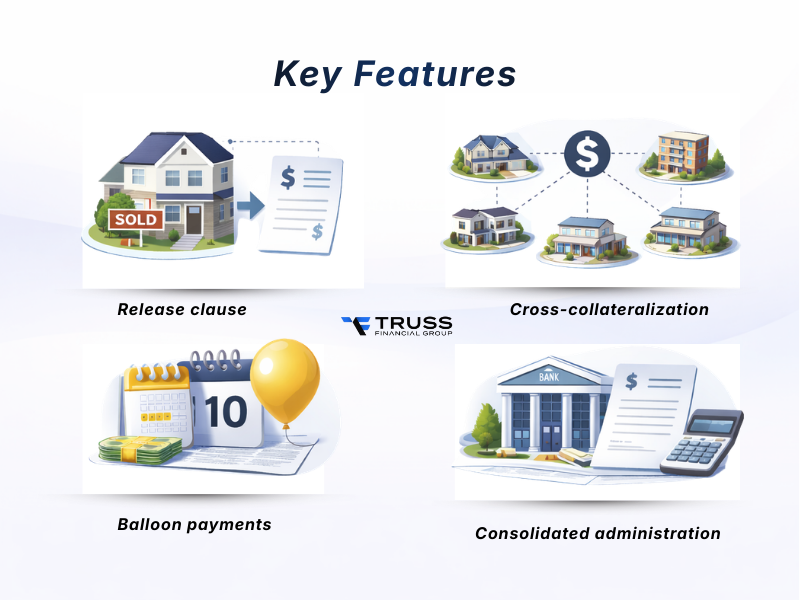
Four features define how a blanket loan behaves in practice, and each one has direct implications for how you manage your portfolio:
- Release clause: Sell one property, repay its attributed balance, and it's removed from the lien without disturbing the rest of the loan. The repayment amount is typically a set percentage of the original loan allocation for that property, not necessarily the full sale proceeds. This is what makes blanket loans viable for investors who rotate investment properties regularly.
- Cross-collateralization: Every property under the loan secures the full loan balance. If a borrower defaults, the lender has a claim over all the properties covered, not just one. The efficiency of a single mortgage comes with concentrated portfolio exposure.
- Balloon payments: Many blanket mortgages are structured with lower payments, sometimes interest-only, during the loan term, followed by a large lump sum due at maturity. Common structures run a 5 to 10 year balloon over a 15 to 20 year amortization schedule. You need a documented exit strategy before you sign, not after.
- Consolidated administration: One loan means one monthly payment, one interest rate, one escrow account, and one servicer. For an investor managing many properties, the reduction in administrative overhead has real operational value and keeps more cash working in the portfolio rather than lost across fragmented loan management.
Who Should Consider a Blanket Mortgage?
Blanket mortgages are not entry-level products. Lenders expect demonstrated experience, financial strength, and a clear investment strategy. Here's where the product fits and where it doesn't:
|
Borrower Profile |
Good Fit? |
Why |
|
Experienced real estate investor scaling a rental portfolio |
Yes |
Release clause and consolidated financing support portfolio rotation |
|
Real estate developer acquiring multiple parcels or large tracts |
Yes |
Blanket structure finances the full acquisition in one transaction |
|
House flippers running parallel projects |
Yes |
Balloon structure matches short hold periods; release clause handles individual sales |
|
Business financing multiple locations |
Yes |
One loan across all sites, operationally clean |
|
First-time real estate buyer |
No |
Qualification bar too high; risk exposure too concentrated |
|
Beginner landlord with one or two properties |
No |
A traditional mortgage or individual loans are more appropriate and accessible |
If you're still building your first portfolio, a blanket mortgage isn't the next step. It's the tool for investors who've already proven they can manage multiple properties and are ready to operate at scale. Understanding the potential downsides and making informed decisions before committing is what separates investors who use this product well from those who don't.
Blanket Mortgage Pros and Cons
Pros:
- One set of closing costs across all properties, less than paying closing costs on separate loans for each asset when purchasing multiple properties individually
- Single monthly payment and one lender relationship, less administrative drag across the portfolio
- Release clause flexibility to rotate investment properties without restructuring the entire loan
- Access to combined equity across all properties, not capped by what a single property can support
- Can offer a lower interest rate per property compared to stacking multiple individual mortgages
- Faster scaling by financing multiple acquisitions in one transaction instead of sequencing individual applications
Cons:
- Down payment of 25% to 50% of the combined property value, significantly higher than conventional investment loans
- Cross-collateralization means a borrower defaults and risks losing all properties under the lien, not just one
- Balloon payments require a fully planned exit strategy before closing
- Not all lenders offer blanket mortgages; finding the right one takes real effort
- Geographic restrictions mean many lenders require all properties to be in the same state or region
- Absolute closing costs are still higher than a single mortgage, even if lower than buying multiple properties with individual loans
How a Blanket Mortgage Compares to Other Mortgage Options?
A blanket mortgage is the right tool for a specific investor profile and a specific strategy. Here's how it stacks up against the alternatives:
|
Feature |
Blanket Mortgage |
Conventional Investment Loan |
Portfolio Loan |
Hard Money Loan |
|
Properties covered |
Multiple |
One |
One (typically) |
One |
|
Held by the lender |
Yes |
No (sold to GSEs) |
Yes |
Yes |
|
Income verification |
Full doc / DSCR |
Full doc |
Flexible |
Asset-based |
|
Down payment |
25% to 50% |
15% to 25% |
Varies |
20% to 40% |
|
Release clause |
Yes |
No |
Rare |
No |
|
Balloon payment |
Common |
Rare |
Possible |
Common |
|
Lender type |
Commercial / Non-QM |
Retail / GSE |
Portfolio lender |
Private lender |
|
Best for |
Portfolio scaling |
Single property |
Single property, flexible doc |
Short-term, distressed |
Blanket mortgage vs. traditional mortgage
A traditional mortgage is a single mortgage on a single property, underwritten to GSE standards and sold to the secondary market. It's the baseline product for individual property financing. A blanket mortgage sits outside that framework entirely, covering multiple properties under one lien and held by the lender on their own books.
Blanket mortgage vs. portfolio loan
Portfolio loans are also held by the lender, which gives them underwriting flexibility. But they typically cover a single property. If you want documentation flexibility on one acquisition, a portfolio loan is the cleaner fit. If you're consolidating multiple properties or buying multiple properties simultaneously, the blanket structure is more efficient.
Blanket mortgage vs. hard money
Hard money is short-term, asset-based financing built for acquisition and rehab, not long-term holding. Rates typically run 10% to 15% and above, and terms are 6 to 24 months. Hard money fits a single distressed acquisition where speed matters. A blanket loan fits a multi-property strategy with a medium to long hold horizon. These are not substitutes.
What Lenders Require to Approve a Blanket Mortgage?
There's no GSE standard for blanket mortgage qualification. Each lender sets their own criteria. But across commercial lenders, portfolio lenders, and non-QM specialists that offer blanket mortgages, the evaluation follows a consistent pattern:
|
Requirement |
Typical Range |
Notes |
|
Credit Score |
650 to 720+ |
A higher score compensates for multi-property underwriting complexity |
|
Down Payment |
25% to 50% |
Based on the combined property value |
|
1.20 to 1.25x minimum |
Net operating income must cover debt service with a buffer |
|
|
Investor Experience |
Demonstrated portfolio management |
Most lenders require proven multi-property transaction history |
|
Property Appraisals |
Required per property |
Each asset typically requires its own independent appraisal |
|
Geographic Scope |
Same state or region |
Many lenders restrict properties to one market |
|
Loan Size |
$500K to $50M+ |
Varies by lender and property type |
|
Documentation |
Tax returns, rent rolls, NOI statements, entity financials |
Entity docs required for LLC or corporate-owned portfolios |
These are market-range benchmarks. Individual lender criteria vary, and a specialist lender will evaluate the full picture before determining program fit.
How to Get a Blanket Mortgage
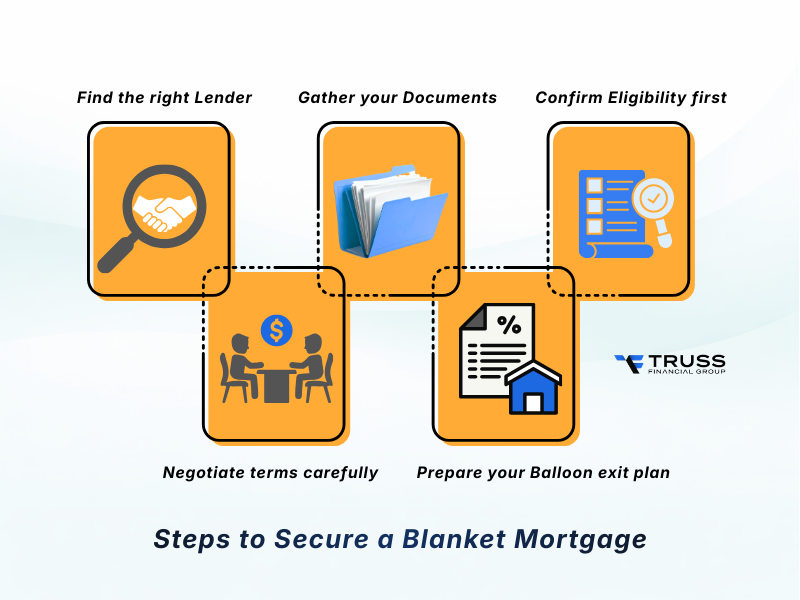
- Find the right lender: Blanket mortgages aren't available at retail banks. The search starts with commercial lenders, portfolio lenders, and non-QM specialists. Specialized mortgage brokers and lenders like Truss Financial Group, who work in the commercial and investment space, can significantly compress this process and match you to the right program before you apply.
- Assemble your documentation: Tax returns, rent rolls, NOI statements per property, entity documents for LLC or corporate-owned portfolios, and a clear picture of combined LTV across all assets.
- Verify qualification criteria before applying: Credit score minimums, DSCR thresholds, geographic restrictions, and experience requirements differ by lender. Know where you stand before submitting.
- Negotiate terms deliberately: Blanket mortgage terms are not standardized. Rate, balloon structure, release clause mechanics, prepayment penalties, and origination fees are all negotiable based on your borrower profile and the property mix.
- Have your balloon exit documented before closing: Refinance timeline, property sale plan, or a cash reserve target. This is not something to plan retroactively.
Frequently Asked Questions
What is a blanket mortgage loan?
A blanket mortgage loan is a single loan that finances two or more real estate properties under one structure. All properties serve as collateral collectively, and the loan typically includes a release clause that allows individual properties to be sold and removed from the lien without refinancing the entire loan.
How does the release clause work in a blanket mortgage?
The release clause allows the borrower to sell one property and remove it from the blanket lien by repaying its attributed loan balance. The remaining properties stay under the original loan, untouched. It's the feature that makes blanket loans viable for investors who regularly rotate investment properties within a portfolio.
What is the minimum down payment for a blanket mortgage?
Most blanket mortgage lenders require a down payment of 25% to 50% of the combined property value. This is significantly higher than conventional investment loans and reflects the complexity and risk profile of multi-property underwriting.
Can I use a blanket mortgage for residential rental properties?
Yes. While blanket mortgages are most commonly associated with commercial real estate, residential landlords and rental portfolio investors do use them for buying multiple properties, including single-family and multifamily assets, under one loan.
What happens if a borrower defaults on a blanket mortgage?
Because all properties are cross-collateralized, a borrower defaults and risks losing all properties under the lien. Depending on local laws and the outstanding loan balance, the lender may foreclose on one or all of the properties involved. This is the primary risk of the blanket structure and a key reason lenders vet borrower experience carefully before approving.
How is a blanket mortgage different from taking out individual mortgages?
Taking out individual mortgages means a separate loan, separate closing costs, and separate monthly payments for each property. A blanket mortgage consolidates all of that under one loan with one payment, and the release clause allows properties to be sold off without refinancing the whole structure. For personal finance management across a large portfolio, the difference is significant.
What credit score do I need for a blanket mortgage?
Most lenders look for a minimum credit score of 650 to 720+, depending on the program and the number of properties involved. A stronger credit profile can compensate for lighter documentation or more complex portfolio structures.
Is a Blanket Mortgage the Right Structure for Your Portfolio?
A blanket mortgage is built for a specific kind of investor, one who's already managing multiple properties, understands the implications of cross-collateralization, and has a clear plan for both the release clause and the balloon.
It's not a workaround. It's the structurally correct product for portfolio-scale real estate investing, one loan that consolidates your assets, travels with your investment strategy, and doesn't require you to restart the lending process every time a new deal closes.
If you're at that stage, working with a specialized lender like Truss Financial Group means the structure gets matched to your portfolio from the first conversation, before the application, before the credit pull, before anything goes to underwriting.

.svg)

Discuss your unique requirements
Get direct answers and a roadmap for your future.
.png?width=202&height=202&name=image%20588255187%20(1).png)







.svg)

.svg)
.svg)