.svg "Truss Financial Group")
15 min read

15 min read

Finding the best no-appraisal HELOC lenders can save you weeks of waiting and hundreds in appraisal fees. Traditional HELOCs typically require scheduling an in-person appraisal, waiting 2 to 4 weeks for the report, and paying $400 to $800 upfront. These delays frustrate homeowners who need quick access to equity for home improvements, debt consolidation, or emergencies.
No-appraisal HELOC lenders use automated valuation models instead, cutting closing times from 30 to 45 days down to just 7 to 14 days. However, not all properties qualify, and traditional banks often still require full appraisals despite advertising otherwise.
Mortgage brokers like Truss Financial Group offer broader no-appraisal availability for primary residences, second homes, and investment properties, with approvals in as little as 7 to 10 business days. This guide explains which lenders truly deliver no-appraisal HELOCs and what you need to qualify.
A no-appraisal HELOC is a home equity line of credit that uses alternative property valuation methods instead of requiring a full in-person appraisal. Rather than sending an appraiser to inspect your property, measure rooms, and photograph every detail, lenders rely on technology and public data to estimate your home's value.
Here's how different valuation methods work:
It's important to understand that "no appraisal" doesn't mean "no valuation." Lenders still need to confirm your property value to determine how much equity you can borrow against; they're just doing it faster and with less intrusion.
This approach eliminates scheduling conflicts, appraiser backlogs, and the 2 to 4 week delays that come with traditional appraisals. However, lenders typically require homes to be in well-documented markets with recent comparable sales data. If your property is unique, located in a rural area, or hasn't seen similar home sales nearby in the past six months, you'll likely still need a full appraisal.
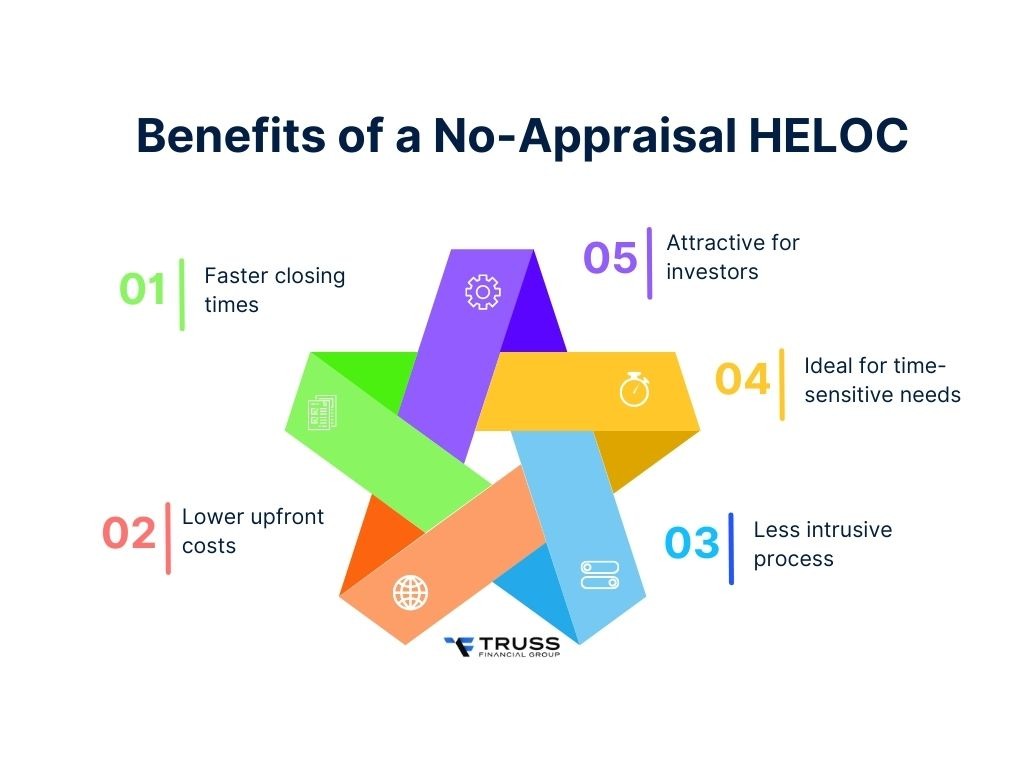
No-appraisal HELOCs offer several practical advantages, especially for borrowers who need to move quickly:
However, no-appraisal HELOCs aren't available from every lender, and eligibility varies significantly based on your property type, location, and loan amount. Below are the best lenders offering this option in 2026.
We've reviewed the top lenders offering no-appraisal HELOCs based on loan amounts, property type eligibility, speed, and flexibility.
Truss Financial Group is a specialized lender and mortgage broker offering no-appraisal HELOCs for primary residences, second homes, and investment properties. Unlike traditional banks, they use flexible underwriting and partner with 90+ lenders to approve borrowers who don't fit conventional boxes.
Key features:
Note: With streamlined, digitally underwritten no‑appraisal‑style HELOC processes, some specialized lenders can close in about 5–14 days, though many HELOCs still fall in the 2–6‑week range. Traditional HELOCs that require an in‑person appraisal often add one to several weeks to that timeline.
Who this is best for:
Tradeoffs:
Among the lenders listed, Truss Financial Group emphasizes Non-QM options (including DSCR- and bank-statement-based programs) that may fit some investors and self-employed borrowers; actual appraisal requirements and maximum line amounts depend on the specific program and underwriting. Their network of lender partnerships means they can find solutions even when traditional banks say no.
PNC Bank is a major traditional bank offering no-appraisal HELOCs in select cases, primarily for existing customers with strong banking relationships and W-2 employment income.
Key features:
Who this is best for:
Tradeoffs:
Bank of America offers no-appraisal HELOCs in select cases, particularly for existing customers with strong banking relationships. It states there’s no fee to apply, no closing costs on lines of credit up to $1,000,000, and no annual fee.
Key features:
Who this is best for:
Tradeoffs:
Navy Federal is a credit union exclusively for military members, veterans, and their families. It offers some of the most competitive HELOC terms, including no-appraisal options for qualifying members.
Key features:
Who this is best for:
Tradeoffs:
Most lenders follow similar baseline requirements, though specialized lenders like Truss Financial Group offer more flexibility for non-traditional borrowers.
Not all properties qualify for automated valuations. Lenders look for homes in well-documented markets with recent comparable sales. Single-family homes and condos are most likely to qualify, while rural properties, unique homes, or properties over a certain value may still require full appraisals.
Even if a lender advertises "no appraisal," they may still order a desktop valuation or property condition report. The key difference is that you won't need to schedule an in-person visit.
Understanding when you'll still need a traditional appraisal helps set realistic expectations and avoid surprises during the application process.
Lenders use AVMs when they have high confidence in automated property valuations. If your home doesn't fit their model, they'll default to a traditional appraisal to protect their investment.
|
Feature |
No-Appraisal HELOC |
Traditional HELOC |
|
Valuation method |
AVM, desktop appraisal |
Full in-person appraisal |
|
Closing time |
7 to 14 days |
30 to 45 days |
|
Upfront costs |
Lower (no appraisal fee) |
Higher ($400 to $800 appraisal) |
|
Loan-to-value ratio |
Typically 70% to 80% |
Typically 80% to 90% |
|
Property types |
Limited (varies by lender) |
All property types |
|
Interest rates |
May be slightly higher |
Generally lower |
No-appraisal HELOCs trade slightly lower loan amounts and potentially higher rates for speed and convenience. For borrowers who need equity quickly and have straightforward properties, this tradeoff is often worthwhile.
Understanding the true cost of a no-appraisal HELOC helps you make an informed decision.
Common fees (even without appraisals):
What you save by skipping the appraisal:
Not necessarily. While some lenders charge slightly higher rates for no-appraisal HELOCs, you save on upfront costs and gain access to funds faster. The total cost depends on your loan amount, how long you carry a balance, and the lender's rate structure.
Truss Financial Group offers transparent pricing and works with 90+ lenders to find competitive rates, even for no-appraisal HELOCs on investment properties.
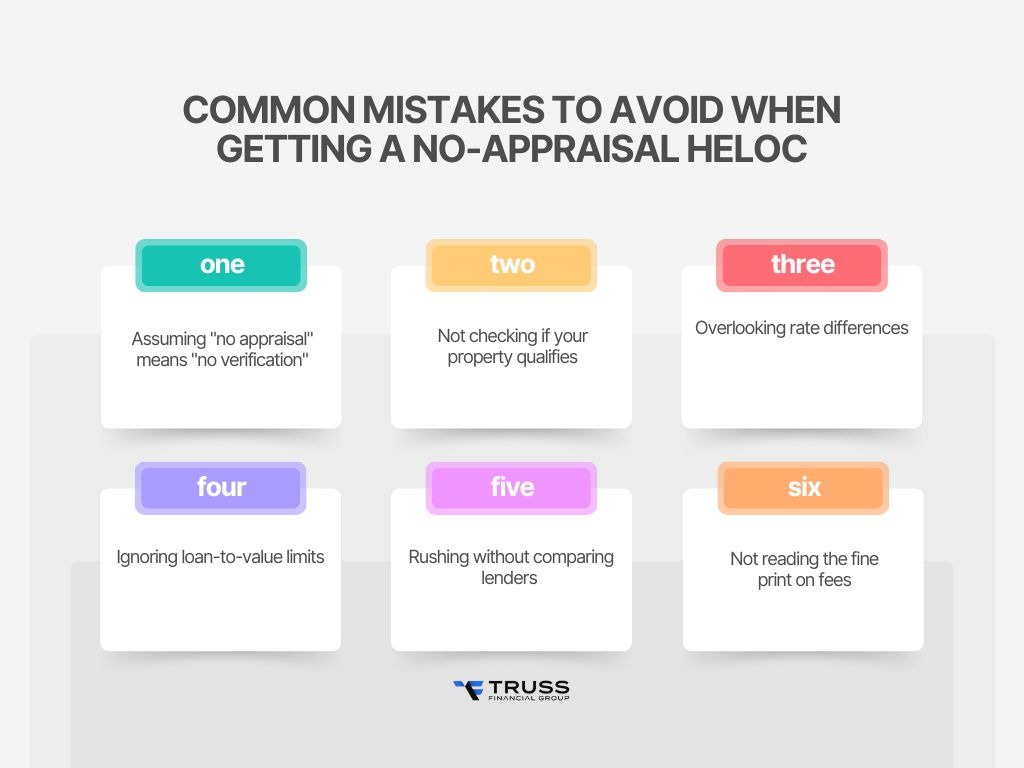
The best no-appraisal HELOC isn't always the fastest. It's the one that matches your property type, income situation, and borrowing needs.
If a no-appraisal HELOC doesn't fit your situation, several alternatives might work better:

Yes, you can get a HELOC without appraisals. Many lenders use automated valuation models (AVMs) to approve HELOCs without requiring a full in-person appraisal. However, eligibility depends on your property type, location, and loan amount.
Truss Financial Group, Bank of America, PNC Bank, and Navy Federal Credit Union offer no-appraisal HELOCs in select cases. However, traditional banks often have strict eligibility requirements, and many borrowers still end up needing full appraisals.
Not always. You save on appraisal fees ($400 to $800), but some lenders charge slightly higher interest rates. Total cost depends on your loan amount and how long you carry a balance.
Yes, but options are limited. Some lenders specialize in no-appraisal HELOCs for investment properties and rental properties.
Traditional HELOC lenders often require at least about 660–680, while flexible/non‑traditional programs (including some offered by Truss Financial Group) may start as low as 620, often at higher rates.
Closing times range from 7 to 10 days with specialized lenders, compared to 3 to 6 weeks with traditional banks like PNC. The fastest closings happen with streamlined lenders that prioritize no-appraisal processes.
No. Properties in rural areas, unique homes, and properties with limited sales data may still require full appraisals.
Yes. Truss Financial Group offers no-appraisal HELOCs with flexible underwriting, including bank statement and DSCR options for self-employed borrowers.
No-appraisal HELOCs offer speed and convenience, but eligibility varies by property type and lender. Traditional banks often still require full appraisals despite advertising otherwise.
Truss Financial Group emphasizes loan‑aggregation and Non‑QM‑style programs that can sometimes support very high balances; exact maximum HELOC amounts and eligibility depend on the specific program, LTV, and underwriting.
Ready to explore your options? Check your eligibility for a digitally underwritten HELOC or explore all mortgage options.



Take your pick of loans
Experience a clear, stress-free loan process with personalized service and expert guidance.
Get a quote.jpg?width=352&name=xxxxxx%20header%20(6).jpg)
25 min

3 min
.png?width=352&name=xxxxxx%20header%20(44).png)
18 min
Discover your borrowing power and plan your mortgage journey with knowledge on your side.
Get a quoteGet a quote in 3 easy steps
Tell us what you want
Fill out our online form to help us understand your financial situation and loan needs.
We get to work for you
We review your info and look for competitive rates that match your specific goals.
You get a personalized quote
You’ll receive a customized rate quote that meets your unique profile.