.svg)



%20(1).svg)
%20(2).svg)
.png?width=480&height=420&name=Img%20(1).png)
%20(3).svg)
%20(4).svg)

%20(5).svg)


 View all states

15 mins
In this blog
Buying a home in 2026 isn't just about finding a house you like. It's about making the numbers work.
As of September, 2026, the average 30-year fixed mortgage rate was 6.71%, according to Freddie Mac, up from 6.50% a year earlier. And buyers are feeling the squeeze from more than mortgage rates alone. In Bank of America's 2026 Homebuyer Insights Report, 58% of respondents said expensive home prices were a barrier to buying, while 47% pointed to high interest rates in 2026.
Affordable mortgage programs can help eligible buyers reduce some of the upfront or ongoing costs of buying a home. They can be especially useful for first-time buyers and households with limited savings or low-to-moderate incomes. But the right choice is not necessarily the loan with the smallest down payment or the lowest advertised interest rate. You need to look at the whole picture.
With Truss Financial Group, buyers can compare eligible affordable mortgages while looking at both the cash needed upfront and the monthly cost they will carry after closing. Let’s discuss.
What Makes a Mortgage Affordable?
Affordability is really about two numbers: how much money you need to get through closing and how much you will have to spend on housing every month afterward. The first part is easy to underestimate. You might have enough saved for a 3% down payment, for example, but still come up short once closing costs and other expenses enter the picture.
The monthly side deserves just as much attention. Your housing payment may include:
- Principal and interest
- Property taxes
- Homeowners insurance
- Mortgage insurance, when required
- HOA dues, if the property has them
A lender may approve you for a certain loan amount based on your income, debts, credit profile, and applicable underwriting rules. That does not mean you need to spend that much.
Your own budget has other demands. Utilities, transportation, childcare, maintenance, savings, and the occasional financial surprise do not disappear because you bought a house. Affordable home loans that look manageable during the application process can feel very different six months later.
There is also a trade-off with a smaller down payment. You keep more cash in the bank, which can be helpful, but you are also financing a larger portion of the purchase price. Depending on the loan, that can mean higher principal and interest and potentially more mortgage insurance.
Loan Estimate, Home Loan Prequalification and Home Loan Preapproval
- Home loan prequalification is generally an early indication of what you might be able to borrow. The catch? Lenders don't all use the term in exactly the same way. Some may base it largely on information you provide, while others may verify more of your financial details.
- Home loan preapproval usually involves a deeper review. A lender may examine your income, assets, debts, employment, and credit information before issuing a preapproval letter.
Still, neither one is a guarantee that your mortgage will close. The property, appraisal, title, insurance, underwriting, and other conditions can affect the final decision.
So, if a lender gives you a home loan preapproval, ask a few questions:
- What information was actually verified?
- Was your credit checked?
- How long is the letter valid?
- What conditions are still outstanding?
Once you formally apply, a Loan Estimate becomes an important document for comparing mortgage offers. For most covered mortgages, lenders generally provide it within three business days after receiving the six pieces of information that make up an application under the disclosure rules.
Unlike a casual online quote, a Loan Estimate lays out the loan terms, projected monthly payments, closing costs, and estimated cash to close. That's much more useful when you are trying to compare two options side by side.
You may also need to provide documents such as identification, recent income records, tax returns where applicable, bank or asset statements, employment history, debt information, and paperwork for gift or assistance funds. The exact requirements depend on your loan program and financial situation.
Affordable Mortgage Programs to Compare
There is no single mortgage that works best for everyone. A program that looks inexpensive upfront could cost more over time, while another option may require more cash at closing but produce a payment that feels much easier to manage.
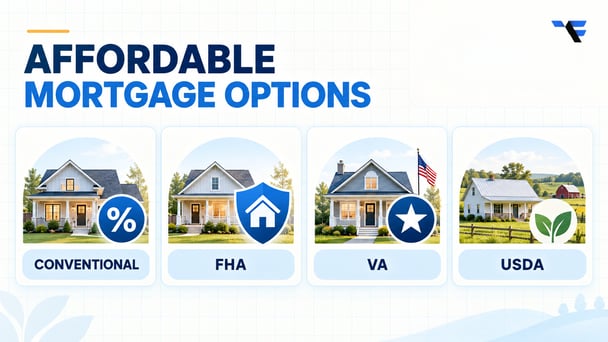
Here are several affordable mortgages worth researching:
| Option | Potential Affordability Benefit | Main Eligibility or Cost Check |
|---|---|---|
| Conventional low-down-payment | Some options, including HomeReady and Home Possible, may allow as little as 3% down | Income, credit, occupancy and mortgage-insurance requirements |
| FHA | Down payment may be as low as 3.5% | Mortgage insurance, property standards, loan limits and lender requirements |
| VA | Eligible borrowers may qualify with no down payment and no monthly mortgage insurance | Service eligibility, occupancy, appraisal, funding fee or exemption |
| USDA guaranteed | Eligible buyers may receive 100% financing | Household income, eligible rural location, primary residence and guarantee fees |
| State or local assistance | May reduce down payment or closing-cost burden | Income and price limits, education, occupancy, funding and repayment terms |
Note: Don't assume assistance is reserved for first-time buyers. Some programs are available to repeat buyers, while the definition of a first-time homebuyer can vary from one program to another.
Down Payment Assistance and First-Time Homebuyer Programs
Down payment assistance is not one specific type of benefit. It can come in several forms, and the repayment rules can be very different. Depending on the program, assistance could be a grant, a forgivable loan, a deferred-payment loan, or a repayable second mortgage.
A grant may not have to be repaid if program conditions are met. Forgivable loans typically have requirements you must satisfy before the balance is forgiven. Deferred-payment loans postpone repayment until a specified event, while second mortgages may have their own payment and repayment terms.
Before counting on assistance as part of your homebuying budget, check the fine print. Look at:
- Income limits
- Purchase-price limits
- Property-location requirements
- Primary-residence rules
- Homebuyer education requirements
- Approved-lender requirements
- Current funding availability
- Occupancy requirements
- Repayment or forgiveness conditions
- Rules that apply if you sell or refinance
A program offering $15,000 of assistance is not necessarily better than one offering $8,000. If the larger benefit comes with restrictions that do not fit your plans, the headline number may not mean much.
Assistance can also affect the first mortgage and the closing process. Make sure you understand how the two pieces work together before moving forward. For current options, check your state housing finance agency, city or county housing office, or a HUD-approved housing counselor rather than relying on a static state-by-state list.
How Rates, APR and Points Affect Affordability
The interest rate is the annual cost of borrowing expressed as a percentage. It obviously matters, but it is only one piece of the mortgage puzzle.
- The annual percentage rate (APR) gives you a broader view because it includes the interest rate plus certain loan charges. It can be useful when comparing similar mortgage offers, although you should still review the individual costs shown on the Loan Estimate.
- With a fixed-rate mortgage, the principal-and-interest payment generally stays the same over the loan term. An adjustable-rate mortgage, or ARM, works differently. The rate can change after the initial period, which means the payment may increase or decrease later.
- Then there are discount points. You pay these upfront in exchange for a lower interest rate. Whether that makes financial sense depends on how long you expect to keep the loan and how much the lower payment actually saves.
A simple break-even calculation can help:
Cost of points ÷ monthly savings = approximate break-even period
Suppose points cost $3,000 and reduce your payment by $50 per month. The basic break-even point would be 60 months, or five years.
That's not the whole financial analysis, but it gives you a useful starting point.
When you compare offers, try to compare similar Loan Estimates issued around the same time. Mortgage pricing can move, and differences in points, credits or rate can make two offers look more comparable than they really are.
Down Payment, Closing Costs and Cash to Close
Your down payment is the portion of the home's purchase price you pay upfront.
Closing costs cover various expenses involved in completing the mortgage and real estate transaction. CFPB guidance says closing costs often fall around 2% to 5% of the purchase price, excluding the down payment. That's useful for early budgeting, but it is not a quote. Actual costs vary by loan, lender, property, and location.
Then there is cash to close. That's the amount you actually need to bring to closing after accounting for the down payment, closing costs, deposits, credits, adjustments, and other applicable amounts.
For a $300,000 home, the low down payment mortgage math alone would look like this:
| Down Payment | Cash Amount | Loan Amount Before Financed Fees |
|---|---|---|
| 3% | $9,000 | $291,000 |
| 3.5% | $10,500 | $289,500 |
| 5% | $15,000 | $285,000 |
| 10% | $30,000 | $270,000 |
| 20% | $60,000 | $240,000 |
Illustrative example only: These numbers show the down payment and resulting loan amount before financed fees. They do not include closing costs, taxes, insurance, mortgage insurance, or changes in the monthly payment.
Seller credits and lender credits may help with eligible closing expenses, but neither should automatically be viewed as free money. They can have limits and may involve pricing trade-offs.
And don't forget your emergency fund. Using every dollar you have for the purchase can leave you in a difficult position if the water heater breaks two months after closing.

Use a Mortgage Affordability Calculator to Set a Budget
A mortgage affordability calculator is useful before you start shopping seriously because it gives you a way to test different scenarios.
Enter your gross income and recurring monthly debts, then add assumptions for the interest rate, loan term, down payment, property taxes, homeowners insurance, mortgage insurance and HOA dues where applicable.
Don't stop with one scenario. Try a few – what if you make a smaller down payment? What if property taxes or insurance are higher than expected? What if the home has an HOA fee? What if the rate increases before you lock?
You should also budget for maintenance, utilities, moving expenses, and an emergency fund. These costs may not appear in the lender's projected housing payment, but they are still part of owning a home.
A calculator is simply a planning tool. It does not constitute a preapproval and cannot guarantee that you qualify for a particular loan program.
Try the mortgage affordability calculator to get a starting point for your budget.
How Credit, Debt and Documents Affect Your Options
Your credit profile can influence which affordable home loans you qualify for, the interest rate you receive and, depending on the program, mortgage-insurance pricing.
- Credit score: There is no universal credit-score number that guarantees mortgage approval. Program requirements differ, and lenders can have additional requirements.
- Debt-to-income ratio: The same goes for your debt-to-income ratio, or DTI. In simple terms, DTI compares your recurring monthly debt obligations with your gross monthly income. Different loan programs and lenders may calculate or treat debts and income differently.
- Credit reports: If you have time before buying, review your credit reports and look for errors. Correcting inaccurate information early is much easier than discovering an issue during underwriting.
- Paperwork: It's also worth keeping your financial paperwork organized. Income documents, employment records, bank statements, gift-fund documentation, and assistance paperwork may all become relevant.
- Financial decisions: Once you start the mortgage process, avoid making major financial moves without talking to your loan officer first. Opening new credit, taking on large debt, or moving substantial amounts of money can create additional questions during underwriting.
Homebuyer Education and Housing Counseling
Some affordable loan and assistance programs require homebuyer education before closing.
A class or workshop can cover useful basics such as budgeting, credit, mortgage terminology and the responsibilities that come with owning a home. But general education is not the same as individualized housing counseling.
A HUD-approved housing counselor can provide one-on-one guidance about your budget, credit situation and potential homebuyer programs.
If you aren't sure whether you're financially ready to buy, that kind of conversation can be useful before you start making offers. It's much easier to adjust your plan early than after you've committed to a property.
How to Choose the Right Affordable Mortgage
The right mortgage is the one that fits your finances and plans. Not the one with the flashiest advertisement. Before choosing, work through these questions:
- Are you eligible for the mortgage and any assistance program you're considering?
- How much will you actually need for cash to close?
- What will the full monthly payment be after taxes, insurance and mortgage insurance?
- How do the rate, APR, points and lender credits compare on matching Loan Estimates?
- If you're receiving assistance, when does it have to be repaid or forgiven?
- What happens to the assistance if you sell or refinance?
- Will you still have an emergency fund after closing?
- Does the payment feel comfortable, rather than merely technically affordable?
A lender's approval amount tells you what may fit within underwriting guidelines. Your personal comfort limit tells you what you can live with month after month.
How to Apply and Close
Once you've established a budget, the process generally moves from prequalification or preapproval into selecting a loan and checking for assistance programs.
- After you make an offer and apply for the mortgage, you'll receive Loan Estimates that can help you compare costs and terms.
- The property then moves through inspection, appraisal, title work, and underwriting.
- Near the end of the process, you'll receive a Closing Disclosure for covered mortgages. It generally must be provided at least three business days before closing.
- Read it. Compare it with your most recent Loan Estimate. Check the rate, projected payment, closing costs, lender credits, and cash to close. If something looks different, ask your lender to explain the change.
- Escrow may collect money for property taxes and homeowners insurance, although the exact arrangement depends on the loan and location.
- Seller concessions may also help with eligible closing costs. They are negotiable and subject to loan-program rules and market conditions, so they should not be treated as a guaranteed way to eliminate your upfront cash requirement.
FAQs (Frequently Asked Questions)
What is the most affordable type of mortgage?
There isn't one mortgage that is cheapest for every borrower. Your most affordable option depends on your eligibility, down payment, monthly payment, mortgage insurance, closing costs, assistance, and how long you expect to own the home.
Can I buy a home with 3% down?
Some conventional programs allow eligible borrowers to put down as little as 3%. Other mortgage programs have different requirements, so compare the complete loan cost rather than focusing only on the down payment.
Are affordable mortgage programs only for first-time buyers?
No. Some programs are available to repeat buyers as well. When a program does require first-time homebuyer status, its definition may differ from another program's definition.
Can down payment assistance cover closing costs too?
Some assistance programs can help with closing costs, while others focus on the down payment. The eligible expenses, amount available, and repayment requirements depend on the specific program.
What is the difference between prequalification and preapproval?
Lenders use these terms differently. Preapproval typically involves a more detailed review of your financial information, but neither prequalification nor preapproval guarantees final mortgage approval.
Should I compare interest rate or APR?
Look at both, and don't ignore the rest of the Loan Estimate. The interest rate affects your borrowing cost, while APR incorporates the rate and certain loan charges, giving you another way to compare similar offers.
Where can I find legitimate local homebuyer assistance?
Start with your state housing finance agency, city or county housing office, or a HUD-approved housing counselor. Because programs and funding can change, always confirm the current requirements through an official source.
Next Steps for Finding an Affordable Home Loan
Start with a payment that feels manageable, then work backward to determine what home price, down payment, and loan structure fit that budget. Estimate your total cash to close, check official sources for current assistance programs, and compare mortgage offers using Loan Estimates rather than relying on an advertised rate alone.
If you're still unsure which direction makes sense, a Truss Financial Group loan officer can help you compare eligible options, upfront costs, and the full monthly payment before you make an offer.
Get a personalized quote and use that information to make a decision based on the real cost of owning the home, not just the number that looks good in an advertisement.

.svg)

Discuss your unique requirements
Get direct answers and a roadmap for your future.
.png?width=202&height=202&name=image%20588255187%20(1).png)









.svg)

.svg)
.svg)