.svg)



%20(1).svg)
%20(2).svg)
.png?width=480&height=420&name=Img%20(1).png)
%20(3).svg)
%20(4).svg)

%20(5).svg)


 View all states

10 mins
-1.png)
In this blog
Housing inventory remains tight across much of the country, and well-priced homes in high demand are routinely attracting multiple offers within days of listing. For buyers, that means a straightforward purchase offer at the asking price often isn't enough. You need a strategy.
One tool that's becoming increasingly common in hot markets is the escalation clause. It doesn't require you to throw out your highest number upfront. Instead, it lets your offer respond automatically to competing bids, keeping you in the running without overpaying before you have to.
Lenders like Truss Financial Group see buyers navigate these decisions every day. This guide breaks down exactly how escalation clauses in real estate work, when to use one, when to skip it, and what sellers actually think when they see one attached to a real estate offer.
What Is an Escalation Clause in Real Estate?
An escalation clause, sometimes called an escalator clause, is a provision added to a real estate purchase contract that automatically increases a prospective buyer's offer by a set amount above any competing offer, up to a specified maximum purchase price.
In plain terms: instead of guessing how high to go, you set a starting offer, a step-up increment, and a ceiling. If a higher bid comes in from other buyers, your offer rises automatically. If no one outbids you, you pay your original offer price.
The clause is only triggered when the seller receives and can document a bona fide offer from another buyer. A seller cannot fabricate a competing bid to activate it.
How Does an Escalation Clause Work?
Every real estate escalation clause has three main components:
- Initial offer price - your starting bid
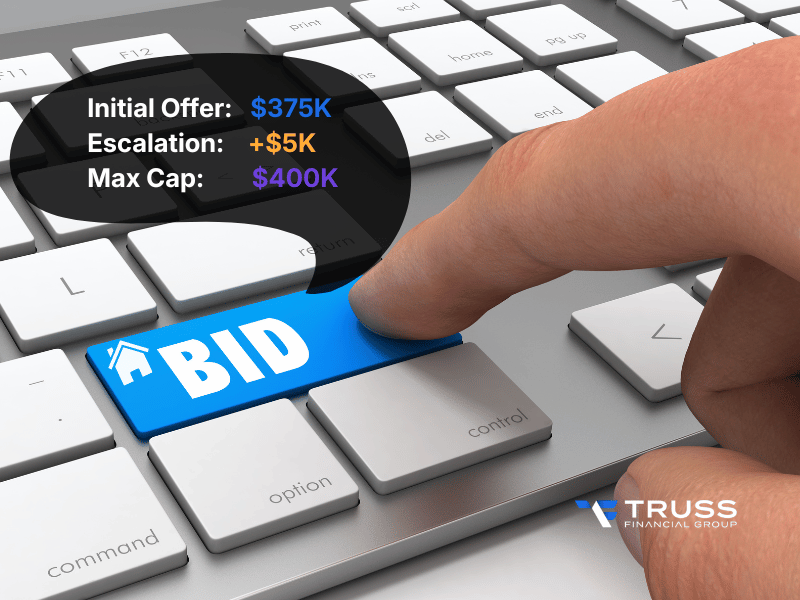
- Escalation amount - the fixed increment your offer rises above each competing bid (e.g., $5,000)
- Maximum price cap - the absolute ceiling you're willing to pay, no matter what
The clause is submitted as an escalation addendum attached to the main purchase contract. When the seller receives a qualifying competing offer, your offer automatically increases by the escalation amount above that bid until it either wins or hits your cap.
Escalation Clause Example
Say a buyer submits an offer of $375,000 with a $5,000 escalation amount and a maximum purchase price of $400,000.
|
Scenario |
Details |
Outcome |
|
Competing offer at $380,000 |
Clause activates: $380,000 + $5,000 |
Buyer wins at $385,000 |
|
Competing offer at $402,000 |
Exceeds the $400,000 cap |
Clause stops, and the buyer is out |
|
No competing offers received |
The clause never activates |
Buyer pays original $375,000 |
The escalation clause only increases what you pay when a real competing bid forces it. When there's no competition, it costs you nothing.
.png?width=800&height=600&name=In%20blog%20images%20800600%20(1).png)
Pros and Cons of an Escalation Clause
Before including an escalation clause in your purchase offer, weigh both sides honestly.
Pros:
- Keeps your offer competitive in a bidding war without committing to an inflated fixed price upfront
- Your offer only increases when the seller receives a verified higher offer, which helps avoid overpaying in a vacuum
- An escalation clause shows the seller you're serious and willing to compete, giving you more confidence going into a multiple-offer situation
- Reduces the back-and-forth of repeated counteroffers in fast-moving markets
Cons:
- Reveals your maximum amount immediately, so the seller knows your ceiling and can use it to weaken your negotiating position
- Risk of overpaying against weaker competing bids: if other offers have poor financing or heavy contingencies, the escalation clause may have cost you thousands unnecessarily
- Not all sellers accept offers with escalation clauses, as some prefer the simplicity of a highest and best offer
- If your escalated price exceeds the home's appraised value, you'll need to cover that gap in cash
When an Escalation Clause Can Backfire
Most articles mention the risks in passing. Here's what they actually look like with numbers.
The appraisal gap problem
If your escalated offer lands at $392,000 but the home appraises at $377,000, your lender will only finance up to the appraised value. You'd need to bring an additional $15,000 to closing in cash or renegotiate with the seller. This risk is highest when price increases from escalation clauses push offers beyond what the local market has supported recently.
Outbidding a weaker offer unnecessarily
Your escalation clause activates against any bona fide offer regardless of its quality. If the only competing bid is from a buyer with shaky financing or five contingencies attached, the seller might have chosen your original offer anyway. With multiple buyers in the mix, it's easy to assume every competing bid is strong; that's not always the case, and your clause may have cost you a higher price for no reason.
The seller says no
Some sellers view escalation clauses as complex or treat them as a signal that the buyer isn't fully committed to a number. In those cases, the seller may reject the clause entirely and counter by requesting a highest and best offer, which puts you back to a fixed number without the safety net. A real estate professional can help you read the situation before you submit.
Always have a fallback price ready before you use an escalation clause.
Escalation Clause vs. Highest and Best Offer
These two strategies come up together often, and the distinction matters.
A highest and best offer is a seller's request for all buyers to submit their single strongest offer by a deadline with no adjustments and no escalation. Many sellers prefer this because it's clean and simple, especially when other offers are already strong.
An escalation clause lets your offer respond automatically to competing bids, but it puts your maximum amount on the table from the start, which can limit your negotiating power in ways a fixed offer doesn't.
|
Escalation Clause |
Highest and Best |
|
|
Buyer commits to |
Starting price + increment rules |
One fixed final price |
|
Adjusts automatically? |
Yes |
No |
|
Reveals max price? |
Yes |
Only if you choose to |
|
Seller preference |
Mixed |
Widely preferred |
|
Best used when |
Multiple offers are confirmed |
Seller explicitly requests it |
If the listing agent signals that the seller wants the highest and best offers, submitting an escalation clause could get your offer passed over. Always ask your real estate agent before including one.
When to Use an Escalation Clause and When to Skip It
.png?width=800&height=600&name=In%20blog%20images%20800600%20(2).png)
Use one when:
- Multiple offers are confirmed or strongly expected in a competitive real estate market
- The home is priced competitively and has had a strong showing of traffic from more buyers than usual
- You have a firm maximum amount you're comfortable committing to
- You have the right mortgage preapproval in place, and your lender has confirmed they can support the escalated amount
Skip it when:
- The seller has requested the highest and best offers
- Limited inventory is not a factor, and the market is slow, as escalation clauses can signal desperation in a buyer's market
- You're not certain about your ceiling, since an undefined maximum makes the clause dangerous
- The home is likely to appraise below your cap, and you can't cover the gap
How to Write an Escalation Clause That Holds Up
A vague clause creates disputes and can be rejected outright. Every real estate escalation clause should clearly include:
- Your initial offer price
- The exact escalation amount above each competing bid
- Your maximum purchase price, stated in dollars
- A verification requirement, so the seller must provide proof of the competing offer before the clause activates
- The effective window during which the clause applies
- Submission as a formal escalation addendum, separate from the main contract and clearly labeled
Have a real estate attorney review the language before signing. Once the seller accepts, the clause is legally binding.
How Sellers View Escalation Clauses
Not every seller welcomes them. Some appreciate what the clause signals: serious interest, financial commitment, and less back-and-forth when other offers are on the table. Others dislike the complexity, especially when multiple buyers each submit their own escalation clause, and the offers start stacking.
When two buyers both include escalation clauses, both may activate simultaneously as other offers are reviewed. The buyer with the higher cap or larger escalation amount typically wins, but the outcome depends on the specific terms and how the seller administers the process.
From a seller's perspective, a buyer whose maximum amount is already visible has given up negotiating power. That's one reason sellers prefer the clarity of a single deadline and a single number in many cases. Working with specialized lenders like Truss Financial Group means having a team that understands how to position a real estate offer before it ever reaches the seller, including whether an escalation clause helps or hurts given current market conditions.
Your Dream Home Checklist: Before You Submit an Escalation Clause
- Secure the right mortgage preapproval and confirm your lender supports the cap amount
- Set a firm maximum amount before drafting the clause
- Have your real estate agent contact the listing agent to confirm the seller will accept escalation clauses
- Research comparable sales to assess appraisal gap risk and avoid overpaying beyond market value
- Set an escalation amount that's meaningful, as too small a signal signals hesitation to other buyers
- Include a verification requirement for competing bids
- Prepare a fallback highest and best number in case the seller asks for it
Frequently Asked Questions
What is an escalation clause in real estate?
A provision in a real estate purchase contract that automatically increases a buyer's offer by a set amount above any competing offer, up to a maximum price the buyer sets in advance.
How is an escalation clause triggered?
The seller must receive and document a bona fide offer from another buyer. The clause activates automatically once that qualifying competing offer is verified.
Can a seller reject an escalation clause?
Yes. Not all sellers accept offers with escalation clauses. Some prefer a highest and best offer deadline instead. Always confirm seller preference with your real estate agent before submitting.
What happens if two buyers both submit escalation clauses?
Both clauses may activate simultaneously. The buyer with the higher cap or larger escalation amount typically ends up with the winning bid, depending on how the seller reviews and administers the other offers.
Can an escalation clause cause me to overpay?
It can, particularly if the escalated price increases beyond the home's appraised value, or if the clause activates against weaker competing bids you would have beaten anyway.
Do I need a real estate attorney to use one?
It's strongly recommended. Once the seller accepts, the escalation clause is part of a legally binding contract. A real estate professional or attorney reviewing the language before signing protects both parties.
Ready to Make a Competitive Offer?
An escalation clause is not a guaranteed win. It's a precision tool. The buyers who use it effectively are the ones who walk in with a firm maximum amount, understand the appraisal risk, and confirm the market conditions warrant it before submitting.
If you're preparing to make a real estate offer and want to understand exactly what your financing supports at every price point, including your escalation cap, mortgage brokers like Truss Financial Group can help you get there before the offer goes in.

.svg)

Discuss your unique requirements
Get direct answers and a roadmap for your future.
.png?width=202&height=202&name=image%20588255187%20(1).png)







.svg)

.svg)
.svg)