.svg)



%20(1).svg)
%20(2).svg)
.png?width=480&height=420&name=Img%20(1).png)
%20(3).svg)
%20(4).svg)

%20(5).svg)


 View all states
What Does the Fed Rate Cut Mean for Mortgages: Key Insights for 2026

11 mins
.png)
In this blog
Key Takeaways
- Fed rate cuts don't directly lower mortgage rates. Treasury yields and lender risk appetite control pricing
- Banks tighten lending standards even as rates fall, making Non-QM loans more relevant for self-employed, investor, and non-traditional borrowers
- DSCR loans, HELOCs, and STR financing become strategic tools when traditional mortgages become harder to access
You've heard the headlines. The Federal Reserve cut interest rates three times in 2025, and more cuts are expected in 2026. So here's what confuses borrowers: what does the Fed rate cut mean for mortgages, and why are rates still expensive? You check mortgage rates expecting relief, but the numbers remain frustratingly high. Financial news discusses basis points and economic activity, yet your monthly payment projections haven't improved much.
The confusion is understandable, and the answer matters more than most people realize. The relationship between Fed policy and your actual mortgage payment is indirect, complex, and often counterintuitive. Understanding how this mechanism works changes everything about how you should approach financing property this year.
Why the 2026 Fed Rate Cuts Matter More Than People Realize
The Federal Reserve cut interest rates three times in 2025, bringing the federal funds rate to 3.50-3.75% by December. Market watchers expect at least one more cut in early 2026, possibly two. The unemployment rate climbed to 4.6% in November, the highest in over four years, while inflation held at 2.7%, stubbornly above the Fed's 2% target.

Why Do Mortgage Rates Stay High Despite Fed Cuts?
Here's what confuses borrowers: Why are mortgage rates still expensive if the Fed keeps cutting?
The answer changes how you should think about financing property in 2026.
Fed rate cuts signal economic concerns: slowing growth, credit stress, and reduced housing liquidity. When the Federal Open Market Committee lowers the target range, it's trying to keep money flowing through the economy. But here's the catch: banks don't respond by opening the lending floodgates. They tighten.
Why? Lower rates often mean higher perceived risk. Banks protect capital. They raise credit score requirements. They scrutinize tax returns harder. They reject borrowers who would have been approved six months earlier.
The Real Problem: Loan Type, Not Rate
This is the mistake most borrowers make after rate cuts: assuming cheaper money means easier money. It doesn't. The problem isn't the rate. It's the loan type.
When banks get nervous, Non-QM lending expands, not contracts. Specialized lenders like Truss Financial Group were built for this exact phase of the cycle: when traditional underwriting fails intelligent borrowers.
How Fed Rate Cuts Actually Flow Into Mortgage Rates?
Let's kill the myth.
The Fed controls the federal funds rate: the rate banks charge each other for overnight loans. Mortgage rates? Those follow 10-year Treasury yields, bond market expectations, and lender risk spreads.
When the Fed cuts by 25 basis points, your mortgage rate doesn't automatically drop by 25 basis points. Sometimes it doesn't drop at all.
Here's why: mortgage rates are priced based on what investors expect inflation to do over the next decade, plus what they demand as compensation for risk. If inflation remains elevated or if bond markets anticipate future economic uncertainty, mortgage rates stay high even when the Fed cuts.
Spreads widen during uncertainty. The difference between what lenders pay to borrow money and what they charge you grows. Banks protect their margins. They slow down approvals. They demand more documentation.
This is why traditional mortgages get harder even when rates go down, and why Non-QM fills the gap.
What Happens to Borrowers in 2026 When Rates Fall
Refinances rise. Approvals fall.
It sounds contradictory, but it's predictable. Lower rates bring more applications. Banks respond by tightening standards. The borrowers who get squeezed out?
- Self-employed borrowers whose tax returns show minimal income after write-offs
- Real estate investors with multiple properties and complex income streams
- Short-term rental operators whose Airbnb revenue doesn't fit Fannie Mae guidelines
- High debt-to-income borrowers who have cash flow but messy tax documentation
Documentation becomes the real bottleneck. Banks want W-2s, pay stubs, and two years of clean tax returns. If your income doesn't fit their box, you're declined, regardless of how much cash you generate monthly.
Non-QM lenders underwrite income reality, not just tax returns. That distinction matters in 2026.

Why Non-QM Thrives After Fed Rate Cuts
Banks tighten. Non-QM expands.
Non-QM lenders gain market share during easing cycles because they use asset-based underwriting instead of W-2 logic. They look at actual rental income, bank deposits, investment property cash flow: the numbers that reflect how money actually moves.
Speed and flexibility beat rate chasing. A borrower who waits six months for a 0.25% rate drop while banks reject their application loses more than someone who closes now with a Non-QM loan at slightly higher rates.
This is why forward-thinking lenders like Truss Financial Group focus on DSCR, Bank Statement, HELOC, STR, and Asset-Based lending in 2026. These aren't alternative products. They're often the only products that work for high-capacity borrowers that the traditional system rejects.
DSCR Loans in a Lower-Rate Environment (Even Below 1.0)
DSCR loans become more powerful when rates fall because rental property cash flow improves relative to carrying costs. The Debt Service Coverage Ratio measures whether a property's rental income covers its mortgage payment. A DSCR of 1.0 means break-even. Below 1.0 means the property runs slightly negative monthly.
Most banks won't touch DSCR below 1.0. They want proof that the property pays for itself immediately. But investors know that's not how real estate works. Properties appreciate. Rents rise. Tax benefits offset cash flow gaps.
Experienced Non-QM lenders work with programs that allow DSCR below 1.0, short-term rentals, and multi-state portfolios. This is exactly how investors scale in 2026: by accessing capital when others can't.

Short-Term Rental (Airbnb) Loans After Fed Cuts
STR demand rises when interest rates drop because travelers return and occupancy improves. But Fannie Mae still blocks most STR borrowers. Traditional lenders treat Airbnb income skeptically or ignore it entirely.
Non-QM uses actual Airbnb revenue. Bank statements plus property cash flow beat tax returns. If your Airbnb shows $8,000 monthly deposits and the property runs profitably, that's underwriting data.
Specialized lending institutions structure STR loans in most U.S. states, even when banks won't. The strategy: prove cash flow, not employment history.
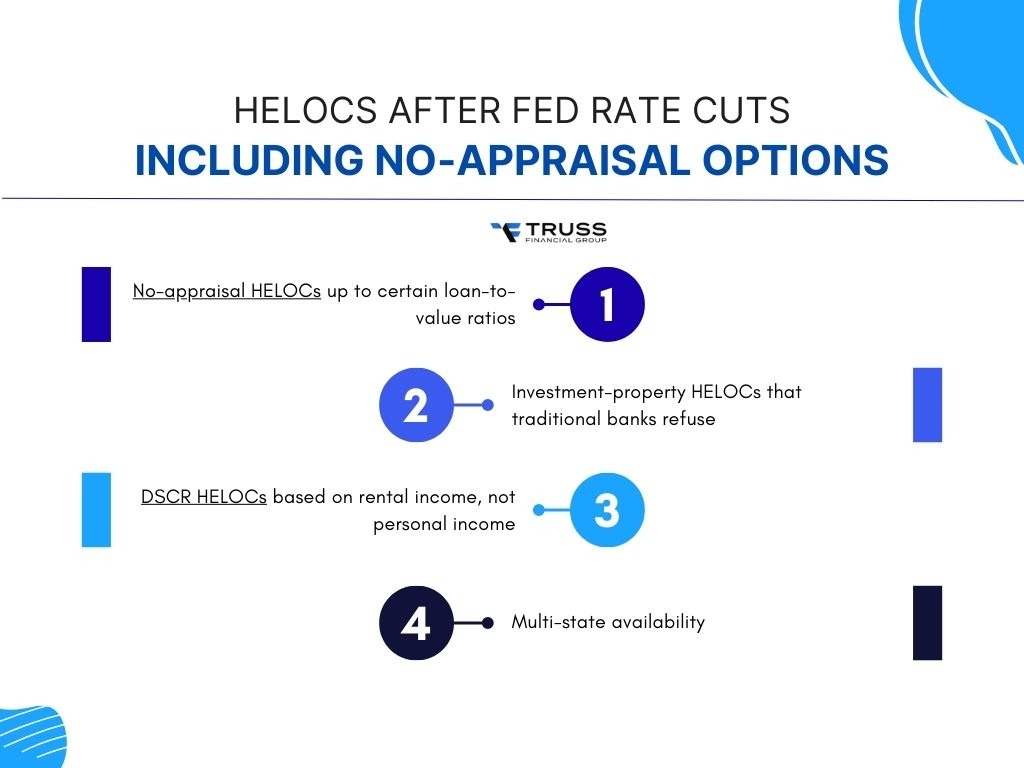
HELOCs After Fed Rate Cuts (Including No-Appraisal Options)
HELOC demand spikes after rate cuts because homeowners realize they're sitting on equity they could deploy. Home equity lines of credit offer liquidity without selling or refinancing.
But banks still cap or deny HELOCs, especially on investment properties or for borrowers with multiple mortgages. Non-QM HELOCs differ. They allow:
- No-appraisal HELOCs up to certain loan-to-value ratios
- Investment-property HELOCs that traditional banks refuse
- DSCR HELOCs based on rental income, not personal income
- Multi-state availability
Perfect for 2026 liquidity strategies when you need cash without disrupting existing financing.
Self-Employed Borrowers in 2026
Self-employed borrowers struggle even when rates fall because tax write-offs kill approvals. You write off expenses to reduce taxable income. Banks see low income and decline your loan. You know you earn $15,000 monthly, but your tax return shows $3,000.
Bank statement loans fix this. Instead of tax returns, lenders review 12-24 months of business or personal bank deposits. Cash-flow underwriting wins in 2026 because it reflects economic reality.
Non-QM lenders specialize in self-employed loans across most U.S. states. If your bank statements show deposits, you qualify.
Will We Ever See 3% Mortgage Rates Again?
Probably not.
Inflation expectations, federal deficits, and bond market dynamics changed the game. The era of sub-3% rates was an anomaly driven by pandemic emergency policy. Even if the Fed cuts the federal funds rate to 2%, mortgage rates are unlikely to fall below 4.5-5% in the near term.
Chasing 3% costs people years of lost opportunity. Rental properties appreciate. Home equity grows. Business income compounds. Waiting for perfect rates means missing real wealth creation.
Flexible financing beats timing. A DSCR loan at 6.5% that lets you buy now often outperforms waiting two years for a conventional loan at 5%.
2026 Economic Outlook and Housing Strategy
Economic forecasts vary: soft landing, mild recession, or stagnation. But housing stays undersupplied. Inventory remains tight. Investors still win because demand exceeds supply in most markets.
Access to capital matters more than rate. Borrowers who can close quickly, finance unconventional income, and leverage property cash flow will outperform those waiting for traditional bank approval.
How Smart Borrowers Use the 2026 Fed Cycle?
Here's the strategy:
- Use DSCR instead of DTI: Stop fighting debt-to-income ratios. Let property cash flow qualify you.
- Use HELOCs instead of selling: Tap equity without disrupting ownership or triggering capital gains.
- Use STR income instead of W-2s: Monetize actual rental revenue, not employment history.
- Use Non-QM instead of waiting for banks: Speed and certainty close deals that hesitation loses.

Why Truss Financial Group Was Built for This Market
Truss Financial Group operates with 90+ lenders and maintains an 81% approval rate across multi-state Non-QM coverage. They offer DSCR loans, STR financing, HELOCs, Bank Statement loans, Asset-Based lending, and select no-doc options.
No impact on credit to get options. No waiting for perfect rates. No fighting banks that reject what they don't understand. They are the anti-bank in a bank-tightening cycle.
Get a quote today!
FAQ
Do Fed rate cuts affect mortgage rates?
Yes, but indirectly. Mortgage rates follow 10-year Treasury yields more than the federal funds rate. Fed cuts can influence market expectations, but mortgage rates don't drop 1-for-1 with Fed cuts.
How will the interest rate cut affect my mortgage?
If you have a fixed-rate mortgage, Fed cuts won't change your rate. If you have an adjustable-rate mortgage tied to SOFR, your rate may decrease. Refinancing becomes more attractive, but approval standards often tighten.
What will interest rate cuts mean for mortgages?
Lower borrowing costs in theory, but banks often tighten lending standards during rate-cut cycles, making Non-QM and alternative financing more relevant.
Will we ever see a 3% mortgage rate again?
Unlikely in the near term. Structural inflation, deficits, and bond market expectations keep rates elevated compared to pandemic-era lows.
What is the current Fed rate today?
As of December 2025, the federal funds rate is 3.50-3.75%. Check the Federal Reserve or Trading Economics for real-time updates.
Will interest rates go down in 2026?
Market expectations point to 1-2 Fed cuts in 2026, likely in April and September, but this depends on employment data and inflation trends.
What to expect in 2026 in the economy?
Economists predict modest growth with elevated unemployment risks. Housing remains undersupplied, supporting property values even if economic activity slows.
Are we headed for a recession in 2026?
Uncertain. Rising unemployment and slowing payroll growth raise concerns, but no definitive recession indicators have triggered yet.
What time will the Fed announce rate cuts?
The Federal Open Market Committee typically announces decisions at 2:00 PM ET following scheduled meetings. Check the Fed's official calendar for exact dates.
Is the Fed expected to cut rates?
Possibly. Fed officials in their December 2025 median projection forecast one quarter-point rate cut for 2026, though fixed-income markets suggest two cuts are possible depending on economic data. The timing and number of cuts remain uncertain as Fed leadership emphasized a 'wait and see' approach.
What is the Fed rate cut prediction?
The median forecast shows one cut in 2026, though some analysts expect two, depending on labor market conditions.

.svg)

Discuss your unique requirements
Get direct answers and a roadmap for your future.
.png?width=202&height=202&name=image%20588255187%20(1).png)


.png?width=389&height=221&name=xxxxxx%20header%20(14).png)


.svg)

.svg)
.svg)