.svg "Truss Financial Group")
4.6 from 700+ reviews

4.6 from 700+ reviews

4.6 from 700+ reviews
.svg)
Welcome to Big Sky country’s comprehensive home loan guide. Whether you’re a self-employed homebuyer or a first-timer in Montana, securing a mortgage here requires up-to-date knowledge of rates, local home prices, and loan options. As of today, Montana’s statewide median home price is around $545,700, and 30-year mortgage rates average about 6.3%, far from the rock-bottom levels of a few years ago.
In this guide, we’ll break down everything you need to know, from quick facts and key loan requirements to special programs for the self-employed. We’ll also walk you through the Montana home buying process, provide current interest rate tables, compare mortgage options by borrower type, demonstrate using a mortgage calculator, and help you decide whether to buy now or wait.
Quick Takeaways: Montana Mortgage Facts at a Glance
To get started, here’s a quick-reference table answering common questions about Montana home loans:
| Question | Quick Answer |
|---|---|
|
Current 30-Year Mortgage Rate (Avg) |
~6.3% (30-year fixed, national average as of Dec 2025). Rates change daily – today’s Montana rates are in this range. |
|
Minimum Down Payment |
3% – 5% for most loans (e.g. 3% for first-time conventional, 3.5% FHA). 0% down available via VA or USDA. |
|
Minimum Credit Score |
~620 for conventional loans (often required); 580 for FHA (with 3.5% down). Higher scores get better rates. |
|
Median Home Price (Montana) |
~$545,700 statewide (late 2025). Home values rose ~5.5% year-over-year, reflecting Montana’s high housing demand. |
|
Self-Employed Loan Programs |
YES – available. Bank statement mortgages, DSCR investor loans, and other “no tax return” programs are offered (Truss specializes in these!). |
These key points illustrate that Montana homebuyers (especially entrepreneurs and gig-economy workers) have viable paths to homeownership even if traditional W-2 documentation is a challenge. Next, we’ll look deeper at Montana’s market metrics and what they mean for you.
Montana Home Loan Snapshot – Key Metrics
Let’s put Montana’s housing market and mortgage climate into perspective with a quick snapshot of important numbers:
| Metric (Montana) | Value |
|---|---|
|
Median Home Sale Price |
$545,700 (Oct 2025) – up +5.5% year-over-year. |
|
Average 30-Year Mortgage Rate |
6.27% (current interest rate, Dec 5, 2025). |
|
Median Down Payment (MT) |
$9,099 (median upfront payment as of late 2024). |
|
Days on Market (Median) |
42 days pending (homes sell quickly). |
|
Montana Housing Programs Rate |
5.875% (state bond program 30-yr rate, mid-2025) – below market for qualifying first-timers. |
What do these numbers mean? In short, Montana’s housing market remains competitive – prices are high and rising, and homes don’t sit for long. Mortgage rates are off their peaks but still around 6%, making affordability a key concern. The good news is that down payments in Montana tend to be modest (the median was only ~$9K, likely due to low-down programs and assistance).
And if you qualify for Montana Housing’s bond loan, you could snag a rate in the high-5% range, slightly easing costs. Next, we’ll discuss where in Montana you can get home financing and how Truss Financial Group serves buyers across the state.
Coverage Areas: We Serve All of Montana
Truss Financial Group proudly serves homebuyers across the entire state of Montana. Whether you’re looking to purchase in a bustling city or a quiet rural town, Truss can help you secure financing. Major coverage areas include:
- Billings – Montana’s largest city (Yellowstone County) and economic hub.
- Missoula – A vibrant college town in western Montana.
- Bozeman – A fast-growing tech and tourism center in Gallatin Valley.
- Great Falls – An affordable market along the Missouri River.
- Helena – The state capital, rich in history.
- Kalispell & Flathead Valley – Gateway to Glacier Park, with resort-area housing.
- And everywhere in between – from Butte to Belgrade, Havre to Hamilton – our lending services extend statewide.
No matter where you are buying, Montana’s homebuying process follows similar steps (with some state-specific quirks we’ll cover below). And as a licensed Montana mortgage broker, Truss Financial Group is equipped to finance properties anywhere in the Treasure State – be it a condo in downtown Bozeman or a ranch on the prairie.

What Home Loan Options Exist for Self-Employed Buyers?
One of the biggest challenges for self-employed and small business owners is proving income in the traditional way. The standard route – two years of tax returns showing steady (and sufficient) profit – can be a hurdle if you write off lots of expenses or have fluctuating earnings.
Fortunately, there are special loan programs tailored for self-employed borrowers. Truss Financial Group specializes in these alternative solutions, often called non-QM (non-qualified mortgage) loans because they don’t fit agency standards. Here are the key options:
Bank Statement Loans
Qualify with Deposits, Not Tax Returns: Instead of W-2s or tax forms, lenders use 12–24 months of your bank statements to gauge your income. This is ideal for sole proprietors, freelancers, contractors, or any self-employed professional whose tax returns don’t reflect their true cash flow.
How it works: The lender reviews your business or personal account deposits to calculate an average monthly income.
Pros: No tax returns needed, flexible underwriting.
Cons: Typically requires a larger down payment (around 10% or more) and a decent credit score (often 620+ is needed).
DSCR Loans
Debt-Service Coverage for Investors: If you are self-employed and investing in rental properties, a DSCR loan might be perfect. DSCR (Debt Service Coverage Ratio) loans qualify you based on the property’s cash flow, not your personal income.
Essentially, if the expected rent covers the mortgage (usually DSCR ≥ 1.0), you can get the loan.
Pros: No personal income documentation; can finance multiple rentals.
Cons: For non-owner-occupied properties only (you can’t use DSCR for a primary home), and usually requires 20–25% down and a solid credit score (often 660–680+).
No Doc and Asset-Based Loans:
Beyond bank statements, there are other creative no doc programs. For example, Asset Depletion loans consider your liquid assets (stock portfolios, savings) as imputed income – essentially, your assets are converted into a hypothetical income stream to qualify.
Other no-doc or low-doc loans might not require employment info at all if you have a large down payment or lots of equity. Truss Financial Group offers a variety of such loans (asset-depletion, interest-only options, etc.) to high-net-worth or unconventional borrowers.
Traditional Full-Doc Loans:
Self-employed borrowers can also qualify for conventional, FHA, or VA loans; you're not forced into a non-QM product if you have the documentation. You’ll typically need to provide two years of personal and business tax returns, along with possibly a year-to-date profit-and-loss (P&L) statement and recent bank statements.
Lenders will verify that your income is stable or growing over those two years and will calculate your debt-to-income ratio using your net income from taxes (after write-offs).
Tip: If you plan to go this route, be mindful of how many deductions you take – too many write-offs can reduce your qualifying income. Also, ensure you’ve been self-employed for at least 2 years (or sometimes 1 year with a strong prior employment history in the same field). If you meet these requirements, you can access excellent rates on conventional or government-backed loans just like any W-2 borrower.
Bottom line: Self-employed homebuyers in Montana have more financing options than ever. From bank statement mortgages that “say YES when others say NO” to flexible no-doc solutions, Truss Financial Group matches you with a loan that fits your unique financial situation. Next, we’ll discuss Montana’s homebuying process and what to expect as you move from loan pre-approval to closing.

The Montana Homebuying Process (Overview & Timeline)
Purchasing a home in Montana involves a series of steps that will feel familiar if you’ve bought property in other states – with a few Montana-specific details to note. Below is a step-by-step overview of the process, along with a table summarizing key milestones and typical timelines in Montana’s market:
Typical Steps to Buy a Home in Montana & Timeline
| Step | Description | Timeline/Notes |
|---|---|---|
|
1. Pre-Approval |
Get pre-approved for a mortgage. Work with your lender (e.g., Truss Financial Group) to review income, credit, and down payment. |
Timing: 1–3 days (for a basic pre-approval letter). Tip: Self-employed buyers may take slightly longer as more documents can be needed (tax returns or bank statements). |
|
2. House Hunting |
Partner with a Montana REALTOR and search for homes within your budget. Focus on areas that meet your needs (school district, commute, etc.). |
Timing: Varies (1–8+ weeks). Homes go to pending in ~42 days on average, so be prepared to act quickly once you find “the one.” |
|
3. Making an Offer |
When you find a home, your agent helps you write a purchase offer. You’ll include your pre-approval and often an earnest money deposit (held in escrow). |
Timing: Offer expiry is typically a few days. Montana notes: There’s no state transfer tax on real estate, but you will file a Realty Transfer Certificate at closing. |
|
4. Under Contract |
The seller accepts your offer; the contract is ratified. Now the due diligence period begins: you’ll order inspections and the lender will order an appraisal. |
Timing: Usually 7–10 days for home inspection contingency. Appraisals in Montana might take 2–3 weeks (rural properties can be longer). |
|
5. Loan Processing |
Submit the full loan application. Lender’s underwriting verifies all information. Self-employed borrowers may provide additional docs (business licenses, P&Ls, etc.). |
Timing: ~30 days from contract to loan approval. Montana specific: Lenders check that the property meets guidelines (e.g., if rural, well/septic conditions). No attorney is required – Montana is a title/escrow state, so closings are handled by title companies. |
|
6. Closing |
Sign final documents and transfer funds. You’ll meet at a title company (or escrow agent) to execute the deed, mortgage, etc. Once recorded, you get the keys! |
Timing: Typically around 30–45 days after contract. Closing costs in MT include lender fees, title insurance, etc., but no state sales or transfer tax keeps them lower. |
As shown above, the overall timeline from finding a home to closing in Montana is often about 1 to 2 months. One unique thing in Montana is that real estate closings are usually handled by title companies rather than attorneys, making the process straightforward. You’ll still want an experienced real estate agent and possibly an attorney for advice on complex deals, but it’s not a legal requirement to have a lawyer present at closing.
In addition, Montana’s property tax system recently changed with a new homestead exemption. Property taxes on owner-occupied homes are now capped around 0.76% of assessed value on average, which is relatively moderate nationally. This will factor into your monthly payment (more on that in the mortgage calculator section).
Throughout this process, Truss Financial Group will be by your side, ensuring the financing goes smoothly. Our loan officers are known for creative solutions and a customer-first approach.
Now, let’s switch gears to explore current mortgage rates and how different loan terms compare, so you can make an informed decision on your financing.
Today’s Mortgage Rates in Montana (by Loan Term)
Interest rates have a huge impact on your monthly payment and overall affordability. Below is a table of current average mortgage interest rates by term, based on national data (Montana’s rates generally track these averages):
| Loan Term | Average Interest Rate (Dec 5, 2025) |
|---|---|
|
30-Year Fixed Mortgage |
6.27% (national average rate for new purchase loans) |
|
15-Year Fixed Mortgage |
5.63% (shorter term, lower rate & less interest paid overall) |
|
10-Year Fixed Mortgage |
5.68% (often used for smaller loans or rapid payoff) |
|
5/1 ARM (Adjustable Rate) |
5.53% (fixed for 5 years, then adjusts annually) |
As shown, shorter-term loans like 15-year and 10-year fixed mortgages have lower rates (in the mid-5% range) compared to the 30-year fixed. However, keep in mind the monthly payments on a 15-year loan will be much higher because you’re paying the debt off in half the time. Many buyers opt for the 30-year fixed for its lower payment, especially with Montana’s high home prices.
What about FHA/VA rates? Government-backed loans (FHA, VA) often have interest rates similar to or slightly lower than conventional. For instance, VA loans for veterans sometimes come in a tad below conventional rates, and FHA rates can be competitive (though FHA’s required mortgage insurance adds to the APR).
Also, remember that Montana Board of Housing offers special low-rate programs for first-time buyers – currently around 5.875% for a 30-year loan as of mid-2025, which is an attractive option if you qualify (income and purchase price limits apply).
Tip: Rates change daily, and you can often lock in a rate once you’re under contract. Given the volatility in recent months, stay in close contact with your lender on when to lock. Tools like the Bankrate Rate Trend Index suggest experts see rates staying relatively stable in the 6% range for now, but economic news (inflation reports, Federal Reserve meetings) can cause swings. Truss Financial Group monitors the market and will help you time your rate lock for the best outcome.
Next, let’s compare mortgage options for different types of borrowers – especially how being self-employed or a first-time buyer might influence your loan choice or strategy.
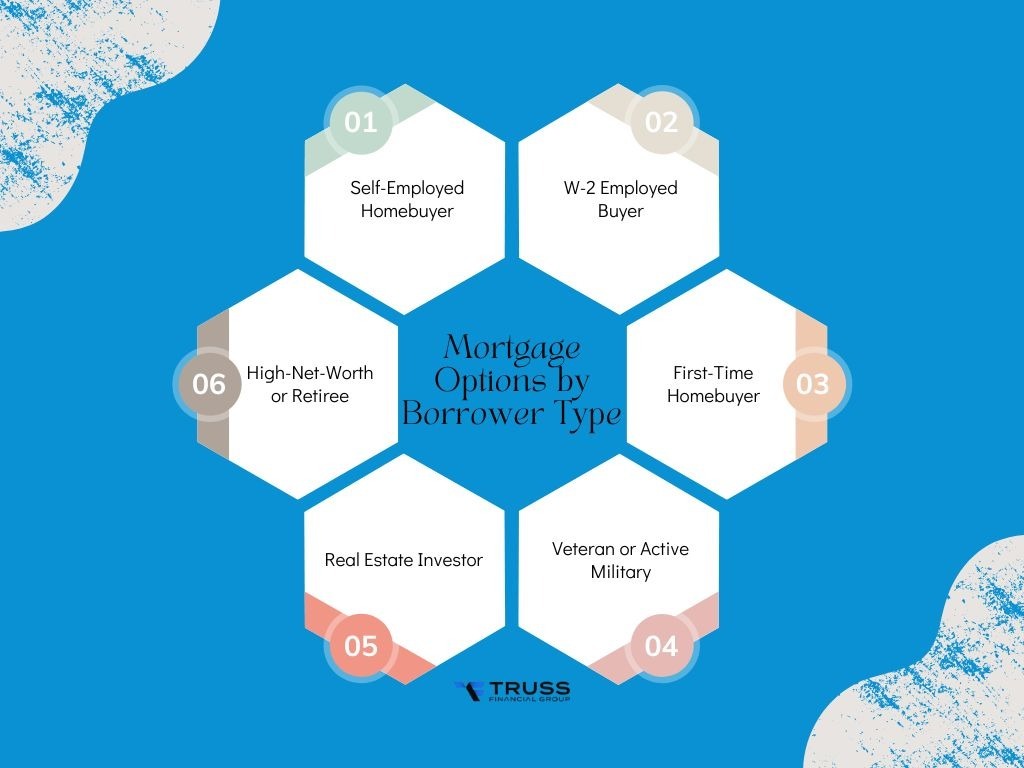
Mortgage Options by Borrower Type: Which Loan is Best for You?
Homebuyers come in many forms, first-time buyers, repeat buyers, self-employed entrepreneurs, veterans, investors, and more. Each may gravitate toward different mortgage programs. The table below compares loan options for a few borrower scenarios, highlighting pros and cons for each:
| Borrower Type | Typical Loan Options | Key Considerations |
|---|---|---|
|
Self-Employed Homebuyer |
Bank Statement Loan, Conventional or FHA (with full docs), Stated Income (Non-QM). |
Pros: Can qualify without tax returns using bank deposits (Truss offers up to 90% LTV stated-income). Flexibility in documenting income. Cons: Non-QM loans often have slightly higher rates and require 10-20% down. Credit score ~620+ needed (sometimes higher for no-doc). If using conventional/FHA, be ready to show 2 years of steady income. |
|
W-2 Employed Buyer |
Conventional Loan, FHA/VA (if lower credit or down payment), USDA (if rural). |
Pros: Streamlined approval with pay stubs and W-2s. Could do as low as 3% down conventional or 0% VA/USDA. Best rates with good credit (740+). Cons: Still need at least ~620 credit for conventional. FHA offers leniency (580 scores OK) but includes mortgage insurance premiums. |
|
First-Time Homebuyer |
FHA Loan, Conventional HomeReady/Home Possible (3% down), Montana Housing Bond Program, VA/USDA if eligible. |
Pros: Lower down payments and down payment assistance available (Montana offers up to $15,000 DPA loans). FHA’s 3.5% down and flexible credit is popular for newbies. Cons: Be mindful of added costs like FHA insurance or bond program restrictions (income/price caps). First-timers should budget for closing costs; ask about seller credits or state grants. |
|
Veteran or Active Military |
VA Loan (0% down, government-backed). |
Pros: No down payment required and no monthly PMI – huge benefit. Often lower interest rates than conventional. Flexible credit underwriting (no official minimum score, though lenders often want ~620). Cons: VA funding fee (1.25–3.3% depending on usage/down, waived if you have disability). Must be buying a primary residence and have VA eligibility (thank you for your service!). |
|
Real Estate Investor |
DSCR Loan, Conventional (if income qualifies), Commercial/Hard Money for flips. |
Pros: DSCR loans allow rental property purchases without personal income proof – the rent covers the loan. Can build a portfolio quickly. Cons: 20-25% down typically needed; DSCR only for non-owner-occupied homes. Rates higher than homeowner loans. Hard money loans offer fast closings but very high rates/fees – use only for short-term (e.g., fix-and-flip). |
|
High-Net-Worth or Retiree |
Asset Depletion Loan, Jumbo loan (if high price), Reverse Mortgage (if 62+). |
Pros: Asset-based loans consider your stock/bank assets as income – great if you have savings but no job income. Jumbo loans available for Montana’s luxury properties (e.g., Bozeman area). Cons: Asset qualifier loans require significant assets (e.g., $500K+ in accounts). Jumbo loans often need strong credit (700+) and larger down payments (15-20%). For seniors, a reverse mortgage can eliminate payments but will eat into equity. |
As you can see, self-employed buyers often benefit from different products than a typical salaried borrower. While a corporate employee might go straight to a conventional 30-year loan with minimal fuss, a self-employed person might opt for a bank statement or stated-income loan to avoid the headache of income calculation.
The good news is Montana homebuyers have access to all these programs, and Truss Financial Group offers virtually every type of loan above, from VA and FHA to specialized non-QM loans. Our loan officers will evaluate your situation and guide you to the option that saves you money and fits your goals.

Should You Buy Now or Wait? – Market Forecast for 2026
With mortgage rates above 6% and home prices near record highs in Montana, it’s natural to wonder if you’d be better off waiting for conditions to improve. The decision to buy now versus later depends on a few key factors: interest rate projections, home price trends, and your personal situation (renting currently? need to relocate? etc.). Let’s examine what experts predict and how that applies to Montana:
Interest Rate Forecast:
Most economists do not expect rates to drop dramatically in the short term. The Federal Reserve has started easing its rate hikes, and some forecasts show 30-year mortgage rates dipping below 6% by late 2026. For example, Fannie Mae’s October 2025 outlook projected rates around 6.3% at the end of 2025 and about 5.9% by end of 2026. In other words, maybe a half-point lower in a year or two.
Housing experts caution that rates likely won’t return to the 3–4% range we saw in 2021; the consensus is that 6%+ is the “new normal” for the time being. So waiting solely for a much lower interest rate may not pay off – you could be holding out for a modest improvement (say 5.5% instead of 6.3%).
Home Price Outlook in Montana:
Montana’s housing market has been extremely strong the past few years (median values up ~66% since 2020). There are signs of cooling – for instance, from mid-2024 to mid-2025 price growth slowed to single digits, and some overheated areas like Bozeman saw slight declines in late 2024. But cooling is not crashing. Inventory remains tight and demand high, especially as people continue moving into Montana for its quality of life.
One long-term projection even suggests Montana’s median home price could approach $932,000 by 2030 if trends continue – nearly double today’s median, far outpacing income growth. That may or may not materialize, but it underscores that the risk of higher prices is real. In Great Falls, for example, realtors predicted a 5–8% price increase in 2025 due to low supply. So waiting might mean paying more for the same house next year, even if your interest rate is a bit lower.
Rent vs Buy and Personal Timing:
If you’re currently renting, consider that rents in Montana (especially in hot markets like Bozeman) have been rising as well, though some areas saw a recent dip due to new apartment construction. Buying fixes your housing cost (aside from taxes/insurance changes) and lets you build equity.
If you have a stable income and plan to stay put for a few years, buying sooner locks in today’s price and you can refinance later if rates drop. As one strategy, some buyers are opting for 5/1 or 7/1 ARMs at ~5.5% to save on interest now, betting they’ll refinance into a fixed loan before the ARM adjusts. This can work, but it carries risk if rates don’t fall or if your plans change – so discuss with your lender carefully.
Upside of Waiting:
On the flip side, if your financial situation is currently in flux – say you need to save more for down payment or improve your credit – waiting a year could make you a stronger buyer. Also, the real estate market can be cyclical. Montana saw huge appreciation during the pandemic; it’s possible prices might flatten or dip slightly in certain areas, giving buyers a bit more leverage.
As of late 2025, many Montana markets have shifted from frenzy to a more balanced state. If you’re in a position to wait and watch, you might find a better selection of homes as new listings slowly increase. Additionally, by late 2024 and 2025, sellers have become more open to negotiation (fewer bidding wars than 2021–22). So there’s less pressure to rush into a bad deal now.
For most, it makes sense to buy when you’re ready, rather than trying to time the market perfectly. If you find a home you love in Montana and can afford the payments at today’s rates, there’s a solid argument to purchase now. You’ll start building equity, possibly benefit from price appreciation, and you always have the option to refinance if rates drop in the coming years.
Remember, a 1% drop in rate on a $400K loan saves you about $250/month in interest – significant, but not life-changing if home prices are 10% higher by then. Conversely, if you wait and home prices climb another 5–10% next year, that could negate the savings from a mildly lower rate.
As Bankrate’s analysts note, mortgage rates are likely to “stay relatively stable” in the near term, so the window of ~6% rates may be as good as it gets for a while. And Montana’s housing crunch means supply will remain a challenge, keeping prices buoyant absent a major economic shift.
In summary:
If you're financially prepared and find the right home, buying now is worth strongly considering. If you’re not ready, use the time to save money, reduce debts, and get prepped, but keep an eye on the market so a good opportunity doesn’t pass you by.

Ready to Move Forward? – Apply with Truss Financial Group
Embarking on a home purchase can feel daunting, especially when you’re self-employed or exploring non-traditional financing. That’s where Truss Financial Group comes in as your dedicated partner. We’re here to answer every question and leave no loan unturned, so you can proceed with confidence.
Why Truss? We bring Montana homebuyers a winning combination of expertise, personalized service, and innovative loan programs. Our specialists have deep experience in VA, FHA, USDA, conventional loans as well as the unique bank statement, DSCR, and no-doc loans that self-employed and investor borrowers need. We understand Montana’s market nuances – from Bozeman’s jumbo loan needs to rural USDA eligibility – and we work fast. Many clients praise how we “made the process incredibly smooth and manageable” even when other lenders struggled with complex income.
Get started today: It only takes a few minutes to kick off your pre-approval or loan inquiry. You can request a rate quote or call us at 888-878-7715. There’s no obligation, no heavy paperwork upfront, and no impact on your credit score to get initial quotes. We’ll simply have a conversation about your goals, review some basics, and present you with tailored options.

Frequently Asked Questions (FAQ)
What credit score do I need to buy a home in Montana?
Most conventional loans need around 620. FHA works with 580 and 3.5 percent down. VA has no official minimum, but lenders usually want about 620. Higher scores get better rates.
Are zero down loans available in Montana?
Yes. VA loans and USDA loans both allow zero down. Large parts of Montana are USDA eligible, and state programs can cover down payment needs too.
How can self employed buyers qualify for a mortgage?
You’ll usually show two years of tax returns, bank statements, P&L and proof your business is active. If taxes show low income, use a bank statement loan instead.
What is the current median home price in Montana?
Around 545,000 to 550,000 dollars statewide. Bozeman and resort markets lean higher; Great Falls, Butte and similar areas trend lower.
Does Montana offer first time homebuyer programs?
Yes. Montana Housing offers below market rates and up to 15,000 dollars in down payment assistance for eligible buyers who meet income and purchase limits.
How long does closing take in Montana?
Usually 30 to 45 days. Rural appraisals or specialty loans can stretch timelines slightly.
Are property taxes high in Montana?
No. Effective taxes hover around 0.7 to 0.8 percent of value. Insurance can be higher in wildfire or severe weather zones.
Can I qualify using bank statements instead of tax returns?
Yes. Bank statement loans use 12 to 24 months of deposits to verify income. Perfect for buyers with strong cash flow but low taxable income. Truss offers these.
Get the information you need to make confident decisions
Discover your borrowing power and plan your mortgage journey with knowledge on your side.
Get a quote- No documents required
- No commitment
- No commitment
Get a quote in 3 easy steps
Tell us what you want
Fill out our online form to help us understand your financial situation and loan needs.
We get to work for you
We review your info and look for competitive rates that match your specific goals.
You get a personalized quote
You’ll receive a customized rate quote that meets your unique profile.