.svg "Truss Financial Group")
4.6 from 700+ reviews

4.6 from 700+ reviews

4.6 from 700+ reviews
.svg)
Key Takeaways
- Mortgage rates are higher but stabilizing: In Minnesota, 30-year mortgage rates are around the 6%–6.5% range in 2025, which is above recent years but starting to inch down. You can always refinance if rates drop later, so focus on finding a comfortable monthly payment now.
- Home prices are up modestly: The median home price in MN is about $350k in 2025. Prices have risen only 1–3% in the past year, so the market isn’t overheated. It’s a good sign for buyers that values are holding steady without huge jumps.
- Lots of loan options: You can choose from conventional, FHA, VA, USDA, jumbo, etc. – each fits different needs. For example, FHA and Minnesota Housing programs allow low down payments (3% -- 3.5%), VA/USDA offer 0% down, and conventional loans reward higher credit scores with the best rates. Truss Financial Group offers all these loan types and will match you to the best option.
- Help for first-time buyers: Minnesota Housing’s Start Up program can provide up to $18,000 for down payment/closing costs for eligible first-time buyers. This can drastically reduce the cash you need to buy. Always check for down payment assistance – Truss can help you apply through these programs.
- Down payments are flexible: You do not need 20% down. The average first-time buyer puts about 6%–10% down these days. Many loans allow 3%–5% down, and some 0%. It’s okay to start with a smaller down payment as long as you budget for the monthly mortgage insurance if applicable.
- Credit scores matter: Aim for a 620+ credit score for more loan choices, and 740+ for the very best rates. A higher score can save you thousands in interest. But if your score is lower, options like FHA or VA loans are available – don’t count yourself out. We can also advise on improving your credit to qualify.
- Minnesota market 2025 – a good window: With stable prices and gradually easing rates, it’s a reasonably good time to buy if you’re ready. Inventory is still somewhat limited, but you have a bit more negotiating power now than during the frenzy. If you find the right home, you can feel confident about buying in the current market knowing you’re investing in a home you can enjoy and build equity in.
- Work with a trusted lender: The mortgage process is much smoother with expert guidance. Truss Financial Group will not only secure a competitive rate for you, but also help you navigate loan programs, handle the paperwork, and be your advocate every step of the way. We’re a local team that knows the Minnesota market inside and out.
Buying a home in Minnesota is exciting, but the 2025 market can feel a bit intimidating. Mortgage rates are higher than a few years ago and home prices have climbed steadily, but don’t worry, you have lots of options.
In this guide, we’ll walk through current interest rates and home prices, explain all the major home loan programs (from conventional to VA and more), and highlight special first-time buyer programs available in Minnesota.
Throughout, we’ll keep it conversational and recommend working with a trusted local lender like Truss Financial Group to make the process easier. Let’s dive in!

Minnesota Housing Market in 2025: Rates and Prices
Mortgage Interest Rates: As of late 2025, mortgage rates remain elevated compared to the ultra-low rates of the pandemic years, but they have started to ease slightly. The average 30-year fixed rate has been hovering in the mid-6% range. In fact, Minnesota’s average 30-year mortgage rate was around 6.25% in October 2025.
This is a bit lower than a year prior, indicating a slight improvement in borrowing costs. (For context, experts predict rates might dip further to roughly 6.3% in 2026 on average – still higher than the 3-4% of a few years ago, but a move in the right direction.) The key takeaway is that rates are around the mid-6% range, so budget accordingly for your monthly payment, and remember you can always refinance later if rates drop.
Home Prices in Minnesota: Home values in Minnesota have been rising modestly rather than skyrocketing. The median sale price statewide is roughly $350,000 as of fall 2025. That’s only about a 1–2% increase from the year before, so prices have leveled off compared to the big jumps seen earlier in the decade.
Zillow’s Home Value Index for Minnesota is about $340,600 (up ~2.5% year-over-year), indicating slow, steady growth. In the Twin Cities metro specifically, the median price is higher (around $389k), while many smaller towns and rural areas see lower prices. Homes are spending a median of about 27–45 days on market, which means you still need to act decisively but it’s not the frenzied pace of 2021. Overall, Minnesota’s market in 2025 is more balanced than the extreme seller’s market of a few years ago – prices are up a little, not a lot, and buyers have a bit more breathing room.
Truss Financial Tip: When planning your home purchase, start by getting pre-approved for a loan at today’s rates. Truss Financial Group can help you understand how a 6% interest rate translates to your monthly payment on a $350k home. We’ll also discuss strategies like rate buydowns or future refinancing to ease the cost.
Understanding Your Home Loan Options in Minnesota
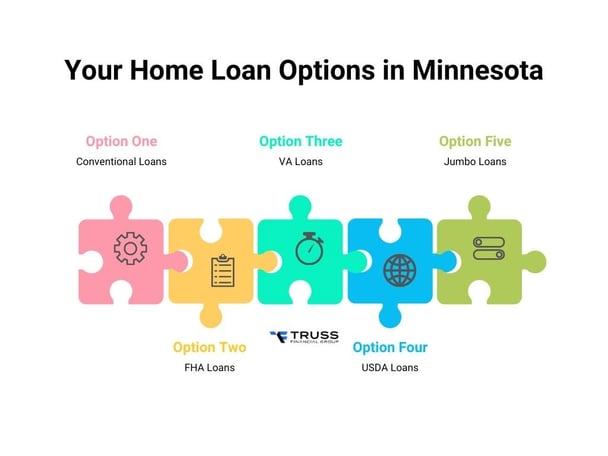
Homebuyers in Minnesota have a variety of mortgage options in 2025. The right loan for you depends on your financial profile and the type of home you’re buying. Here’s a rundown of the main home loan types and what to know about each:
Conventional Loans: Conventional loans are standard mortgages not backed by the government. Most lenders require a 620+ credit score and at least 3% down for first-time buyers (5% for others). A 20% down payment avoids PMI. Borrowers with strong credit, especially 740+, often get better rates. For 2025, conforming loan limits are about $806,500 in most counties; anything higher is considered a jumbo loan.
FHA Loans: FHA loans are government-backed and great for first-time or moderate-credit buyers. You can qualify with a 580+ credit score and just 3.5% down, or as low as 500 with 10% down. They allow flexible underwriting, higher debt-to-income ratios, and easier credit requirements. FHA loans require mortgage insurance, and Minnesota’s 2025 limits start around $498k. For buyers without 20% down or with credit in the 600s, they’re a strong option.
VA Loans: VA loans are one of the best options for eligible veterans, active-duty service members, and surviving spouses. They require no down payment, offer low interest rates, and don’t require mortgage insurance. A one-time funding fee applies, though many vets are exempt. While the VA sets no official credit minimum, lenders often look for a 620+ score. For those who qualify, VA loans make buying a home extremely affordable and accessible.
USDA Loans: USDA loans offer 0% down financing for homes in eligible rural or semi-rural areas. They come with low rates, a small upfront guarantee fee (1%), and a low annual fee (0.35%). There’s no official credit minimum, but most lenders look for 620–640 scores. Income must fall within program limits, and the property must be USDA-eligible. For buyers outside major cities, USDA loans provide an affordable path to homeownership.
Jumbo Loans: Jumbo loans are mortgages above the 2025 conforming limit of about $806,500 in most of Minnesota. Because they’re not backed by Fannie Mae or Freddie Mac, lenders require stronger qualifications: 700+ credit scores, 10–20% down, and solid income documentation. Some programs allow 5% down with excellent credit. You may also need 6–12 months of reserves. Jumbo loans are ideal for high-priced homes if you’re a well-qualified buyer.
To make these differences easier to digest, here’s a comparison table of key loan types and their typical requirements:
|
Loan Type |
Minimum Credit Score |
Minimum Down Payment |
Best For |
|
Conventional |
~620 (standard minimum) |
3% (for first-time buyers) |
Buyers with solid credit and some savings; widely used for primary or investment homes. |
|
FHA |
580 for 3.5% down 500 for 10% down |
3.5% (with 580+ credit) |
First-time buyers or those with lower credit scores or limited savings; more forgiving on credit. |
|
VA |
No official minimum (620+ typical) |
0% (no down payment) |
Eligible veterans and military families; offers zero down and no PMI for those who qualify. |
|
USDA |
No official minimum (640+ recommended) |
0% (no down payment) |
Buyers in rural areas with moderate incomes; great for 100% financing if home/location is eligible. |
|
Jumbo |
~700 or higher (varies by lender) |
10–20% (often closer to 20%) |
Buyers purchasing above ~$806k; requires strong credit, higher income, and larger down payments. |
Note: Loan requirements can vary by lender – Truss Financial Group can help you explore flexible programs within these categories.
As you can see, each loan type has its niche. First-time buyer with minimal down payment? FHA or a Minnesota Housing program (next section!) might be your ticket. Excellent credit and 5% down? A conventional loan could work. Veteran with no down payment saved? VA is unbeatable. Buying a farmhouse outstate? USDA could be perfect. High-end property? Jumbo loan to the rescue.
Truss Financial Group offers all of these loan options, so we can customize the mortgage to your situation. We’ll also help you compare interest rates and fees across loan types – for example, FHA loans have mortgage insurance and VA loans have a funding fee, so even if the interest rate is low, the other costs matter too. Our goal is to find the most affordable financing for your dream home.

Minnesota First-Time Homebuyer Programs
Being a first-time homebuyer can be challenging – saving up for a down payment and closing costs is tough, and you might not have equity from a previous home to help. Luckily, Minnesota offers some great first-time homebuyer programs to ease the path to homeownership. One of the main resources is the Minnesota Housing Finance Agency (MHFA), commonly known as Minnesota Housing.
Minnesota Housing Start Up Program:
This is the state’s flagship program for first-time buyers. If you haven’t owned a home in the past three years (or never have), you may qualify. Start Up offers affordable 30-year fixed-rate loans (conventional, FHA, VA or USDA – the program works with various primary loan types) along with down payment and closing cost assistance loans. Qualified borrowers can get up to $18,000 in assistance to help cover their down payment or closing costs. This assistance often comes as a low-interest or deferred second mortgage that you pay off only when you sell or refinance, making it a fantastic way to reduce your upfront costs.
To be eligible for the Start Up program, you’ll need to meet income and purchase price limits (designed to serve low-to-moderate income buyers). These limits are pretty generous – for example, the household income limit is around $152,000 in many parts of Minnesota for 2025, and the purchase price limit is about $659,000 in the Twin Cities metro ($604,400 in other counties). In other words, many middle-class first-time buyers and moderately priced homes qualify.
You’ll also need a minimum credit score (MHFA does require a certain credit score – typically in the mid-600s for conventional or FHA loans through the program) and you must complete an approved homebuyer education course. The program is meant to foster successful, sustainable homeownership, so they ensure you’re prepared for the responsibility.
How Truss Financial Group helps
Minnesota Housing programs like Start Up are accessed through approved participating lenders – you don’t get a loan directly from the state. Truss Financial Group is a participating lender, which means we can originate these loans and help you qualify. We’ll check your eligibility for Start Up, guide you through the required paperwork, and layer the assistance with your main mortgage seamlessly.
Essentially, we handle the “behind the scenes” with MHFA so you can focus on finding the right home. We’ll make sure you understand the terms of the down payment loan (e.g. whether it’s deferred payment or monthly payment) and how it works with your primary mortgage. By working through Truss, you get the benefit of state programs plus the convenience of one-stop shopping for your mortgage.
Other First-Time Buyer Resources:
In addition to the state program, some local cities and counties in Minnesota offer down payment grants or loans, and there are national programs like Fannie Mae’s HomeReady and Freddie Mac’s Home Possible conventional loans which allow 3% down and have discounted mortgage insurance for low-to-moderate income buyers. These can be combined with Minnesota Housing assistance or used separately. We won’t bog you down in details here, but just know there’s a whole toolkit for first-time buyers. For example, if you have a lower income, a HomeReady loan could let you qualify with 3% down and even use income from roommates or family members to help you qualify.
Or if you’re a first-generation homebuyer (your parents didn’t own a home), Minnesota had a special pilot program recently (though funds were limited). Truss Financial Group stays up-to-date on all these programs – when you come to us as a first-time buyer, we’ll make sure no stone is unturned. We love helping new homeowners take advantage of every benefit available.
Bottom line: Don’t assume you can’t afford a house. Between FHA loans, state assistance, and other programs, you might be closer to homeownership than you think. Many of our Truss clients are amazed to learn they qualify for a mortgage with only a few thousand dollars out of pocket thanks to these programs. If homeownership is your goal, let’s talk and explore your options.
How Much Do You Need for a Down Payment?
One of the biggest questions homebuyers have is, “How much cash do I really need to buy a house?” The old rule of thumb says 20% down for a conventional mortgage. While 20% is ideal, it lowers monthly payments and avoids private mortgage insurance (PMI), it’s far from required. In 2025, many buyers, especially first-timers, are putting much less down.
To give you perspective, the median down payment for first-time homebuyers in 2025 was only about 9% of the purchase price. Repeat buyers who sold a previous home often put more, around 23%, but first-timers usually don’t have that equity yet. Nationally, the median for all buyers was about 18–19%, slightly under the classic 20%. Clearly, you’re not alone if you can’t put down a huge sum.
With various loan programs, the minimum down payments are far lower: 0% for VA and USDA loans, 3.5% for FHA loans, and 3% for certain conventional loans. On a $300,000 home, a 3% down payment is just $9,000, while FHA’s 3.5% would be $10,500. Down payment assistance programs, like Minnesota Start Up, which offers up to $18,000, can make this even more manageable.
That said, if you have the ability to put 10%, 15%, or 20% down, it can be beneficial. Larger down payments reduce how much you finance, lowering your monthly payments. A 20% down payment on a conventional loan also avoids PMI, which can save roughly $100–$200 per month on a $300k loan. However, don’t let the 20% rule stop you from buying. If your income is stable and debt manageable, buying now with a smaller down payment may make more sense than waiting years to save 20%, especially with rising home prices and rents.
Finally, remember that down payment isn’t the only cash needed. Closing costs, typically 2–5% of the purchase price, cover appraisal, title, taxes, and more. Some programs allow these costs to be covered by the seller or added to the loan, but it’s wise to have savings for closing costs. At Truss Financial Group, we provide a full estimate of total cash needed at pre-approval so there are no surprises.
Down Payment Examples by Loan Type
|
Loan Type |
Minimum Down Payment |
Example on $300,000 Home |
Notes |
|
VA Loan |
0% |
$0 |
No PMI; some veterans exempt from funding fee |
|
USDA Loan |
0% |
$0 |
Must be in eligible rural/semi-rural area; small guarantee fee applies |
|
FHA Loan |
3.5% |
$10,500 |
Mortgage insurance required; flexible credit guidelines |
|
Conventional |
3% |
$9,000 |
PMI required if under 20%; better rates with higher credit scores |
Truss Financial Tip: If you’re short on cash, we’ll explore options like down payment assistance, seller credits, or even gift funds from a family member (most loan programs allow family gift money for down payment). We’ve helped buyers close with less than $1,000 out of pocket by combining these resources. The key is to plan ahead and discuss your situation, you might be in better shape than you think.
Credit Scores and Mortgage Approval: Why It Matters
Your credit score affects loan approval, interest rates, and available mortgage options. Higher scores (740+) get the best rates, while lower scores (below 620) may require FHA, VA, or credit improvement. Even small score improvements can lower monthly payments. Truss Financial Group helps buyers optimize credit, choose the right loan, and plan refinancing if needed. Credit is important, but income, down payment, and property details also matter.
|
Loan Type |
Minimum Credit Score |
Notes |
|
Conventional |
~620 |
Higher scores (740+) get best rates |
|
FHA |
580 (3.5% down) |
500+ may qualify with 10% down |
|
VA |
No formal minimum |
Practically ~620; some lenders approve lower |
|
USDA |
No formal minimum |
Practically ~620–640; rural property & income limits apply |
Is 2025 a Good Time to Buy a Home in Minnesota?
If you’re wondering whether to buy now or wait, Minnesota’s 2025 housing market offers a fairly balanced picture. Home prices are up modestly, around 1%–3% year-over-year, with over 70% of counties seeing growth. Big price drops aren’t expected, so waiting may not save much—and in some areas, prices could continue creeping up.
Interest rates currently sit in the mid-6% range. While rates may ease slightly in 2026, a return to historic lows is unlikely. Buying now gives you the option to refinance later if rates drop, while waiting could bring more competition as buyers react to lower rates.
Inventory remains tight but is slowly improving, with about 3.1 months of statewide supply. Homes are sitting a bit longer than last year, giving buyers slightly more negotiating power. Strong economic factors like Minnesota’s stable job market and comparatively affordable housing, make homeownership attainable, especially for younger buyers.
The key is personal readiness: stable income, manageable payments, and a plan to stay put for a few years. Minnesota’s market isn’t overheated nor at a bottom—buying now allows you to secure a home you love and adjust your mortgage later. Truss Financial Group can provide guidance and market data to help you make a smart, informed decision.
Ready to take the next step toward your Minnesota home? Keep reading for answers to some common questions new homebuyers ask – and feel free to reach out to Truss Financial Group at any time for personalized advice!

Frequently Asked Questions
Q: What are the current mortgage interest rates in Minnesota (2025)?
A: Rates average mid-6% for a 30-year fixed. Excellent credit may get ~6%, lower credit 7%+. Rates fluctuate daily, and you can refinance later if rates drop. Truss Financial Group can provide personalized rate quotes and help you lock in a competitive rate.
Q: How much do I need for a down payment in Minnesota?
A: You don’t need 20%. Programs allow 0% (VA/USDA), 3% (conventional), or 3.5% (FHA) down. Median first-time buyer down payment is 6–9%. Minnesota offers up to $18k in assistance. Closing costs (~3%) should also be planned.
Q: What first-time homebuyer programs are available in Minnesota?
A: Minnesota Housing’s Start Up program offers affordable mortgages, down payment, and closing cost assistance (up to $18k). Local grants may also be available. National options include HomeReady®, Home Possible®, FHA 203(k), and HUD programs. Truss helps identify qualifying programs and handles the paperwork.
Q: What credit score do I need for a home loan?
A: Minimums vary: Conventional ~620, FHA 580 (3.5% down), VA/USDA no formal minimum (~620 practical). Scores 600–700 may need FHA/VA. Lower scores can be improved via debt paydown, correcting errors, or waiting. Truss helps simulate strategies to boost credit and find the best loan option.
Q: Should I buy now or wait for rates/prices to change?
A: Minnesota’s 2025 market is stable; prices are modestly rising, rates ~6.5%. Waiting may not save much and could increase competition. Buying now lets you start building equity, then refinance if rates drop. Truss can model scenarios to help you decide confidently.
We hope this blog post has demystified the home loan process for you and shown that with the right information (and the right lender partner), buying a home in Minnesota in 2025 is absolutely achievable.
If you have any more questions or want to start the pre-approval process, reach out to Truss Financial Group. We’re excited to help you become a homeowner in the North Star State!
Get the information you need to make confident decisions
Discover your borrowing power and plan your mortgage journey with knowledge on your side.
Get a quote- No documents required
- No commitment
- No commitment
Get a quote in 3 easy steps
Tell us what you want
Fill out our online form to help us understand your financial situation and loan needs.
We get to work for you
We review your info and look for competitive rates that match your specific goals.
You get a personalized quote
You’ll receive a customized rate quote that meets your unique profile.