.svg)



%20(1).svg)
%20(2).svg)
.png?width=480&height=420&name=Img%20(1).png)
%20(3).svg)
%20(4).svg)

%20(5).svg)


 View all states
Mortgage Rate Trends in 2026: What U.S. Homebuyers & Self-Employed Borrowers Should Expect

18 mins
In this blog
Key Takeaways
- Mortgage rates are expected to stabilize in the 5.9% to 6.3% range in 2026, offering modest relief but not a return to pandemic-era lows
- Self-employed borrowers and real estate investors need specialized loan programs like bank statement mortgages and DSCR loans to qualify
- Your approval strategy matters more than timing the market: working with the right lender who understands alternative documentation can unlock homeownership even when rates feel high
After two years of volatility that left many homebuyers on the sidelines, mortgage rate trends in 2026 represent something different: predictability. Mortgage rates are finally stabilizing after the Federal Reserve's aggressive rate-hiking campaign that pushed borrowing costs into the high 7% range in early 2025.
As of December 2025, the average 30-year fixed rate mortgage sits around 6.2%, down from the 7.05% peak earlier in the year. The Fed has delivered three consecutive rate cuts, bringing the federal funds rate to 3.50%–3.75%. For the first time in recent years, experts predict mortgage rates will settle into a more predictable pattern rather than swinging wildly month to month.
But here's what borrowers need to understand: 2026 won't be defined by dramatically lower rates. Instead, it's a year where strategy matters more than timing. Whether you're a W-2 employee, a self-employed business owner, or a real estate investor, knowing which loan program matches your financial profile will determine whether you can buy or whether you keep waiting for a "perfect" market that may never arrive.
At Truss Financial Group, we've seen how the right loan structure can make homeownership accessible even when rates aren't ideal. The question isn't whether rates will drop to 3% again (they won't, at least not in 2026). The question is whether you're positioned to act when opportunity meets preparation.
Current Housing Market Snapshot Heading Into 2026
Understanding mortgage rates requires understanding the broader housing market they exist within. The housing outlook for 2026 shows a market that's cooling but not collapsing.
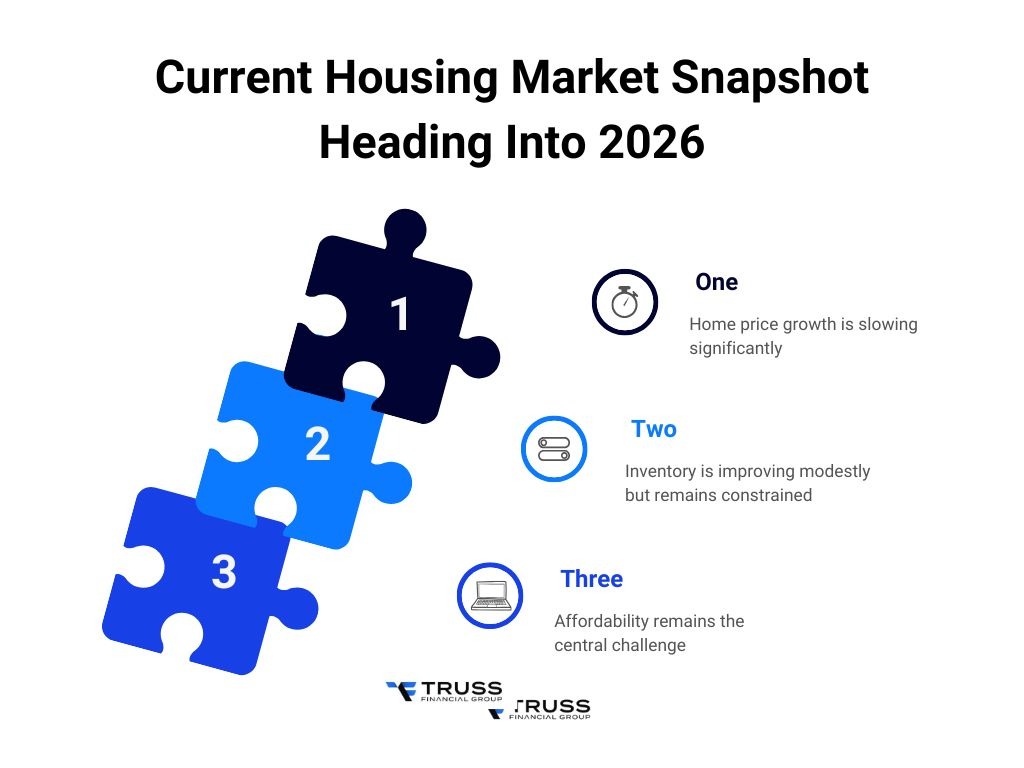
- Home price growth is slowing significantly: After years of double-digit appreciation that priced many buyers out, national home prices are expected to rise between 1% and 1.2%, according to forecasts from Zillow and Redfin, though the National Association of Realtors projects higher appreciation of 4%. This represents meaningful progress toward affordability, not because prices are falling, but because wage growth is finally catching up to housing costs for the first time since 2008.
- Inventory is improving modestly but remains constrained: Zillow's third quarter 2025 data showed inventory levels rising from pandemic-era lows, yet still sitting 17% below pre-pandemic levels. In practical terms, this means buyers have more options than they did two years ago, but well-priced homes in desirable neighborhoods still move quickly.
- Affordability remains the central challenge: Even with mortgage interest rates moderating and home prices growing more slowly, monthly payments remain elevated due to higher property taxes, insurance costs, and the baseline reality that median home prices are still historically high.
What this means for different buyers:
- W-2 homebuyers face predictable underwriting but need strong credit profiles and cash reserves to compete
- Self-employed borrowers often struggle with traditional loans because tax write-offs suppress their qualifying income, even when their actual cash flow is strong
- Real estate investors benefit from stable rate environments where cash flow analysis drives approval decisions
What Factors Will Influence Mortgage Rates in 2026?
1. Federal Reserve Policy & Inflation
Most borrowers assume the Federal Reserve directly controls mortgage rates. It doesn't. The Fed sets the federal funds rate, the overnight lending rate banks charge each other, which influences short-term borrowing costs. Mortgage rates, by contrast, track longer-term economic expectations.
When the Fed cuts rates (as it did three times in late 2025), it's signaling confidence that inflation is cooling. That signal influences bond markets, which then influence mortgage rates, but with a lag effect. Think of it like turning a giant ship: the Fed moves the wheel, but it takes time for the hull to change direction.
Why inflation matters more: Mortgage lenders price risk based on expected inflation over the 15 to 30-year life of the loan. As long as inflation continues trending toward the Fed's 2% target, mortgage rates should drift lower gradually in 2026.
2. 10-Year Treasury Yield & Mortgage-Backed Securities
Here's the more technical driver of mortgage rates: the 10-year U.S. Treasury yield.
Mortgage-backed securities are bundles of home loans sold to investors. When Treasury yields rise, these securities must offer higher returns to compete, which means mortgage rates rise. When Treasury yields fall, mortgage rates typically follow.
Why this matters: Headlines about the Fed cutting rates can be misleading. If bond markets expect future inflation or economic growth, Treasury yields can rise even as the Fed cuts rates. This happened briefly in late 2025, when mortgage rates ticked upward despite Fed rate cuts.
3. Lender Risk Appetite
Even when broader market conditions stay the same, some lenders tighten underwriting while others relax standards. This creates a spread where one lender might quote you 6.5% with strict requirements, while another offers 6.25% with more flexible terms.
For self-employed borrowers, this matters enormously. Traditional banks often maintain rigid underwriting standards. Non-QM lenders offering bank statement loans and DSCR loans adjust their risk appetite based on portfolio performance. In 2026, as mortgage markets stabilize, more lenders are willing to approve borrowers with strong cash flow but unconventional documentation.
Mortgage Rate Predictions for 2026 (Expert Forecasts)
- Mortgage Bankers Association: Projects the average 30-year fixed rate mortgage will end 2025 at 6.3% and hold steady through the first quarter of 2026. The MBA's forecast assumes continued inflation moderation and gradual Fed rate cuts.
- Freddie Mac: Expects mortgage rates to remain near current levels through 2026, around 6.2%. Their outlook assumes continued inflation moderation and successful Federal Reserve policy implementation.
- Fannie Mae: Forecasts mortgage rates will end 2026 at approximately 5.9%, the most optimistic of the major predictions. This projection depends on stable labor market conditions and inflation remaining near the Fed's 2% goal.
- Why forecasts cluster: Notice all three major forecasts fall within a narrow band, roughly 5.9% to 6.4%. This clustering reflects a broad consensus about the economic trajectory: gradual improvement without dramatic shifts.
Important disclaimer: Forecasts are educated guesses, not guarantees. Economic conditions can change rapidly. Use forecasts as context, not certainty.
Will Mortgage Rates Go Down in 2026?
Short answer: Yes, modestly and unevenly.
Three critical factors will determine how much the rates actually drop:
- Inflation trajectory determines everything. As long as inflation continues cooling toward the Federal Reserve's 2% target, downward pressure on mortgage rates will persist. But inflation doesn't move in a straight line.
- Fed signaling vs. actual rate cuts. Bond markets don't wait for the Fed to cut rates (they price in expectations months in advance). In 2026, if the Fed signals more aggressive cuts than markets expect, rates could drop faster.
- Market expectations are already priced in. Much of the expected rate improvement for 2026 is already reflected in current mortgage rates. Markets are efficient (when smart money expects rates to fall, they start falling immediately).
Bottom line: Expect mortgage rates to drift lower gradually through 2026, potentially reaching the high-5% range by year-end if conditions align. But don't expect sudden drops. The difference between a 6.3% rate today and a 5.9% rate in late 2026 might save you $100 to $150 per month on a $400,000 loan. That's meaningful but not transformational.
How 2026 Mortgage Rates Affect Different Borrowers
1. W-2 Homebuyers
Traditional employees with predictable W-2 income have the most straightforward path to approval. For W-2 buyers in 2026, credit scores matter more as lenders become selective about pricing tiers, and cash reserves increasingly differentiate approved applicants.
2. Self-Employed Borrowers
This is where traditional mortgage lending breaks down.
If you're a business owner, independent contractor, or consultant, you likely use tax deductions to reduce your taxable income. That's smart tax planning—but it destroys your mortgage qualifying income.
Example: A marketing consultant generates $180,000 annually in gross revenue. After legitimate business expenses, their net taxable income shows $75,000. Traditional lenders qualify them based on $75,000, maybe approving a $300,000 loan when they can comfortably afford $600,000.
The solution: Bank statement mortgages and no-tax-return loan programs that qualify borrowers based on actual deposits, not tax returns.
For self-employed borrowers,the mortgage rate is secondary to the approval structure. A bank statement loan at 6.75% that approves your actual cash flow is infinitely better than a conventional loan at 6.25% that denies you.
Real Estate Investors
Debt Service Coverage Ratio (DSCR) loans solve investor challenges by qualifying borrowers based solely on rental income. The lender analyzes whether the property generates enough rent to cover the mortgage payment. If the rental income covers 100% to 125% of the total housing expense, the loan is approved, regardless of personal income.
In 2026, real estate investors benefit from predictable borrowing costs and the ability to model cash flow with confidence.
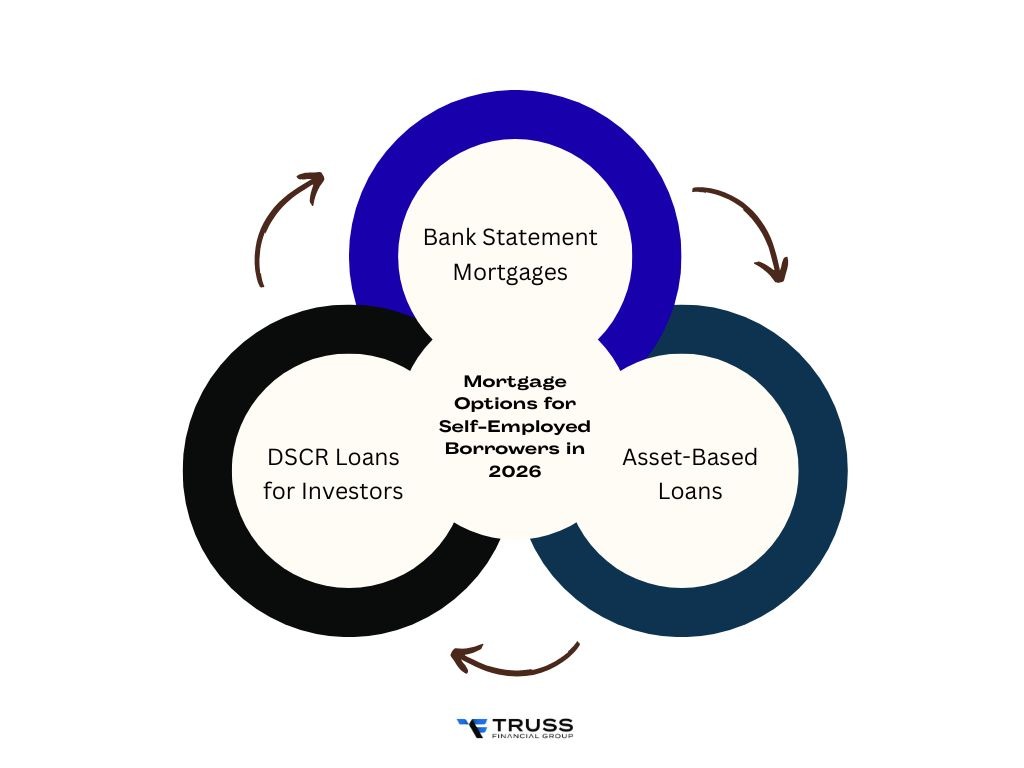
Mortgage Options for Self-Employed Borrowers in 2026
Bank Statement Mortgages
How they work: Instead of tax returns, lenders review 12 to 24 months of personal or business bank statements. Bank statement loans focus on calculating average monthly deposits and use that figure as qualifying income.
Who they're for:
- Business owners with significant tax write-offs
- Independent contractors and consultants
- Freelancers with fluctuating but consistent income
Trade-offs: Bank statement loans typically carry slightly higher interest rates (0.25% to 0.75% above conventional rates). But the approval odds and loan amounts often justify the cost.
DSCR Loans for Investors
How approval works: The lender orders an appraisal with a rent schedule. They divide the monthly rent by the total monthly housing payment. If the ratio is 1.0 or higher, the loan is approved (no personal income calculation needed).
Example: An investor purchases a $350,000 rental property with 20% down. Monthly rent is $2,400. The mortgage payment is approximately $1,862. Add $400 for taxes/insurance. Total expense: $2,262. DSCR = $2,400 ÷ $2,262 = 1.06. Loan approved.
Asset-Based Loans
For borrowers with significant liquid assets but unpredictable income, asset-based loans qualify borrowers by "depleting" assets over the loan term. A borrower with $1.2 million in investment accounts applies for a $400,000 mortgage. The lender divides the assets by the loan term, creating a theoretical monthly income.
At Truss Financial Group, we specialize in matching self-employed borrowers and investors to the right loan structure. Access to 90+ lenders means we're finding the program that actually works for your situation.
Are Alternative Loans More Expensive in 2026?
Yes, alternative loan programs typically carry slightly higher interest rates than conventional mortgages. But "more expensive" is misleading.
Typical rate differences:
- Bank statement mortgages: 0.25% to 0.75% above conventional rates
- DSCR loans: 0.5% to 1.0% above conventional rates
But here's what borrowers miss:
- Higher approval odds. If a conventional loan denies you or limits your buying power, a bank statement loan at a slightly higher rate that actually gets you into the home is infinitely more valuable.
- Opportunity cost vs. rate obsession. Waiting for conventional loan approval while missing the right property costs more than paying an extra 0.5% in interest.
- Refinance optionality. Many borrowers use alternative loans to purchase, then refinance to conventional loans once their financial profile improves.
Example: On a $400,000 loan, the difference between 6.25% and 6.75% is roughly $125/month. If waiting costs you the home you wanted, or that home appreciates $15,000 in six months, the rate premium becomes irrelevant.
Down Payment, APR & Closing Costs in 2026
Typical Down Payment Ranges
- 3.5% (FHA loans): Accessible for first-time buyers with lower credit scores
- 5% to 10% (Conventional loans): Common for borrowers with good credit but limited cash reserves
- 15% to 20% (Non-QM loans): Bank statement and DSCR loans often require larger down payments
- 20%+ (Investment properties): May require 25% to 30% down
APR vs. Interest Rate
The interest rate is the percentage you pay annually on borrowed money. The annual percentage rate (APR) includes the interest rate plus lender fees, points, and closing costs.
Think of the interest rate as the base price of a car, and the APR as the total cost, including taxes and fees. You need both numbers to make informed decisions.
Closing Costs (2% to 5%)
Closing costs typically run 2% to 5% of the loan amount. On a $400,000 loan, expect $8,000 to $20,000 in closing costs, including origination fees, appraisal, title insurance, and prepaid property taxes.

Fourth Quarter Mortgage Rate Trends in 2026
Why Q4 Matters Historically?
- Lower competition: Fewer buyers compete during the holiday season. Sellers listing in Q4 are often motivated, relocating for jobs or needing to close before year-end.
- Rate stability: By the fourth quarter, the Federal Reserve has typically signaled its policy stance. Bond markets price in expectations, reducing volatility.
Most forecasters expect mortgage rates to settle into a stable range by Q4 2026, likely between 5.75% and 6.25%. This stability matters more than the specific number.
How to Prepare for a Mortgage in 2026?
1. Credit Positioning
Target score: Conventional loans favor 740+ for best pricing. Alternative loans may approve 640+, but higher scores unlock better rates.
Actions to take:
- Pull credit reports and dispute errors
- Pay down credit card balances below 30% utilization
- Avoid opening new credit accounts within six months of applying
2. Income Documentation Strategy
For self-employed borrowers:
- Collect 12–24 months of bank statements
- Organize 1099s and profit/loss statements
- Prepare explanations for income fluctuations
For investors using DSCR loans:
- Gather lease agreements showing rental income
- Compile property tax and insurance documentation
3. Choosing the Right Loan Type Early
Don't wait until you're under contract to explore loan options. Different programs have different requirements.
Self-assessment questions:
- Does your tax return accurately reflect your ability to pay? (If no → explore bank statement loans)
- Are you purchasing an investment property? (If yes → consider DSCR loans)
- Do you have substantial assets but variable income? (If yes → explore asset-based loans)
Why Working With the Right Lender Matters More Than Timing the Market?
Access to 90+ Lenders
Mortgage brokers with access to dozens of lenders can shop your scenario to find the best match. A self-employed borrower denied by one bank's rigid underwriting might be approved by another bank's statement program.
Non-QM Expertise
Bank statement loans, DSCR loans, and asset-based programs each have unique documentation requirements and pricing structures. Specialist lenders like Truss Financial Group focus on non-QM lending, meaning we know exactly which documents to request and which lenders offer the best terms for your profile.
Matching Borrower Profile to the Correct Program
The "best" mortgage isn't the one with the lowest rate. It's the one that approves your specific financial situation and offers terms you can sustain long-term.

Frequently Asked Questions
Will mortgage rates go down by 2026?
Yes, mortgage rates are expected to gradually decline in 2026, with most forecasts predicting the 30-year fixed rate mortgage will settle between 5.9% and 6.4% by year-end.
What will the interest rate be in 2026 for a house loan?
Based on forecasts from Fannie Mae, Freddie Mac, and the Mortgage Bankers Association, the average 30-year fixed mortgage rate is expected to range from 5.9% to 6.4% throughout 2026.
Will mortgage rates ever get down to 3% again?
Extremely unlikely. The 3% mortgage rates of 2020–2021 were tied to emergency Federal Reserve policies during the pandemic. A range of 5%–6% is more sustainable historically.
What is the current mortgage trend?
Mortgage rates are stabilizing in the low-to-mid 6% range after peaking above 7% earlier in 2025. The trend is gradual improvement driven by cooling inflation and Fed rate cuts.
Are mortgage rates predicted to go down?
Yes, most expert forecasts predict mortgage rates will continue declining gradually through 2026, potentially reaching the high-5% range by year-end.
Is 2026 going to be a good year to buy a house?
2026 could be strong for prepared buyers. Mortgage rates are expected to stabilize, home price growth is slowing, and inventory is improving. However, affordability remains constrained in many markets.
Will mortgage rates ever be 3% again?
The consensus among economists is no, 3% mortgage rates required emergency pandemic-era policies that are not repeatable in normal economic conditions.
Final Thoughts: Mortgage Rates Aren't the Bottleneck in 2026
Mortgage rates in 2026 will likely improve modestly. They won't drop to 3%. They might reach the high-5% range. They'll probably stay in the low-to-mid 6% range for most of the year. But obsessing over whether rates hit 5.9% or 6.2% misses the bigger picture.
The real bottleneck isn't the rate. It's the approval path.
For self-employed borrowers, traditional lending has failed you for years, penalizing smart tax planning and ignoring actual cash flow. Bank statement mortgages, DSCR loans, and asset-based programs finally recognize that your income is real, just documented differently.
For real estate investors, conventional loans cap your portfolio growth at arbitrary debt-to-income limits. DSCR loans let you scale based on property performance, not personal income.
For W-2 homebuyers, rates matter, but credit positioning, cash reserves, and working with a lender who can lock quickly in competitive markets often matter more.
The borrowers who succeed in 2026 aren't the ones who time the market perfectly. They're the ones who prepare thoroughly, choose the right loan structure, and work with lenders who actually understand their financial profile.
Ready to explore your options? Contact us and let's build your mortgage strategy for 2026. Get a quote today!

.svg)

Discuss your unique requirements
Get direct answers and a roadmap for your future.
.png?width=202&height=202&name=image%20588255187%20(1).png)








.svg)

.svg)
.svg)