.svg)



%20(1).svg)
%20(2).svg)
.png?width=480&height=420&name=Img%20(1).png)
%20(3).svg)
%20(4).svg)

%20(5).svg)


 View all states
Fannie Mae Rental Income Rules: How Rental Income Is Calculated (And Why DSCR May Work Better)

20 mins
.png)
In this blog
Why Fannie Mae Rental Income Rules Trip Up Borrowers
If you’ve ever been told your rental property “cash flows just fine” but still doesn’t qualify for financing, you’ve run straight into Fannie Mae rental income rules. This is one of the most common and frustrating disconnects borrowers face when applying for a conventional mortgage.
Under Fannie Mae rental income guidelines, the rent you collect each month is not the same as the income a lender is allowed to use. Qualification depends less on how well the property performs today and more on how rental income is documented, calculated, and adjusted under Fannie Mae’s framework. Worksheets, tax returns, lease history, and expense deductions often matter more than actual cash flow.
At Truss Financial Group, we see this play out daily with self-employed borrowers, real estate investors, and landlords who assume strong rental income will carry the loan only to be limited by Schedule E losses, vacancy adjustments, or conservative income calculations.
That’s why it’s important to understand these rules clearly, and to know when a different loan structure makes more sense. DSCR loans, for example, aren’t a workaround or loophole. They’re a fundamentally different way of qualifying, built around property performance rather than personal income reporting.
In this guide, we’ll break down how Fannie Mae rental income is calculated, why so many borrowers get tripped up, and when alternative options like DSCR may align better with how real estate actually works.

What Is Considered Rental Income Under Fannie Mae?
Under Fannie Mae rental income guidelines, not all rent collected from a rental property automatically qualifies as income for mortgage approval. What counts depends on which property generates the rent, how long it has been rented, and how the income is documented.
Subject property vs. non-subject rental properties
Fannie Mae distinguishes between the subject property (the property being financed) and non-subject rental properties (other properties the borrower already owns). Rental income from non-subject properties is generally easier to use, provided it’s properly documented on tax returns. Rental income from the subject property especially if it’s newly acquired or recently converted faces stricter rules and additional scrutiny.
Long-term rentals vs. short-term rentals
Fannie Mae primarily recognizes long-term rental income supported by a one-year lease or historical reporting on IRS Schedule E. Short-term rental income (such as Airbnb or vacation rentals) is much harder to use unless it shows a stable, documented history and is reflected accurately on tax returns. Even then, lenders often apply conservative adjustments.
When rental income counts as qualifying income
Rental income becomes qualifying rental income only after Fannie Mae applies its required calculations and adjustments. This means the lender doesn’t look at raw rent collected, but at adjusted income after expenses, vacancies, and other deductions. Strong property performance alone isn’t enough documentation and calculation method determine whether the income can actually be used.
Gross Rental Income vs Qualifying Rental Income
One of the biggest misunderstandings borrowers face is assuming gross rental income equals qualifying income. Under Fannie Mae rules, it doesn’t.
What gross monthly rent means
Gross rental income is the total monthly rent collected from a rental property, typically based on a lease agreement or market rent estimate. On paper, this may look strong especially for well-performing investment properties.
Why Fannie Mae discounts rental income
Fannie Mae assumes rental properties have ongoing operating expenses and vacancy risk, even when a property appears fully occupied. To account for this, lenders reduce gross rental income using standardized rules rather than actual cash flow.
Vacancy and expense assumptions
In most cases, Fannie Mae applies a vacancy and expense factor (commonly around 25%) to gross rental income before determining what can be used for qualification. The remaining amount after subtracting expenses shown on Schedule E and accounting for vacancies is what becomes qualifying rental income.
This is why many borrowers with healthy monthly rent still struggle to qualify. The gap between monthly rent collected and qualifying rental income can be significant, especially for self-employed borrowers or investors with aggressive write-offs.
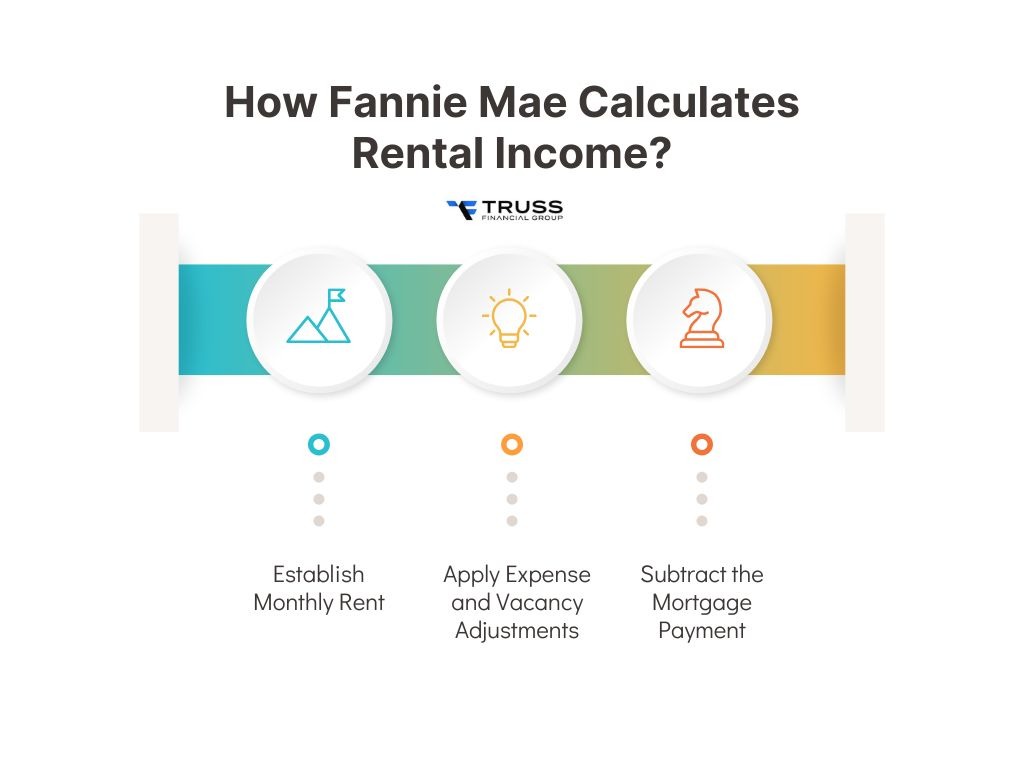
How Fannie Mae Calculates Rental Income?
Step 1: Establish Monthly Rent
The first step is determining the monthly rent figure used for income calculation.
Fannie Mae allows lenders to use:
- An existing lease agreement, or
- Market rent supported by an appraisal
However, lenders must apply the lower-of rule. This means they must use the lower of actual lease rent or market rent, even if the property is currently renting for more.
For properties without a long rental history, lenders rely on:
- Form 1007 (Single-Family Rent Schedule) for one-unit properties
- Form 1025 for two- to four-unit properties
These appraisal forms estimate market rent based on comparable rental properties, not the borrower’s actual rent collected.
This step alone often reduces the usable rental income before any expenses are considered.
Step 2: Apply Expense and Vacancy Adjustments
Once monthly rent is established, Fannie Mae applies standardized deductions.
Why 100% of rent is never used
Fannie Mae assumes:
- Ongoing operating expenses
- Maintenance costs
- Vacancy risk
As a result, lenders do not use full gross rental income when qualifying borrowers.
The “50% rule” explained
Borrowers often hear about a “50% rule,” but this is usually a shorthand interpretation. In practice:
- Fannie Mae commonly applies a 25% vacancy/expense factor
- Additional expenses shown on tax returns may further reduce income
Between vacancy assumptions and reported expenses, usable income can drop sharply, especially for properties with aggressive write-offs.
Step 3: Subtract the Mortgage Payment
After adjusting rental income, lenders subtract the full PITIA payment for the rental property:
- Principal
- Interest
- Taxes
- Insurance
- Association dues (if applicable)
This determines whether the rental produces:
- Positive qualifying rental income, or
- A rental loss, which is added to the borrower’s debt-to-income ratio
Even profitable properties can show as a loss under Fannie Mae’s income calculation rules, particularly in high-tax or high-insurance markets.
This final number, positive or negative is what flows into the borrower’s monthly qualifying rental income for underwriting

Using Tax Returns: Schedule E Rental Income Rules
This is where many self-employed borrowers hit friction.
When Schedule E Is Required
Fannie Mae generally requires IRS Form 1040, Schedule E when:
- The borrower owns rental property
- Rental income is being used to qualify
- The property has an established operating history
Lenders use Schedule E to verify:
- Gross rental income
- Operating expenses
- Net rental income or loss
If the income isn’t reported on Schedule E, it usually cannot be used, regardless of bank deposits or lease agreements.
Why Self-Employed Borrowers Struggle Here
Self-employed borrowers frequently:
- Maximize deductions to reduce taxes
- Show lower net income on Schedule E
- Appear less qualified under Fannie Mae rules
This is a structural issue, not a performance issue. Strong cash flow doesn’t matter if it isn’t reflected cleanly on tax returns.
Lease Agreements and Rental Income Documentation
Documentation quality matters as much as the numbers themselves.
Existing Leases vs. Newly Executed Leases
- Existing leases with payment history carry more weight
- Newly executed leases may be discounted or rejected if there’s no track record
Fannie Mae prefers leases that show stability, not projections.
Minimum Lease Requirements
To be usable, a lease generally must:
- Be for at least 12 months
- Clearly state monthly rent
- Be signed by all parties
- Match tax return and appraisal data
Any mismatch can delay or derail approval.
Security Deposits and What Does Not Count
Security deposits:
- Are not considered rental income
- Cannot be used to offset vacancies
- Do not improve qualifying income
Only documented rent calculated under Fannie Mae’s formula counts.
Why This Pushes Borrowers Toward DSCR Loans
These rules explain why many investors with strong-performing properties still fail to qualify under Fannie Mae and why DSCR loans often make more sense.
DSCR underwriting focuses on:
- Property cash flow
- Rental income vs. mortgage payment
- Performance, not tax strategy
It’s not a loophole, it’s a fundamentally different structure.

Departing Residence Rental Income Rules
Under Fannie Mae guidelines, a departing residence is a borrower’s current primary residence that is being converted into a rental property because the borrower is purchasing or occupying a new primary home. This scenario is treated differently from standard investment properties, and it is one of the most commonly misunderstood rental income rules.
When a Primary Residence Becomes a Rental
Fannie Mae does not automatically allow rental income from a departing residence. The lender must determine whether the borrower is reasonably able to carry both housing payments without financial strain. Because the property was previously owner-occupied, Fannie Mae applies stricter scrutiny to prevent overstated income or speculative rent assumptions.
In most cases, rental income from a departing residence can only be used if the borrower meets specific equity and documentation thresholds.
Equity and Reserve Requirements
To use rental income from a departing residence, Fannie Mae typically requires:
- At least 30% equity in the departing residence, verified by an appraisal
• A fully executed lease agreement
• Evidence that the rental arrangement is stable and market-supported
If the borrower does not meet the equity requirement, the rental income is usually not allowed at all, even if a lease exists. In addition, lenders often require additional cash reserves to demonstrate the borrower can cover multiple mortgage payments if the property becomes vacant.
This is a key difference from standard rental properties, where rental income may be offset against the mortgage payment rather than disallowed outright.
Why This Rule Is Often Misunderstood
Many borrowers assume that signing a lease is enough to qualify rental income from a departing residence. It is not. Fannie Mae is less concerned with whether rent exists and more concerned with whether the borrower can safely transition from one primary residence to another without relying on unproven rental income.
As a result, borrowers with strong rental demand but insufficient equity are often surprised to learn that the income cannot be used, increasing their debt-to-income ratio instead of helping it.
This restriction is one of the most common reasons borrowers exploring a move-up purchase begin looking at DSCR-based alternatives, where rental income usability is tied to property performance rather than personal housing transitions.

Short-Term Rentals and Airbnb Income Under Fannie Mae
Short-term rental (STR) income, including Airbnb income, is treated conservatively under Fannie Mae guidelines. While STR properties are not prohibited, the income is not automatically considered qualifying rental income, especially if it lacks a documented operating history.
When STR Income Is Allowed
Fannie Mae may allow short-term rental income only when it is supported by historical evidence, typically through tax returns. In practice, this means the income must be reported on Schedule E and demonstrate consistency over time. Market projections, booking calendars, or platform screenshots are not sufficient on their own.
For newly converted short-term rentals or properties without a tax history, the income is often excluded entirely from qualification.
Documentation Hurdles
STR owners face stricter documentation requirements than long-term landlords. Lenders may require:
• tax returns showing reported rental income
• proof of expenses and net income
• confirmation that local zoning permits short-term rentals
Even when documentation exists, lenders may still discount the income due to volatility and seasonality.
Why Many STR Owners Hit a Dead End
Many STR properties generate strong cash flow but fail Fannie Mae qualification because the income is either too new, too variable, or insufficiently documented. As a result, the rental income cannot be used to offset the mortgage payment, causing otherwise profitable properties to fail DTI requirements.

Common Fannie Mae Rental Income Mistakes That Cause Denials
Most rental-income-related denials are not caused by weak properties but by incorrect assumptions about how income is evaluated.
One of the most common mistakes is assuming gross rent counts as income. Fannie Mae never uses 100% of rental income. Vacancy and expense adjustments are applied before qualification.
Another frequent error is ignoring PITIA subtraction. For non-subject rental properties, the full mortgage payment, including principal, interest, taxes, insurance, and association dues, is deducted before rental income is added to the borrower’s profile.
Borrowers also often rely on lease agreements without tax history, particularly for short-term rentals or newly acquired properties. Without Schedule E support, rental income may be excluded altogether.
Finally, misclassifying the property type, such as treating a departing residence or short-term rental as a standard investment property, can invalidate the income calculation entirely.
When Fannie Mae Rental Income Rules Break Down
Fannie Mae rental income rules tend to break down in scenarios where properties perform well in reality but poorly on paper. Strong cash-flowing rentals can still fail if the income is discounted, excluded, or offset by mortgage obligations.
The core bottleneck is the debt-to-income (DTI) ratio. When rental income cannot be fully applied, the borrower’s personal income must carry the mortgage payment, even if the property pays for itself. This is especially restrictive for investors with multiple properties, short-term rentals, or aggressive tax write-offs.
As portfolios grow, borrowers often discover that conventional underwriting is no longer aligned with how their real estate actually operates.
Why DSCR Loans Often Work Better Than Fannie Mae
DSCR loans are structured around a different underwriting question: Does the property support its own debt? Instead of evaluating the borrower’s personal income and tax returns, DSCR loans focus on the relationship between rental income and the property’s housing expense.
Because qualification is property-based, DSCR loans do not rely on personal DTI calculations and do not require Schedule E income to be used in the same way. This makes them particularly well-suited for real estate investors, short-term rental owners, and self-employed borrowers whose tax returns do not reflect their true cash flow.
When rental income exists but cannot be used under Fannie Mae rules, DSCR structures often align more closely with how investment properties actually perform.

DSCR Is Not Just for Purchases: DSCR HELOCs and HELOANs
DSCR lending is often associated with purchase loans and cash-out refinances, but the same property-based logic also applies to equity products. DSCR HELOCs and DSCR HELOANs allow real estate investors to access property equity without requalifying under conventional income rules.
How DSCR HELOCs Differ From Conventional HELOCs
Traditional HELOCs are underwritten based on the borrower’s personal income, tax returns, and debt-to-income ratio. Rental income must be documented, discounted, and applied through the borrower’s DTI calculation.
DSCR HELOCs take a different approach. Qualification is driven primarily by the property’s ability to service its own debt, rather than the borrower’s global income profile. Because of this, rental income usability matters less than whether the property’s cash flow supports the housing expense.
When Tapping Equity Makes More Sense Than Refinancing
For many investors, refinancing under conventional guidelines becomes restrictive once rental income is partially excluded or tax write-offs reduce usable income. In those cases, tapping equity through a DSCR HELOC or HELOAN can provide access to capital without disturbing an existing first mortgage or triggering a full re-underwrite under Fannie Mae rules.
This is especially relevant for investors holding low-rate first liens or managing properties that cash flow well but do not qualify cleanly under traditional DTI-based analysis.
Why Rental Income Usability Matters Less Under DSCR
Under DSCR structures, the emphasis shifts from how rental income is documented to whether the property supports its debt. As a result, issues like Schedule E treatment, lease seasoning, or partial rent exclusions play a smaller role in qualification.
Some lenders, including Truss Financial Group, offer DSCR-based HELOC and HELOAN structures designed specifically for investor-owned properties where conventional equity access is limited.

Fannie Mae vs DSCR: Which Option Fits Which Borrower
Choosing between Fannie Mae financing and DSCR financing depends less on property quality and more on how income is evaluated.
When Fannie Mae Makes Sense
Fannie Mae loans tend to work best for borrowers with:
• stable W-2 or easily documented income
• long-term leases with clean tax history
• limited real estate portfolios
• minimal income write-offs
In these cases, rental income can be integrated into DTI calculations without significant exclusions.
When DSCR First-Lien Loans Make More Sense
DSCR purchase or refinance loans are often a better fit when:
• rental income is strong but inconsistently documented
• tax returns understate cash flow
• the borrower owns multiple properties
• personal DTI no longer reflects portfolio performance
Here, property-level analysis aligns more closely with reality than borrower-level underwriting.
When DSCR HELOCs or HELOANs Make More Sense
DSCR equity products are typically most appropriate when:
• the borrower wants liquidity without refinancing
• conventional HELOCs are blocked by DTI constraints
• rental income is usable at the property level but not under Fannie Mae rules
• preserving an existing first mortgage is a priority
In these scenarios, DSCR HELOCs and HELOANs function as access tools, not replacement loans.

Frequently Asked Questions
What are the rules for rental income for Fannie Mae?
Fannie Mae allows rental income to be used for mortgage qualification only if it is properly documented, supported by history, and calculated under specific guidelines. Rental income is typically discounted for vacancies and expenses, and in many cases must be supported by tax returns or appraisal-based market rent.
What is the 50% rule in rental income?
The “50% rule” is an informal way of describing how rental income is reduced after expenses and debt obligations, not a literal policy limit. Fannie Mae never allows 100% of rental income to be used, and the usable amount depends on expenses, vacancy assumptions, and the property’s mortgage payment.
Can you use rental income as income for a mortgage?
Yes, rental income can be used as qualifying income, but only after it is adjusted under Fannie Mae’s calculation rules. Gross rent is not used directly, and the final usable amount may be much lower than rent collected.
How much of rental income can be used to qualify for a loan?
There is no fixed percentage. The usable amount depends on:
- whether the property is subject or non-subject
- whether income is supported by Schedule E or leases
- vacancy and expense assumptions
- whether the mortgage payment must be subtracted
Does Fannie Mae allow rental income from Airbnb?
Fannie Mae may allow short-term rental or Airbnb income only when it is documented on tax returns and demonstrates a consistent history. Projected income, booking calendars, or platform screenshots alone are usually not sufficient.
What is the income limit for Fannie Mae?
Fannie Mae does not impose a single universal income limit. Income limits apply only to specific programs, such as HomeReady or affordable housing initiatives, not to standard conventional loans.
What are Fannie Mae's eligibility requirements?
Eligibility depends on factors such as:
• credit score
• debt-to-income ratio
• loan-to-value ratio
• property type
• documentation quality
Rental income must meet additional documentation and calculation standards.
Does rental property count as income for a mortgage?
Yes, rental property income can count as qualifying income, but it is netted and adjusted under Fannie Mae rules. In some cases, rental income may result in a loss that increases the borrower’s DTI.
What is the 50% rule in rental property?
The 50% rule is commonly used to estimate expenses when analyzing rental properties, but it is not a formal Fannie Mae guideline. Fannie Mae uses documented expenses and standardized assumptions, not a flat rule.
Is rental property considered as income?
Rental property income is considered an income source only after it is properly documented and adjusted. Simply owning a rental property does not guarantee the income can be used for qualification.
What does it mean if a property is a Fannie Mae property?
A “Fannie Mae property” typically refers to a mortgage that is owned or securitized by Fannie Mae, not to the physical condition or ownership of the home itself.
Does Fannie Mae allow rental income from departing residence?
Yes, but only in limited cases. Rental income from a departing primary residence is usually allowed only if the borrower has sufficient equity and meets additional documentation requirements. Otherwise, the income may be excluded.
How to calculate rental income fannie mae?
Rental income is calculated by:
- Determining monthly rent (lease or market rent, whichever is lower)
- Applying vacancy and expense adjustments
- Subtracting the full mortgage payment when required
- Using the resulting net amount in the DTI calculation
Can you use rental income to family members-fannie mae?
Rental income from family members is generally restricted. Fannie Mae often treats rent paid by relatives as boarder income, which may not be allowed or may require stricter documentation.
Does fannie mae allow rental income from family member?
In most cases, rental income from a family member cannot be used to qualify unless it meets specific exceptions and documentation standards. This rule exists to prevent non-arms-length income assumptions.
The Real Difference Between Fannie Mae and DSCR
The core difference between Fannie Mae and DSCR financing is what each system is designed to evaluate. Fannie Mae underwriting focuses on the borrower’s paperwork, tax returns, leases, income history, and standardized calculations that determine how much rental income is allowed to count. Even strong cash-flowing properties can fail if the income cannot be documented or applied under these rules.
DSCR underwriting takes a different approach. Instead of centering the analysis on the borrower’s personal income, it evaluates whether the property itself can support its debt obligations. This shift matters most for investors, short-term rental owners, and self-employed borrowers whose real-world cash flow does not translate cleanly into conventional documentation.
Understanding this distinction upfront prevents wasted applications, unnecessary denials, and mismatched loan choices. The right option is not about which program is “better,” but about which framework aligns with how the income actually exists, on paper or at the property level.

.svg)

Discuss your unique requirements
Get direct answers and a roadmap for your future.
.png?width=202&height=202&name=image%20588255187%20(1).png)






.svg)

.svg)
.svg)