.svg)



%20(1).svg)
%20(2).svg)
.png?width=480&height=420&name=Img%20(1).png)
%20(3).svg)
%20(4).svg)

%20(5).svg)


 View all states

12 mins

In this blog
Short-term rentals changed the way investors think about rental income, and DSCR lenders have had to adapt with them. A traditional appraisal can help establish property value, but it may not tell the full story when a property is being purchased or refinanced as an Airbnb, VRBO, or vacation rental.
That is why some DSCR lenders now review tools like AirDNA when they evaluate short-term rental income. AirDNA can help estimate market-level revenue, occupancy, average daily rate, and seasonality for a specific location. Used correctly, it gives lenders a more realistic view of the income potential of a short-term rental property.
The important detail is this: AirDNA does not simply replace a 1004 appraisal for property value. In many loan files, the lender may still require an appraisal for collateral value. AirDNA is more commonly used as a rental-income support tool for short-term rental underwriting, especially in DSCR loan scenarios where property income is the center of the qualification story.
Quick Answer: Do Lenders Use AirDNA Instead of a 1004 Appraisal?
Some DSCR lenders use AirDNA to help support projected short-term rental income, but it usually does not replace the property valuation function of a 1004 appraisal. Think of the 1004 as a value and collateral report, and AirDNA as a market-income tool for Airbnb-style properties.
- AirDNA helps with income: occupancy, average daily rate, annual revenue, and market comps.
- The appraisal still matters: lenders may still need value, condition, and collateral support.
- DSCR drives the loan: projected rent is compared with the proposed debt payment to determine whether the property can support the loan.
First, Clear Up the 1004 vs. 1007 vs. AirDNA Confusion
A lot of articles talk about AirDNA replacing a 1004 appraisal, but that phrasing is not quite right. The 1004 appraisal is primarily a residential appraisal report used to support market value. Rental-income analysis is usually a separate question.
Fannie Mae's appraisal forms guidance explains the use of appraisal reports such as Form 1004, while its rental income guidance addresses how rental income can be documented in agency loans. DSCR lending is different because it is commonly non-QM and investor-focused, but the distinction between value and rent still matters.
| Tool or Report | What It Usually Supports | Why It Matters for STR DSCR Loans |
| 1004 appraisal | Property value, condition, comparable sales, and collateral support. | The lender still needs to know whether the property value supports the loan amount. |
| 1007 rent schedule | Long-term market rent for a single-family investment property. | Helpful for long-term rentals, but often too limited for nightly or seasonal STR income. |
| AirDNA | Projected short-term rental revenue, occupancy, average daily rate, and local STR demand. | Can help a DSCR lender evaluate income potential when the property will operate as a vacation rental. |
Important Note for Accuracy
The better way to describe this shift is not "AirDNA replaces the appraisal." It is: "Some DSCR lenders use AirDNA or similar STR market data to support projected rental income, while still using appraisal or valuation tools for collateral value."
Why Short-Term Rental Income Needs a Different Review
A long-term rental is easier to underwrite because the income is usually fixed by a lease. If the tenant pays $2,500 per month, the lender has a clear starting point.
A short-term rental is different. Revenue depends on nightly rates, seasonality, local events, tourism demand, occupancy, regulations, cleaning costs, property management, and guest competition. A beach-market property, mountain cabin, urban condo, and suburban STR can all perform differently even if the purchase prices look similar.
Seasonality
Income may spike during peak travel months and soften sharply during the off-season.
Local Demand
Revenue can depend on tourism, business travel, local attractions, event calendars, and neighborhood rules.
Operating Skill
Photos, pricing, reviews, amenities, and management quality can affect actual income.
This is why lenders may look beyond a simple long-term rent estimate when a borrower is applying for a DSCR loan for Airbnb or another short-term rental property.

What AirDNA Shows Lenders
AirDNA collects and models short-term rental market data to estimate how a property may perform. Its Airbnb calculator and Rentalizer tool can show projected revenue, average daily rate, occupancy, and comparable STR performance for a given location.
For DSCR lenders, that data can help answer the practical question: if the property operates as a short-term rental, is the projected income strong enough to cover the proposed mortgage payment?
AirDNA Data Points Lenders May Review
- Annual revenue estimate: the projected gross income before operating expenses and debt service.
- Average daily rate: the nightly rate a comparable STR may command.
- Occupancy rate: how often similar properties are booked.
- Seasonality: how revenue changes by month.
- Comparable listings: nearby STRs with similar bedroom count, location, amenities, and guest appeal.
- Market score or demand indicators: signals that help lenders judge whether the market is deep enough to support projected income.
How AirDNA Fits Into DSCR Loan Underwriting
A DSCR loan compares the income generated by the property with the debt payment on the loan. The core formula is straightforward:
DSCR = Rental Income / PITIA
PITIA means principal, interest, taxes, insurance, and association dues when applicable. Some lenders may adjust income or expenses before calculating the ratio.
If the AirDNA report projects $6,000 in monthly gross STR revenue and the proposed PITIA is $4,800, the starting DSCR appears to be 1.25. But the lender may not use that number exactly as shown. Depending on the program, the lender may apply a haircut, review market support, factor operating expenses, or use a more conservative income figure.
That is why investors should run the numbers early with a DSCR calculator and then ask the lender how the specific program treats projected STR income. For a deeper explanation of the ratio itself, see Truss's guide to the debt service coverage ratio mortgage.
What Lenders Usually Want to Confirm
Revenue Is Market-Supported
The projection should be supported by comparable STRs, not just an optimistic nightly rate.
Property Can Legally Operate
City, county, HOA, condo, and licensing rules can affect whether STR income is usable.
Borrower Has Reserves
STR income can be uneven, so reserves help offset slow seasons or unexpected repairs.
Why This Matters for Short-Term Rental Investors
For investors, the difference between long-term rent and short-term rental revenue can be significant. A property that looks weak under a monthly lease estimate may perform much better as a vacation rental. On the other hand, a property that looks strong in a generic STR projection may become much less attractive after occupancy, cleaning, management, furnishing, maintenance, and local rules are considered.
This is where AirDNA can be useful, but only when it is paired with lender judgment and conservative underwriting. Investors should not treat a projected revenue number as guaranteed income. It is a starting point for analysis.
Investor Notes Before You Rely on AirDNA
- Compare AirDNA projections with actual nearby STR listings, not just the top-line revenue number.
- Check if the comparable set matches the subject property in bedroom count, location, amenities, and quality.
- Look for seasonality. A high annual revenue estimate can still mean several soft months.
- Confirm local STR rules before assuming nightly rental income will be accepted.
- Build a conservative expense model using net operating income, not only gross revenue.
What Can Make a Lender Discount an AirDNA Projection?
Not every AirDNA report will be accepted at face value. Lenders may reduce the usable income or ask for more support when the file has added risk.
Weak Comparable Set
If the closest comps are too far away or materially different, projected income may be less persuasive.
Regulatory Risk
Restrictions on STR permits, rental days, HOA rules, or zoning can weaken the income case.
Thin Operating History
A purchase with no prior STR history may require stronger market support than a refinance with proven revenue.
Low DSCR
If the ratio is tight, a small adjustment to revenue can change approval, pricing, or cash-to-close.
If your projected ratio is tight, review Truss's guide on what can happen with a DSCR loan below 1.

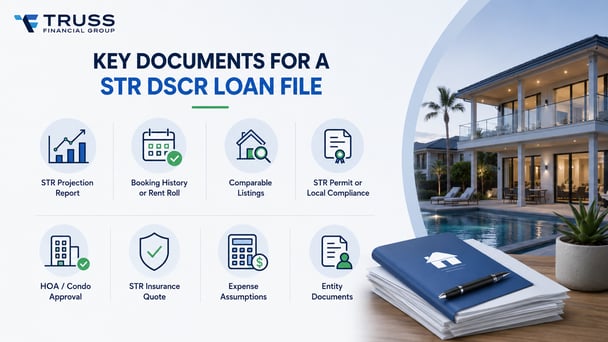
Documents That Can Strengthen a Short-Term Rental DSCR File
A strong AirDNA report is helpful, but it is rarely the only thing a lender reviews. The cleaner your file is, the easier it is for the lender to understand the deal.
- AirDNA or similar STR projection report.
- Current lease, rent roll, or booking history if the property already operates as an STR.
- Comparable listing support from Airbnb, VRBO, or local property managers.
- Proof of STR permit, license, or local compliance when required.
- HOA or condo documents showing short-term rentals are allowed.
- Insurance quote appropriate for short-term rental use.
- Expense assumptions for management, cleaning, utilities, repairs, furnishing, taxes, and reserves.
- Entity documents if the property will close in an LLC.
This is also where the right loan product matters. Some investors may compare short-term rental financing options, while others may need to compare DSCR loans vs. hard money loans if the property needs work before it can generate income.
When AirDNA Can Help Most
AirDNA tends to be most useful when the property's intended use is clearly short-term rental and long-term rent would understate the actual income strategy.
Purchase Scenario
The property does not have a full STR history yet, so the lender needs market-supported projected income.
Refinance Scenario
Actual STR history can be compared with AirDNA market support to validate income strength.
Portfolio Strategy
Investors can compare markets and property types before choosing where to deploy capital.
Investors who are new to the space may also want to read Truss's guide on DSCR loans for first-time investors before choosing a lender.
How Truss Financial Group Helps Investors Evaluate STR Income
For investors, the question is not just whether AirDNA looks strong. The real question is whether the property, market, borrower profile, and loan structure fit a lender's actual DSCR guidelines.
Truss Financial Group helps investors look at the full picture: projected STR income, DSCR ratio, down payment, reserves, property type, ownership structure, and whether a DSCR lender is likely to accept the income method being used. That matters because different lenders can treat the same AirDNA projection differently.
If you are comparing an Airbnb-style investment property, start with the numbers before you make the offer. Review the projected revenue, check local restrictions, run the DSCR, and confirm how the lender will treat short-term rental income.
Frequently Asked Questions
1. Can AirDNA replace a 1004 appraisal?
Usually no. AirDNA may support short-term rental income projections, while a 1004 appraisal supports property value and collateral. Some DSCR lenders use both in the same file.
2. Why do DSCR lenders use AirDNA?
DSCR lenders may use AirDNA because short-term rental income depends on nightly rates, occupancy, seasonality, and local demand. A standard long-term rent estimate may not capture that income strategy.
3. What does AirDNA show for a short-term rental property?
AirDNA can show projected annual revenue, average daily rate, occupancy rate, comparable listings, and seasonality. Lenders may use those data points to evaluate projected rental income.
4. Will every lender accept AirDNA income?
No. AirDNA acceptance depends on the lender, loan program, property type, DSCR ratio, market strength, and whether local short-term rental rules support the intended use.
5. What is the difference between Form 1007 and AirDNA?
Form 1007 is generally used to estimate long-term monthly market rent. AirDNA is used to analyze short-term rental performance, including nightly rates, occupancy, and projected revenue.
6. Can I qualify for a DSCR loan using projected Airbnb income?
You may be able to, depending on the lender. Some DSCR programs allow projected short-term rental income supported by AirDNA or similar data, but requirements vary.
7. What DSCR ratio do lenders usually want for short-term rentals?
Many lenders prefer the property to be at or above 1.0, with stronger files often at 1.15 to 1.25 or higher. Exact thresholds depend on the program and the overall risk profile.
8. What can hurt my AirDNA-based DSCR approval?
Weak comparable listings, local STR restrictions, low reserves, a tight DSCR ratio, or a property with no operating history can make approval more difficult.
9. Should I rely only on AirDNA before buying a short-term rental?
No. AirDNA is useful, but investors should also review actual comps, local rules, operating expenses, management assumptions, reserves, and the lender's income calculation method.
10. Does Truss Financial Group offer DSCR loans for short-term rentals?
Truss Financial Group works with investor-focused loan options, including DSCR loans that may fit short-term rental properties depending on the property, income support, and lender guidelines.
Investor Takeaway
Use AirDNA as a Starting Point, Not the Whole Loan Strategy
AirDNA can make a short-term rental file stronger when the data supports the property's income potential. But the best DSCR approvals come from matching the projection with the right lender, the right documentation, and a realistic view of the property's operating risk.
If you are evaluating an Airbnb, vacation rental, or mixed short-term rental strategy, Truss can help you review whether the income approach fits current DSCR lender guidelines before you go too far into the deal.

.svg)

Discuss your unique requirements
Get direct answers and a roadmap for your future.
.png?width=202&height=202&name=image%20588255187%20(1).png)

.png?width=389&height=221&name=xxxxxx%20header%20(14).png)




.svg)

.svg)
.svg)