View all states

12 mins
In this blog
Today's stated income loan requirements may look different from the loans many borrowers remember. Traditional stated income loans, which accepted a borrower's word for income, became unavailable to many after the financial crisis. Newer programs use bank statements, profit-and-loss statements, or verified assets in place of tax returns.
If you are self-employed or a contractor, the challenge is to choose among available documentation routes based on your records. Truss Financial Group, a U.S. mortgage lender and broker, can help self-employed borrowers evaluate their options. Start by comparing your numbers with an estimate of self-employed qualifying income.
What Does Stated Income Mean for a Mortgage Today?
To compare current stated income loan requirements, it helps to understand how the category has changed. In the past, a stated income mortgage allowed borrowers to self-report income, and many of these loans were associated with high default rates. The Ability-to-Repay rule under the Dodd-Frank Act now requires lenders to make a reasonable, good-faith determination of repayment ability, which typically means analyzing income with third-party documentation. The CFPB's Ability-to-Repay rule describes these standards.
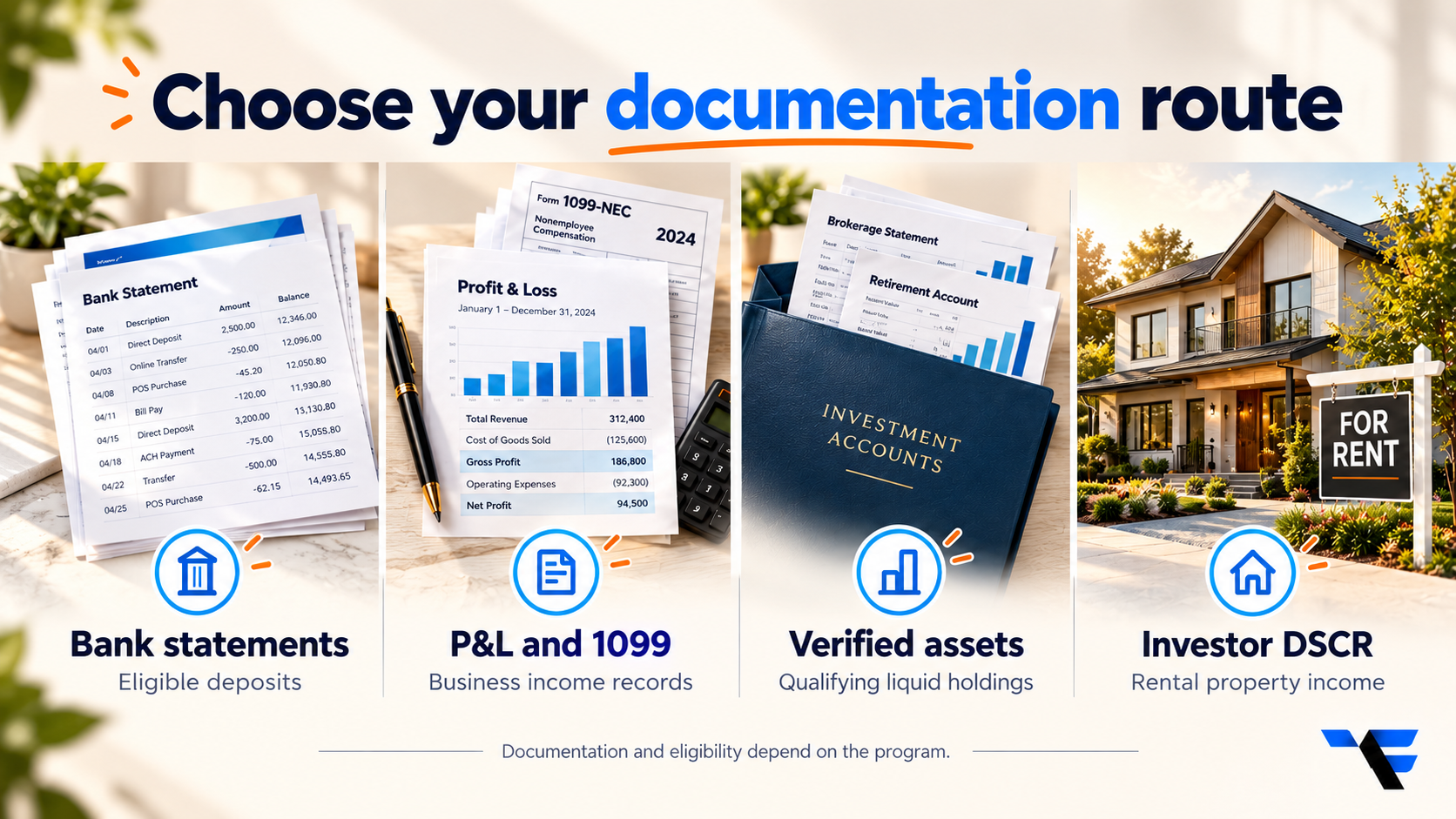
Stated income mortgages for the self-employed now typically require alternative income documentation through bank statements, profit-and-loss (P&L) statements, or assets in place of tax returns. Bank statement loans calculate income using 12 or 24 months of deposits, with adjustments for eligible expenses.
P&L loans require a business income statement, often supported by a CPA letter. Asset-based loans convert qualifying liquid assets into a monthly income figure. Investor loans (DSCR) rely on a rental property's income and apply only to investment property. Many borrowers seeking a mortgage without tax returns start with bank statement loans.
What Are the Requirements for a Stated Income Loan?
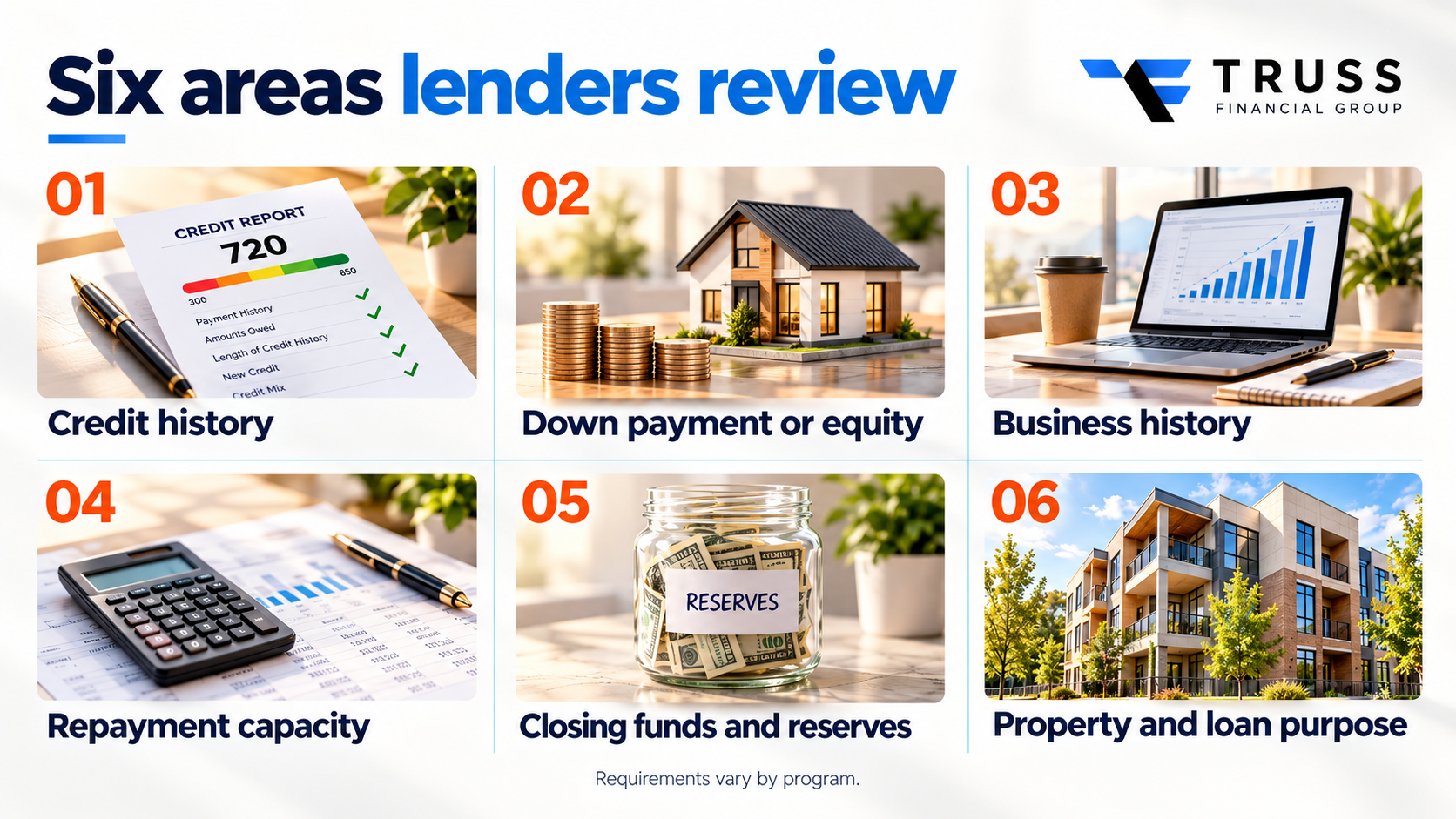
Stated income loan requirements vary by program, but most involve six areas of review. This general list should not replace consultation with a loan officer, but it can help you understand your options.
- A stated income loan credit score that meets the minimum for your chosen program, along with a clean payment history for your mortgage and other debts
- A down payment or refinance equity that meets the program's loan-to-value (LTV) guidelines
- A business history that suggests stability, not a recent start-up
- Qualifying income that reflects the proposed payment, along with your other monthly payments
- Verified funds for closing, along with any reserves the program requires
- A property, occupancy, and loan purpose that are eligible in your state
1. Credit Score and Payment History
Your score and payment history can affect which program tier you qualify for. Minimums vary by lender, but most stated income loans require a credit score that would qualify for a conventional loan. Stated income loan requirements typically include a review of your mortgage payment history, along with other debts, bankruptcies, and foreclosures. For more on scoring systems, see mortgage credit score requirements.
2. Down Payment or Refinance Equity
Stated income loan requirements for purchases specify a down payment amount and LTV ratio. Refinance requirements specify the borrower's equity in the home. Equity and LTV guidelines apply to most stated income programs, with higher LTVs typically available for primary residences.
LTV guidelines are stated as "up to" amounts that vary by credit, occupancy, and documentation. Closing costs for a stated income mortgage are budgeted separately from the purchase price or refinance amount.
3. Self-Employment and Business History
Lenders evaluate business continuity, not just years in business, for stated income loans. In some cases, the operating history may be longer than the documentation period, so self-employed borrowers should document both. Stated income loan requirements for self-employment typically specify minimum qualifying income, so it is important to understand your options.
Some programs allow a shorter self-employment history with compensating equity or reserves. See our guide to mortgages with a shorter self-employment history.
4. Repayment Capacity and Existing Debts
The ability to repay a stated income loan is evaluated the same way as any other mortgage. Lenders analyze the borrower's income and subtract existing monthly payments on credit cards, automobiles, and other debts. Most stated income programs specify a maximum debt-to-income (DTI) percentage, typically between 45% and 55%. For investor mortgages, the comparable measure is the debt service coverage ratio (DSCR). Your stated income loan requirements will include a review of your credit score and DTI.
5. Closing Funds and Cash Reserves
Lenders base income and asset requirements for stated income loans on documented funds, such as savings and permissible gifts. Reserves are typically measured in months of housing payments, and the amount varies by loan size and the number of financed units.
6. Property, Occupancy, and Loan Purpose
Property type, occupancy (owner-occupied, second home, or investment), and loan purpose (purchase, refinance, or cash-out refinance) determine property guidelines. Valuation, title, and insurance also apply to stated income loans, and these requirements vary by state.
What Documents Do You Need for a Stated Income Mortgage?
Documentation is central to most stated income loan requirements, so choose the options that fit your situation. A mortgage without tax returns still requires documentation, but the lender analyzes income from other records. Conventional loans generally require two years of tax returns, while alternative routes replace that requirement with other records. Stated income loans for the self-employed rely on several categories.
1. Bank Statements
Bank statement programs typically require 12 or 24 months of personal or business statements. The underwriter reviews large deposits and adjusts for transfers between your accounts and loan proceeds. It is best to keep personal and business expenses separate, and you can review your bank statement options before choosing a program.
2. Profit-and-Loss and 1099 Income
A P&L statement summarizes your revenue and expenses and may need to be signed by you or prepared by a CPA, depending on the program. Some stated income programs also accept 1099 income for sole proprietorships and independent contractors. See CPA letters for mortgage applications.
3. Verified Assets
Asset-based programs consider liquid assets, including checking, savings, and brokerage accounts. Lenders document account balances and convert assets to monthly income. To qualify using verified assets, review how your liquid holdings apply to a program.
4. Investor Route
DSCR loans for investors require an income stream from the rental property, along with an appraisal and entity documents if the property is held in an LLC.
Not sure which income documentation applies to your self-employment situation? Request a self-employed mortgage quote and work with Truss Financial Group to review your stated income loan options.
How Do Lenders Calculate Qualifying Income and the Loan Amount?
Most lenders analyze bank statements or P&L statements and subtract eligible expenses, your ownership share, and one-time payments.
For example, a contractor has $240,000 in eligible deposits over 12 months. Assuming a 50% expense factor (an illustrative figure, not a standard), qualifying income is $120,000 per year, or $10,000 per month. If the proposed housing payment is $2,800 and existing debts total $1,200, obligations come to $4,000, or 40% of qualifying income. Review the program's DTI requirements to see whether this income qualifies.
Borrowing capacity also depends on LTV and the proposed monthly payment. Use our monthly payment estimator to test scenarios.
What Rates, Fees, and Risks Should You Compare?
Stated income loans typically carry higher interest rates than conventional W-2 loans because most programs require additional verification and documentation. Stated income loan requirements help determine the applicable rate, and a lower stated income loan credit score may affect it.
To understand how rates, APR, and fees apply to your situation, request a self-employed mortgage quote.
APR reflects the interest rate along with certain finance charges, so review the Loan Estimate with your loan officer. Your payment options also affect APR and fees for a stated income loan. Interest-only periods reduce payments in the early years, but the principal is still owed at the end of the term.
Stated income loans have specific prepayment guidelines, and some charge additional fees if you pay off the mortgage early. A stated income refinance may carry additional fees as well. Declining income or a refinance that does not close as planned can also increase costs.
TFG's rate scenarios page shows general W-2 examples. Because stated income programs vary by documentation, credit, and property requirements, a quote is the best way to understand your APR and fees.
How Do You Apply for a Stated Income Loan?
- Define your objective and timeline: Specify whether you are purchasing or refinancing, and give a target closing date.
- Select a documentation route: Compare bank statement, P&L, asset-based, and conventional alternatives against your documentation and income.
- Complete underwriting and valuation: Submit your income documentation and schedule the appraisal.
- Compare your final terms: Review the rate, APR, fees, and payment structure before you lock in the loan.
As both lender and broker, Truss Financial Group can compare alternatives to help you finalize your options. Whether you are buying or refinancing a primary residence, a stated income refinance or purchase can give you more flexibility. Reviewing final terms helps you understand the overall cost of a stated income loan.
When Should You Look for Other Mortgage Options?
Not every self-employed borrower needs an alternative income documentation route. With two years of consistent tax returns, a conventional loan may offer a lower rate and simpler approval requirements. Borrowers with significant deductions or a short self-employment history may find that a bank statement or P&L route evaluates income more accurately.
Stated income loans are one category of mortgage, not the only option, so it is important to evaluate alternatives. If meeting stated income mortgage requirements with bank statements seems unmanageable, consider conventional options. If your goal is a mortgage without tax returns, bank statement and asset-based routes are the usual starting points.
Homeowners who want to access equity without a stated income refinance may consider a HELOC, which does not require refinancing. You can read about fixed-rate HELOC options if that structure fits your goals. For a stated income refinance, compare the costs and benefits against a HELOC before you finalize your decision.
Review Your Mortgage Options With Truss Financial Group
Stated income loan requirements vary by program, and the best option depends on your documentation, credit, equity, and goals. For self-employed borrowers, the right route often hinges on an honest assessment of your stated income. For a mortgage without tax returns, a stated income refinance, or a conventional loan with alternative income documentation, a clear comparison of your options is the first step. Truss Financial Group, a U.S. mortgage lender and broker, can help you evaluate stated income loan requirements and arrive at a practical solution.
Are you ready to compare your options? Discuss your mortgage options with TFG today.
FAQs (Frequently Asked Questions)
1. Are stated income loans still available and legal?
No-verification stated income loans are rare because Ability-to-Repay rules require lenders to evaluate income with documentation. Alternative documentation programs using bank statements, P&L statements, and assets are widely available. See how stated income loans work today.
2. Can I get a stated income loan for my primary residence?
Yes, some programs allow owner-occupied purchases and refinances with alternative income documentation, subject to LTV, credit, and state requirements. Request a self-employed mortgage quote to evaluate your situation.
3. What credit score do I need for a stated income mortgage?
There is no single minimum, because stated income loan requirements vary by program, and a higher score typically widens your options. See mortgage credit score requirements.
4. Can I qualify for a mortgage without tax returns if I am self-employed?
Often, yes. Stated income loans for the self-employed can use a bank statement, P&L, or asset-based route in place of tax returns, but documentation is still required. Use an estimate of self-employed qualifying income to review your options.
5. How long must I be self-employed to qualify for a stated income mortgage?
It depends on the program. Some stated income loans require a longer self-employment history, while others allow a shorter history with compensating reserves or equity. See mortgages with a shorter self-employment history.
6. How many months of bank statements do I need for a mortgage?
Most bank statement programs use 12 or 24 months of statements. The right choice depends on your income and program requirements, so compare 12-month and 24-month statement programs.
7. Do I need a CPA letter or a P&L statement for a stated income loan?
It depends on the program. Some stated income loans require a P&L, while others accept a CPA letter confirming that your business is active. See why you need CPA letters for mortgage applications.
8. Can a retiree qualify for a mortgage using assets instead of employment income?
Yes, some asset-based programs convert qualifying liquid assets into income. Eligibility depends on the type of asset, how long it has been held, and other program requirements. See how to qualify using verified assets.
9. Can I refinance or take cash out with a stated income mortgage?
Some programs allow a stated income refinance or cash-out refinance, subject to LTV, equity, and documentation requirements. Discuss refinancing with TFG to see which alternatives apply to your situation.
10. What can prevent approval for a stated income mortgage?
Late mortgage payments, inconsistent deposits, commingled accounts, excessive existing debt, and insufficient reserves are common concerns for stated income mortgage requirements. See bank statement mortgage problems before you apply.


Discuss your unique requirements
Get direct answers and a roadmap for your future.