.svg)



%20(1).svg)
%20(2).svg)
.png?width=480&height=420&name=Img%20(1).png)
%20(3).svg)
%20(4).svg)

%20(5).svg)


 View all states

20 mins
In this blog
Your business can be doing well, yet your tax return might suggest you don’t earn enough to borrow against your home. That’s because deductions and business expenses can shrink your reported income, even when your cash flow tells a different story. If you’re self employed, proving what you earn can get complicated without the usual pay stubs
Some lenders offer stated income HELOCs for borrowers who need an alternative to conventional income verification. These loans aren’t available everywhere, and each lender has its own requirements.
At TFG, we work with homeowners whose finances don’t fit the standard lending checklist. Depending on the state, we may handle the loan directly or connect you with a lending partner. If you’re considering using your home’s equity, our available HELOC programs are one place to explore your options.
Before getting started, here’s what to know about stated income HELOCs, the information lenders may ask for, and how to prepare for an application.
What does a "stated income HELOC" mean for self-employed borrowers?
A stated income HELOC is a form of home equity line of credit, but uses a different method of determining income than a conventional HELOC. It’s not necessarily a loan with no income verification, nor is it always the case that income documentation is completely replaced by bank statements or assets.
Self-employed borrowers, business owners and other applicants may find that they do not qualify for a conventional HELOC based on the income documentation they can provide.
However, "stated income" can be interpreted differently by different lenders and loan programs. In some cases, a borrower simply provides a statement about their income during the application process, but also submits additional documentation about their financial status instead of standard income verification. In other cases, a borrower provides bank statements or other information about their assets and income.
Our guide on stated income HELOC includes the program's features and requirements. Terms can change frequently, and a specific loan product may not be available to all applicants in all states.
What are the requirements for a stated income HELOC?
The requirements for a stated income HELOC are not set in a single list, since different lenders look at a borrower's financial situation holistically.
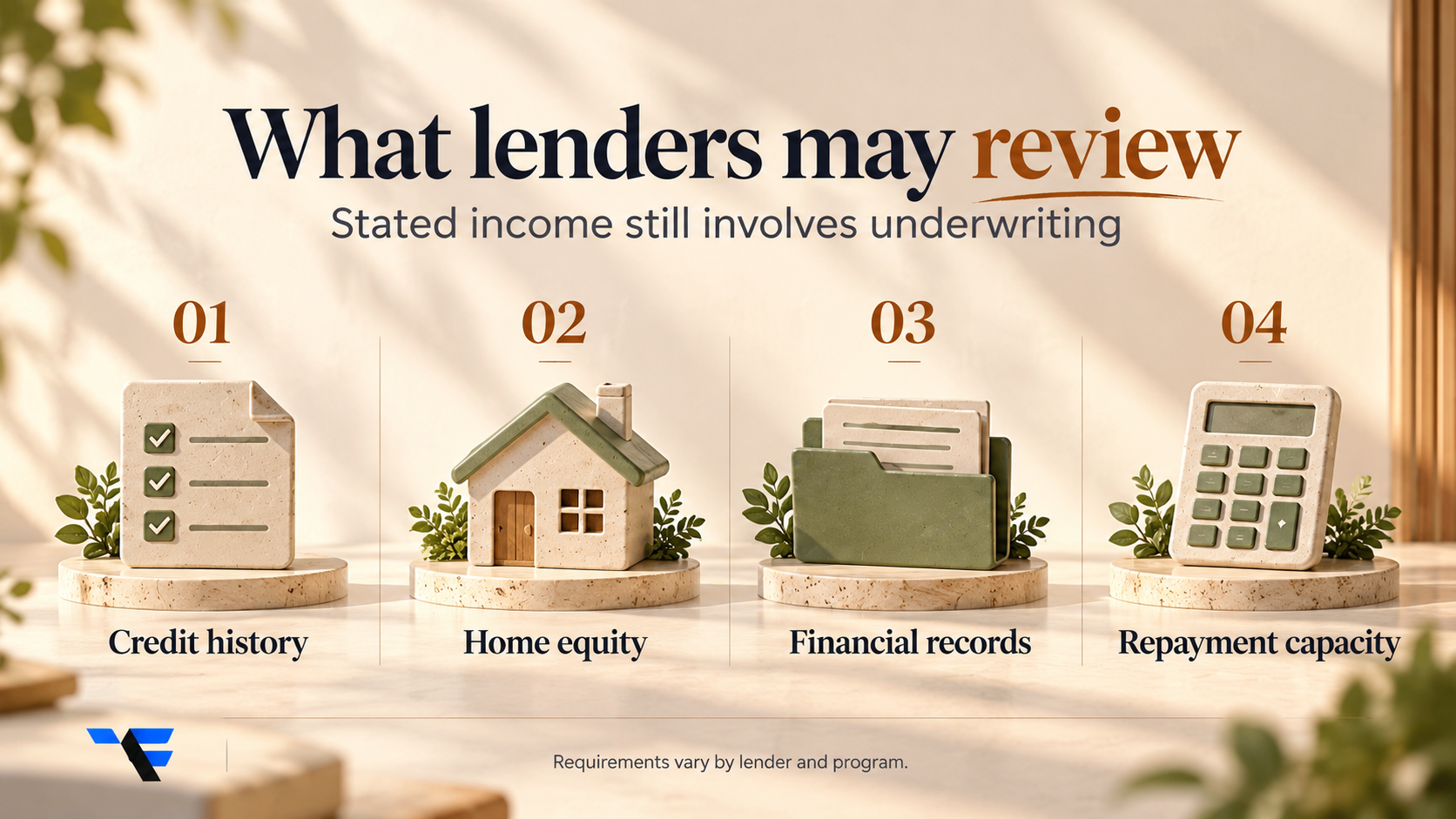
Credit score and payment history
A borrower's credit score is one way of evaluating their responsible financial behavior, and their capacity to handle monthly payments. Lenders also consider a borrower's payment history, including any derogatory marks, late or delinquent payments, and collection accounts.
Alternative documentation programs sometimes have tougher requirements than conventional income-based loan programs. For example, TFG’s latest stated income HELOC guide indicates a minimum credit score of 660 for this product. This is a general guideline, but not a universal standard - there are other HELOC programs that have different minimums. A lower score does not always mean an applicant won't qualify, but it can affect their options.
Home equity and mortgage balance
The value of the borrower's home and their existing mortgage will be relevant to the HELOC. Lenders evaluate the amount of equity in the borrower's home, along with the borrower's existing monthly payments and any other liens or debts against the property.
The combined loan-to-value (CLTV) ratio is one metric that lenders use to evaluate a borrower's capacity to repay a HELOC. It considers the amount of outstanding debt against the home, compared to its overall value. A borrower with substantial equity in their home has more room for a HELOC than a borrower with little or no equity.
Self-employment history and income documentation
In the case of a self-employed borrower, a lender will want to review their self-employment history and income. The program's requirements will determine whether the borrower submits bank statements, a profit-and-loss statement, information about 1099 income, or other documents.
For some alternative documentation programs, the focus is less on the income itself and more on the overall financial position of the borrower. The lender uses this information to determine the applicant's capacity to repay the loan, but income is just one factor in the discussion.
Debt-to-income ratio and repayment capacity
A borrower's debt-to-income (DTI) ratio is their monthly debt payments, compared to their monthly income. Income is relevant to the DTI, but it depends on which type of income the lender considers.
In the case of a self-employed borrower, the lender may not accept all of the borrower's deposits as income. DTI also affects the borrower's home mortgage, if they have one, since the monthly mortgage payment is part of the overall debt payments. A stated income program does not always override the importance of the DTI - the applicant still has to meet the requirements for their monthly obligations.
Property, occupancy and location
The occupancy and value of the borrower's home is another consideration. A primary residence, second home or investment property will have different guidelines. The title on the property, any debts or liens, and the availability of the loan program in the borrower's area will also affect the terms.
An investment property may have different requirements than a primary residence, even if they are in the same state. The borrower should ask for the requirements for each type of property before finalizing an application.
What documents do you need for a stated income HELOC?
The documents required will depend on the program, but a stated income HELOC generally requires alternative documentation methods. Tax returns or pay stubs are not the primary source of income verification, but the borrower still has to submit some form of financial records.
Depending on the program, this may include:
- Identity and property documents: Identification, insurance documents, mortgage records and other documents that confirm the borrower's identity, ownership of the property and title to the home.
- Bank statements: Personal and/or business banking statements, depending on the program. These should include all pages, and not just the pages that include deposits.
- Business documents: Records that confirm the borrower's ownership of a business and/or that the business is operational, such as a profit-and-loss statement.
- Alternatives to income documentation: A 1099 form or a profit-and-loss statement, asset statements or other documents that the lender will accept, depending on the program.
- Existing debts: Records of the borrower's mortgage, any liens or debts against the property and monthly statements of existing financial obligations.
If the borrower makes transfers from their personal bank account to their business account, or vice versa, they should be prepared to justify these transfers. Moving money from one account to another within the same bank is not income, and unexplained deposits can affect the application.
It is usually best to ask for a list of required documents for a specific stated income HELOC program, before submitting any records. This is important both to avoid preparing unnecessary records, and to ensure that all necessary documents are submitted. The IRS recordkeeping guidance for self-employed individuals also explains how business records help document income and expenses.
How do lenders qualify self-employed homeowners?
It depends on the product. A conventional HELOC is likely to be based on the borrower's income, as stated on their tax returns. A bank statement HELOC will analyze the borrower's income based on their bank deposits, and apply any relevant rules about what qualifies as income. A stated income HELOC may allow the borrower to report their income, but still require additional verification. An asset-based HELOC will analyze the borrower's assets according to the lender's guidelines.
Each of these qualification methods is significantly different, and a borrower considering one type of alternative documentation should research the others. TFG's bank statement HELOC guide provides more information about one such option.
Who else may qualify for alternative documentation options?
Self-employed business owners are a natural fit for these alternative HELOC programs, but independent contractors, real estate investors and retirees with non-traditional income may qualify. A stated income HELOC program usually has requirements that apply to all borrowers, regardless of how they earn income.
Retirees with investment income, for instance, may need to apply for an asset-based HELOC, rather than a self-employment based loan. Each program will have its own set of requirements, and a borrower should analyze the guidelines for each, before determining which one fits their income and financial situation.
How much can you borrow against your home equity?
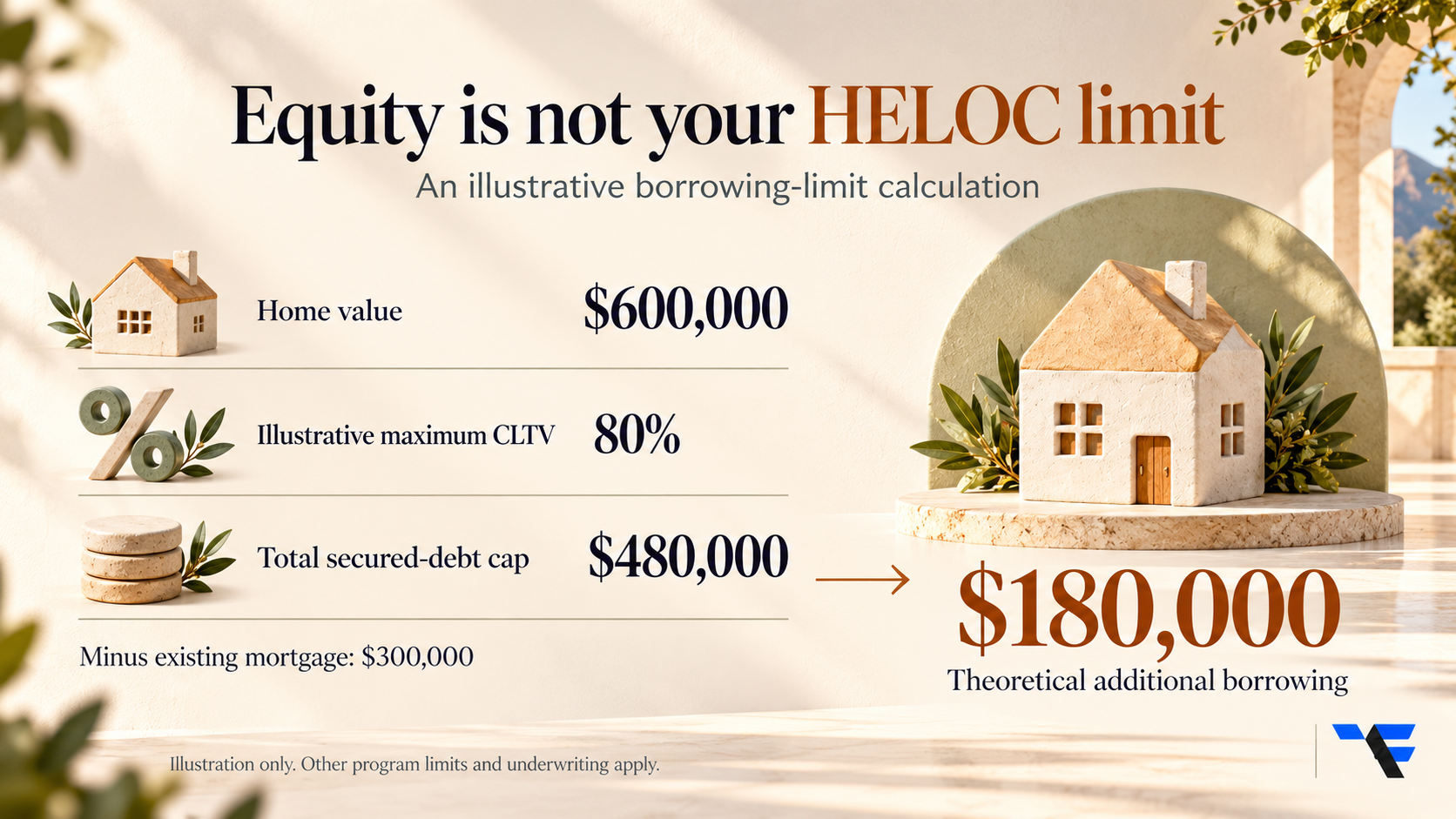
The amount of available equity is only one factor in a HELOC, but it is the starting point for any application. The borrower has to have enough equity in their home for the lender to be willing to extend credit. To estimate available equity, subtract the balance of the existing mortgage and any other liens from the estimated value of the home.
Example:
- Estimated value: $600,000
- Current mortgage: $300,000
- Liens: $0
- Estimated equity: $300,000
| Please Note: This is only an estimate, and the actual amount of available equity may be less, due to the lender's combined loan-to-value (CLTV) ratio. The borrower's eligibility for the HELOC program will affect the amount that they can borrow, as well as the maximum CLTV for that program. |
For example, if a program had a maximum CLTV of 80%, borrowing against a property valued at $600,000 would be capped at $480,000 in total secured debt. Subtracting the existing $300,000 mortgage would leave a theoretical maximum of $180,000 in additional secured borrowing, before other limitations or conditions apply.
The actual figures for a HELOC will depend on several factors, including the borrower's credit, income documentation method and the program's maximum CLTV. TFG's stated income HELOC page will list the CLTV maximum for that particular product, but the borrower should always confirm this information and apply the relevant guidelines to their own situation.
How to apply for a stated income HELOC?
A little research and organization can make it easier to identify a suitable stated income HELOC program, and prepare the required documents before submitting an application. The process generally follows five steps:
1. Determine the best method of income documentation
The borrower should be able to describe their income source, and confirm that they have access to the necessary records. Tax returns may indicate significantly lower income than a self-employed business owner would like to report. Bank statements or other methods of verifying income may be more appropriate, depending on the borrower's personal circumstances.
2. Analyze credit, debts and potential borrowing amount
The borrower should review their credit report and analyze their current debts, including their mortgage. They should also estimate their available borrowing amount (based on the value of the home and the existing liens). This provides a general idea of the options, but a lender can give a more accurate assessment after receiving the application.
If the borrower's credit score has changed recently, or if they have additional debts, they should mention this when discussing their options.
3. Prepare the required documentation
The borrower should request a list of required documents and keep the relevant records organized. Most lenders will specify the requirements for each alternative documentation program, and it is important to keep pages in order and include all necessary statements.
If the borrower has transferred money into a business account, or receives payments via direct deposit, they should be able to explain these transactions. Transfers within the same bank are not income, but a bank may consider these to be transfers of funds between accounts.
4. Undergo the underwriting and property review process
Once the borrower submits an application, the lender or a third-party partner will review the application and the supporting documents. They may request additional information, verify some of the figures, or conduct a valuation of the borrower's home.
The terms of the HELOC may change during the underwriting process, and an initial approval is not necessarily final. The borrower should discuss their options with the lender, and consider how changes to the interest rate or the draw amount will affect their payments.
5. Review the final offer before accepting
The borrower should carefully review the conditions of the HELOC, including the draw and repayment periods, and the monthly payment amount. They should consider whether the approved borrowing amount is sufficient to meet their needs, and whether they will be able to maintain their payments if their income decreases or the interest rate increases.
A HELOC should be analyzed based on the terms and conditions, rather than a simple "approval" or "denial." The borrower should take into account the total interest that they will pay, as well as any closing costs, before signing the agreement.
Stated income HELOC rates, fees and repayment costs
The terms of a stated income HELOC will depend on the program, the borrower's credit and the value of the property. Borrowers should carefully consider the costs and risks of a HELOC before signing an agreement.
The CFPB's HELOC guide is a good resource for understanding the draw and repayment periods, the costs of a HELOC, and the effect of monthly payments on the borrower's budget. Some of the main considerations are discussed below.
How the draw period and repayment period works
The draw period allows the borrower to withdraw funds up to the credit limit. They may also have the opportunity to redraw some or all of the money that they have already repaid, depending on the terms of the HELOC.
The repayment period begins after the draw period ends, and may involve significantly higher monthly payments. During the draw period, the borrower may only be responsible for paying the interest on the amount that they have withdrawn. When the repayment period starts, they will have to pay both the principal and the interest on the loan.
The borrower should analyze the terms and length of the repayment periods, and the method of calculating monthly payments. They should be aware that an interest-only payment plan will end at some point, and that they will have to repay the principal as well.
Initial draws and fees
The lender may charge additional fees in addition to the interest rate. Some programs have specific requirements for the first draw, or a minimum outstanding balance before the borrower can withdraw funds. Borrowers should ask about the method of charging fees - whether it is a percentage of the withdrawn amount, a flat fee, or a charge at a specific point in the HELOC process.
The borrower should also determine how frequently they can request a draw, how long it takes before the money is available, and whether a fee is charged for each transaction.
How does the interest rate affect monthly payments?
HELOCs generally have variable interest rates, which means that the rate can change over time. The borrower should review the interest rate information and make sure that they understand how it will affect their monthly payments.
Some HELOC programs offer a fixed-rate option for a certain portion of the balance, for a specific period of time. The borrower should ask about the terms of the rate, and analyze the impact that it will have on their monthly payments.
The following examples illustrate approximate monthly payments for a $50,000 balance at various interest rates and repayment terms. These are hypothetical calculations, and not based on any specific offers from TFG.
Example 1: Interest-only payment at 9%
$50,000 balance at 9% | Interest-only payment; rate and balance stay constant | $375
Example 2: Interest-only payment at 11%
$50,000 balance at 11% | Interest-only payment; rate and balance stay constant | $458.33
Example 3: Principal and interest repaid over 10 years at 9%
$50,000 balance at 9% | Principal and interest repaid over 10 years at a constant rate | Approximately $633.38
The borrower should be aware that these figures do not include any additional fees or charges. The interest rate will affect the overall amount that they pay, and the length of the repayment period will determine how long they have to pay it back.
Interest-only payments do not reduce the balance of the loan, and the borrower will have to repay the full amount eventually. They should develop a plan for repaying the principal balance, based on their income and their other financial commitments.
The borrower should always consider the fact that a HELOC is a secured loan, and that they may put their home at risk if they cannot make the monthly payments.
What are the alternatives to a stated income HELOC?
A stated income HELOC is not the only option for a borrower who needs to access their home equity. The best choice depends on a variety of factors, including whether the borrower needs a line of credit or a lump sum, and how quickly they need the funds.
Home equity loan
A home equity loan is similar to a HELOC, but the borrower has to repay a lump sum, rather than drawing money from a credit line. This may be a good option if the borrower knows the amount that they need, and has a specific project in mind.
The CFPB's comparison of home equity loans and HELOCs provides additional information about the differences between these two types of loans.
Cash-out refinance
A cash-out refinance replaces the mortgage with a new one, and provides some of the proceeds in cash. This may be a good option if the borrower wants to change their mortgage terms, but it will affect their monthly payments.
Bank statement HELOC
Some lenders offer a bank statement HELOC program, which analyzes the borrower's income based on their bank statements, rather than their tax returns. This may be a good option if the borrower has difficulty providing traditional income documentation.
Personal loan, personal line of credit or credit card
Depending on the amount you need to borrow and how soon you need the money, a personal loan, personal line of credit or credit card can also be an option. Different interest rates, payment terms and requirements apply to each, so it’s important to consider your situation and the purpose of the borrowing when comparing your options.
Curious if taking out a loan against your home would save you money? Our HELOC vs personal loan costs guide for 2026 provided a side-by-side comparison of the two forms of credit.
Exploring your HELOC options with Truss Financial Group
Self-employed homeowners have a wide range of options when it comes to home equity loans, home equity lines of credit and refinancing. Some may have sufficient income, but not enough taxable income, or the wrong type of income. At Truss Financial Group, we work with borrowers who need alternative documentation methods, and can provide conventional bank statements and stated income HELOC programs.
As a mortgage lender and broker, TFG has the ability to originate certain loan products, depending on the requirements of the state and the program. This distinction is important, since it determines the options that the borrower has, and the documentation that they need to provide.
Self-employed borrowers should organize their financial records, review their options and prepare questions before speaking with a lender. They should consider the draw and repayment periods, the interest rate and the monthly payments, based on their income and other financial commitments.
Are you a self-employed borrower, considering a stated income HELOC? TFG can discuss the documentation options and your financing needs. Explore your stated income HELOC options and connect with a TFG specialist, to learn more about your stated income, alternative documentation program and financial needs. All applications are subject to underwriting and program availability.
Frequently Asked Questions About Stated Income HELOCs
Are stated income loans still available?
Some lenders offer stated income HELOCs and other alternative documentation options. Availability is subject to the lender and the state in which the home equity line of credit is being issued. Eligibility requirements may also vary by lender. For homeowners considering alternatives to typical HELOC requirements, stated income HELOCs is one open worth considering.
What is needed for a stated income HELOC?
Requirements may include a qualifying credit score, sufficient home equity, identification, mortgage information and alternative financial documentation. The exact list depends on the lender's income verification method and property guidelines.
What are the stated income HELOC lenders in the USA?
Some mortgage lenders and brokers offer alternative-documentation HELOC programs. Compare their credit requirements, income verification methods, fees, borrowing limits and state availability before applying. You can begin by reviewing TFG's HELOC options.
What lenders don't require proof of income?
Some lenders offer programs that do not rely on traditional income documentation, but they may still require bank statements, asset records or other evidence of financial capacity. TFG works with borrowers exploring alternative-documentation options, subject to program eligibility and underwriting.
What disqualifies you from a HELOC?
Insufficient home equity, a credit profile that falls outside program requirements, excessive debt, unsuitable property characteristics or an inability to demonstrate repayment capacity can affect eligibility. Each lender applies its own guidelines.
Can I get a HELOC without proof of income?
Some programs allow borrowers to qualify without conventional proof of income, such as tax returns or pay stubs. However, alternative financial documentation or other underwriting checks may still be required. See TFG's guide to getting a HELOC without tax returns.
Do mortgage lenders use gross or net income for self-employed borrowers?
The answer depends on the loan program and its underwriting rules. Traditional mortgage qualification may rely on income calculated from tax documentation, while bank statement programs may assess eligible deposits using their own expense and income calculations.
Can I get a stated income HELOC without providing tax returns?
Some stated income HELOC programs do not require tax returns, but they may request other financial records. Confirm the accepted documentation and eligibility requirements for the specific program before applying.
Can I get a stated income HELOC with a 640 credit score?
A 640 credit score may meet the requirements of some alternative-documentation programs but fall below the minimum for others. TFG's published stated income HELOC page lists a minimum score of 660, so a 640 score would fall short of that stated threshold unless the applicable program guidelines change.
How much would a $250,000 HELOC cost per month?
The payment depends on the amount drawn, interest rate, repayment structure and fees. For illustration, a $250,000 balance at 9% would cost $1,875 per month in interest alone if the rate and balance remained constant. Principal-and-interest payments would be higher, depending on the repayment term.

.svg)

Discuss your unique requirements
Get direct answers and a roadmap for your future.
.png?width=202&height=202&name=image%20588255187%20(1).png)








.svg)

.svg)
.svg)